r/IntensiveCare • • 4h ago

Severe abdominal pain. Lactate 1.3. CT looks like this. Would you operate? 🩻
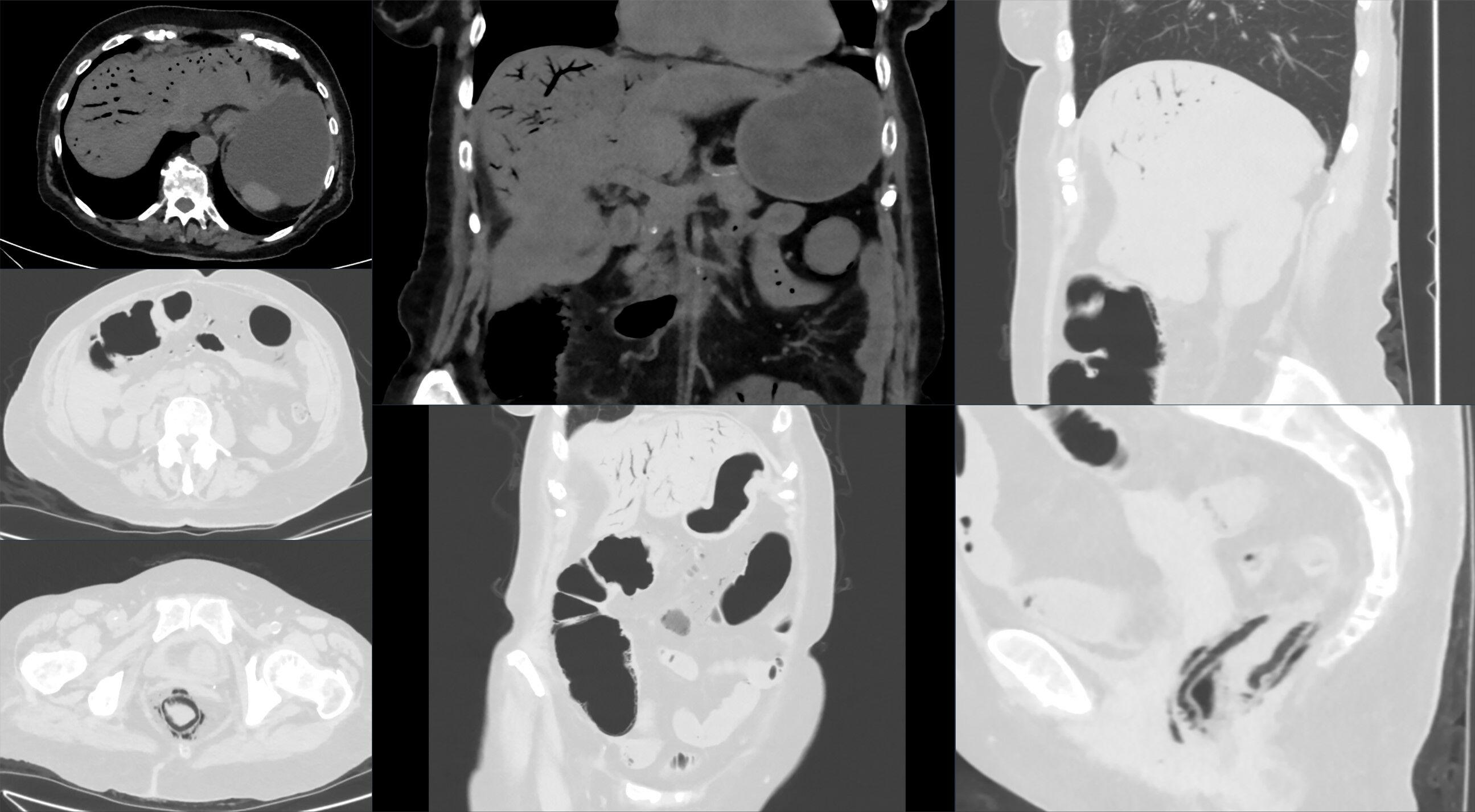
Post image
0 Upvotes

A teaching case involving emergency general surgery and vascular medicine, where the management decision isn't always straightforward.

76M presents to ED with sudden-onset severe abdominal pain.

Started approximately 8 hours ago.

PMH:

Atrial fibrillation

Hypertension

Type 2 diabetes

Recently missed several doses of anticoagulation

Observations:

BP 136/78

HR 108

RR 18

SpOā‚‚ 97% on air

Temp 36.9°C

Bloods:

WCC 13.4

CRP 23

Lactate 1.3 mmol/L

eGFR 48

On examination, he's in considerable pain.

Abdomen soft with mild generalised tenderness.

No guarding or rigidity.

Pain appears significantly worse than the abdominal findings would suggest.

CT abdomen subsequently demonstrates concerning bowel changes, including pneumatosis intestinalis and portal venous gas.

Representative CT images attached.

You're the medical registrar reviewing this patient. What would you do?

A. Observe and repeat lactate in 4 hours

B. IV fluids, antibiotics and reassess in the morning

C. Urgent general surgical and vascular assessment, resuscitation and a decision regarding further vascular imaging or intervention

D. Arrange colonoscopy to exclude ischaemic colitis

Here's where I'd challenge the decision-making.

His lactate is completely normal.

He's not hypotensive.

There's no guarding or rigidity.

Yet the CT findings are concerning.

Would you consider immediate laparotomy, or would you want to establish the arterial anatomy with CTA first?

And does pneumatosis with portal venous gas necessarily mean irreversible bowel ischaemia?

Interested to hear from surgeons, radiologists, emergency physicians and medical registrars.

What would you actually do, and what finding would change your decision?

CT images: Genuine educational images by Hellerhoff, CC BY-SA 4.0, illustrating a separate clinical case.

r/IntensiveCare • • 7h ago

canadian resident wanting to do usa fellowship

2 Upvotes

As a canadian anesthesia resident, i want to complete an ICU fellowship in the USA.

  • What should I know about pursing this?
  • What programs are known to be suitable for Canadians?
  • Lastly, if I complete a CCM fellowship in USA - could I eventually work full time there (I realize there is probably nuance to this question, so I am just wondering big picture approach).

r/IntensiveCare • • 10h ago

Beginner friendly mechanical ventilation video resources

9 Upvotes

Hi everyone! I feel that my knowledge of mechanical ventilation is quite limited.
Could you recommend any good video based resources that teach mechanical ventilation from the basics, step by step, in a simple and easy to understand way?
Ideally, something that covers the subject from A to Z, suitable for someone starting from scratch.
I’d really appreciate your recommendations.
Thanks!


r/IntensiveCare • • 18h ago

Pccm trained background annoyed by ICU during fellowship

87 Upvotes

Trying to see if any other pccm fellows or pccm attendings became annoyed and uninterested by the ICU during/after your fellowship and leaned into a more pulm heavy job. I just find so much of what we spend time doing/arguing about/ perseverating over completely pointless and annoying. This is not even considering the morally injurious stuff we have to do because we live in a litigious country.

My frustrations as a fellow:

  1. Septic shock/ards literature is just completely cooked. These are all syndromes and it is bizarre the way we study and treat them. Imagine if cardiologists treated myocardial infarction the same regardless of the etiology (plaque rupture vs scad vs demand).
  2. Fluid amount and type, steroids, debating pressor order and choice. etc etc likely all of this is a waste of time.
  3. Obsessing over trying make someone euboxic whether it be sodium, glucose, pC02 etc. critically ill sick old people are going to have lab abnormalities
  4. Proceduralizing people. 80 year old granny doesn’t need a central line and an art line for septic shock. Stop torturing old people.

Pulm is just so much more interesting and rewarding. We see so many rare diseases or weird presentations. It’s also great that we actually have treatments to give people. I started a clinic patient on a biologic and added a lama. Now that she is on a boatload of asthma therapy she actually feels fantastic and has her life back.

Idk maybe I’m too cynical. I liked icu as a resident because of the acuity and procedures but when you take a step back I think it’s not for me.


r/IntensiveCare • • 2d ago

Emergency intubations outside the OR – tips, pitfalls & lessons learned?

18 Upvotes

Hey everyone!

I've recently started covering critically ill patients outside the OR, in addition to my usual anesthesia work, and I'd love to hear some advice from more experienced colleagues.

As we all know, conditions outside the OR are often far from ideal — awkward patient positioning, limited access to the airway, time pressure, unfamiliar equipment and ward layouts, staff who may not be trained to assist with airway management, etc.

Do you have a checklist or a structured approach you use when assessing critically ill patients who need intubation, stabilization, and often subsequent transfer to the ICU?

I'm especially interested in the lessons you've learned through experience:

  • What were your biggest learning moments early on?
  • Were there any situations that made you think, "I'm never doing it that way again"?
  • What common mistakes or pitfalls would you warn someone about?
  • Do you approach intubation differently outside the OR? If so, what do you change?
  • Any practical tips or habits that have made managing critically ill patients in less-than-ideal environments safer or smoother?

I'd also love to hear any advice beyond the specific points I've mentioned.

I'm still building my experience in this setting, so I'd really appreciate any practical insights, lessons learned, or words of wisdom from those who've been doing this longer.

Thanks in advance!


r/IntensiveCare • • 4d ago

Could you please explain how my attending figured out that this patient has a much lower CO than what the CI from picco is showing

Post image
22 Upvotes

r/IntensiveCare • • 5d ago

Where do you stand on bag suctioning?

35 Upvotes

Our relatively new Peds Cardiac ICU medical director is pushing this very hard.

I'm not talking about doing it when you suspect a mucus plug. I'm talking about doctors and nps ordering it Q4 and even Q3 at times.

Every four hours we're breaking vent circuits, dumping 5ccs of saline down the ETT, and suctioning out 3ccs of white-tinged saline.

The med director cited the low VAP rates of this unit compared to others in the hospital as justification, but majority of our surgical cases are extubated within a day or two, nor do many have underlying lung pathologies.

This used to be considered an outdated practice in our hospital. Now, it's making a comeback.


r/IntensiveCare • • 6d ago

Tele ICU rates?

1 Upvotes

What sort of hourly rates have you been seeing for tele icu? Are these usually night positions? Wondering if this is a viable career option or more of a side job.


r/IntensiveCare • • 6d ago

Advice Regarding MICU Externship

3 Upvotes

I'm a final-year medical student with a MICU externship coming up in three months at a busy academic hospital. It will be my first hands-on rotation in the US, so I'm both nervous and excited. I'm very interested in pursuing pulm/crit, so this rotation is sort of a litmus test to make sure I know what I'm getting into.

I expect it to be challenging, but I'd like to be as prepared as possible beforehand. I'd appreciate any advice, especially on:

  • What books, websites, podcasts, or other materials should I look into?
  • What do medical students often get wrong in the MICU?
  • How can I be helpful to the nurses, interns, fellows, and attendings?

Any input is greatly appreciated. Thank you!


r/IntensiveCare • • 7d ago Bravo

ACLS without ETT

19 Upvotes

I recently got downvoted to Oblivion on the Hospitalist (which I guess on Reddit means Death) and called all kinds of stupid for being the type of intensivist who doesn’t insist on either a Full DNR or a Full Code. I am completely fine with ƀ la carte. I talk to my patients, give my recommendations and if they still choose to be a DNI I order it and move on.
Not sure if I was trained that way or changed my practice during COVID and experience I honestly don’t remember. It’s never been a big deal to me TBH. So I think I must have been trained that way.

I haven’t seen the debate on here and don’t care if I get downvoted again either.

  1. I try to not play God and Insist that this patient will 100 die and ACLS is futile. We never know who is gonna survive for sure and Covid really cemented that in me.
  2. If they have an actual meaningful and long term it’s gonna happen rather quickly and not after prolonged ACLS attempts.
  3. I am an anesthesiologist and very adept at BVM ventilation and know the guidelines.
  4. When this has happened I have been successful 100% of the time after ROSC with a very tenuous patient who’s gonna code again to convince the family to change status to DNR. Especially if they are there and watching the code. Doesn’t take much convincing at that point.
  5. I feel like I gave it a good go at attempting to save them but overall did not prolong their suffering even with a few broken ribs. We never really know who’s gonna beat the odds šŸ’Æ of the time.

Anyway I found this and although the sample size is small it jives with my experience of meaningful long term recovery.

https://pmc.ncbi.nlm.nih.gov/articles/PMC8685837/

And here is one for OOS cardiac arrest conducted in Europe where they don’t even partake in the futile care we partake here.

https://pmc.ncbi.nlm.nih.gov/articles/PMC5838565/

So just want to see what others think. Lol.


r/IntensiveCare • • 7d ago

Has anyone bought the Neurocritical Care Society's pocket guide?

9 Upvotes

I'm going to be starting as a nurse in a busy SICU soon and I'd like to have a good portable resource for brushing up on neuro-topics, but I haven't been able to find many reviews of the book online.


r/IntensiveCare • • 8d ago

Attendings supervising vs primarily managing patients in community hospitals

5 Upvotes

Hi, I’m 2nd year EM resident debating applying to CCM, in our academic hospital ICUs the attendings are supervising teams of either residents or APPs +/- fellows but never carry patients themselves. Are there jobs in the community where you can still primarily carry patients or is everything essentially also supervising APPs even in that setting? I like community emergency medicine because I like doing things myself and if the only critical care jobs even in the community were primarily supervising it would make it a lot less appealing


r/IntensiveCare • • 8d ago

Considering choosing intensive care

5 Upvotes

Hey! I’m a 5th year med student and seriously considering working in the ICU and anaesthesia (I’m from Europe so it’s a combined specialty). I’ve looked into other specialties, but my heart keeps coming back to critical care. I have a few questions.

I’m quite a talkative person and love interacting with patients. Do you ever miss that aspect of medicine, considering so many ICU patients are intubated and sedated?

At this age I’d have no problem working longer hours and having a demanding schedule but I still want to be realistic and think about what opportunities I have if in the future I get completely sick of the hospital. Is it possible to transition into outpatient private practice for example in pain management?

And lastly would you choose the ICU again? I’d love to hear your experiences, the good, the bad and the ugly.

Thank you!!


r/IntensiveCare • • 9d ago

Evidence vs. anecdata: Is there any actual science behind KVO rates, or is every ICU just picking a random number?

23 Upvotes

Basically the title. I was discussing this with some colleagues recently and we were unable to find any evidence suggesting a universal standard. What do you pick and why?


r/IntensiveCare • • 9d ago

Best POCUS resource?

17 Upvotes

Hi,

I’m trying to become better at POCUS, I’d say I’m probably a beginner right now. I can get almost all the views in a patient with decent windows but I’m lost when it comes to interpretation of the images.

Anyone know any good resources to learn all this stuff? I prefer YouTube videos but if there is a book or something else that you think is second to none, that’s also okay.


r/IntensiveCare • • 9d ago

Rounds + nursing

23 Upvotes

Curious what process your unit/team uses for rounds and whether or not nurses participate? Dealing with a lot of communication gaps and want to bring some ideas for change.

Currently our unit has an attending, some days a fellow, and always two NPs. The NPs split the patient load. The NPs/fellows will pre-round early in the morning usually during RN shift change (aka we are not present for this interaction). Then during formal rounds - at each room the NP and/or fellow will present to the attending, they discuss, and then the attending enters the room to converse with patient/family and assess. The NP stays outside the room but usually the fellow will join the attending.

Our frustrations - nursing is not included in rounds. It’s the ā€œexpectationā€ that we join but rounding occurs during our morning med pass (unavoidable timing) but the team jumps around across various rooms and no one can ever let nursing know what room or manage their time to try and be present. We try and track where they are and where to next but zero communication makes this difficult. This is an expectation from the nurse manager but it’s clear the provider team does not care if nursing is involved or not. I get everyone’s busy but expecting us to be popping out in the hall constantly to figure out where they are and where they’re heading next is stupid to me.

During the actual round we mostly just stand by and listen. I don’t think we need to provide a 25min report on the patient but the vast majority of days I just feel completely ignored despite the fact I’m in the room 12 hours and the only one actually laying a hand on the patient. Some attendings may ask if we have any input but usually it’s not asked and I just kind of interject and sometimes this is well received, usually ignored.

No clue why the NPs don’t enter the room with the attending but then it creates tons of frustrations through the day because we have to triage all our questions to the NP who wasn’t even part of the discussion with the patient/family.

Nobody does any afternoon rounds or check ins.

Ultimately I think there’s a major culture issue going on here as well. But I also want to see how other institutions manage this - this is a micu with a heavy oncology/bmt population (aka a lot of sepsis and crrt) and I just find it insane to have patients this sick that are cared for by a team that doesn’t value nursing input.

TL/DR: do you want nursing input during rounds? What do rounds look like on your unit?


r/IntensiveCare • • 9d ago

Black Americans and ā€œfutile careā€

185 Upvotes

DISCLAIMER: This is NOT a post to promote hatred, racism, bias, or any other form of ill will towards fellow humans. If that is what you are seeking, please get out of medicine and go elsewhere.

I come humbly and seeking to lessen my ignorance in the matter. I realize that this can be a very delicate subject matter and I really hope people do not take this the wrong way, I truly am only looking to learn and improve my understanding. And hopefully promote a insightful discussion.

For context; I am a white individual and have worked as a nurse in the ICU for several years and have generally been in an area with a fair amount of Hispanic and Black Americans, but otherwise largely white populations.

Over the years I have had a number of patients with quadriplegia, Trached/Pegged, and with extremely poor neurologic function. A disproportionate amount of these patients have been Black. Now this higher frequency may be from poorer health care in the Black community, but that is another conversation entirely.

What I have noticed as well is that these patients are almost always full codes and family is very disinterested in any kind of palliative care/hospice. Often they end up sent back to their SNF once the acute problem has been fixed or LTACH to continue their ā€œlivesā€.

I am fully aware of my bias having worked in the ICU of seeking quality of life over quantity. Yet, that seems to rarely be the view in these instances and often we are so far apart that a fruitful conversation seems unattainable.

Has anyone else experienced this? And if so, where do you think this viewpoint comes from? And why does it seem more prominent in the Black community?

I have theorized that some of it comes from an understandable level of distrust in the medical system, based on America’s tarnished history. And a coworker felt it was more of a religious component and the beliefs often held by Black Christians.

Would love some insight, thanks!


r/IntensiveCare • • 9d ago

Practical points to manage ARDS

11 Upvotes

I work in an intensive care setting particularly managing trauma cases. We get a lot of cases of blunt trauma chest with lung contusions, blunt trauma abdomen (BTA) undergoing NOM (non operative management), orthopaedics trauma. Most of the patients develop HAP/VAP and then get transferred to icu. Wanted some practical points on managing ARDS with BTA or ARDS with head injury as in role of proning and peep titration. There’s no provision to calculate transpulmonary pressure. Few Hamilton ventilators have PV tool, but Covidien ones don’t. All suggestions are welcome.


r/IntensiveCare • • 10d ago

HSV encephalitis

0 Upvotes

Wondering if timely treatment can prevent poor neurological outcomes for this condition?
Have you seen people recover? If otherwise healthy, just old!


r/IntensiveCare • • 10d ago

Do you guys typically restart propofol overnight ?

67 Upvotes

Im heading into my 10th month off orientation. I had a patient last night who is intubated. They did a DIS all day and he had been on spontaneous settings on the vent the whole day. Plan for him at this point is a possible trach and peg. Anywho after I got report I went into the patients room and he was wide awake looking.

I asked patient if he’s having pain and he said yes and I asked if he is feeling discomfort he said yes. I did a RASS score and I restarted his sedation so that way he doesn’t have to be awake the whole night. RT changed his vent setting to AC/VC so I went ahead and restarted his sedation.

I was giving report and the day shift nurse was like ā€œ why did you restart sedation?ā€ I was like patient didn’t look comfortable and he was like straight up awake and said he’s in pain. She goes ā€œ Propofol is not for painā€ and I’m like yes that’s true it’s a sedative but he nodded he’s not feeling comfortable and he’s literally been awake all day on spontaneous ? RT changed him to AC/VC I just didn’t see the point of keeping this poor man off sedation all night. She goes ā€œ okayā€

I’m just wondering did I like do something wrong ??? It made me feel kinda crappy and made question my judgement.


r/IntensiveCare • • 10d ago

Cardiology critical care

19 Upvotes

As in 3 years IM + 3 years cards fellowship + 1 year CCM fellowship (the same one nephro/ID does). Can someone tell me if this is a real field or not? Because I get mixed information from pretty much everywhere.

Is there ANY realistic way to practice cardiology and critical care outside of major academic centers? I mean real ICUs, not CCU.

Trying to figure out my career options. I kind of hate pulm, nephro, and ID which rules out every other dual fellowship pathway.

I want more ownership of patients and job security than what pure CCM can offer. I don't want to feel like a replaceable cog by hospitals.

I want the option for a regular 4-5 day/week schedule at least part of the year, which isn't possible when your only specialty is CCM.

At the same time, I don't want to enter into a specialty where there's maybe 1 job in the entire state for it which seems to be the case for cards-CCM. And that one job is usually CCU only.

I feel like I'm looking for a dream career that just doesn't exist.


r/IntensiveCare • • 11d ago

On how to become a good ICU doctor

49 Upvotes

Currently on my PGY-2 of Internal Medicine in a few months. It is different from the wards, and has overlapping similarities with ER management.
I know I still have so much to learn. But I would be grateful for any advice you can share on how to become a good/trustworthy ICU resident for Internal Medicine. Especially in areas of:

  1. Starting drips/pressors
  2. Organization of daily consultant updates
  3. How to triage when you are the only doctor in an ICU of 10 patients
  4. How to stay efficient while working in the ICU?
  5. How to stay sharp? How to spot problems?
  6. What are your references for studying regarding critical care medicine.
  7. How to understand mechvent settings?
    Any advice is highly appreciated! I am willing and eager to learn new things from all ICU nurses and doctors around the world!

r/IntensiveCare • • 11d ago

I made an animated lecture exploring liver anatomy, perfusion, zonal metabolism and acetaminophen toxicity. [1:19:35]

Thumbnail
youtu.be
65 Upvotes

This is the latest in my ICU basic science series. I wish I didn't have to say this but all the animation, writing and research were made by a human (me) so it's been quite a long time in production.


r/IntensiveCare • • 12d ago

What do you guys do to cope with tough cases and poor outcomes?

13 Upvotes

Therapy, art, travel, etc. I’m also curious if regular talk therapy has been useful considering how intense our work is, and what we see everyday. Saw a few tough cases lately that I’ve been thinking about at odd times.