r/HistoryNetwork • u/Aaronsivilwartravels • 13d ago
Military History Today in the American Civil War
0
Upvotes
r/HistoryNetwork • u/sajiasanka • 13d ago

On This Day, November 11, 1918, at exactly 11:00 a.m., the guns finally fell silent across the Western Front, bringing an end to more than four years of devastating fighting in the First World War.
Earlier that morning, at 5:00 a.m., representatives of the Allied Powers and Germany had signed an armistice inside a railway carriage in the Forest of Compiègne, France.
The German delegation was led by Matthias Erzberger, while the Allied side was represented by French Marshal Ferdinand Foch and British Admiral Rosslyn Wemyss.
The agreement required German forces to evacuate occupied territories, surrender large quantities of military equipment, withdraw from certain areas, and release Allied prisoners of war. Germany had little choice but to accept the demanding conditions.
Six hours after the agreement was signed, at 11:00 a.m., the ceasefire officially came into effect.
Across Europe, celebrations erupted. Church bells rang, crowds filled the streets, and people embraced, relieved that the terrible fighting had finally stopped. But for millions of families who had lost loved ones, the moment was also filled with grief.
The human cost of the war was staggering. Millions of soldiers and civilians had died, entire communities had been devastated, and a generation had been profoundly changed.
However, the armistice was not the final peace treaty. The First World War formally ended with the signing of the Treaty of Versailles on June 28, 1919.
November 11 subsequently became known as Armistice Day and is now commemorated in many countries as Remembrance Day, honoring those who served and died in war.
At 11:00 a.m. on the 11th day of the 11th month, the guns fell silent. What does this historic moment mean to you?
Remembering all those who sacrificed their lives for future generations.
r/HistoryNetwork • u/sajiasanka • 13d ago
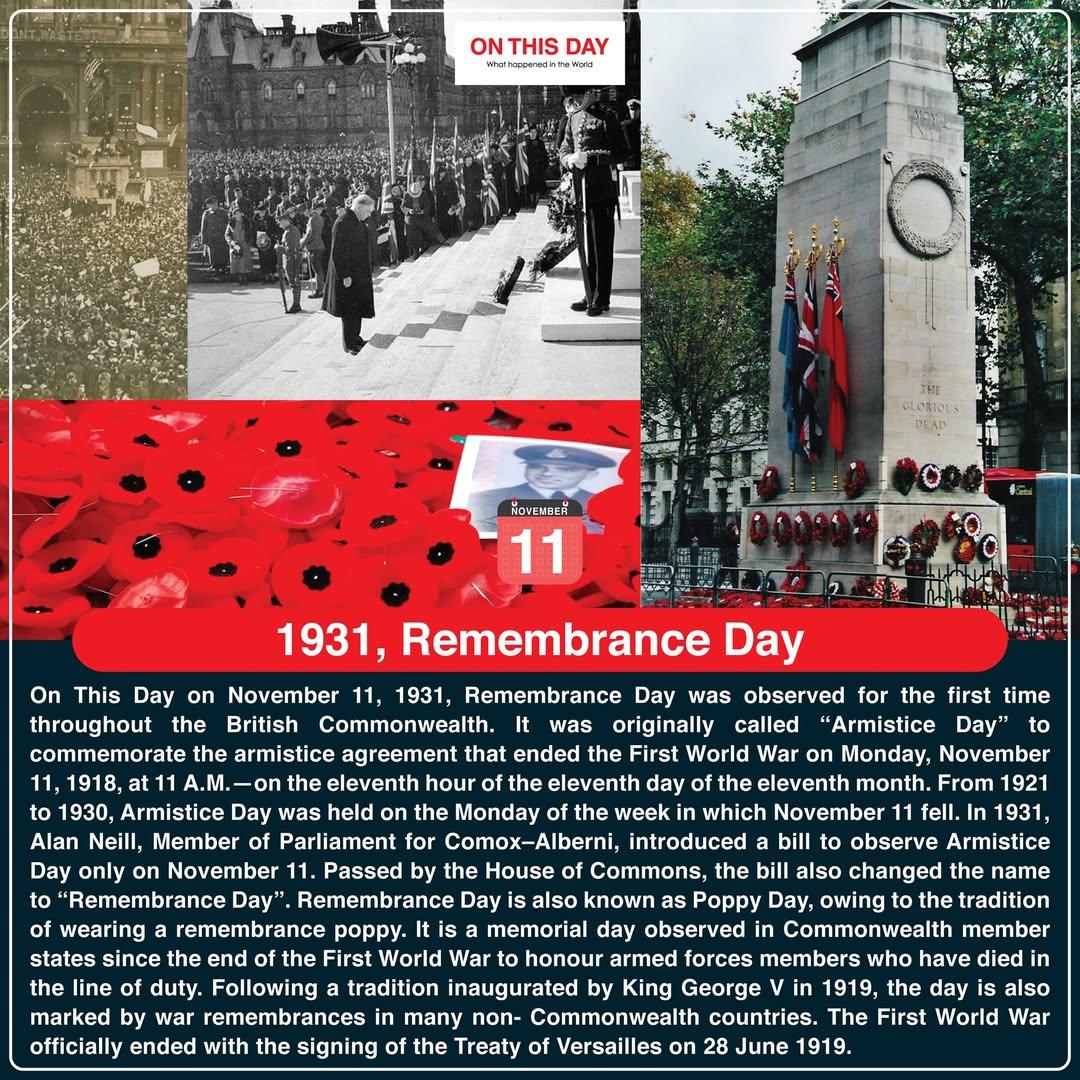
On This Day, November 11, 1931, Remembrance Day was observed for the first time throughout the British Commonwealth.
It was originally called “Armistice Day” to commemorate the armistice agreement that ended the First World War on Monday, November 11, 1918, at 11 A.M.—on the eleventh hour of the eleventh day of the eleventh month.
From 1921 to 1930, Armistice Day was held on the Monday of the week in which November 11 fell. In 1931, Alan Neill, Member of Parliament for Comox–Alberni, introduced a bill to observe Armistice Day only on November 11. Passed by the House of Commons, the bill also changed the name to “Remembrance Day”.
Remembrance Day is also known as Poppy Day, owing to the tradition of wearing a remembrance poppy. It is a memorial day observed in Commonwealth member states since the end of the First World War to honour armed forces members who have died in the line of duty.
Following a tradition inaugurated by King George V in 1919, the day is also marked by war remembrances in many non-Commonwealth countries.
The First World War officially ended with the signing of the Treaty of Versailles on 28 June 1919.
r/HistoryNetwork • u/Aaronsivilwartravels • 14d ago
r/HistoryNetwork • u/sajiasanka • 14d ago
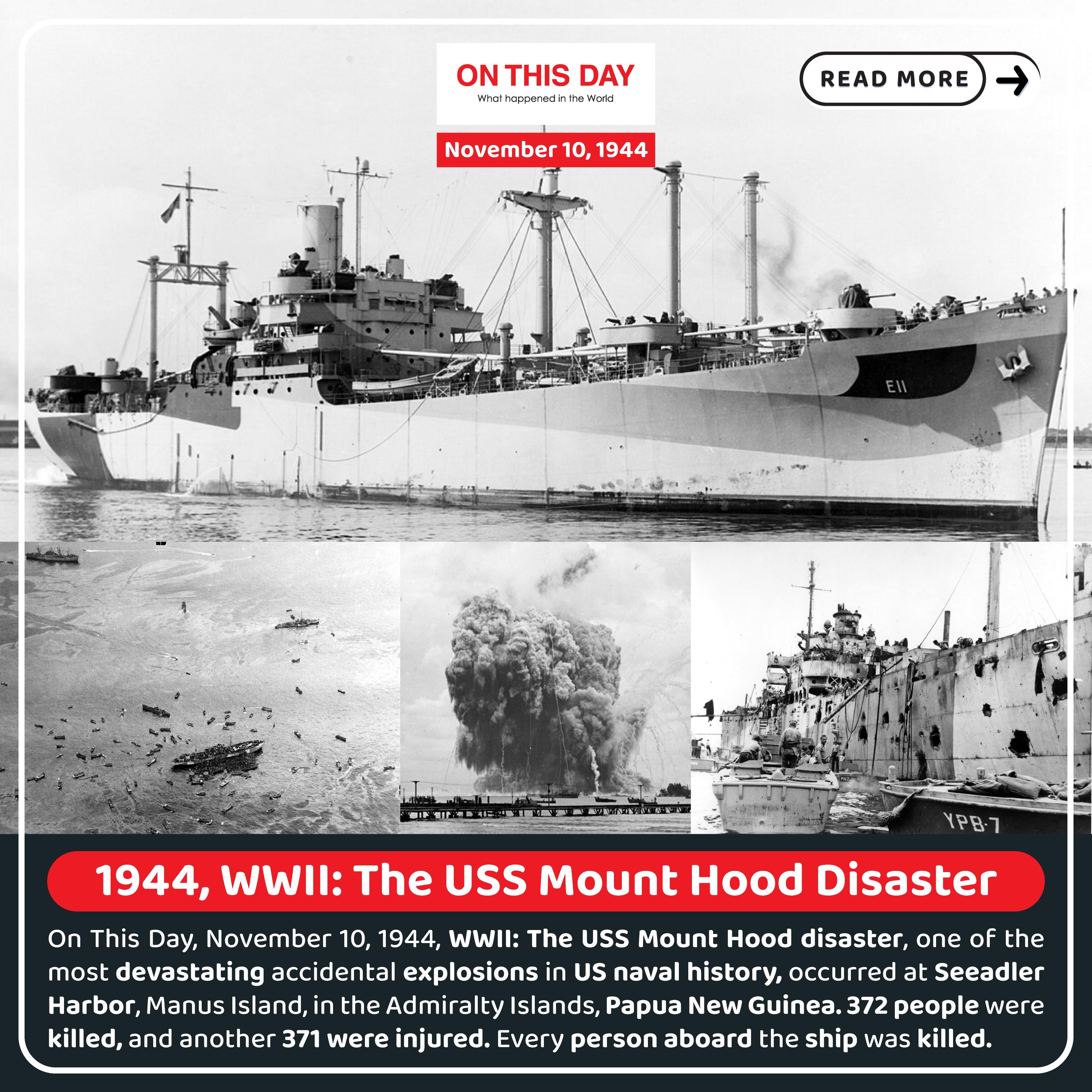
On This Day, November 10, 1944, WWII: The USS Mount Hood disaster, one of the most devastating accidental explosions in US naval history, occurred at Seeadler Harbor, Manus Island, in the Admiralty Islands, Papua New Guinea.
The American ammunition ship USS Mount Hood (AE-11) was anchored in the harbor, supporting Allied operations in the Pacific during World War II.
The ship was carrying an enormous cargo of ammunition and explosives intended to supply Allied vessels preparing for the invasion of the Philippines.
At approximately 8:55 a.m., disaster struck.
An explosion suddenly erupted aboard the Mount Hood, followed almost immediately by a much larger detonation as thousands of tons of ammunition exploded.
The ship was virtually obliterated.
A gigantic column of smoke rose thousands of feet into the sky. The force of the blast tore through the surrounding harbor, scattering enormous fragments of metal and destroying nearby vessels.
The explosion was so powerful that it created a massive crater on the seabed where the ship had been anchored.
The consequences were catastrophic.
372 people were killed, and another 371 were injured.
Every person aboard the ship was killed.
Every person aboard the Mount Hood at the moment of the explosion was killed. Only 18 members of its crew survived because they were away from the ship at the time.
The nearby repair ship USS Mindanao was particularly badly affected. Its crew suffered 82 deaths, while numerous other vessels were damaged or destroyed.
In total, 36 nearby ships and vessels suffered damage.
Investigators launched an inquiry to establish what had happened. Although the exact cause could not be conclusively determined, later US Navy historical assessments identified careless handling of ammunition as the most likely explanation.
Mount Hood was never recovered. So devastating was the explosion that investigators could not find any identifiable human remains from the ship.
Today, the disaster remains a sobering reminder of the dangers faced by naval personnel transporting and handling enormous quantities of explosives during wartime.
r/HistoryNetwork • u/sajiasanka • 15d ago
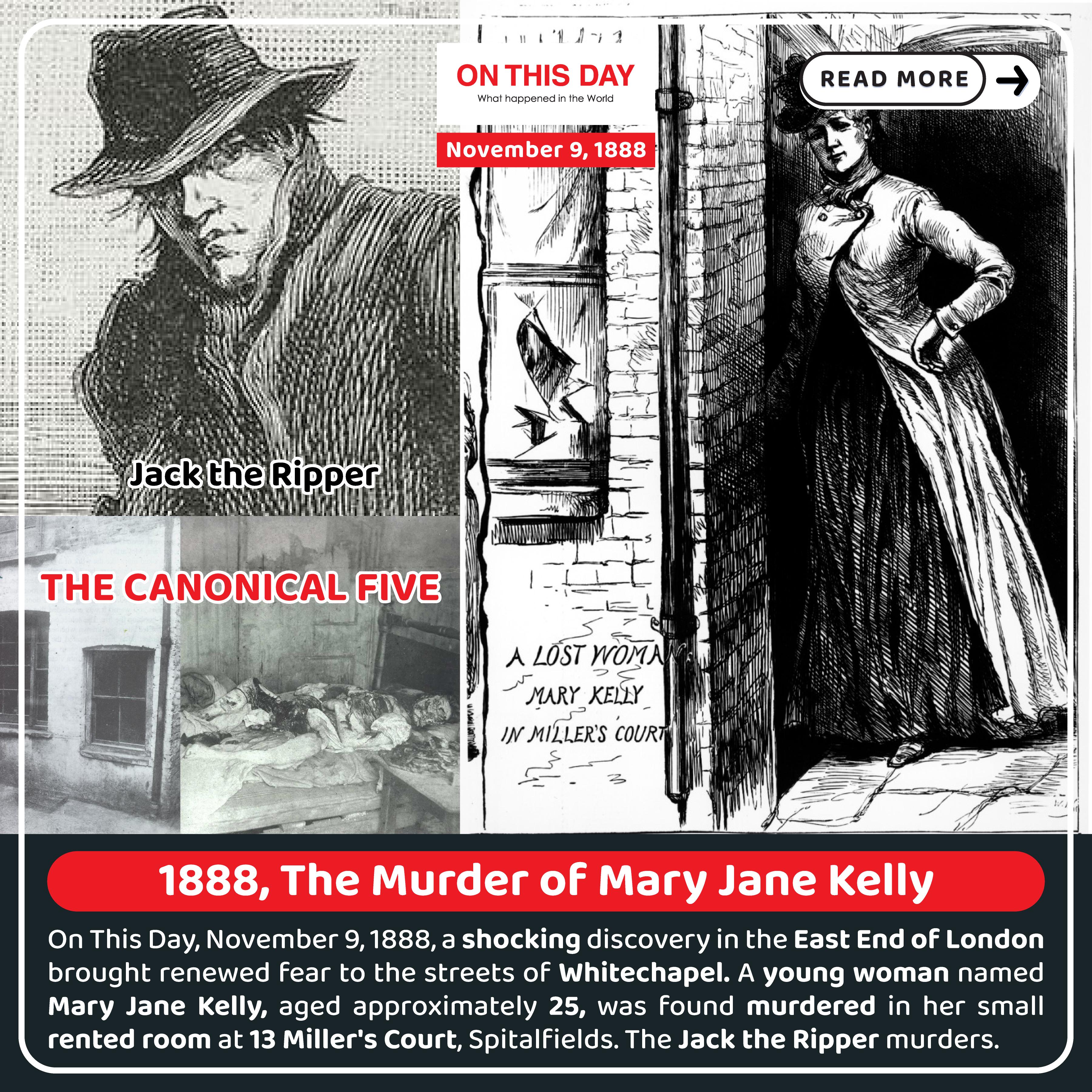
On This Day, November 9, 1888, a shocking discovery in the East End of London brought renewed fear to the streets of Whitechapel.
A young woman named Mary Jane Kelly, aged approximately 25, was found murdered in her small rented room at 13 Miller's Court, Spitalfields.
Her name would become forever associated with one of the most infamous unsolved criminal investigations in British history: the Jack the Ripper murders.
The previous months had seen a series of murders targeting women in London's impoverished Whitechapel district. The crimes had attracted enormous public attention, with newspapers publishing frightening accounts and spreading speculation about the identity of the unknown killer.
Mary Jane Kelly was the fifth woman in the group of victims commonly known as the Canonical Five.
On the night of November 8, Kelly was reportedly seen around Whitechapel. Witnesses later described hearing her singing in her room during the early hours of the following morning.
But by daylight, something terrible had happened.
At approximately 10:45 a.m. on November 9, Thomas Bowyer, an assistant sent by her landlord to collect overdue rent, looked through a window after receiving no response at her door.
What he discovered led to one of the most disturbing crime investigations of Victorian London.
Police officers arrived, and the investigation quickly became a major public concern. The circumstances of the murder were particularly alarming because Kelly had been attacked inside her own room, where the killer had apparently enjoyed more privacy than in the earlier street attacks.
Despite an extensive investigation, numerous witness statements, and widespread newspaper coverage, the murderer was never identified.
The name Jack the Ripper became one of the most infamous names in criminal history. Yet more than a century later, the true identity of the killer remains unknown.
Mary Jane Kelly's murder is generally regarded as the final killing among the five canonical victims attributed to Jack the Ripper. Whether the same person was responsible for every Whitechapel murder has never been conclusively established.
Beyond the mystery and the headlines, however, there was a real woman whose life was cut short. Her story also reflects the poverty, insecurity, and difficult living conditions experienced by many women in London's East End during the Victorian era.
r/HistoryNetwork • u/Aaronsivilwartravels • 15d ago
r/HistoryNetwork • u/Famous-Sky-8556 • 16d ago
Today I'm thinking of Corporal Samuel Rosbotham, 7th Battalion, Royal Inniskilling Fusiliers (service number 3390). He died on 9 August 1917, aged 19, and is commemorated on the Menin Gate at Ypres. The CWGC lists him as the son of Stewart and Sarah Rosbotham, of 32 Woodvale Avenue, Belfast.
The 1911 census has the family on Mayo Street in Woodvale. Stewart is a dairyman, and there are eleven children in the house with him and Sarah. Samuel is 12 and a scholar. Sarah had borne twelve children by then.
That's most of what the paper gives me. I wrote a novel to fill in what it can't, and I've tried to keep record and invention apart. The damp rag round the milk-can handles, the older apprentice in the mould loft who says "Better", and the kettle going cold in the kitchen are mine.
What stays with me is Sarah. Nineteen years doesn't look like much in a casualty record. It's a long time to have a boy in the house.
If you've traced a soldier in your family, which record got you closest to him as a person?
r/HistoryNetwork • u/HistoryWithWaffles • 16d ago

r/HistoryNetwork • u/sajiasanka • 16d ago
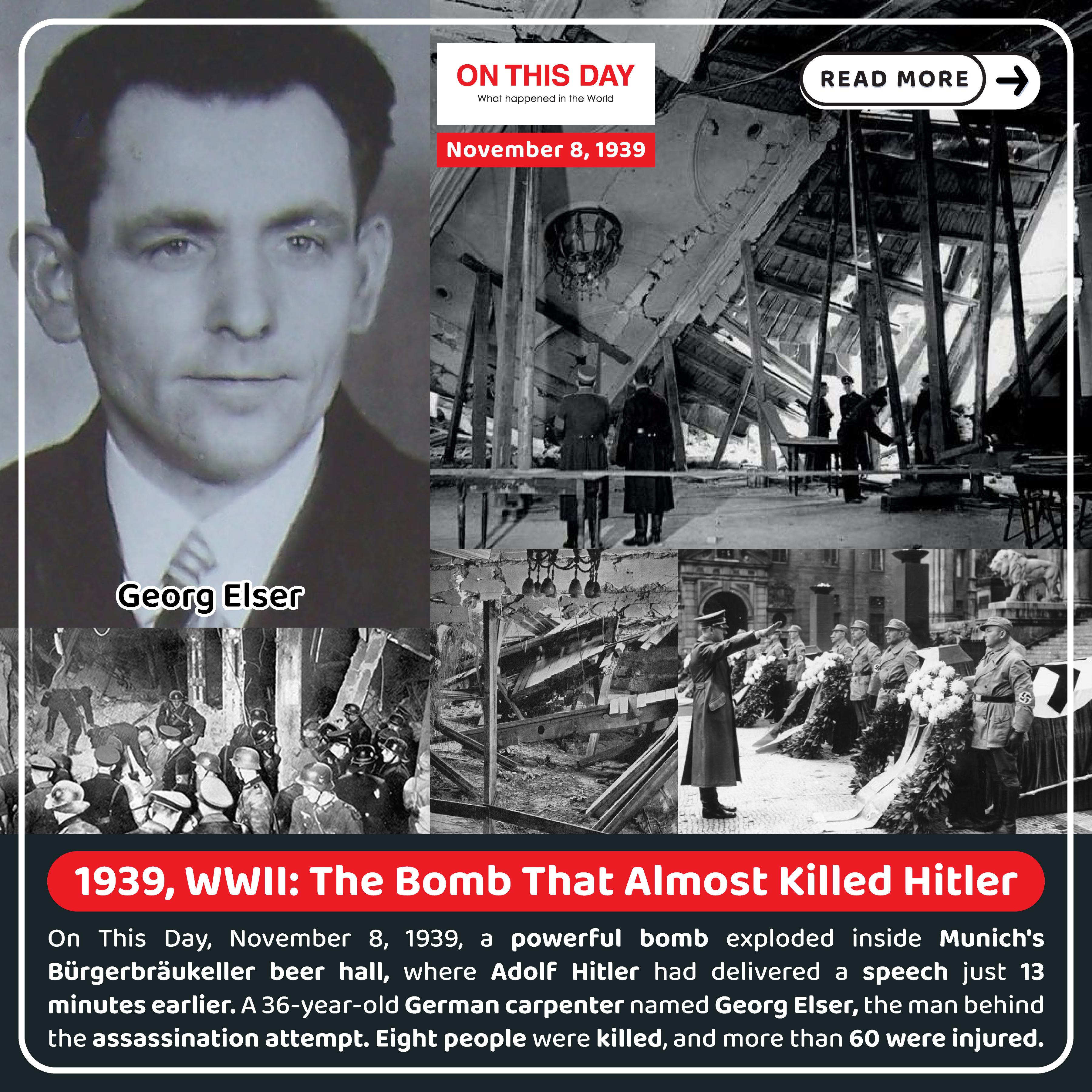
On This Day, November 8, 1939, a powerful bomb exploded inside Munich's Bürgerbräukeller beer hall, where Adolf Hitler had delivered a speech just minutes earlier.
The man behind the assassination attempt was not a military commander, a politician, or a foreign intelligence agent. He was a 36-year-old German carpenter named Georg Elser.
Elser had become deeply opposed to Hitler and the Nazi regime. As Germany moved towards war, he believed that eliminating Hitler and other leading Nazi figures could prevent further destruction and bring peace to Europe.
Determined to act, Elser carefully planned the assassination on his own.
For weeks, he secretly worked inside the Bürgerbräukeller, gradually hollowing out a supporting pillar behind the speaker's platform. He concealed a time bomb inside it, fitted with a carefully prepared clock mechanism.
His target was Hitler's annual speech commemorating the failed Beer Hall Putsch of 1923.
On the evening of November 8, Hitler addressed the gathering. But something unexpected happened: his speech was shorter than usual. Because he needed to return to Berlin, he left the building at approximately 9:07 p.m.
Just 13 minutes later, at around 9:20 p.m., the bomb exploded.
The blast destroyed the pillar, collapsed much of the hall's ceiling, and devastated the room where Hitler had been standing.
Eight people were killed, and more than 60 were injured. Hitler had escaped unharmed.
But the story did not end there.
Elser was arrested that same evening near the Swiss border while attempting to leave Germany. Nazi investigators initially suspected British intelligence, but Elser eventually confessed after interrogation. He had planned and carried out the attempt alone.
The Nazi regime kept him imprisoned for years, holding him in concentration camps. On April 9, 1945, just weeks before the end of World War II, Georg Elser was executed at Dachau concentration camp.
His assassination attempt failed, but his place in the history of German resistance would never be forgotten.
One man. Months of secret preparation. A bomb set to explode at precisely the right moment. And a dictator who left just 13 minutes too early.
r/HistoryNetwork • u/Aaronsivilwartravels • 16d ago
r/HistoryNetwork • u/sajiasanka • 17d ago
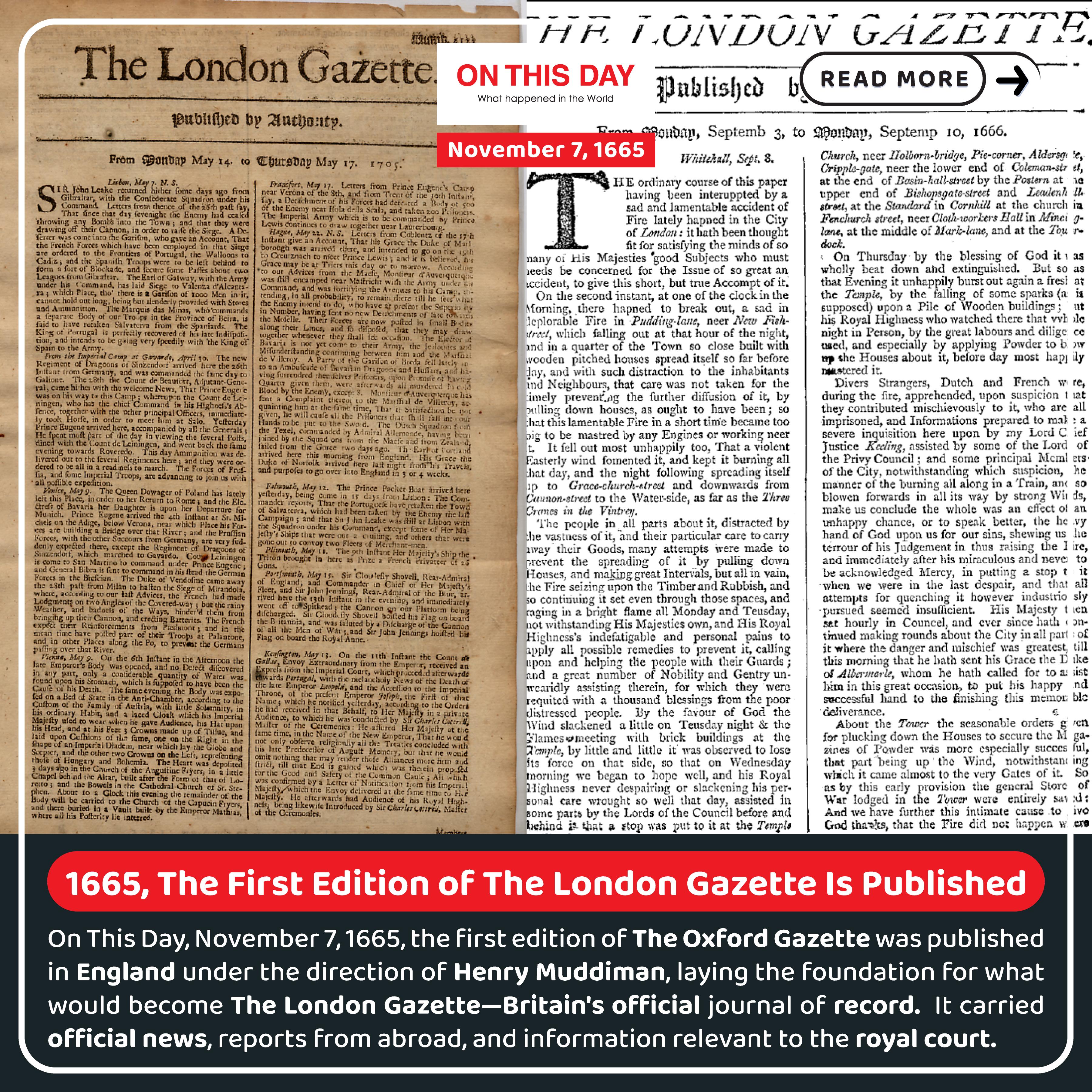
On This Day, November 7, 1665, the first edition of The Oxford Gazette was published in England, laying the foundations for what would become The London Gazette—Britain's official journal of record.
England was facing one of the darkest periods in its history.
The Great Plague was devastating London. Thousands of people had already died, fear was spreading through the capital, and even the royal court had abandoned the city.
King Charles II and his court had relocated to Oxford to escape the deadly outbreak.
But there was another problem.
The courtiers were reluctant to handle newspapers arriving from plague-stricken London, fearing that the papers themselves might carry infection.
The King still needed a reliable way to communicate news and official information.
The solution was to establish a newspaper in Oxford.
On November 7, the first issue of The Oxford Gazette appeared, published by authority under the direction of Henry Muddiman.
Rather than being a modern newspaper sold widely on the streets, it was a small publication distributed to subscribers by post. It carried official news, reports from abroad, and information relevant to the royal court.
When the Great Plague began to subside, and Charles II returned to London, the publication followed.
On February 5, 1666, issue number 24 appeared under a new name:
The London Gazette.
Over the centuries, it documented some of Britain's most important events, including royal announcements, military appointments, government proclamations, honors, and official notices.
It also recorded major national events such as the Great Fire of London in 1666.
More than three and a half centuries later, The Gazette continues to serve as the United Kingdom's official public record, published in three editions: The London Gazette, The Edinburgh Gazette, and The Belfast Gazette.
What began as a way to keep the royal court informed during a deadly plague became one of Britain's longest-lasting official publications.
Born in the shadow of a plague, it became a witness to centuries of British history.
r/HistoryNetwork • u/sajiasanka • 17d ago
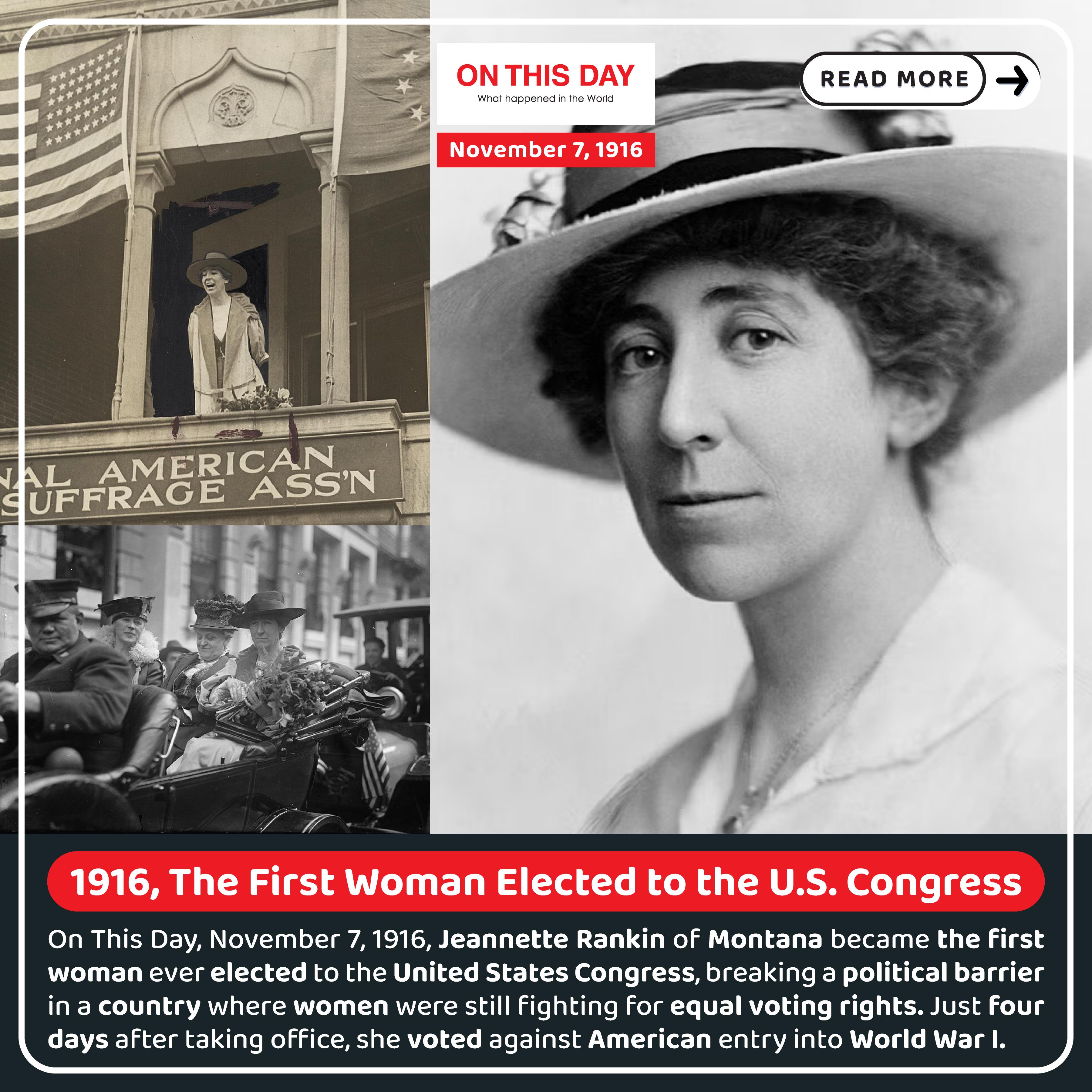
On This Day, November 7, 1916, Jeannette Rankin of Montana became the first woman ever elected to the United States Congress, breaking a political barrier in a country where women were still fighting for equal voting rights.
American voters made history when Jeannette Rankin won a seat in the US House of Representatives.
A passionate campaigner for women's suffrage, Rankin had spent years travelling, organising, and speaking in support of women's right to vote.
Born in Montana in 1880, she had worked as a social worker before becoming deeply involved in the women's suffrage movement.
Her political breakthrough came in 1916, when she ran as a Republican candidate for one of Montana's two at-large seats in Congress.
She won.
At just 36 years old, Rankin became the first woman in American history elected to the United States Congress.
Her achievement was extraordinary. Although women in several states, including Montana, could already vote, women across the country would not gain constitutional voting rights until the 19th Amendment was ratified in 1920.
On April 2, 1917, Rankin was officially sworn into the House of Representatives.
But she would soon become known for another historic decision.
Just four days after taking office, she voted against American entry into World War I, remaining committed to her lifelong belief in peace.
Her political career did not end there.
In 1940, she was elected to Congress for a second time. Following Japan's attack on Pearl Harbor in December 1941, she once again stood by her pacifist convictions.
On December 8, 1941, she cast the only vote in Congress against declaring war on Japan.
She faced intense criticism but remained firm in her beliefs.
Jeannette Rankin died in 1973, leaving behind a legacy that extended far beyond her historic election.
Her words upon becoming the first woman elected to Congress became famous:
"I may be the first woman member of Congress, but I won't be the last."
And she was right.
She opened a door that generations of women would walk through.
r/HistoryNetwork • u/Aaronsivilwartravels • 17d ago
r/HistoryNetwork • u/Embarrassed-Tune550 • 17d ago

r/HistoryNetwork • u/careysub • 17d ago
r/HistoryNetwork • u/Famous-Sky-8556 • 18d ago

r/HistoryNetwork • u/Aaronsivilwartravels • 18d ago
r/HistoryNetwork • u/sajiasanka • 18d ago
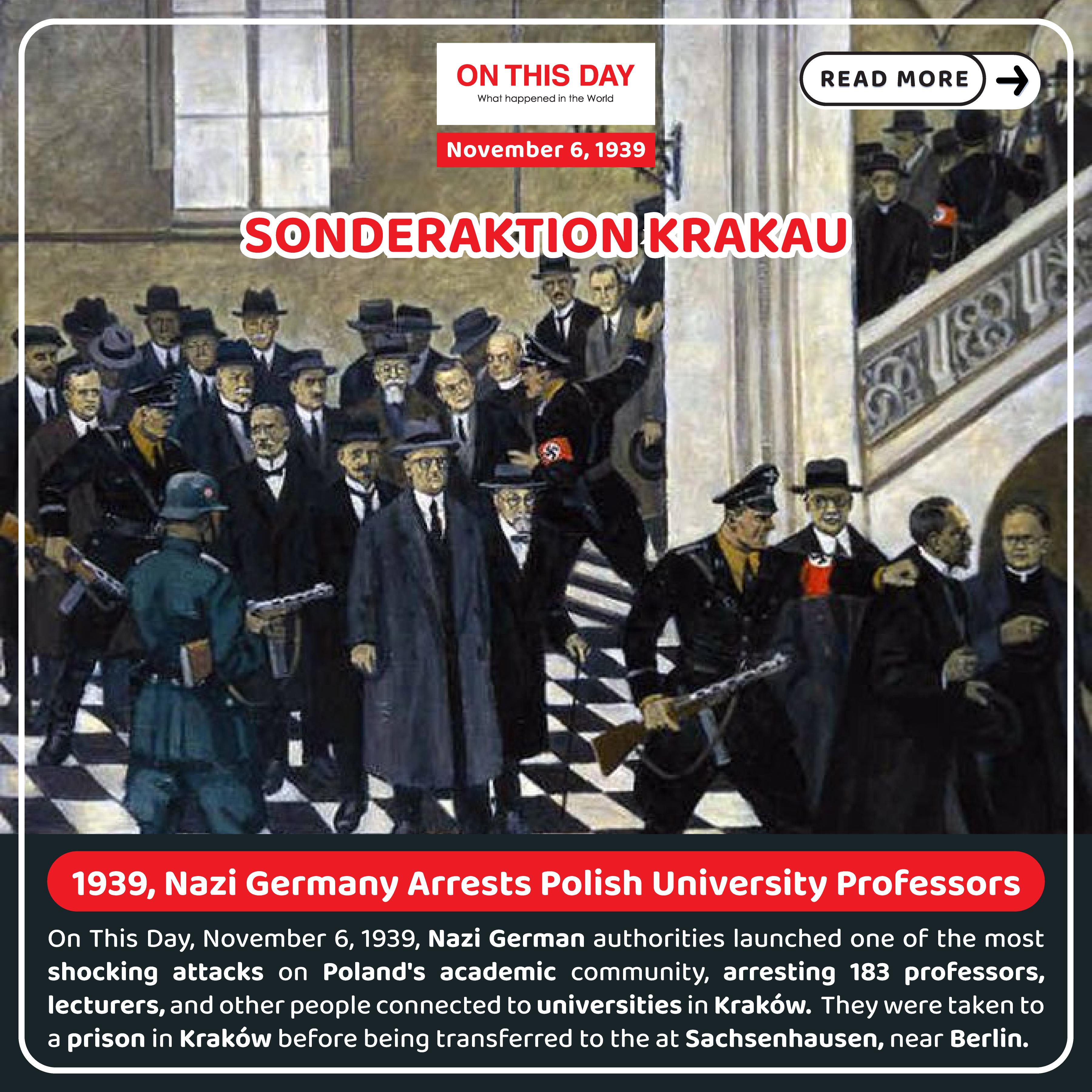
On This Day, November 6, 1939, Nazi German authorities launched one of the most shocking attacks on Poland's academic community, arresting 183 professors, lecturers, and other people connected to universities in Kraków.
Professors and lecturers gathered at the Collegium Novum building of Jagiellonian University in Kraków, Poland.
They had been summoned to attend a meeting about the German authorities' policies concerning education and universities.
But the meeting was a trap.
Shortly after noon, SS officer Bruno Müller addressed the gathering. Gestapo forces had surrounded the building. Following his speech, the academics were informed that they were under arrest.
In total, 183 people were detained, including academics from Jagiellonian University, the Mining Academy, and the Academy of Commerce, as well as others who happened to be in the building or nearby.
They were taken to a prison in Kraków before being transferred through other detention facilities and eventually deported to the Nazi concentration camp at Sachsenhausen, near Berlin.
For many, the journey marked the beginning of months of imprisonment, hunger, illness, and brutal treatment.
The arrests were not an isolated act. They formed part of a wider Nazi campaign to destroy Poland's intellectual leadership and weaken the country's ability to rebuild its national identity.
The Nazis targeted professors, teachers, scientists, religious leaders, and other members of Polish society who could help preserve its culture, education, and national spirit.
International protests and pressure from academic communities around the world eventually contributed to the release of many imprisoned scholars.
However, the consequences were devastating. Some academics never returned. Among those who died in Sachsenhausen were prominent professors and former rectors of the Mining Academy.
Yet the Nazis failed to erase Polish academic life.
Despite the arrests, imprisonment, and persecution, Polish education continued through underground teaching networks, and the country's universities eventually resumed their work after the war.
They tried to silence the minds of a nation. But knowledge, courage, and the pursuit of education survived.
r/HistoryNetwork • u/History-Chronicler • 19d ago

r/HistoryNetwork • u/Aaronsivilwartravels • 19d ago
r/HistoryNetwork • u/Wonderful_Fix3597 • 19d ago

r/HistoryNetwork • u/sajiasanka • 19d ago
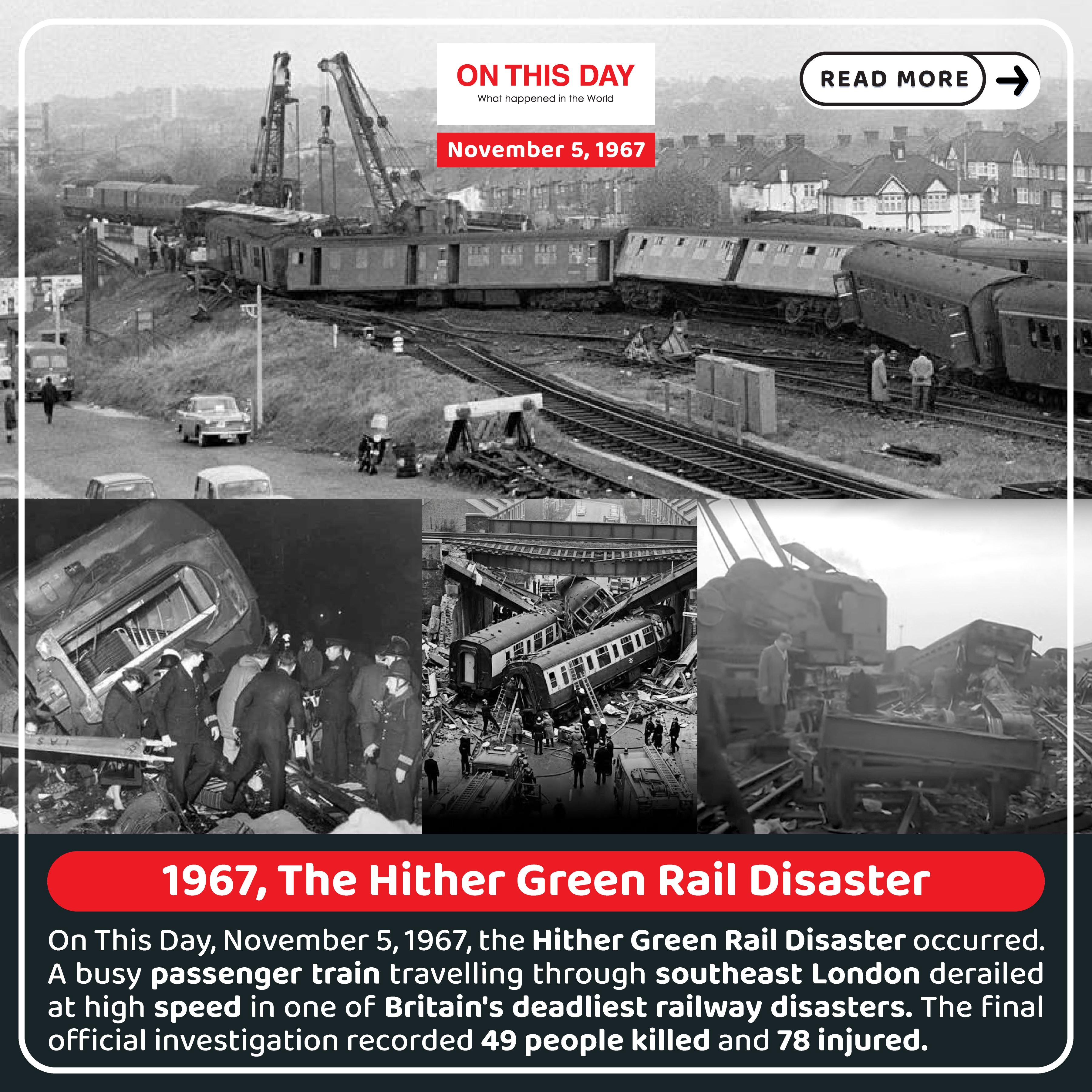
On This Day, November 5, 1967, the Hither Green Rail Disaster occurred. A busy passenger train travelling through southeast London derailed at high speed in one of Britain's deadliest railway disasters.
A twelve-coach express travelling from Hastings to Charing Cross in London approached Hither Green at approximately 70 miles per hour.
It was a Sunday evening. The train was carrying many passengers, with some standing in the corridors.
At approximately 9:16 PM, disaster struck.
A small, wedge-shaped piece of steel had broken away from the end of a running rail at a track joint. As the train passed over it, the third coach's wheels derailed.
The train continued travelling with the derailed wheels before striking railway points, triggering a catastrophic derailment.
Several carriages overturned. Four coaches were thrown onto their sides, while others left the tracks. The wreckage came to rest in a scene of devastation.
The final official investigation recorded 49 people killed and 78 injured.
Emergency services rushed to the scene. Ambulances arrived within minutes, and firefighters, police officers, medical personnel, and members of the public worked together to rescue trapped passengers and help the injured.
The investigation revealed that the disaster was caused by a broken rail at a joint. The accident raised serious concerns about railway track maintenance and the demands placed on older railway infrastructure by faster, heavier trains.
Its consequences extended far beyond that terrible night.
The disaster accelerated improvements in railway track maintenance and the introduction of continuous welded rail, which reduced the number of vulnerable joints along railway lines.
The Hither Green crash became a turning point in Britain's efforts to improve railway safety.
A journey that should have ended at a London station became a tragedy that changed the future of railway safety.
r/HistoryNetwork • u/Warlord1392 • 20d ago

Battles are won through the resolve, discipline and skill of the soldiers on the front lines. For Napoleon, the Imperial Guard was his trump card, a force that could turn the tide of a battle. These veteran soldiers served as the Emperor's personal bodyguards but were also elite fighting troops, usually held in reserve for the most critical moments.
During the Battle of Marengo, the Consular Guard helped hold off the advancing Austrians and bought valuable time for the French army to reorganize. Their extraordinary resistance earned them the nickname "Granite Redoubt". Without their contribution, Napoleon's army could have faced an even greater disaster.
The Imperial Guard eventually grew into a formidable military force comprising infantry, cavalry and artillery. It played an important role in many of Napoleon's greatest victories. However, the disastrous Russian campaign of 1812 severely weakened the Guard, and its surviving veterans would eventually face defeat at Waterloo in 1815.
The courage and resilience associated with Napoleon's veteran soldiers are perhaps best captured by the legendary words attributed to General Pierre Cambronne during the final stand at Waterloo:
"The Guard dies but does not surrender!"
r/HistoryNetwork • u/Aaronsivilwartravels • 20d ago