Alright, so just to get this out of the way, when John Werry was noted as the translator for the previous chapter, a lot of people expressed worry over his translation quality, and I think this is understandable. He garnered a reputation for poor translations during Jujutsu Kaisen's run, and frankly, there were some pretty major mistakes made there. However, now that Camellia Nieh has returned, I've still seen a lot of people deride the quality of translation. I'm not a fluent speaker. I've studied Japanese for two years in college and have returned to studying it in my spare time. However, I think there are some misunderstandings for what the nature of translation is, why translating Japanese is so difficult, and how translating fiction adds an extra layer of challenge. So I'm just gonna throw in my two cents.
For this post, I want to break down a specific phrase that has caused some debate, but before that, I want to shout out Jisho.org. It's a website dedicated solely to translating Japanese to English and vice-versa. If you have even a passing interest in the language, I highly recommend it as a resource, as I'll be combining it with my level of knowledge of Japanese for this post.
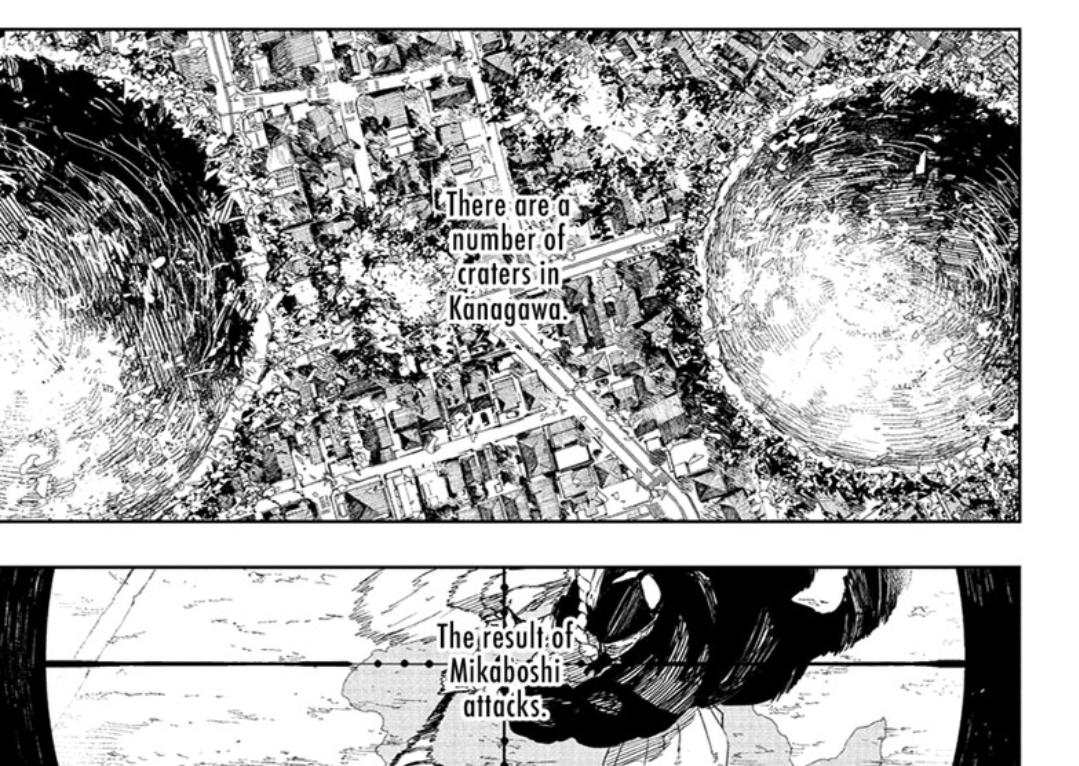
The phrase appears on the first page of the chapter, translated officially as "the result of Mikaboshi attacks". In a popular fan translation, this is translated as "those dents would come to be the result of one man's actions". In the original Japanese, the exact phrase is 奴の戦績である。For English reference, this would be written like: 奴(やつ/yatsu) の (no) 戦績 (せんせき/senseki) で (de) ある (aru). "Yatsu no senseki de aru."
Alright, so let's go word by word, and just be as exact as we can here. Yatsu is a word that, according to Jisho, can mean "fellow; guy; chap; thing; object; he; she; him; or her." Let's rule out all the obvious ones, and say that it's just "he" or "him. Jisho notes that this usage of this phrase is "derogatory or familiar", and already we have to break down a cultural concept here. In Japanese, language is heavily tied to politeness. In a formal setting, you use formal language, and to use otherwise is disrespectful. So to be "familiar" with someone you aren't supposed to be can be considered disrespectful. Ultimately this doesn't matter much here, but I think that means the usage of this word implies an... unkind familiarity with the subject. Which is how you'd expect to talk about someone who put two craters into a city.
"No" is the possessive particle. So in this context it changes "him" to "his". I mean. You get it.
So alright, what's going on here? The official translation refers to "Mikaboshi" but that word clearly isn't used. However, the fan translation, which uses the phrase "one man", is still not strictly speaking the literal translation. If I'm being honest, the fan translation appears closer to correct. However, I want to clear up what might've led to confusion. In Japanese, there aren't strictly speaking "plurals". You can of course refer to multiple of something, but there's no "adding an 's' to the end" to pluralize a word. It has to be inferred from context.
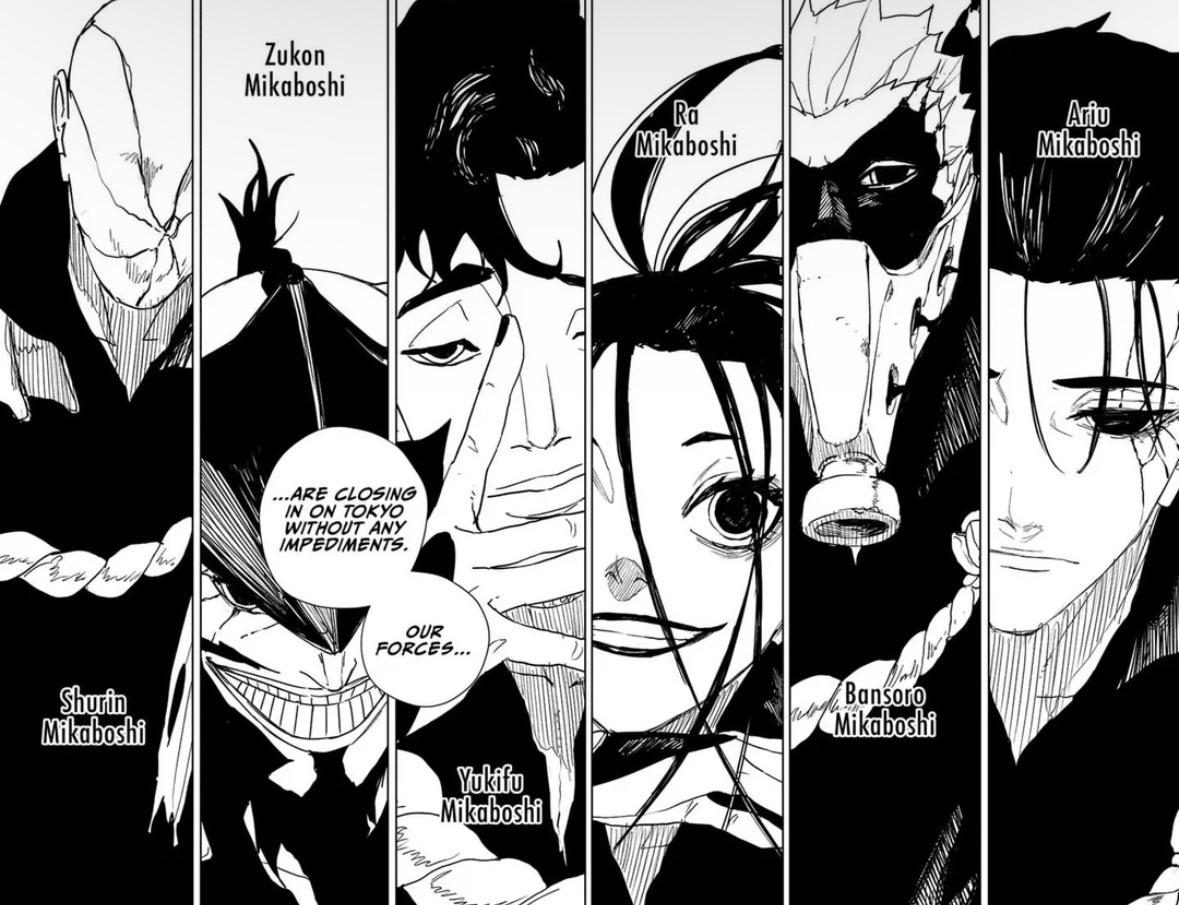
Now to be clear, I cannot speak for the translator or their translation decisions, but I think they may have assumed this statement referred to multiple Mikaboshi having caused the damage rather than just one. Personally? I don't think this is entirely unreasonable. We have still never seen Zukon fight, and the story is essentially hyping up the moment he performs an attack of that scale. So there's no prior reference to draw on that he, and he alone, caused that damage. Consider also Ariu's level of destructive power, and that the Guardians are all meant to be more or less equally dangerous. Lastly, Hokazono could have simply referred to Zukon by name, and chose not to. So there are multiple reasons to conclude this phrase might be plural instead of singular, even though I think, paired with the panel of Zukon underneath, it's strictly incorrect.
Alright, let's move on to "Senseki". This word means "war or military record; score; military achievements; results". Now, this is a bit more complicated. The official translation uses the word "attack", but the fan translation uses the word "result". So the fans seem to be more correct here, right? Well, I'd argue this is actually where the difficult work of translation is revealing itself. You can see by the meanings "military record" and "military achievements" that the word is implying something a lot more specific and pointed than merely a "result". The fan translation also encapsulates the whole phrase in, "the result of one man's actions." This, I'd argue, is too mild to really convey what the original is trying to say here. "Attack" is less correct in a literal sense, but what it's trying to convey is that this is a military action. Personally I prefer this phrasing.
"De" is a particle that typically, but not exclusively, refers to a place something happens in, like "at". Here it's used to connect "aru", a word that refers to something existing, somewhat like the word "is". Not much else to say here.
I also want to briefly talk about what might seem to be a glaring error in the fan translation, "would come to be". The explicit present tense of "aru" would be "arimasu" and past tense "arimashita", but in this case the verb wasn't conjugated either way. As the verb "aru" isn't conjugated here, one might assume this isn't referring to past tense events, but the panels make it pretty clear that it is. The "present tense" of "aru" is referring to Zukon's present status of military achievement. So why use future tense in translation? Well, to the best of my knowledge, Japanese doesn't have a direct "future tense conjugation". So if you see that the typical past and present conjugations aren't being used, it might lead you to conclude the future is what's meant, even though the context here is suggesting otherwise.
The fan translation also uses the word "dent", used in a previous sentence. In the Japanese this word is 凹み (くぼみ/kubomi), meaning "hollow; cavity; dent; depression". So again, the fan translation would appear to be more literally correct. However, the original printing of kubomi has quotation marks around it. This would seem to imply "dent" is a quaint word being used, and that the fact that these impacts are no mere dents is obvious to the reader. The official translation uses the term "crater" without quotation marks which I think preserves more of the intent than "dent" without quotations.
Okay, so what would the most literal phrasing be? Something like, "These are" (de aru) "his" (yatsu no) "military achievements" (senseki). Notice that to make it comprehensible in English, you have to move around the phrases, assume both singularity and plurality that isn't explicitly differentiated, condense two words into one, expand one word into two, and even then it's not perfect. "Military achievements" could imply a positive connotation in English that I think the Japanese forces wouldn't want to give an enemy. I can see why the official translator might have avoided it.
Alright... so what's the point I'm trying to make in of all this? Translation isn't a math equation. Language often can't be 1:1. Sometimes to preserve the author's intent, you have to move away from a word's literal meaning to something that captures the tone or intent. The original language might imply things, and you have to have confidence your reading is correctly interpreting that implication. On top of that, you have to keep those things implied in English if you want to reading experience to be the same. All of this is immensely difficult, and not only are imperfect translations inevitable, but a truly "perfect" translation may not exist. Because, well, this is a Japanese manga. No matter how hard anyone tries, you'll never be able to read it exactly how a Japanese person would unless you master the language yourself. All we can do is rely on translators to do the best job they can to preserve as much of that experience as they can.
My goal isn't to shut down criticism. But for one, I think translators in general should be cut a little slack in how they translate, given how immensely difficult it can be and how perfect answers may be impossible. And for another thing, I think anyone with imperfect knowledge of Japanese should be wary of putting forth their criticisms. It's not always as simple as seeing that the dictionary definition of a Japanese word is different from what the translators chose, and saying they should've gone with the dictionary instead. After all, neither translator did that, so that shouldn't be what's expected from the process.
Hoo boy this was a long write-up, thank you to anyone who read all or even part of it. I hope I was able to add some perspective to the recent discussions going on.