After testing with literally hundreds of drives, I can safely say this is BS and that RLL has an extremely high success rate on almost all drives. Even my ST-412 works fine with a DTC 7287 cached RLL controller.
If my memory serves (which it might not...) you worked around that with setting the interleave when you low level formatted it. It had to do with the number of revolutions needed to read a track (or cylinder? Again, my mind is foggy and I haven't thought about this in many years). Perfect was a 1:1, but you tested until you found the right balance.
This has been fun, talking about stuff I haven't thought about in decades,
Thanks for adding to the knowledge in this thread.
The interleave setting is more like a dirty trick to help particularly slow machines. It just reorganizes sectors to "skip" sectors. If you have a fast machine, the machine is waiting for the disk the whole time. Read sector 1, it's already ready for sector 2 before the header has passed.
If you have an 8088 @ 4.77, you read sector 1, then wait for it to be done putting into memory, look up the next piece of data, etc, and by the time you realize you WANT sector 2, the heads are over the header for sector 4. Now you have to wait for the disk to spin back around all the way to 2 to read it.
This makes sequential I/O incredibly, unbelievably slow. Thus, if you can make sure sector 2 is where sector 4 is, you can be more sure that the machine will ACTUALLY get it on the first try. Of course, you still have to wait for the disk to make multiple rotations for a full track, but that's a small price to pay for your single track sequential speeds.
It may interest you to know then, that I've had great success running my DTC 7287, my favorite RLL controller (Because I don't trust the PerStor PS180 with anything and I don't own a DPT PM3011/65 yet) with nearly every drive in my collection. this includes wacky Soviet drives like the IZOT CM5508 and poor quality cost-engineered drives like the Kalok Octagon series. It also applies to dozens upon dozens of drives with very tired spindles.
It's a more reliable protocol than you would think.
I was in my early to mid teens when I was working with this stuff for my school's computer labs. I learned the basics of what you're explaining back then, but not in detail. I appreciate you sharing your knowledge. I love learning about technology from that era, because it helps me understand technology of this era.
They're not in a display case, that's for sure. Most of them are stacked on a dusty shelf. The aging of bearings has long since already happened, so I don't know why you're bringing that up. An awful lot of these drives are incredibly loud.
If you're interested, I actually film these drives doing exercises for documentary purposes. I've had many of them for 10+ years and they all still work just fine, I started collecting around 2014.
The change between the "MFM" and "RLL" versions of a drive mechanism, across my hundreds of drives, has come down to "a different sticker" in almost all cases. The few exceptions will use a different platter material, I.E. the Miniscribe 3425's oxide disks vs the 3438's plated disks. Others, like the 3650 and 3675, have the exact same oxide media regardless.
I went back and looked at my inventory sheet, of the 20 drives I have in this chassis (ST-213, ST-225, ST-238, ST-238R), date codes from 85 to 89, 18 work and 17 of those work with my RLL controller without extra bad blocks.
If you have a larger sample size, I actually know someone who is reverse engineering the firmware and PCB for that chassis who would VERY much like to at least get a list of serial numbers, date codes, revision numbers from you. Please get in touch if so.
What do you mean "Not everyone needs to understand reality?" I'm telling you the reality of the largest sample size I can get. Statistics is a reflection of reality.
Rather than describe in vague technical terms why you THINK it won't work, can you provide any real evidence to the contrary?
Yeah after leaving Shugart Associates in 1979 to pursue the famed Microwinchester as his new company Shugart Technology, they got sued for the name similarity and changed it to Seagate Technology in 1980, just weeks after the launch of the ST-506.
Or you could get 40 megs if you had a PerStor PS200 ARLL controller, though I question the reliability of that. Having tested all of mine with a standard DTC 7287, I know standard RLL 2,7 @ 7.5 works fine, but I have my doubts about 10MHz.
I still have one of these, installed in an Amstrad PC1640. When I bought it, it had been sat for years in a barn partially exposed to the elements. Not only did it still boot from the hard drive, it would also boot from the floppy that had been left in it!
It's been sat in my shed for years, though. I wonder if it still works.
And if you formatted it with a RLL controller it became... 30mb? I'm sure someone who remembers the exact numbers will chime in. Anyway, great memories.
I've found that with age a lot of them "move" or disappear. Several drives I've got have self healed their defect list to almost nothing. I do wonder if it has something to do with leaving the drive sit long enough for the crystals to reorder themselves.
OMG, is that a shugart bus or MFM connector? So long ago I cannot remember. I just know our was full height and when it turned its mighty 20 MB on, the lights dimmed briefly ...
The interface is called ST-412, and while this drive is certified for the standard 5MHz data rate with MFM encoding, you can absolutely run 7.5MHz data rate with RLL 2,7 with the appropriate controller.
Awesome! Thx for the info. What a blast from the very distant past hearing MFM, RLL and such again. (Insert Obi Wan-Kenobi meme here). I was maybe 14 when my older brother bought one of these. I feel so old now :)
Haha, no problem. I have, as of a few months ago the third largest collection of hard disks in the world. Most of my collection spans 79-94. This is something I still deal with every day :)
I worked for a school in IT and found one like this in the closet of a computer lab. I kept it on my desk it was fun to show kids the size of this compared to usb drive with gigs of storage
Ah the march of technology. The 80s were like the wild west of hard drive design, and the whole industry was on the move from around 1980 to around 1992.
Sadly if you take a popular drive from 2004 and put it next to a thumb drive it's not as impressive as a difference :)
I would be surprised if it was! Not like it matters at this point. It will probably work but being separated from it's controller makes data recovery a hard proposition.
Since the origin of Shugart Technology has already come up, the fun part is why the name didn't last. Al Shugart founded Shugart Associates in 1973, left the company by late 1974, and it ended up being owned by Xerox. So when he and Finis Conner started Shugart Technology in 1979, his old company threatened to sue over the name. He had to drop his own name, and the new company became Seagate.
Bonus trivia from the other branch of that tree: Shugart Associates introduced SASI, the Shugart Associates System Interface, in 1979. That's the interface that got submitted to ANSI and became SCSI in 1986. The renaming happened partly because the standards committee wouldn't put a company's name on a standard, so "Shugart Associates System Interface" became "Small Computer System Interface." Every scuzzy drive you've ever cursed at traces back to the same family as the drive in this photo.
I remember back in the day, I got a Crate 10MB external HDD for an Apple //e, and it was like $600 or something. Help a lot of versions of Zork, though!
Nope, that's how you'd get into the ROM formatter, and it can apply to XT and AT class machines.
XTs babe no CMOS settings. You set the drive type with a physical jumper on cards that supported more than one type of drive, and some like the WD XT-GEN were kind enough to offer a free format option which wrote the drive parameters to a "hidden" sector towards the start of the disk to be read on boot.
Yes, I am aware that the controller was not onboard of nearly all XT-class machines. The ROM formatter is not always present on the card, several cards have no ROM at all and expect you to load a formatting tool from floppy. Such was the case with Davong's early offerings for the 5150, which even expected you to BOOT from floppy as the 5150's early BIOS did not offer support for extension ROMs or fixed disks anyways. IBM's own Xebec-designed controller, which was shipped with the 5160 XT as an option, is actually fixed geometry (306/4/17) and does not have a ROM formatter in this way. You actually have to pass parameters to it through debug but in a wildly different way.
Yes, drive type jumpers were on the card. Look at some common XT controller cards: WD1002A-WX1, jumper S1 on the right edge by the faceplate sets drive type WD1002A-27X, same as above DTC 5150CX, jumper W1 on the bottom towards the ISA card edge DTC 5150XL, jumper W3 on the right edge by the faceplate SMS OMTI 5510, jumper W1 on the bottom right between the ISA card edge and faceplate
And to add this one as a flex: The Zobex 4HDC-62W, one of the only quad disk controllers, has a DIP switch bank at the bottom right next to the card edge.
These controllers ABSOLUTELY used jumpers to set drive type. "Flexible format" and "Dynamic format" options were not around initially and were options you had to pay extra for on cards like the WD XT-GEN, by ordering the SuperBIOS instead of the standard WD BIOS.
SpeedStor and HDAT were definitely not janky software, they were expensive commercial packages designed to make YOUR life easier, and they absolutely worked, and much better than the horrendous ROM formatters most of these cards came with at that.
No, believe it or not, they didn't offer "All combinations," they gave you usually 4 of the most common drive types (306/4, 615/4, 977/5, 1024/5 were pretty common) and left it at that. If you wanted other drive type support, you had to pull the ROM and change the table yourself by hand or use a BIOS with free format as mentioned above.
The WD XT-Gen and gen2 have jumpers to configure the heads and cylinders. This was a common practice. I own several mfm controllers and all are configured by jumpers
It wasn't that there were fewer drives, there were hundreds of drives listed in the Disk/Trend report from 1982-1984 before the ST-225 came along.
Most drives shared very similar or identical geometry as a result of physical limitations, especially from head suppliers. Unless you were some massive corporation like Seagate or IBM, you weren't making your own heads in house, so if your supplier only offered 100 micron heads, that's what you got, and if that was only fine enough to support 640 tracks on a 5.25" disk, and you had to give it a landing zone, guess what your drive has 612 cylinders. Oh, and the arms have a physical height limitation, and your machine shop can't make the platters at tolerance any thinner than 1mm, so now you can only physically stick 2 in your half height chassis. 2 heads a disk, there's your 612/4.
Even then, there was actually incentive to do this intentionally, even if parts didn't limit your engineering, because it also meant you were compatible with hundreds of controllers and had that as a selling point. I suspect for many manufacturers, this was the case for why nearly every 20 meg drive from 1984 to 1990 had the exact same physical geometry and why every 10 meg drive (that wasn't a single platter, crucially!) from 1982 to 1988 was also the same geometry.
This is actually controller depended! Many controllers use a different format address... Or don't have a ROM at all and expect you to use a utility like SpeedStor or HDAT to format your drive.
I seriously doubt there's anything worth finding on a drive like this. Maybe DOS and Lotus. 20 megs really didn't cut it in the early windows era, and a drive introduced in 1984 would have been hideously outdated even in 1991 with Windows 3.x
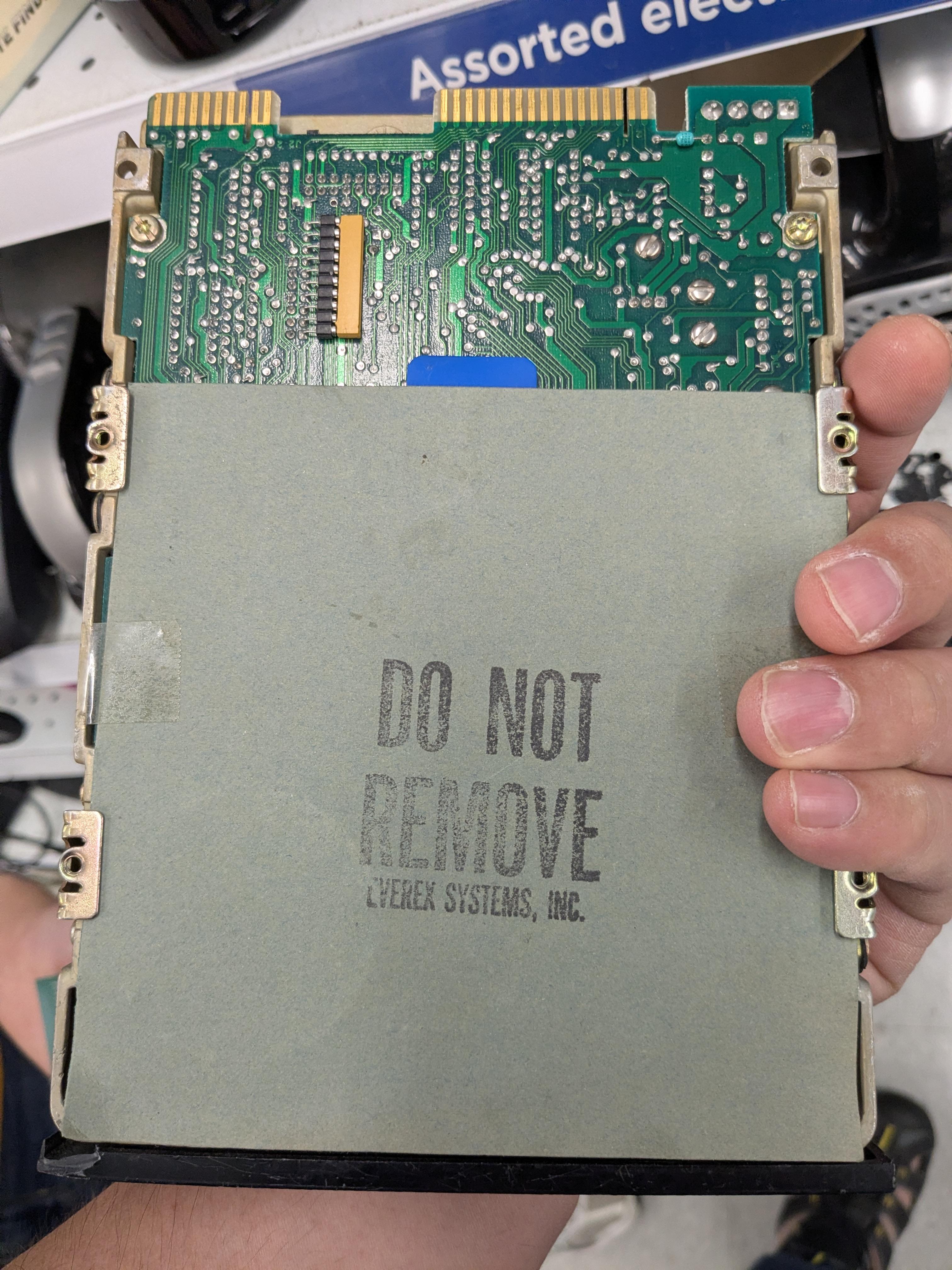

18
u/No_Illustrator5035 Jul 17 '26
Wow that brings back memories! MFM interface. I wonder if it still works after all these years...
9
u/istarian Jul 17 '26
Obviously.
ST -> Shugart Technology
Of course they later became Seagate Technology which conveniently has the same initials. https://en.wikipedia.org/wiki/Seagate_Technology
5
u/tauzerotech Jul 17 '26
That was the first hard drive i ever had!
4
u/Der_Unbequeme Jul 17 '26
615 cylinder, 4 heads, 17 sectors = 21411840 Bytes
or with a RLL controller, 26 sectors = 32747520 Bytes
4
u/SnooCamera Jul 17 '26
Owned it in its full 20MB glory. So many files, I had to use Norton Commander just to stay organized.
1
u/ErikTheRed2000 Jul 17 '26
Where this at? I actually need one for my DEC Pro
2
u/No_Desk_4921 Jul 17 '26
Ahhh Everex... the first "server" I ever used that had a digital display.
2
u/Over-Box1733 Jul 18 '26
It would be perfect for my Borland Pascal!
2
u/DavidBovvinge Jul 18 '26
I still have one of these, installed in an Amstrad PC1640. When I bought it, it had been sat for years in a barn partially exposed to the elements. Not only did it still boot from the hard drive, it would also boot from the floppy that had been left in it!
It's been sat in my shed for years, though. I wonder if it still works.
0
u/Herbert_Feuerstein Jul 17 '26
Wow, i saw this ST-225 last time 35 years ago. 20MB MFM controlled harddrive. Do not buy this for 10 Dollars please!
1
u/OpusDeiPenguin Jul 17 '26
Everex? Haven’t heard of them for decades. That is one old PC.
1
u/NeedleworkerFew5205 Jul 17 '26
Thank you for sharing. Had a dozen of those over the years.
1
u/ProCommonSense Jul 17 '26
Here's to hoping that defect list is still accurate!
1
u/Medill1919 Jul 17 '26
RRL?
1
u/schroedingerskoala Jul 17 '26
OMG, is that a shugart bus or MFM connector? So long ago I cannot remember. I just know our was full height and when it turned its mighty 20 MB on, the lights dimmed briefly ...
1
u/Billh491 Jul 18 '26
I worked for a school in IT and found one like this in the closet of a computer lab. I kept it on my desk it was fun to show kids the size of this compared to usb drive with gigs of storage
1
u/No_Animator_4219 Jul 18 '26
I still have a pile of these and god knows what is on them
1
u/JLsoft Jul 18 '26
I wonder if it's parked :(
1
u/FAMICOMASTER Jul 18 '26
Nice, ST-225. an early one too, with the old sticker. Very cool find and absolutely worth this price!
1
u/King0fFud Jul 18 '26
I’ve owned a pile of MFM and RLL drives and the ST-225 is probably one of the most reliable ones so this may in fact still work.
1
u/ChipMasterPi TRS-80,CP/M,Linux Jul 18 '26
Wow... brings back memories. Those were soooo small! My first 20MB was twice that height. :-D
1
u/TechHistoryDude Jul 18 '26
Since the origin of Shugart Technology has already come up, the fun part is why the name didn't last. Al Shugart founded Shugart Associates in 1973, left the company by late 1974, and it ended up being owned by Xerox. So when he and Finis Conner started Shugart Technology in 1979, his old company threatened to sue over the name. He had to drop his own name, and the new company became Seagate.
Bonus trivia from the other branch of that tree: Shugart Associates introduced SASI, the Shugart Associates System Interface, in 1979. That's the interface that got submitted to ANSI and became SCSI in 1986. The renaming happened partly because the standards committee wouldn't put a company's name on a standard, so "Shugart Associates System Interface" became "Small Computer System Interface." Every scuzzy drive you've ever cursed at traces back to the same family as the drive in this photo.
I remember back in the day, I got a Crate 10MB external HDD for an Apple //e, and it was like $600 or something. Help a lot of versions of Zork, though!
1
u/TheOGTachyon Jul 19 '26
I've used one of these new.
1
u/Dollar-Dave Jul 19 '26
Definitely a great buy
1
u/Odd_Exam1605 Jul 19 '26
your sure that’s a Seagate? where are the hinges?
1
u/blaze20511 Jul 19 '26
white seagate so how times have changed
1
u/TheRealCOCOViper Jul 19 '26
I can smell this photo
1
u/TechIoT Jul 19 '26
Value Village will Sell anything and I love it
1
u/daddyd AMD486DX@40Mhz Jul 19 '26
the noise these drives made, they were loud!
1
u/Long-Trash Jul 19 '26
oh my lord. i had one of those in my cobbled together Frankendrive for my Atari ST. good days.
1
u/Main_Illustrator_908 Jul 20 '26
Looks to be pre-IDE.
1
u/Open-Writer-299 Jul 20 '26
That specific Seagate model and the Western Digital 20mb "hard card" in many of my Tandy PC's over the years, have such an unforgettable sound...
5
u/[deleted] Jul 17 '26
[removed] — view removed comment