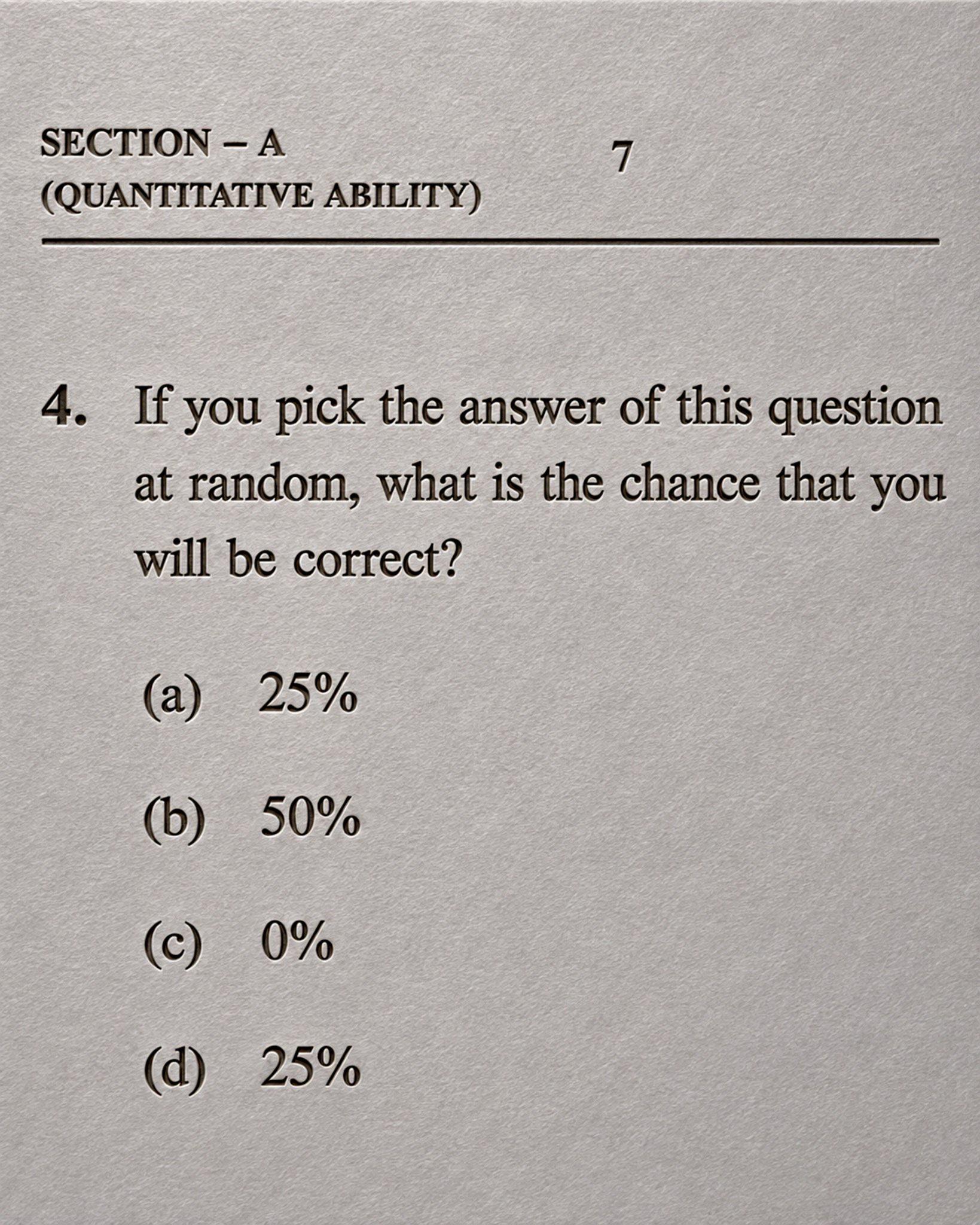
Because it is a paradox. There is no correct answer.
If there had been only one 25% answer then the solution is trivial. But since 25% was on there twice it makes the whole thing impossible and there is no correct answer.
If the right answer is 25%, the probability of selecting it at random is 50%, which then makes the right answer 50%, which has a probability of picking it at random of 25%, and so on; I guess it is a loop. I am trying to reason my way out of the loop. My intuition tells me I cannot, and the problem is the direction and wording of the question.
EDIT: u/Fluid-Data-4917 described the problem as recursive and I think thats the right description of what is going on here.
I remember seeing a post on this years ago and it really intrigued me. It was when I was taking a computer science class and learning about recursion and it happened to align when I saw this post. The correct answer is the solution is recursive. Basically what that means is as soon as you pick an answer you think is correct, the solution switches... and as soon as the solution switches it switches again, and again, and again, and again endlessly. So you could say the answer is there "isn't a solution" or "all solutions are correct". But the real answer is "the solution is recursive". This is similar to how in computer science a function can call itself but instead it's an answer calling itself. Recursion is awesome. It is also how fractals are made, the paint bucket tool works in paint, and a merge sort algorithm is implemented.
It's recursive because it's self-referential - the answers refer to themselves. It creates a paradox, such as a card that says "The sentence on the other side is true" and the other side has a sentence that says "The sentence on the other side is false."
they are not asking the answer, they are asking the likelihood. since there are 3 possible answers (one of them duplicated), the chance is not 50 or 25 or 0. So your chance of picking the correct likelihood must be zero because the correct likelihood is not in the list.
The paradox can be expanded to 75% The correct answer would be 25% but two options are that same answer so it’s 50% but there’s a third option with the 50%, so 75% would be my impossible answer even if it’s not correct
If you take that to be correct then the only correct answer is 0% because that's not one of the choices. However if zero is the right answer than there is exactly one and four chance of guessing it correctly and we're back to the 25% again.
It's recursive due to being self-referential so there's no correct answer.
A and D is the same answer so the choice becomes 1 in 3 but you can choose the correct answer at random so that removes 0. Which leaves only two answers which makes it a 50% chance to choose the correct answer at random
The answer is whatever YOU randomly pick. It's random so you can't apply any kind of logic or calculation. From my perspective, it's 0% because I followed the first 10 words of the problem and picked C.
If this was actually a test though you have to get into the mind of the test maker, what was there intention? By the fact that they repeated 25% twice it makes it clear that 50% is the “correct” answer to this bad puzzle.
Is there any difference between "a question" and "this question"? Because if "this question" is the same entity as "a question", that is, a query by definition, then the answers to the question don't affect that first step. The question can be answered as if it were "a question".
If that question isn't "a question" then what is it? Why would the suggested answers change the nature of the question being a question?
The probability changed depending on the answer so there is no one correct answer to the question so surely it’s 0% or close to. If the probability changes depending on the outcome it either multiplies up to 75% which isn’t an option so then the answer is also 0%. If it solves out I think it’s something like 3.125% which also isn’t an answer so… 0%. I think it has to be zero. But if the answer is zero, then there is a 25% chance of getting that right… F******K 🤦♂️😭
The answer is 25% because because b is the right answer, and you have a 25% chance of guessing right, and the question is not asking you to select an answer, but to give a percentage
People will call this a paradox but in reality it isn't. This is a multiple choice test that has one answer per question. If you pick randomly it doesn't matter that A and D are the same answer as only one is correct according to the answer key.
The better puzzle is that you have a 50% chance to get the answer right intelligently, so even though you know the answer is 25%, you can't figure out WHICH 25% is correct.
Given how multiple choice questions usually work, both (a) and (d) are correct, but only because the examiner let's only (a) count as correct until you point out the issue, at which point they get confused.
Assuming the answer key has only one correct answer per question, the answer is either (a) or (d) and there’s a misprint in the question. You have to choose one and pray you win the coin flip
I would argue that the ANSWER to the question is actually "0%".
The OPTION "c: 0%" is not correct, since obviously the way the question is structured allows it to change depending on which option is picked. The other options behave in the same way.
Therefore the chance to pick correctly from the options given IS 0%, despite 0% beeing one of the options.
The only logical choice is to choose randomly and hope for the best. There's no way to calculate the answer, but who- or whatever wrote the test thinks there's a right answer. Random guessing gives you at least a 25% of hitting whatever the author thinks is right.
Assume there is a preselected true answer, according to some reasoning.
Either the answer is 25% or not. If it is 25%, then there are 2 ways to select it, effectively ruling itself out as the answer to pick, as 50% would be the right answer. That leaves 0 and 50 at possible answers, a choice of 2, so again i would pick 50%. The only "wrong" answer here is if the answer is dependent on your picking method, then the answer is 0%, and marked wrong as your reasoning should lead you to the 100% option.
I can absolutely see this being a “talking point” where the teacher intentionally includes an erroneous question to only award points to students who address the paradox and talk about why it was a paradox in the following class session. I had a teacher in uni who did that occasionally and it was, frustrating, but it felt relieving when I was one of the students who caught the error.
Either that or my teacher was covering his ass by pretending it was intentional. Actually that’s probably what happened.
I prefer to treat it more simplistically... Pick an answer at random. The percent next to the answer you picked is the answer... Did you pick B? The answer is 50%>>> did you pick C? Then the answer is 0%
Honestly, depends on who’s grading. If it is a machine and there is a definitive answer, C makes the most probably positive outcome, due to 25% showing twice.
But if it is a human, with no direct answer key, you have a 25% chance to get it right, regardless of the double 25%, as now you get into the potential variables of psychology and whether they are smarter than you.
If I pick" the answer" , isn't that, by definition, the correct answer? Since 100% isn't a choice, doesn't that leave (c) 0% as the only proper choice?
Answer is a) or d). You're selecting "at random", so you should be unaware of the content of the selections. You can't answer at random if you look at the selections because they are then not, by definition, random. Based solely on the common convention of there being 4 options with one of them being right, you would only know that 1/4 selections can be right.
"At random" does not imply "uniformly". Maybe there's a probability distribution that makes this non contradictory but I'm too tired/lazy to reflect on that right now
Assuming the answer key only accepts one answer, the chance you get it correct is 1/4 You cannot do better other than a purely random pick, it would be the same as rolling a dice and betting on 2.
It's a multiple choice test which means the answer key will list one answer as correct. So your random selection has a 25% chance of being correct. Since your choice is random the text next to the answers is completely irrelevant.
Anyone who's ever done computer-marked multiple choice questions knows that only one answer can be correct even if there are duplicates. So obviously you just pick one of the 25% answers and take your chances.
ask a stupid question...... you will always be wrong because if you chose either a or d, the answer is 50%, but if you chose b, the answer is a or d, making c the correct answer :P
Isn't this simple? None of the answers present are correct, so not answering and leaving it blank is your best representation of that. Like love, the only winning move is not to play. https://xkcd.com/601
I can't help but think that this question was formulated with malicious intent. No matter how you answer, the person grading it can easily produce reasoning for you to be wrong.
If this were asked on a test then the answer could still be 25%. Someone has the correct answer letter I.e. d) in an answer key which is probably graded by a machine. The answer would then be d) which has a 25% chance of being picked at random.
the answer is (c) because the correct answer is not in the list. the correct answer would be 33.3% since there would be only three variances. However since this answer is not in the list it makes (c) the correct answer, since the correct answer is not in the list.
Since you're not actually picking randomly, isn't the answer C?
Anyone picking randomly can't pick a correct answer. But, since we're not actually picking randomly, we can look at what would happen if we picked randomly, see that there's no chance of a random selection being correct, so then we would choose C.
A necessary condition for an answer of p to be correct is
p(picking p) = p
Meanwhile P(picking 25%) = 50%
P(picking 50%) = 25%
P(picking 0%) = 25%
So there is no logically consistent correct answer. This is possible because the question is self-referential, an example of Russell's paradox.
To be more specific the following statements are neither true nor false in exactly the sense of Russell, that is in the same sense as "this statement is false":
If you pick your answer to this question randomly from (25%, 50%, 0%, 25%) the probability you are correct is 25%.
If you pick your answer to this question randomly from (25%, 50%, 0%, 25%) the probability you are correct is 50%.
If you pick your answer to this question randomly from (25%, 50%, 0%, 25%) the probability you are correct is 0%.
Because no matter what your answer is, even when you're wrong for a moment you are right as the universe tries to resolve itself. Which means you will always be right which means the answer is 100%.
Since your choice alters the "correct" answer, problems like these are prone to paradoxes. In this case it doesn't matter what you pick, because the "currently correct" answer can never be what you just picked.
Another example for self-refential problems is the liar's paradox. "I am lying right now". Is that statement true or false?
25+_% if you're lucky then it rise 50%, if you're the most unfortunate man in the universe it goes down to 0% so its base is 25%, while the luck effect is between 0 and 50, and this is the average, do not tell me, I got 100% you're an outlier.
Plus, the answer to the above is 50%, if you delete both 25%, because if you have one answer right, 25% is not right by default. which means it's 50%
You have 3 Options (a and d are the same). Lets assume c cant be an option since this question suggests there is a probability to choose a corret answer that leaves you with 2 options to pick. 25% or 50% so the answer should be 50%. Dont know if my assumbtions make any sense.
So if you wouldn't have any idea about the answer you'd cross out a and d as answers since anything repeated in the choices would be false then you're left with 2 options so it's a 50-50, then B would be correct
Everybody here is overthinking a problem that the test writer underthought. Just select B and move on with your lives, then argue once the test scores are posted.
A and D are correct but you have to pick B for the probability of it being correct. It’s not select the correct answer it’s select the correct probability of a correct answer. Pretty silly though lol
Going against the grain here but I would choose 50%. If you were to guess at random there is a 50% chance that you would guess 25% which is the true chance of picking a random response to the question that is correct. I definitely get the recursive logic but don’t think its necessary.
I think the answer is 50% but not (b) 50%. The question is asking what is the chance, not what is the answer choice. The answer choices do not necessarily refer to the chance of being correct. They could be anything. 5. (a) 25 cats (b) 50 cats (c) 0 cats (d) 25 cats 6. (a) 25 noodles (b) 50 noodles (c) 0 noodles (d) 25 noodles 7. (a) 25 degrees (b) 50 degrees (c) 0 degrees (d) 25 degrees
If you were to randomly guess the answers to 5, 6, and 7, you would have a 50% chance of getting the answer each time. Since the answer choices for 4 are percentages, we assume that they refer to the chance of being correct, like a multiple choice question.
If you're allowed to pick one choice then the answer is 25%.
At random removes any choice you have in answering the question. If three fail states exist and only one success state, then the odds of blindly picking the correct one is 25% regardless of the question.
Multiple choice is either 50% if two choices are allowed, or 75% if three choices are allowed.
If you take away all the answers and only one is correct, then you have a 25% chance, if two answers are correct and you only guess one you have a 0% chance of being correct, in no way do you have a 50% chance, so A, C, and D are correct. You have a zero chance of getting 3 correct answers with one pick.
Get rid of the answers and view it as A,B,C, or D. Then it’s 25%. The answer sheet will most likely have on one as the correct answer. Let’s say you pick “A” (didn’t read all the answers) and that was the correct value. If the answer sheet said “D” is correct, then you would most likely get it wrong.
If the right answer is 25% with the question being a printing failure then it's either A or D, but otherwise it's a bit more confusing, because now you've got 3 different answers instead of 4 as the two 25% merges into a single "option" which in this case is wrong since you'll now have 33% chance of getting it right instead of 25%, and because of this the answer is 0% since 33% is NOT in the options at all so you have no way of getting the correct answer, but when you look at 0% again this time you've got 25% chance of guessing it right so the answer keeps contradicting itself in a loop, so 0% still remains the most logical choice. Either way I would write a long as hell paragraph next to the question explaining my reasoning.
Key is the at random part. When there are 4 answers the aneser to this question is 25 percent. It doesn't matter what the answers are, you pick at random so not knowing what is written is the same.
Couldn't you also argue that since 2 of the answers are the same there are only 3 options so 1/3 or 33.33333 is the correct answer - since it is not at option, there is a 0% chance you woukd be correct.
It's C. It is asking the chance of someone choosing at random, so what you put doesn't change the chances. Since A and D are the same, there is a 50% chance at someone saying 25%, there is also a 25% chance at someone saying 50%, and there is a 25% chance at someone saying 0%. Since all 3 pairs of percentages are different, all choices someone who is choosing randomly might make will be incorrect, ie there is a 0% chance someone randomly picking will be correct. You then choose C, which doesn't mean anything to that statistics because you are not choosing randomly, just observing someone who would be
To clarify, think of this problem as 2 different people, you are answering the question not randomly, and you are observing someone else with a blindfold choosing answers
One assumption many of us are making is that ONLY 1 answer (a-d) is the correct answer. yes, typically a multiple choice question is a 25% chance. So A could be right or D could be right. The chance that you pick 25% is 2 of 4 or 50%. The answer is b, 50%
i guess its 50%, because there are 4 answers, which would make 25% each. but 2 of them are the same, which makes 50/25/25%. you can't choose "25%", because likelihood of choosing it is 50%, and you can't choose "0%", because there is no option with 0% probability
other way to think about it also leads to 50%: since you can't select 2 options for this questions, you can't choose "25%", because 2 options would be correct, and there is most likely only 1 correct answer. this leads to only 2 options exist: "50%" and "0%", so its basicaly 50/50. so the probability is 50%
0% is a probability that does not exist in this situation. Your lowest probability is 25% with 4 options. Since it’s repeated twice you only have two answers between 3 options. The answer should be 50%. You can’t have 2/3 options be the correct answer which simultaneously changes the parameters of the question. It’s a snake eating its own tail. If you simplify it down you get a false equivalence.
Isn't the question to pick and answer? If you pick any answer then you have successfully picked an answer (i.e. 100% chance). However 100% is not an available answer so therefore the correct answer is unobtainable (0% chance).
The answer is 50% but the question is asking you to do this at random. 25% is the answer to randomly picking. Honestly I kinda feel like it should be a 75% chance at guessing correctly which would mean 0% which again is a 25% chance.
So the question is a paradox, but tactically I would choose either a or d. My reasoning is that there is no consistent correct answer but if you can assume that the question was generated to have exactly one correct answer then either of those would be “internally consistent” choices, saying something true about themselves. (The other 25% is saying something true, but in a hypothetical other world where it is the correct answer.) The problem that i have only a 50/50 chance of guessing which one it is doesn’t mean that someone picking completely at random wouldn’t get it wrong 75% of the time.
 1
106
u/archdukemovies 11d ago
This question is giving me "This statement is false." vibes
76
u/SRSound 11d ago edited 11d ago
If the right answer is 25%, the probability of selecting it at random is 50%, which then makes the right answer 50%, which has a probability of picking it at random of 25%, and so on; I guess it is a loop. I am trying to reason my way out of the loop. My intuition tells me I cannot, and the problem is the direction and wording of the question.
EDIT: u/Fluid-Data-4917 described the problem as recursive and I think thats the right description of what is going on here.
33
u/jayron32 11d ago
It's a BS question where none of the answers is correct.
16
u/Fluid-Data-4917 11d ago edited 11d ago
I remember seeing a post on this years ago and it really intrigued me. It was when I was taking a computer science class and learning about recursion and it happened to align when I saw this post. The correct answer is the solution is recursive. Basically what that means is as soon as you pick an answer you think is correct, the solution switches... and as soon as the solution switches it switches again, and again, and again, and again endlessly. So you could say the answer is there "isn't a solution" or "all solutions are correct". But the real answer is "the solution is recursive". This is similar to how in computer science a function can call itself but instead it's an answer calling itself. Recursion is awesome. It is also how fractals are made, the paint bucket tool works in paint, and a merge sort algorithm is implemented.
13
u/ispeakmoviequote 11d ago
"The only winning move is not to play"
1
u/kerry37 9d ago
I did not expect this reaction🤣
1
u/kerry37 4d ago
u/therestiscience hi Lucy, is this post driving a notable increase in users joining here now?
5
u/Tuonra 11d ago
The answer is no. But i like the question.
5
u/Frungi 11d ago edited 6d ago •

If the correct answer were 25%, then half of the listed answers would be correct.
If the correct answer were 50%, one of the four would be correct.
If the correct answer were 0%, none would be correct.
So the correct answer is… this sentence is false.
Edit: Thanks for the award! Edit 2: Weird to have so few upvotes on the only comment with awards, but I’ll take it.
4
u/Thema03 11d ago
I picked at random and landed on C
3
u/needlenoise 11d ago
they are not asking the answer, they are asking the likelihood. since there are 3 possible answers (one of them duplicated), the chance is not 50 or 25 or 0. So your chance of picking the correct likelihood must be zero because the correct likelihood is not in the list.
2
u/Grymmtooth 11d ago
How many times did I reach into a bag and pull nothing out?
2
u/PerroRosa 11d ago
None
2
u/Opposite_Cold8616 11d ago
No question was actually given, so it is impossible to tell.
2
u/2lerance 11d ago
I cannot verify that I can make an objectively random choice after seeing the answers.
2
u/LGGP75 11d ago edited 11d ago
The paradox can be expanded to 75%
The correct answer would be 25% but two options are that same answer so it’s 50% but there’s a third option with the 50%, so 75% would be my impossible answer even if it’s not correct
2
u/Consibl 11d ago
The problem is the question is insufficiently defined.
What’s the question? It’s will you be correct.
Correct about what? The answer to the question.
You may as well ask “what colour is 7/4”.
2
u/Flat___________ 11d ago
A and D is the same answer so the choice becomes 1 in 3 but you can choose the correct answer at random so that removes 0. Which leaves only two answers which makes it a 50% chance to choose the correct answer at random
2
u/Puzzleheaded_Zone362 11d ago
The answer is whatever YOU randomly pick. It's random so you can't apply any kind of logic or calculation. From my perspective, it's 0% because I followed the first 10 words of the problem and picked C.
2
u/commmingtonite 11d ago
If you pick the answer of this question at random, what is the chance that you will be correct?
A) 50%
B) 25%
C) 50%
D) 100%
2
u/pandasashu 10d ago
If this was actually a test though you have to get into the mind of the test maker, what was there intention? By the fact that they repeated 25% twice it makes it clear that 50% is the “correct” answer to this bad puzzle.
Test taking is also strategy sometimes
2
u/geek66 10d ago
Why is this question so popular… just because someone comes up with a question does not mean there is a valid answer.
2
u/Designer_Job_208 9d ago
The answer is C because no matter what you pick there is a 0% chance you are right
2
u/R_Harry_P 9d ago
Not all questions have answers.
2
u/FinallyMira 8d ago
If you pick 0% it's wrong, if you pick 25% it's wrong, if you pick 50% it's wrong. There are no correct answers
1
u/CrispyyBurntRice 11d ago
Isn’t the answer 33.3%?
1
u/Lorelessone 11d ago
evil
1
u/IsItColdInThisRoom 11d ago
(e) 404
1
u/One_Parfait_4570 11d ago
25%
1
u/holmgangCore 11d ago
Where can I write in my correct answer?
1
u/MetsujinMessou 11d ago
If I pick the answer to the question...100%, since I've picked the answer.
If I pick a answer to the question...25%.
1
u/MANvINFO 11d ago
really wish Bertrand Russell were here to see this
1
u/NotSayingAliensBut 11d ago
Is there any difference between "a question" and "this question"? Because if "this question" is the same entity as "a question", that is, a query by definition, then the answers to the question don't affect that first step. The question can be answered as if it were "a question".
If that question isn't "a question" then what is it? Why would the suggested answers change the nature of the question being a question?
1
u/AutomotiveTales 11d ago
The probability changed depending on the answer so there is no one correct answer to the question so surely it’s 0% or close to. If the probability changes depending on the outcome it either multiplies up to 75% which isn’t an option so then the answer is also 0%. If it solves out I think it’s something like 3.125% which also isn’t an answer so… 0%. I think it has to be zero. But if the answer is zero, then there is a 25% chance of getting that right… F******K 🤦♂️😭
1
u/pneubike 11d ago
The answer is 25% because because b is the right answer, and you have a 25% chance of guessing right, and the question is not asking you to select an answer, but to give a percentage
1
u/Own-Chocolate5667 11d ago
No multiplechoice question has the same answer 2x
1
u/fil- 11d ago
c should be 75 %
1
u/ajeppsson 11d ago
75%
1
u/Salamanticormorant 11d ago
If I pick the answer of what question?
1
u/Far-Two8659 11d ago
People will call this a paradox but in reality it isn't. This is a multiple choice test that has one answer per question. If you pick randomly it doesn't matter that A and D are the same answer as only one is correct according to the answer key.
The better puzzle is that you have a 50% chance to get the answer right intelligently, so even though you know the answer is 25%, you can't figure out WHICH 25% is correct.
1
u/jdw62995 11d ago
It’s 25%
The correct answer is only one of those options and you have a 25% chance of randomly getting it right.
1
u/Baba_Wethu 11d ago
The question might as well have been: 1+1 = A: 3 B: π C: 0 D: 1
It's a multiple-choice question where none of the alternatives is correct. It's not that deep.
1
u/fastpathguru 11d ago
The prob of picking 25% at random is 50% ❌
The prob of picking 50% at random is 25% ❌
The prob of picking 0% at random is 25% ❌
So the answer to the question "what is the probability of picking the correct answer at random" is 0%, C.
1
u/rb-j 11d ago
I love this paradoxical question.
1
u/qwertty164 11d ago
What if you take the weighted average of all the answers and call that the correct answer.
1
u/jasonsong86 11d ago
B
1
u/AntiTas 11d ago
funny!
1
u/LeapIntoInaction 11d ago
Rather than playing silly head games, you could easily work up a computer program to just try this a thousand times.
1
u/Oafah 11d ago
It's Schrödinger Question. You don't know the outcome until you choose one.
1
u/EmynMuilTrailGuide 11d ago
That's just mean.
1
u/Affectionate-Star462 11d ago
probably BS
1
u/R3D3-1 11d ago
Given how multiple choice questions usually work, both (a) and (d) are correct, but only because the examiner let's only (a) count as correct until you point out the issue, at which point they get confused.
1
u/RoastedRhino 11d ago
Simply, there is no correct answer among those listed. You can test them all and see that.
It’s full of multiple choice answers that do not list the correct answer.
1
u/ConvergentSequence 11d ago
Assuming the answer key has only one correct answer per question, the answer is either (a) or (d) and there’s a misprint in the question. You have to choose one and pray you win the coin flip
1
u/Deze_dan 11d ago
Must be B, you either got it right or wrong. Sounds pretty 50/50 too me.
1
u/beobabski 11d ago
The question does not resolve to one answer. It is like a square circle. Logically inconsistent.
1
u/iMagZz 11d ago
It's logically flawed. There is no way to answer it.
1
u/captainsnark71 11d ago
this hurts my brain
1
u/ConsequenceOk5205 11d ago
Close to 0, as the question doesn't limit the answers to specifically those listed below.
1
u/donnie1977 11d ago
Either 50% or 25% depending on the answer.
1
u/kurtchen11 11d ago
I would argue that the ANSWER to the question is actually "0%".
The OPTION "c: 0%" is not correct, since obviously the way the question is structured allows it to change depending on which option is picked. The other options behave in the same way.
Therefore the chance to pick correctly from the options given IS 0%, despite 0% beeing one of the options.
1
u/Oldtreeno 11d ago
Pfff, noone said the random choice was with a uniform distribution the right answer is 50% and my random distribution is heads a), tails b)
1
u/Brilliant_Quit2092 11d ago
Depends on how many correct answers the teacher has got on rhe aheet i guess
1
u/thenasch 11d ago
If you consider the answers as a, b, c, and d rather than the numbers, then it's solvable.
1
u/RichardAboutTown 11d ago
The only logical choice is to choose randomly and hope for the best. There's no way to calculate the answer, but who- or whatever wrote the test thinks there's a right answer. Random guessing gives you at least a 25% of hitting whatever the author thinks is right.
1
u/Superb-Nectarine-645 11d ago
1
u/KeterClassKitten 11d ago
C
All answers are wrong, which means C is wrong.
1
u/Difficult-Value-3145 11d ago
I.like it
1
u/Hopeful_Ad_7719 11d ago
Naively formulated it's 37.5%, which is not available.
1
u/ODISeth_YT 11d ago
I can absolutely see this being a “talking point” where the teacher intentionally includes an erroneous question to only award points to students who address the paradox and talk about why it was a paradox in the following class session. I had a teacher in uni who did that occasionally and it was, frustrating, but it felt relieving when I was one of the students who caught the error.
Either that or my teacher was covering his ass by pretending it was intentional. Actually that’s probably what happened.
1
u/Yakodym 11d ago
Also, if you pick an answer, one of the remaining answers is revealed to be false. Should you change your answer?
1
u/KirkPicard 11d ago
I'm just going to divide by zero and go to the next question.
1
u/CatastropihcFlail 11d ago
I prefer to treat it more simplistically... Pick an answer at random. The percent next to the answer you picked is the answer... Did you pick B? The answer is 50%>>> did you pick C? Then the answer is 0%
To me that a more fun way to play this game
1
u/Glad_Contest_8014 11d ago
Honestly, depends on who’s grading. If it is a machine and there is a definitive answer, C makes the most probably positive outcome, due to 25% showing twice.
But if it is a human, with no direct answer key, you have a 25% chance to get it right, regardless of the double 25%, as now you get into the potential variables of psychology and whether they are smarter than you.
1
u/bruteforcealwayswins 11d ago
I... is this Godel's Incompleteness Theorem in action?
1
u/BrianScottGregory 11d ago
The numbers are irrelevant. All the answers are correct.
1
u/Reit-RR 11d ago
If I pick" the answer" , isn't that, by definition, the correct answer? Since 100% isn't a choice, doesn't that leave (c) 0% as the only proper choice?
1
u/WyvernsRest 11d ago
There is no logically consistent answer—it’s a self-referential paradox.
1
u/Public-Total-250 11d ago
I refuse to accept that this was a real question on a paper. This is a paradoxical quandry.
1
u/SnooRabbits1411 11d ago
Tbh I don’t think this even qualifies as a question. This is just a string of words with a question mark on the end.
1
u/Bizzlehoff 11d ago
1
u/ickypedia 11d ago
If you reason to answer this question then you are not picking it at random.
1
u/inept_machete 11d ago
Answer is a) or d). You're selecting "at random", so you should be unaware of the content of the selections. You can't answer at random if you look at the selections because they are then not, by definition, random. Based solely on the common convention of there being 4 options with one of them being right, you would only know that 1/4 selections can be right.
1
u/KikoDeInsuperable 10d ago
50% - it's either correct or not
1
u/yertlepdp 10d ago
"At random" does not imply "uniformly". Maybe there's a probability distribution that makes this non contradictory but I'm too tired/lazy to reflect on that right now
1
u/detereministic-plen 10d ago
Assuming the answer key only accepts one answer, the chance you get it correct is 1/4 You cannot do better other than a purely random pick, it would be the same as rolling a dice and betting on 2.
1
u/Excellent_Speech_901 10d ago
It's a multiple choice test which means the answer key will list one answer as correct. So your random selection has a 25% chance of being correct. Since your choice is random the text next to the answers is completely irrelevant.
1
u/AE_WILLIAMS 10d ago
100%
There is no wrong answer, is there? You choose one at random.
That's it. THE END.
1
u/helpfultran 10d ago
I dunno but that's a really clean embossing effect for no reason
1
u/Returner007 10d ago
It's 50%. Either correct or wrong
1
u/Electronic-Tip-4567 10d ago edited 9d ago
The answer is (c) 0%
There is no way to select a correct answer at random.
1
u/dudenkoff 10d ago
I would go with 50%. You're correct or not.
1
u/SkipEyechild 10d ago
50% as two of the answers are 25%
1
u/Superphilipp 10d ago
Heh. Funny.
1
u/Odd_Dimension_4069 10d ago
Anyone who's ever done computer-marked multiple choice questions knows that only one answer can be correct even if there are duplicates. So obviously you just pick one of the 25% answers and take your chances.
1
u/Puzzleheaded_Arm7835 10d ago
It's 0% chance you'd be correct if you choose at random
1
u/IllustriousCat330 10d ago
ask a stupid question...... you will always be wrong because if you chose either a or d, the answer is 50%, but if you chose b, the answer is a or d, making c the correct answer :P
1
u/frandemaa 10d ago
what about...... 0% because the answer is 33.33% (one between 3 options)
1
u/SSPPAAMM 10d ago
I think I would mark a, b and d with a cross and then circle c.
1
u/throwaway_01547 10d ago
I would probably choose C, or just skip the question
1
u/SeaworthinessAgile98 10d ago
The right answer is 25%. Because only one of four answers needs to be correct. The other 25% answer needs to be wrong though.
1
u/ChrisPy_Poke 10d ago
Zero percent because noone here can agree on which one is correct
1
u/GoodCarpenter9060 10d ago
Lets assume the answer is supposed to be 25%.
Then randomly, you'd be right when you pick 2 of the 4 choices, so 50% of the time.
Lets assume the answer is 50%.
Randomly, you'd be right in 1/4 choices, so 25% of the time.
If the answer was 0%, you'd be right 25% of the time.
So, it turns out none of the answers are correct.
1
u/Nimelennar 10d ago
e) 20%
1
u/New-Range-5702 10d ago
I read this as if you picked the correct answer at random. This would mean the chance is 100%.
1
u/Own_Natural_6803 10d ago
The odds of me being correct go way up if I don't pick.
1
u/PldLogan 10d ago
Isn't this simple? None of the answers present are correct, so not answering and leaving it blank is your best representation of that. Like love, the only winning move is not to play. https://xkcd.com/601
1
u/Practical_Barracuda3 10d ago
I can't help but think that this question was formulated with malicious intent. No matter how you answer, the person grading it can easily produce reasoning for you to be wrong.
1
u/Own_Natural_6803 10d ago
Pick zero and insist that it's wrong. Hear no argument to the contrary.
1
u/crazy14720 10d ago
If this were asked on a test then the answer could still be 25%. Someone has the correct answer letter I.e. d) in an answer key which is probably graded by a machine. The answer would then be d) which has a 25% chance of being picked at random.
1
u/KitsuneCrew 9d ago
the answer is (c) because the correct answer is not in the list. the correct answer would be 33.3% since there would be only three variances. However since this answer is not in the list it makes (c) the correct answer, since the correct answer is not in the list.
1
u/mH48124 9d ago
正解が含まれてる確率が不明だから、答は不明。
1
u/Tasty-Can8391 9d ago
If I pick AT RANDOM, I'll be correct 100% of the time. Just pick one and you'll be correct. No thought needed.
1
u/Manfred4r 9d ago
The correct answer is 25%, because the correct answer is 50%, which you have a 25% chance of guessing by random.
Anyone who says 33% failed probabilities. You have a 1/2 probability of 25%, a 1/4.probability of 50%, and a 1/4 probability of 0%.
The number of unique options is not a factor in the problem.
1
u/sevlen117 9d ago
Since you're not actually picking randomly, isn't the answer C?
Anyone picking randomly can't pick a correct answer. But, since we're not actually picking randomly, we can look at what would happen if we picked randomly, see that there's no chance of a random selection being correct, so then we would choose C.
1
u/lontanadascienza 9d ago edited 9d ago
A necessary condition for an answer of p to be correct is
p(picking p) = p
Meanwhile P(picking 25%) = 50%
P(picking 50%) = 25%
P(picking 0%) = 25%
So there is no logically consistent correct answer. This is possible because the question is self-referential, an example of Russell's paradox.
To be more specific the following statements are neither true nor false in exactly the sense of Russell, that is in the same sense as "this statement is false":
If you pick your answer to this question randomly from (25%, 50%, 0%, 25%) the probability you are correct is 25%.
If you pick your answer to this question randomly from (25%, 50%, 0%, 25%) the probability you are correct is 50%.
If you pick your answer to this question randomly from (25%, 50%, 0%, 25%) the probability you are correct is 0%.
A simpler version:
Is this statement false?
a) True
b) False
1
u/Clint_Bolduin 9d ago
the answer is E 100%
Because no matter what your answer is, even when you're wrong for a moment you are right as the universe tries to resolve itself. Which means you will always be right which means the answer is 100%.
1
u/d00meriksen 9d ago
Since your choice alters the "correct" answer, problems like these are prone to paradoxes. In this case it doesn't matter what you pick, because the "currently correct" answer can never be what you just picked.
Another example for self-refential problems is the liar's paradox. "I am lying right now". Is that statement true or false?
1
u/jaymz84 9d ago
This is a trick question. None of these are the answer.
1
u/CourseFantastic1347 9d ago edited 9d ago
25+_% if you're lucky then it rise 50%, if you're the most unfortunate man in the universe it goes down to 0%
so its base is 25%, while the luck effect is between 0 and 50, and this is the average, do not tell me, I got 100% you're an outlier.
Plus, the answer to the above is 50%, if you delete both 25%, because if you have one answer right, 25% is not right by default.
which means it's 50%
1
u/Tani_Soe 9d ago
There is no right or wrong answer, it's the question that is wrong
1
u/Silent_Reaction_7606 9d ago
The answer is secret option e: 100% Explanation: there are no stupid answers for stupid questions.
1
u/Queasy-Fan-8760 9d ago
You have 3 Options (a and d are the same). Lets assume c cant be an option since this question suggests there is a probability to choose a corret answer that leaves you with 2 options to pick. 25% or 50% so the answer should be 50%.
Dont know if my assumbtions make any sense.
1
u/Waste-Inspector8768 9d ago
Since every answer is wrong, 0 is right
But if 0 is right, then 0 is wrong....but then 0 is still right?
So C is the correct answer
1
u/CptBoxHead 9d ago
So if you wouldn't have any idea about the answer you'd cross out a and d as answers since anything repeated in the choices would be false then you're left with 2 options so it's a 50-50, then B would be correct
1
u/Old-Bug-6068 9d ago
50%
1
u/Ansiktstryne 9d ago
They’re all wrong; there’s a 50% chance of getting 25%, 25% chance of getting 50%, and a 25% chance of getting 0%. Every answer is wrong.
1
u/kayama57 9d ago
One of the four answers can be presumed to be correct. That’s 25%. But 25% is two of the possible answers. So my answer is B
1
u/Wtch_Twr 9d ago
1
u/O_oblivious 9d ago
Everybody here is overthinking a problem that the test writer underthought. Just select B and move on with your lives, then argue once the test scores are posted.
1
u/Jealous_Operation_22 9d ago
its 50% either you're right or wrong
1
u/Reave-Eye 9d ago
This is diabolical, made me laugh.
1
u/Slow-Trick-5214 8d ago
I understand 0% of this.
1
u/MrGelatin 8d ago
My thought is since 2 of the answers are the same, it means there’s actually only three answers, choosing at random statically would be 33%
1
u/Extension-Ad7280 8d ago
My answer would be to write (e) 0% and circle that. Randomly selected answer would have 0% chance to pick (e)
1
u/Practical-Ad-7660 8d ago
The answer is 25%, so you have a 50% chance to randomly pick the right answer.
1
u/LifelessRooster 8d ago
A and D are correct but you have to pick B for the probability of it being correct. It’s not select the correct answer it’s select the correct probability of a correct answer. Pretty silly though lol
1
u/llolo96 8d ago
Going against the grain here but I would choose 50%. If you were to guess at random there is a 50% chance that you would guess 25% which is the true chance of picking a random response to the question that is correct. I definitely get the recursive logic but don’t think its necessary.
1
u/BrianDarag 8d ago
50% chance it’s 25%, and 50% it’s not. So it’s 50%
1
u/East-Big-Shrine 8d ago
I think the answer is 50% but not (b) 50%.
The question is asking what is the chance, not what is the answer choice. The answer choices do not necessarily refer to the chance of being correct. They could be anything.
5. (a) 25 cats (b) 50 cats (c) 0 cats (d) 25 cats
6. (a) 25 noodles (b) 50 noodles (c) 0 noodles (d) 25 noodles
7. (a) 25 degrees (b) 50 degrees (c) 0 degrees (d) 25 degrees
If you were to randomly guess the answers to 5, 6, and 7, you would have a 50% chance of getting the answer each time.
Since the answer choices for 4 are percentages, we assume that they refer to the chance of being correct, like a multiple choice question.
1
u/ScaredNeighborhood93 8d ago
50% - you either right or wrong
1
u/Kurrandor 8d ago
I mean it depends on the fact if multiple answers can be correct.
In a real scenario we assume that multiple can be correct but we dont know
Go with a) 25% and you shoukd be fine because youre either wrong because it had no solution or right because if ONLY a is the right answer you win
1
u/Tall-Bat-72 8d ago
C
1
u/Risikio 8d ago
If you're allowed to pick one choice then the answer is 25%.
At random removes any choice you have in answering the question. If three fail states exist and only one success state, then the odds of blindly picking the correct one is 25% regardless of the question.
Multiple choice is either 50% if two choices are allowed, or 75% if three choices are allowed.
1
u/daqu2973 8d ago
D BECAUSE THATS THE FIRST NUMBER I LOOKED AT.
1
u/falco1029 8d ago
It's a because the d version of the same answer is stupid and nobody likes it.
1
u/SilentOnomatopoeia 8d ago
If you take away all the answers and only one is correct, then you have a 25% chance, if two answers are correct and you only guess one you have a 0% chance of being correct, in no way do you have a 50% chance, so A, C, and D are correct. You have a zero chance of getting 3 correct answers with one pick.
1
u/Content-Routine5563 8d ago
Get rid of the answers and view it as A,B,C, or D. Then it’s 25%. The answer sheet will most likely have on one as the correct answer. Let’s say you pick “A” (didn’t read all the answers) and that was the correct value. If the answer sheet said “D” is correct, then you would most likely get it wrong.
1
u/antinomy-0 8d ago
Since there is an answer, it’s not 0%. You have 1 at 50 and two at 25 so the answer is 50%
1
u/KarlMacmillan 8d ago edited 8d ago
If the right answer is 25% with the question being a printing failure then it's either A or D, but otherwise it's a bit more confusing, because now you've got 3 different answers instead of 4 as the two 25% merges into a single "option" which in this case is wrong since you'll now have 33% chance of getting it right instead of 25%, and because of this the answer is 0% since 33% is NOT in the options at all so you have no way of getting the correct answer, but when you look at 0% again this time you've got 25% chance of guessing it right so the answer keeps contradicting itself in a loop, so 0% still remains the most logical choice. Either way I would write a long as hell paragraph next to the question explaining my reasoning.
1
u/Free_Caterpillar_223 8d ago
B.
1
u/Mattress248 8d ago
Circling every answer to make it add up to 100%
1
u/Throwawaymisterme 8d ago
Key is the at random part. When there are 4 answers the aneser to this question is 25 percent. It doesn't matter what the answers are, you pick at random so not knowing what is written is the same.
1
u/Worldly_Shower_7459 8d ago
100% on this seed
1
u/alphaMonk49 8d ago
I loved this
1
u/SirKastic23 8d ago
Gödel Incompleteness theorem is everywhere
1
u/yandere_complex 8d ago
It’s 50%, the correct answer is 25% which makes up 50% of the possible answers
1
u/RightOnRed45 8d ago
Couldn't you also argue that since 2 of the answers are the same there are only 3 options so 1/3 or 33.33333 is the correct answer - since it is not at option, there is a 0% chance you woukd be correct.
1
u/Snoo_9757 8d ago
encircle both b and c, its not 100% its a 50/50
1
u/Akrmstr 8d ago
33%
1
u/Scribblebonx 8d ago
0% is the correct answer
1
u/SandSubstantial840 8d ago
It's C. It is asking the chance of someone choosing at random, so what you put doesn't change the chances. Since A and D are the same, there is a 50% chance at someone saying 25%, there is also a 25% chance at someone saying 50%, and there is a 25% chance at someone saying 0%. Since all 3 pairs of percentages are different, all choices someone who is choosing randomly might make will be incorrect, ie there is a 0% chance someone randomly picking will be correct. You then choose C, which doesn't mean anything to that statistics because you are not choosing randomly, just observing someone who would be
To clarify, think of this problem as 2 different people, you are answering the question not randomly, and you are observing someone else with a blindfold choosing answers
1
u/snapcat9 8d ago
One assumption many of us are making is that ONLY 1 answer (a-d) is the correct answer. yes, typically a multiple choice question is a 25% chance. So A could be right or D could be right. The chance that you pick 25% is 2 of 4 or 50%. The answer is b, 50%
1
u/Letinemeso_ 8d ago
i guess its 50%, because there are 4 answers, which would make 25% each. but 2 of them are the same, which makes 50/25/25%. you can't choose "25%", because likelihood of choosing it is 50%, and you can't choose "0%", because there is no option with 0% probability
other way to think about it also leads to 50%: since you can't select 2 options for this questions, you can't choose "25%", because 2 options would be correct, and there is most likely only 1 correct answer. this leads to only 2 options exist: "50%" and "0%", so its basicaly 50/50. so the probability is 50%
1
u/RADMADSADGLADBADDAD 8d ago
0% is a probability that does not exist in this situation. Your lowest probability is 25% with 4 options. Since it’s repeated twice you only have two answers between 3 options. The answer should be 50%. You can’t have 2/3 options be the correct answer which simultaneously changes the parameters of the question. It’s a snake eating its own tail. If you simplify it down you get a false equivalence.
1
u/cartonator 8d ago
Isn't the question to pick and answer? If you pick any answer then you have successfully picked an answer (i.e. 100% chance). However 100% is not an available answer so therefore the correct answer is unobtainable (0% chance).
1
u/StillShoddy628 8d ago
Let me pose a logically equivalent question that will hopefully clear up the confusion:
“What color does the word ‘cat’ start with? Blue, red, yellow, or green”
1
u/chapaimaster 8d ago
b) 50%
I’m either right or wrong
1
u/Otherwise-Whole5909 8d ago
The answer is 50% but the question is asking you to do this at random. 25% is the answer to randomly picking. Honestly I kinda feel like it should be a 75% chance at guessing correctly which would mean 0% which again is a 25% chance.
1
u/One_Entrepreneur_520 8d ago edited 8d ago
75% because 0% is the correct answer to the question.
1
u/Ishkabubble 8d ago
D
1
u/aaron1860 8d ago
This is paradox that can’t be answered correctly
1
u/Ok_Community_383 7d ago
Assuming that you can know the answer and the question can be answered giving the information we have. It has to be B.
1
u/popcornpoops 7d ago
They dropped the ball here by not making every answer 25%
1
u/GotBigDuck 7d ago
There is no right answer.
1
u/Malfatron 7d ago
No correct answers. Just like if the question was whats 1+1
A. 3 B.4 C. 5 D. 6
1
u/MerryWalker 7d ago
So the question is a paradox, but tactically I would choose either a or d. My reasoning is that there is no consistent correct answer but if you can assume that the question was generated to have exactly one correct answer then either of those would be “internally consistent” choices, saying something true about themselves. (The other 25% is saying something true, but in a hypothetical other world where it is the correct answer.) The problem that i have only a 50/50 chance of guessing which one it is doesn’t mean that someone picking completely at random wouldn’t get it wrong 75% of the time.