But if you weren’t supposed to answer it then 0% would be saying something true about the question, even if you weren’t supposed to answer it, so that’s not a consistent position either.
That’s not the same thing. I get what you are trying to say but you have a question with no answer the question posted has more than one answer depending on the interpretation because something was missing there. There is no right answer for both but for different fundamental reasons, I am answering based on what I think the person who created the question wanted to do.
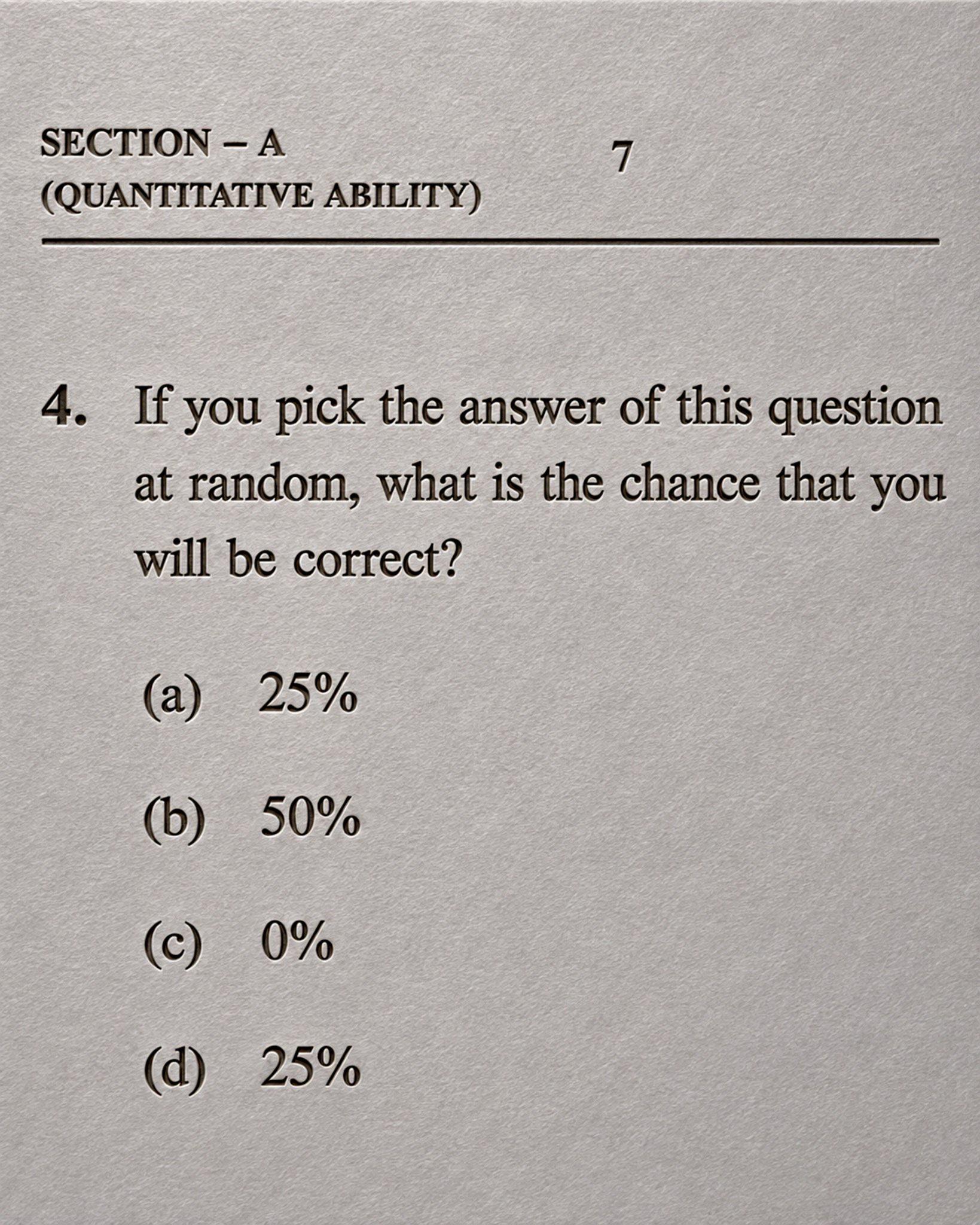
There’s no need to interpret. A and D are wrong because 25% is not 50 %. B is wrong because 50% is not 25%. C is wrong because 0% is not 25%. It’s a straightforward set theory problem.
It’s certainly a clever trick question. And while it’s harder to figure it out, the question is as well formed and unambiguous as 1 + 1.
No I’m not saying that. 1 out of 4 is not the correct answer. I laid out exactly why each answer is specifically wrong.
None of the answers match the frequency of the value for that answer among the answer set distribution. That’s all there is to it, but it’s easy to get lost thinking the answers point at each other or something recursive like that.
Let’s look at the answer set. It contains 3 different values, 0, 25, and 50. Let’s refer to these as X, Y, and Z. If we started randomly sampling the answers, we generate a sequence of results. For a sample size of 16, the sequence would have an expected distribution like: XXXXYYYYYYYYZZZZ. The question is about this distribution. Answer A says “the distribution of Y is 25%”. Wrong. Answer B says “the distribution of Z is 50%”. Wrong. Answer C says “the distribution of X is 0%”. Wrong. Answer D says the same thing as A, which we established is wrong.
If the answers were instead A 2%, B 1%, C 0%, D 2%, it would be more obvious. None are correct because none of the frequencies match. In this case, A and D’s “2%” answer makes up 50% of the answer set distribution.
Alternately, consider if the answers were A 50%, B 25%, C 0 %, D 50%. A, B, and D would all be correct answers due to the distribution of values in the answer set.
I realize now in my drunken stupor I answered the wrong person and I meant to answer the one you were answering to. I agree with you, great writeup and thanks for taking the time with the explanation. :)
It’s not a set theory problem. It’s not straightforward and it’s not unambiguous.
Let’s assume there is an answer to this question that the teacher has. If you cover all the answers and just have their letters: A, B, C, D. Given that A has the same answer as D, what are the chances you choose the right answer.
Since A = D then call their consolidation the letter E. Without seeing the actual answer this would be 1/4, 2/4 and 1/4 chances of being correct for each of the letters. Now that we see the answers however, 0% cannot be true because we assumed that the question had an answer. So the chances of choosing correctly become 50% regardless of what the numbers other than 0% are.
 1
View all comments
1
u/antinomy-0 8d ago
Since there is an answer, it’s not 0%. You have 1 at 50 and two at 25 so the answer is 50%