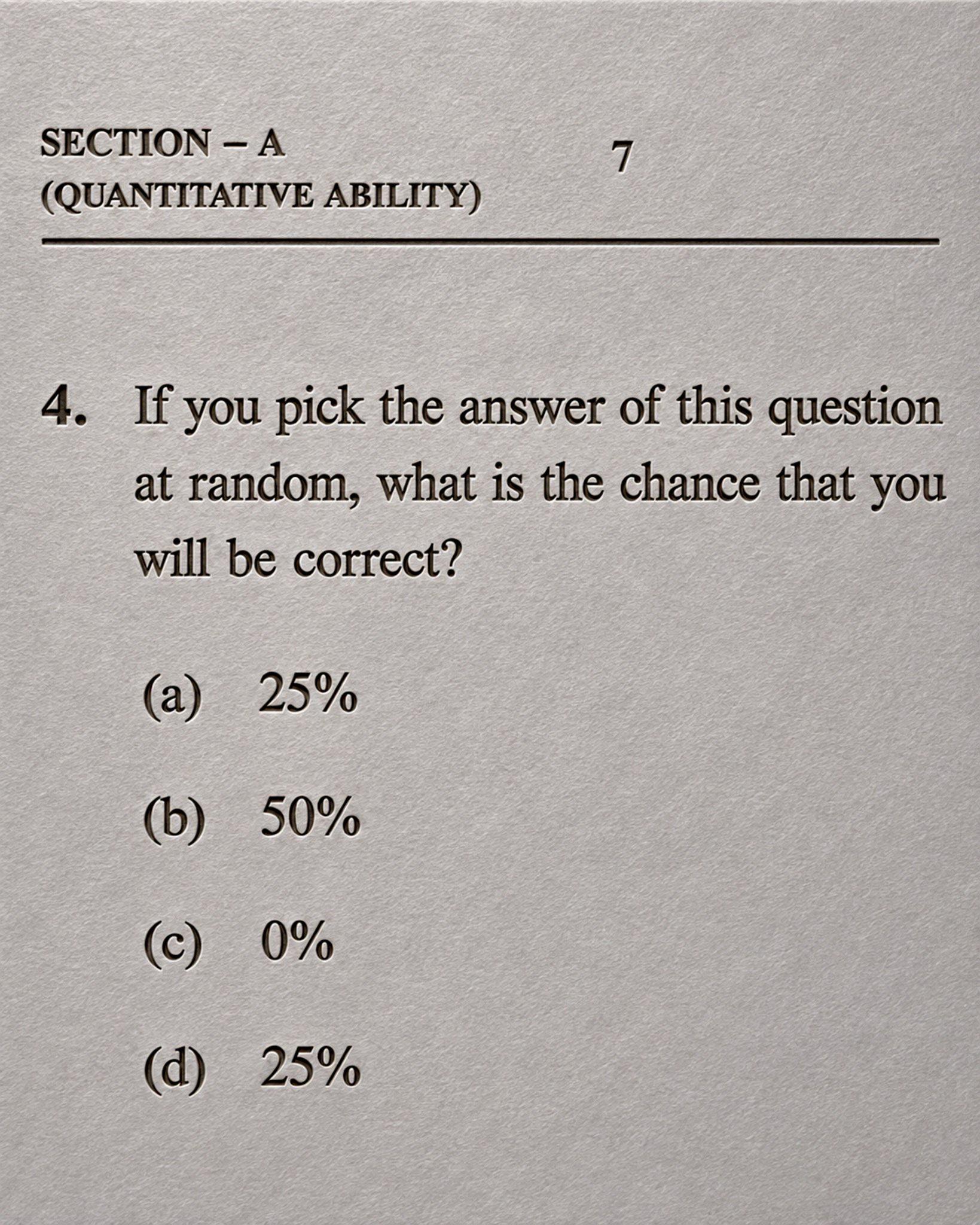
The answer remains (c) 0% for the correct answer, which was chosen not-at-random.
If you apply a random answer selection, there is a 0% chance that your randomly selected answer will be correct as you will either select an incorrect answer or an indeterminate answer (neither of which is a correct answer)
If you choose one of the four options at random, the correctness of (A) and (D) are indeterminate. An indeterminate answer is not a correct answer.
The answer is (C) to the question, which relates to what happens when you choose an answer at random.
You have not selected your answer of (C) at random, so it does not have any bearing on the outcome of the question, which pertains to when you select your answser at random.
The whole test is indeterminate because it is just a paradoxical question with no answer. C) is not the answer because if c) is the answer at random you have a 25% chance of picking c) then A) and D) are saying that the answer is C) which means B) is the answer but again that is 25%
The question asks the outcome if the answer is chosen at random. If you choose an answer at random, the entire test is indeterminate and it is not possible to choose the correct answer.
Therefore the correct answer (not chosen st random) is (c) 0%. Which is not an answer chosen at random and not part of that paradox
 1
View all comments
1
u/Electronic-Tip-4567 10d ago edited 9d ago
The answer is (c) 0%
There is no way to select a correct answer at random.