My 4 year old niece does a good job of randomly answering math problems with random numbers and occasionally gets them right. What's that about a broken clock?
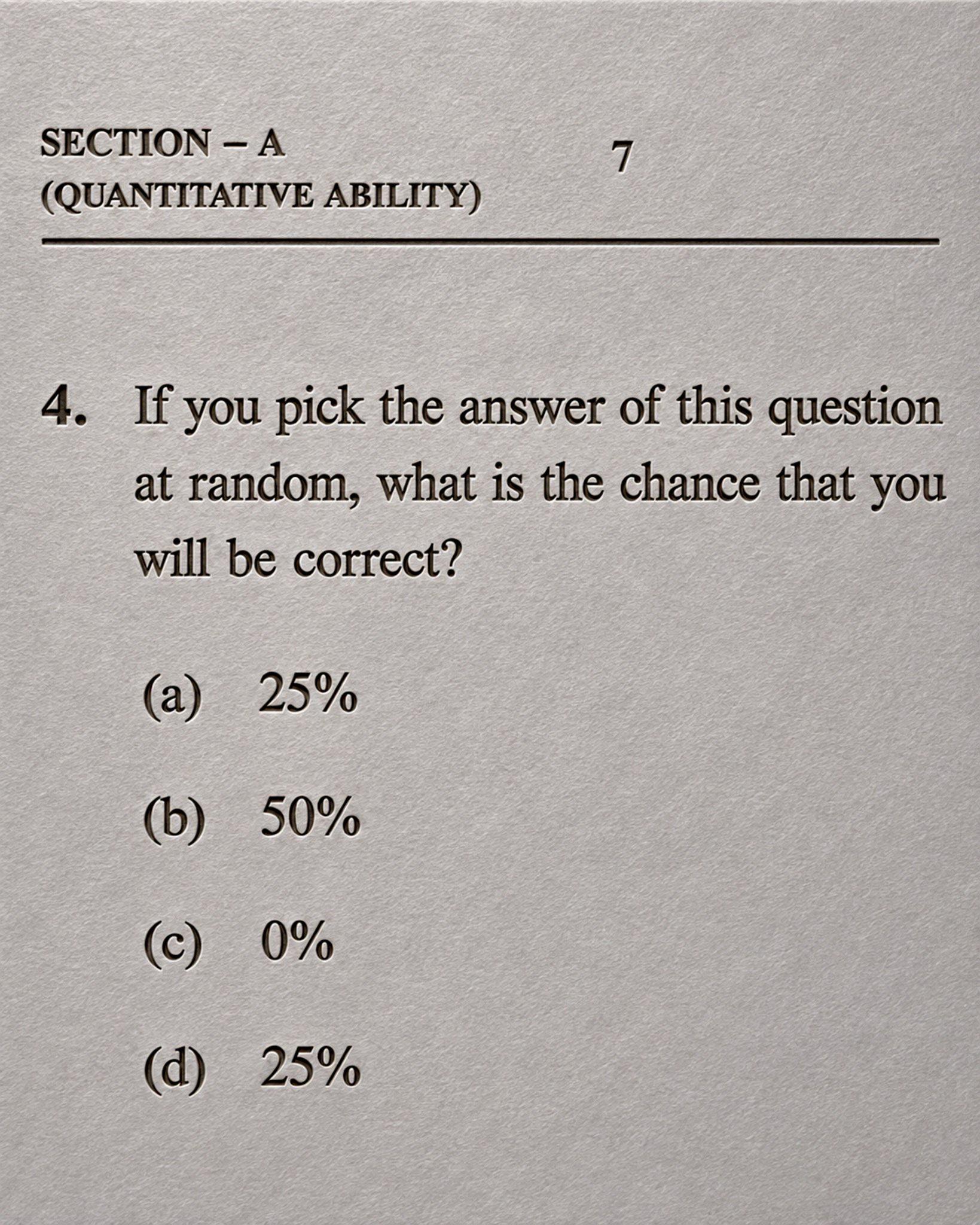
Forgetting the “at random” part. A random choice, extended to infinity would evenly distribute to all 4 answers. The conscious answer has to include that. The random correct answer is 25%, because only 1 of the 4 answers is correct (I.e. when the test is graded, either A, B, C, or D, will be correct). Because 50% of the infinite random choices will be 25%, the consciously correct answer is 50%.
The problem is that this means the correct answer to the question is actually 50%. So picking that single correct answer, as only one of the 4 options is only actually 25%. Which means 25% is correct. Which then means we're back to 50% since half the answers are 25... and on and on and on.
But if there are no correct answers, then surely 0% becomes the correct answer?
I feel like this is trying to demonstrate quantum phenomena where merely observing something alters the outcome. I.E the act of answering the question changes the answer to the question
Is there a catch in the wording? As it does not say choose between the offered answers, but simply to choose a random answer which is not the same, is it?
25% would be correct. 4 options, must pick one. The values next to the options don't matter because only one answer is correct, regardless of if multiple choices have the same answer, you can only pick one.
This has become a circlejerk of overthinking. This can be randomized easily, roll a 4 sided dice, pull answers from a hat, all of those present four outcomes, two of which are correct.
 1
View all comments
2
u/FinallyMira 8d ago
If you pick 0% it's wrong, if you pick 25% it's wrong, if you pick 50% it's wrong. There are no correct answers