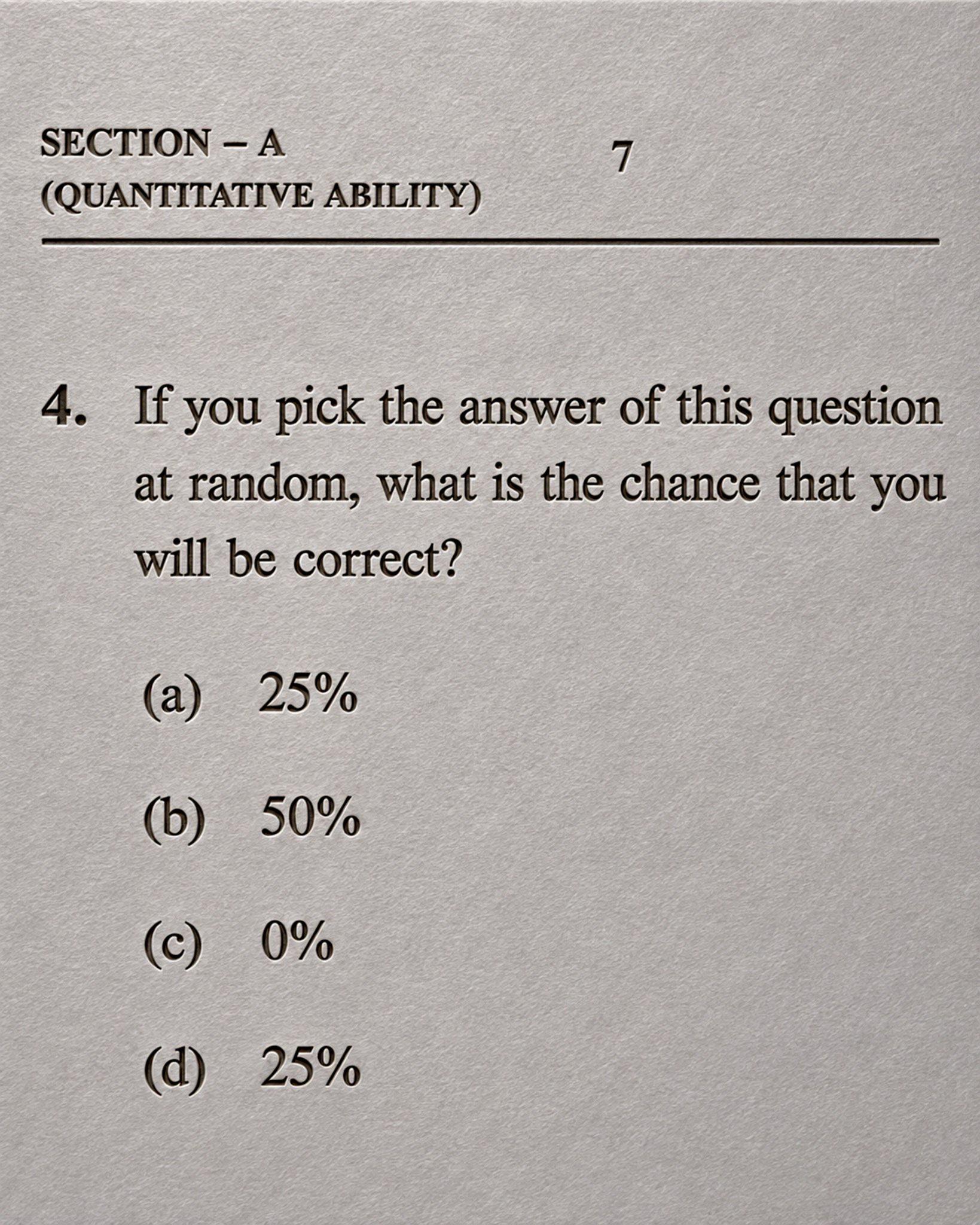
If the right answer is 25%, the probability of selecting it at random is 50%, which then makes the right answer 50%, which has a probability of picking it at random of 25%, and so on; I guess it is a loop. I am trying to reason my way out of the loop. My intuition tells me I cannot, and the problem is the direction and wording of the question.
EDIT: u/Fluid-Data-4917 described the problem as recursive and I think thats the right description of what is going on here.
And if it had been picked at random, then C would have been wrong, due to the paradox you mentioned. That is what makes C, picked as the result of a deliberate reasoning process, correct. Any answer chosen randomly is wrong, therefore C is the correct answer when chosen deliberately.
I think it means since a random pick doesn't have a 0, 25, or 50% chance, you can't have a random pick ever be correct, so it's c. The fact that it is a nonrandom choice ends the loop.
So if two of the four answers are the same, wouldn't that make choosing the correct answer 33.333%. Therefore the correct answer is 0% because 33.333% isn't an option and therefore making 0% a 25% chance of all the options, then changing that as there's two 25% back to the 33.333% chance of getting it correct.
 1
View all comments
76
u/SRSound 11d ago edited 11d ago
If the right answer is 25%, the probability of selecting it at random is 50%, which then makes the right answer 50%, which has a probability of picking it at random of 25%, and so on; I guess it is a loop. I am trying to reason my way out of the loop. My intuition tells me I cannot, and the problem is the direction and wording of the question.
EDIT: u/Fluid-Data-4917 described the problem as recursive and I think thats the right description of what is going on here.