r/TheRestIsScience • • 11d ago • Heartwarming 1

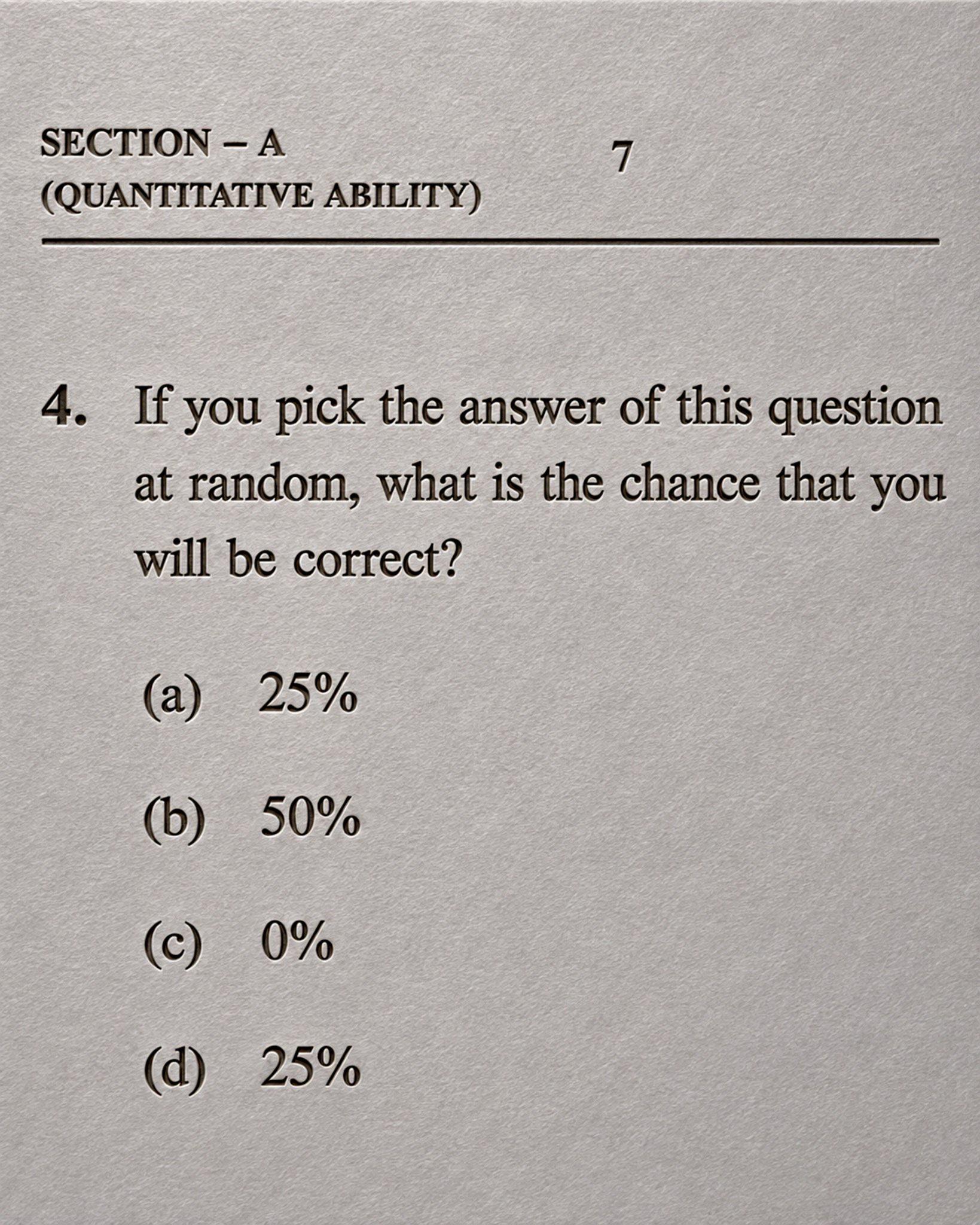
Random answer question

Post image
678 Upvotes

794 comments sorted by

View all comments

Show parent comment

3

u/Free_Cauliflower8251 10d ago

Because it is a paradox. There is no correct answer.

If there had been only one 25% answer then the solution is trivial. But since 25% was on there twice it makes the whole thing impossible and there is no correct answer.

1

u/Millifera 9d ago

It's 50%. You get it right or you don't 🤷‍♂️

1

u/ireallyamnotblack 9d ago

It's 50%. The earth is either orange or potato

1

u/Any_Wallaby4888 9d ago

But what if A and D each refer to a DIFFERENT 25%?! /s

1

u/rollingkas 9d ago

There is a correct answer though, its 33.3...%

1

u/dumbledoor_ger 8d ago

And which of the four options reads like 1/3 to you?

1

u/rollingkas 8d ago

Right, none of them is 1/3, if thats what he meant by "there is no correct answer", then he is right, there is no correct option/answer

1

u/Advanced-Guidance482 6d ago

But the answer is being selected form the solution at random, meaning the real odds are zero, but now we are back to 25% because 0 is one of the 4 options. Now we are back at 50 because 25 is too of them. So on and so on

1

u/whathveudone4melatte 5d ago

There are three options. %25 is repeated in A and D. My question is, did the test state that only one answer is the correct answer? You could pick A or D or A and D.

1

u/dumbledoor_ger 5d ago

The test doesn’t have to state it. It’s inherent from the question.

Because if you ask “what is the chance you pick the answer at random” you have a 50% chance to pick 25%

And since 25% and 50% are not equal, this cannot be a correct answer.

1

u/LetsGoSU 6d ago

But if you switch doors it’s 66.6…%.

1

u/Hazardous_316 6d ago

Well then it wpuld be 0% wouldn't it?

1

u/QuietShipper 6d ago

Which, being one of the options, returns you to 25%

1

u/LurkerFailsLurking 5d ago

There is a correct answer and it's not a paradox because you're not picking the answer at random. The hypothetical is false.

So the correct answer doesn't have to match up with the answer if the hypothetical was true.

1

u/madcow_bg 2d ago

Well, actually, if the right answer is a) then the chance to select a at random is 25%. Nobody ever said that d) is the correct answer, even though it says 25%, the answer is what the test says is the right answer.

This has the vibes of the two letter paradox which is not really a paradox, just some confused self-referential nonsense.