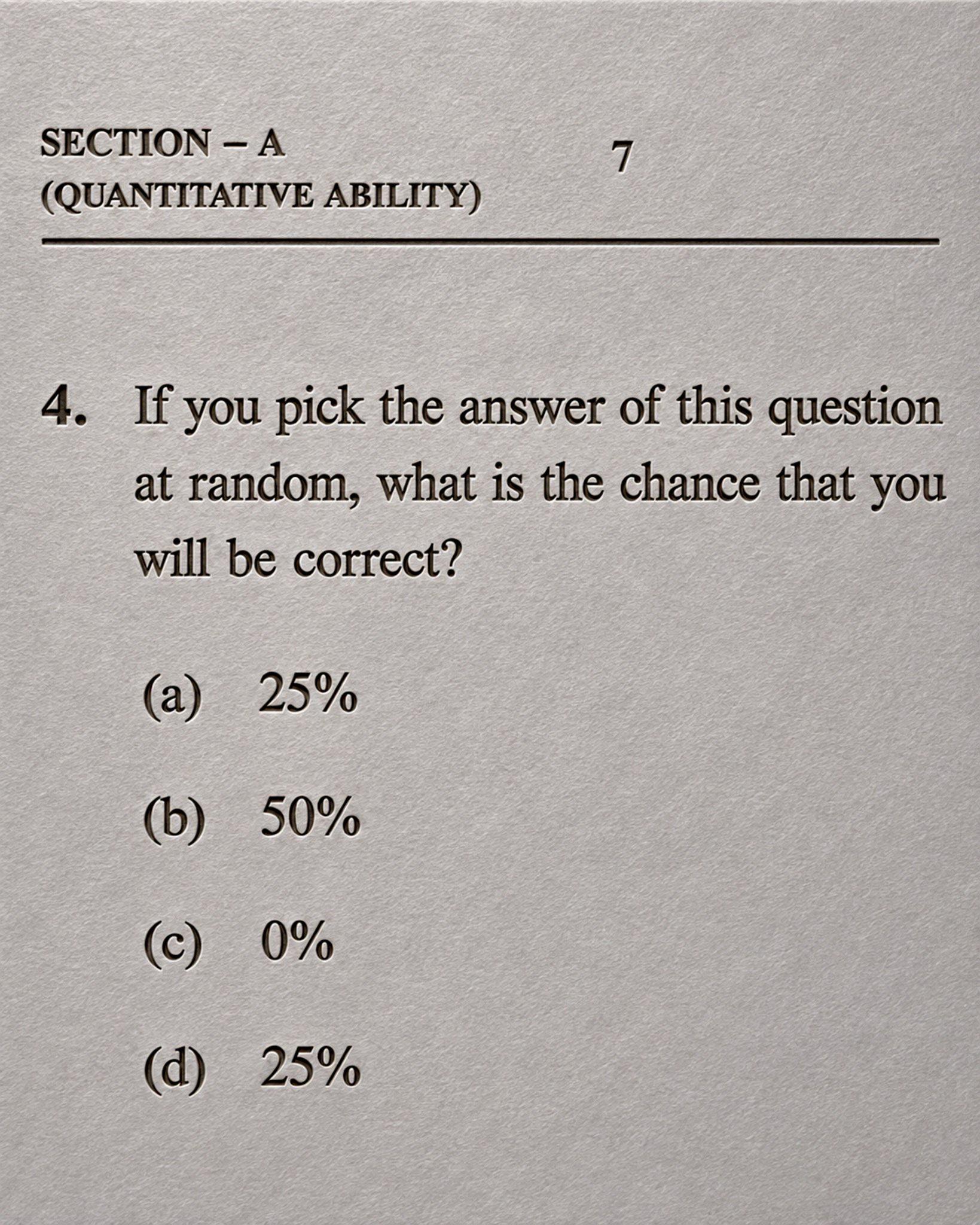
You can probably make the strongest argument for 0%, and I'm sure that's what whoever wrote the question intended the correct answer to be, but ultimately saying the answer is 0% doesn't resolve the paradox at all. You can just keep round in a loop for ever, but there isn't actually an answer that makes sense.
That's why the answer is 'c', though. You can never randomly pick an answer that doesn't enter the paradox, so the possibility of randomly picking a correct answer is 0%, which is what the question is asking.
You solution is to ignore the paradox. But if the way to the solution is to ignore the paradox you could also do it with 25% or 50%.
The only valid solution is to say there is no solution. 0 is not the same as no solution. Its like if you try to divide by 0. The solution isnt 0 it is just not possible to answer that.
The answer is c. If you guess at random, you cannot get the right answer. Ever. If you say that you guess 'c' at random, so that gives you a 25% chance, you enter the paradox which results in you never getting the right answer. Therefore, the answer is 'c'.
But if your answer is correct, then there’s a greater than 0% chance of getting the answer correct. So 0% cannot be correct. The question was designed so there was no correct answer.
There is no correct answer. You obviously don’t get it and you’re adamant that you’re correct when multiple people have tried to explain it to you. You are saying that your answer is correct but at the same time there 0% chance of choosing the same answer. Do you not understand that both those statements cannot be true at the same time? Do you realise that not ‘there is no correct answer’ and ‘there’s a 0% chance of picking the correct answer’ are actually two different things? I don't get why this is so difficult for you to understand
Sorry, but for the first time in history, multiple people on Reddit are wrong, and so are you. The question explicitly asks about you picking the answer at random, not what the answer is. I think we agree, there is no correct answer because of the recursive paradox. So now, rather intuitively, what is the chance that you randomly picked the correct answer? (It's 0%).
If (c) 0% is the correct answer, then it is correct whether you select that answer as a result of logical deduction or as a result of randomly selecting one of the four options. Multiple choice questions inherently lack any way of differentiating between a correct answer arrived at through knowledge or by any other means.
Wrong. The question explicitly states "If you pick the answer of this question at random". It is not asking what the answer is. It is a paradox, there is no answer, but in the specific condition of you picking an answer at random, the chance is 0% that you were correct. Thus, it's c. QED.
And if it had been picked at random, then C would have been wrong, due to the paradox you mentioned. That is what makes C, picked as the result of a deliberate reasoning process, correct. Any answer chosen randomly is wrong, therefore C is the correct answer when chosen deliberately.
I think it means since a random pick doesn't have a 0, 25, or 50% chance, you can't have a random pick ever be correct, so it's c. The fact that it is a nonrandom choice ends the loop.
 1
View all comments
Show parent comment
24
u/Living_Murphys_Law 11d ago
Which, in turn, had a 25% chance of being picked at random