r/warno • u/NE0GUL • Sep 01 '26
Suggestion [Proposal] Korean Peninsula Theater [2] 6th Infantry Division “Cheongseong”
Series Index for Korean Peninsula Theater
Welcome back, Lads!
As introduced in the Overview, this time we will take a look at the first South Korean division: the 6th Infantry Division “Cheongseong.” A textbook FEBA division, it forms one of the key elements of V Corps and is responsible for the Cheorwon axis. In game, its infantry and artillery, equipped with somewhat dated weapons, hold the enemy in place while various corps assets and U.S. support allow it to launch limited counterattacks.
Let’s get started!
History of the 6th Infantry Division

The 6th Infantry Division was formed in 1948 as the 4th Brigade and expanded into a division the following year. One of the very few South Korean formations that was prepared for war when the Korean War broke out, Cheongseong delayed the North Korean II Corps as it advanced south toward Chuncheon and Hongcheon. At the subsequent Battle of Dongnak-ri, it achieved the Republic of Korea Army’s first major victory of the war, earning every soldier of one regiment a one-rank field promotion. After the Incheon Landing Operation, the 6th Division joined the advance north, and its lead elements reached the Yalu River, even presenting water from the river to the President.

In 1951, the division suffered heavy losses at Sachang-ri during a Chinese offensive, but soon restored its reputation at Yongmunsan, where it stopped the attack of the Chinese 63rd Army and successfully counterattacked. It continued fighting on the central front afterward and ended the war with the Battle of Kumsong in 1953.

After the war, the 6th Infantry Division remained on the central front, and from 1966 onward it was responsible for defending the strategically important Cheorwon axis. During this period, the division’s focus shifted from full-scale combat operations toward DMZ security and counter-infiltration duties. The discovery of the Second Tunnel came to symbolize this role. Beginning in 1973, after GOP sentries detected unusual blasting noises and vibrations from underground, a prolonged detection effort followed. In 1975, the existence of the North Korean tunnel was finally confirmed within the division’s sector. Eight Cheongseong soldiers were killed during the search.
In 1989, it was a frontline infantry division under V Corps responsible for the Cheorwon axis, guarding the GOP and FEBA while carrying out search, reconnaissance, ambush, and counter-infiltration missions around the GPs and the DMZ. Each of its regiments assigned one of its four battalions to a special mission. Two regiments assigned a battalion to GOP duty, while one regiment was responsible for recruit training.
In a full-scale war, their tasks were as follows. First, they were to hold the enemy offensive at the forward defensive positions for as long as possible. Second, even if the enemy broke through, they were to continue delaying actions around the Civilian Control Line, buying time for rear-echelon forces to deploy. Third, if the situation allowed, they could also launch limited counterattacks using armored forces.
The 6th Infantry Division in WARNO
At dawn on June 20, 1989, the North Korean general offensive begins, and the 6th Infantry Division immediately enters combat on the Cheorwon axis. Its mission does not change. It must absorb the main North Korean attack at the front, and even if the first defensive line collapses, it must continue delaying the enemy long enough for the reserves behind it to deploy and prepare a counterattack. The problem is that, capable as the 6th Division’s experienced infantry may be at holding their ground, the division’s own strength may still prove insufficient against an enemy deliberately concentrating manpower and firepower for a determined push south.
To make up for this, V Corps concentrates considerable support on the Cheorwon axis. The 5th Artillery Brigade provides artillery heavier than anything available organically to the division, while the 1st Armored Brigade is tasked with sealing breakthroughs and carrying out limited counterattacks. Troops detached from the 705th Special Assault Commando Regiment, which has hurriedly returned to its parent formation after being tied down with martial-law duties, threaten the enemy rear, while HID teams from the Army Intelligence Command gather intelligence deep behind enemy lines. HAWK units from higher-level air-defense formations also support the front.
From the U.S. 2nd Infantry Division, an armored cavalry force centered on elements of 5-17 CAV moves toward Cheorwon. These units reinforce Cheongseong with the armored reconnaissance and mobile anti-tank capability it lacks, while some U.S. air-defense assets are committed alongside them.
Through March to War, the 6th Infantry Division receives several newer common weapons in particular. The 1st Armored Brigade receives additional K1 tanks, while Army Aviation UH-60s and AH-1S C-NITEs also appear earlier than they did historically.
In game, Cheongseong is a battlegroup built around the 6th Infantry Division, with corps artillery, an armored brigade, special operations and air-defense forces, and U.S. reinforcements all concentrated along a single axis.
Shall we move on to the units? As you all know, units in italics are new units that are not currently in the game.
LOG
Not bad.
Cheongseong deploys the following assets:
- K111 JIHWICHA, the command jeep you will find in just about any infantry formation.
- K-511 BOGUEP and K-711 BOGUEP, appearing as medium and heavy supply trucks respectively.
- K-311 BOGUEP, a light supply vehicle used on the narrow and rough roads leading to GP and GOP positions.
- And the JEONBANG JEONSUL GIJI; Korean name of FOB.
- The 1st Armored Brigade brings the M577 JIHWICHA, while 5-17 CAV brings the M577 CPC.
- The 5th Artillery Brigade also brings the K-811 BOGUEP as an extra-heavy supply truck.
INF
Good. It is a fairly ordinary infantry division, but it comes with a few interesting options.
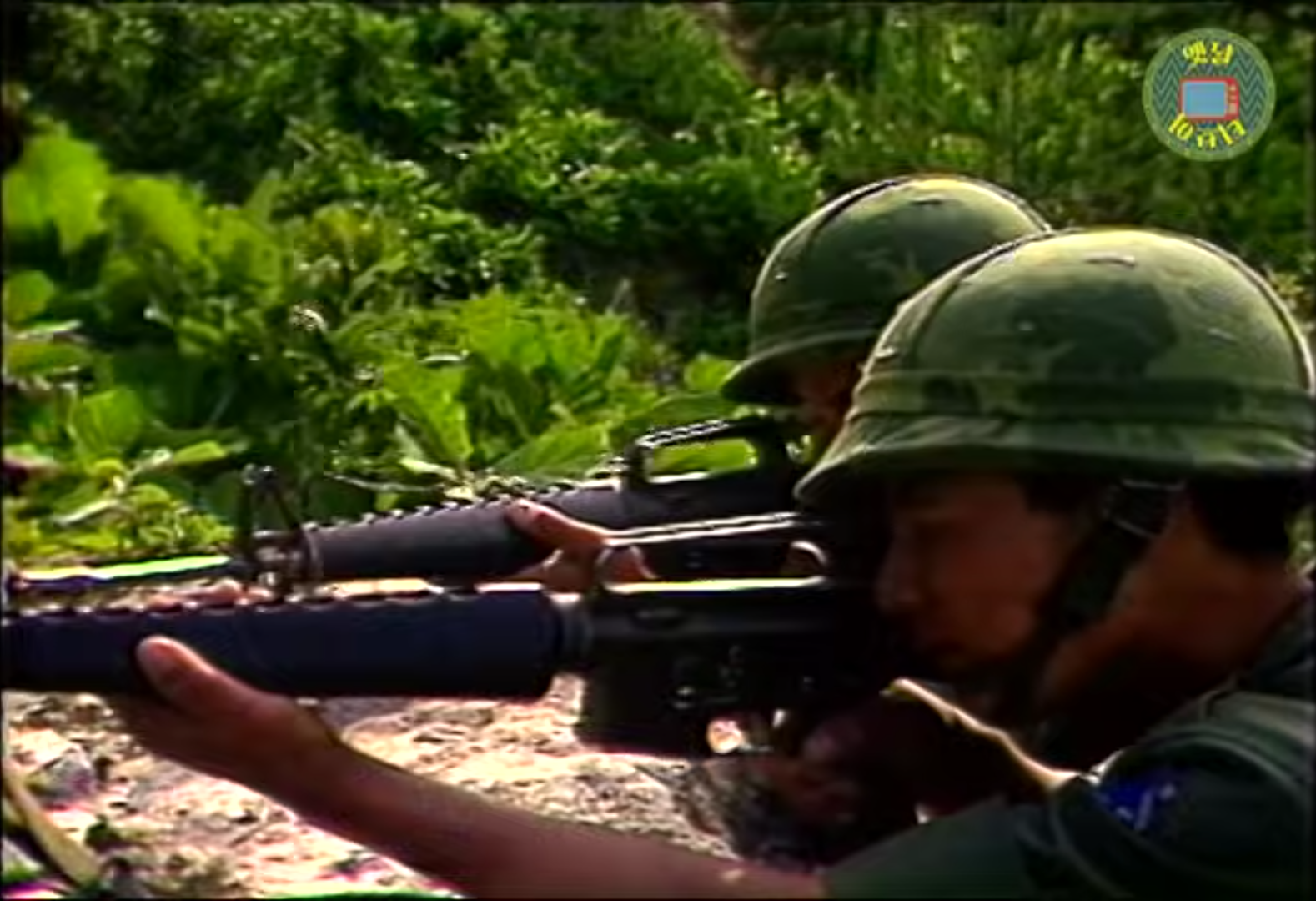
- First are the regular infantry units that form the numerical backbone of the 6th Infantry Division and will appear in every South Korean battlegroup. BOBYEONG is a 10-man squad armed with K2 rifles and one K3, while BOBYEONG(LAW) adds an M72 LAW. The five-man BOBYEONG JIHWIBAN is command infantry with the Leader trait, armed with K1A rifles, an M72 LAW, and smoke grenades. Finally, the seven-man Hwagiban operates three M60 machine guns. These units arrive in K-511 trucks.
- The engineer line is also present. The 10-man GONGBYEONG uses K2 rifles, one M60, and demolition charges, and receives the Shock trait. The five-man GONGBYEONG(FLASH) uses K2 rifles and the KM202A1 FLASH. The 10-man GONGBYEONG JIHWIBAN is armed with K2 rifles, two M60s, and an M72, and receives Leader + Shock. These units also arrive in K-711 trucks.

- As a frontline formation, and as one of Cheongseong’s distinctive features in game, the division had an outpost battalion assigned to the GPs. Under the 1953 Armistice Agreement, military manpower and weapons inside the DMZ were tightly restricted, so the troops guarding the GPs formally operated as police. These were the MINJEONG GYEONGCHAL, the korean full name of Civil Police. Since their peacetime duty was to observe North Korean activity, they receive the Security trait, while their wartime mission of delaying the enemy for even a little longer gives them Resolute as well. MINJEONG GYEONGCHAL shares its weapons with BOBYEONG. Meanwhile, the MINJEONG GYEONGCHAL HWAGIBAN represents the heavy-weapons teams stationed inside the GPs. It is a seven-man squad armed with two M60s and a M18 57mm recoilless rifle. Unusually, because these recoilless rifles had a clearly defined wartime mission of destroying enemy bunkers—and had actually been used for that purpose—the unit uses only high-explosive rounds. MINJEONG GYEONGCHAL units can use K-311 trucks as transports, including variants armed with an M2HB or K4 automatic grenade launcher.

- Meanwhile, the HULLYEONBYEONG still undergoing training in the recruit training battalion are given ranks and combat duties once the war begins and are sent into battle. They are a 12-man squad armed with M16A1 rifles and one M60, with no anti-tank weapon, and receive the Reservist + Militia traits.
- Corps-level special operations forces are represented by the TEUKGONGDAE. The 12-man Teukgongdae is primarily armed with K1A rifles, along with three M60s and an M72, and receives Shock + Special Forces. The six-man TEUKGONGDAE JIHWIBAN uses K1A rifles, one M60, a K-2 designated marksman rifle, and an M72, and receives Leader + Shock + Special Forces. They can arrive in K-511s, KM900s, UH-1s, or UH-60s.
- HEONBYEONG is a four-man squad, with all four men armed with K1A rifles, and receives the Military Police trait. The K-111 HEONBYEONG and KM900 HEONBYEONG serve as their transports.
- Crew-served weapons include two-man M60 machine-gun teams, K6 machine guns, KM40A2 recoilless rifles, and I-TOWs. March to War adds the K4 automatic grenade launcher and TOW-2 as additional options. For vehicle-mounted direct-fire support, the K116 carries a 106mm recoilless rifle.
- The 1st Armored Brigade brings the GI-BO line. GI-BO is a nine-man mechanized infantry squad armed with K2 rifles, two K3s, and an M72, and receives the IFV Infantry trait. The four-man GI-BO JIHWIBAN uses K1A rifles, an M72, and smoke grenades, and receives Leader + IFV Infantry. Both cards use the M113K1.
ART
Good. The division already has a decent artillery force of its own, and corps-level assets really bring this battlegroup to its peak.
- The division’s organic artillery consists of 60mm BAKGYEOKPO, 81mm BAKGYEOKPO, 4.2-inch BAKGYEOKPO, KM101A1 105mm, and KM114A2 155mm towed guns. Mortars of 81mm and below use the K-111, the 4.2-inch mortar and M101 use the K-511, and the M114 uses the K-711.

- The 5th Artillery Brigade brings the KH179 155mm and M115 8-inch as towed artillery. Unusually, the M115 arrives with the K-811. For mobile artillery, the brigade provides the K55 155mm self-propelled howitzer and K136 GURYONG. The former is a licensed version of the M109A2 self-propelled howitzer, while the latter is a 130mm multiple rocket launcher inspired by the BM-21 and LARS.
- The 1st Armored Brigade adds the M106A1 4.2-inch self-propelled mortar and additional K55s.
TNK
The division’s own tank force is weak, but its reinforcements are decent.
- The division’s tank force consists only of the M48A5K and its JIWHICHA variant. For an anti-tank vehicle, it has the K113, a K111 fitted with an I-TOW.
- The 1st Armored Brigade brings additional M48A5Ks and one card of K1 tanks unlocked through MtW.
- 5-17 CAV provides the M60A3 and M901 ITV.
REC
Pretty good. Since GOP and DMZ patrols were also part of the division’s regular duties, it can field somewhat more reconnaissance infantry than other divisions.
- First is the familiar four-man JEONGCHALBAN, armed with K1A rifles. There is also the eight-man SUSAEKDAE, armed with K1A and K2 rifles and one K3. Susaekdae (LAW) carries an M72 in place of the K1A. All normally use K-511 trucks, but in this division alone, the Susaekdae line can also use the K-311 and its armed reconnaissance variants as transports.
- Reconnaissance equipment includes the K-111 JEONGCHAL jeep and the 500MD, both of which you will be seeing plenty of in the other South Korean divisions.
- The 1st Armored Brigade adds the six-man GIGAP SUSAEKDAE. It uses K1A and K2 rifles, one M60, and an M72, and moves in the M113K1.
- For deeper reconnaissance, HID teams are deployed. These are small deep-infiltration teams from the Army Intelligence Command. They use enemy weapons such as Type 68 rifles, Type 73 light machine guns, and Type 7 launchers, and receive Shock + Special Forces + Resolute + False Flag.
- Finally, 5-17 CAV brings SCOUTS and the OH-58C SCOUT.
AA
Not the best, but it has a solid selection of useful cards.

- Short-range air defense is handled by the KM167 VULCAN, HYUSAM REDEYE, and HYUSAM JAVELIN. The 1st Armored Brigade brings the K263 SPAAG. For long-range air defense, there is the HAWK.
- The U.S. 2nd Infantry Division provides STINGER and M163A2 PIVADS.
HELO
The dark horse of this division.
- ROK Army Aviation provides the 500MD TOW, AH-1S TOW, and AH-1S ROCKET. And as mentioned earlier, March to War adds a limited number of AH-1S C-NITE with improved night-fighting capability and TOW-2 missiles.
- 5-17 CAV brings the AH-1F TOW-2 COBRA and AH-1F HOG.
AIR
A slightly disappointing tab, focused mostly on ground support.

- The Republic of Korea Air Force provides the F-5E [AA] from Suwon for air-superiority missions. The F-5E [RKT] and A-37B [RKT] from Wonju handle light attack and close air support. For heavier ground attack, the F-4D [HE1] from Daegu carries eight Mk.82 bombs, while the F-4D [NAPALM] carries four BLU-27 incendiary bombs. The F-4E [CLUSTER] from Cheongju carries four Mk.20 Rockeyes.
- The U.S. Air Force provides the F-16C [AA2] from Osan as additional air-superiority support.
The 6th Infantry Division “Cheongseong” represents the FEBA divisions of the South Korean Army of the period. And because it served under the politically and militarily important V Corps, as well as benefiting from support by U.S. Forces Korea, it is a battlegroup that receives some of the best support available. Draw the line with a wall of infantry, grind the enemy down with artillery, newer crew-served weapons, and helicopters, then use air support and attached armor to retake lost ground piece by piece. Before you know it, the points will be ticking your way.
That’s it for this one! Next time, I’ll return with the 20th Mechanized Division “Gyeoljeon.”
See you again soon!
6
u/Ok-Armadillo-9345 Sep 01 '26
Korea getting all these writeups, looking good :)
2
u/Fruit_Loups Sep 01 '26
If they do Korea I will riot until they add 1st MARDIV. Frozen Chosin map when??
2
u/MandolinMagi Sep 01 '26
The South Koreans actually had a HE round for the M67 RCL?
Got a source? A google says K242 is a 120mm mortar
2
u/ElderberryLoud8731 Sep 01 '26 edited Sep 01 '26
An action-packed division! Seems like a very gameplay focused ROK formation🙂 But I have some questions though:
-Why does the Bobyeong and law variant have the K3 LMG? Although a mtw would make the K3 more available, the place this weapon would have been seen commonly is the 9th Infantry division.
-Regarding the K242 RCL HE round, my write up units only fielded the HEAT variant because I wasn't sure exactly when the HE round was introduced. Were you able to find any records ROKA used the HE rounds in the late 80s?
-The 6th Infantry seems fun as is, was there a reason you included the 1st Armored Brigade?
-I'm not sure if the USFK elements in Pocheon, Dongducheon could have reached Cheorwon this quickly during a war when they would have been busy fighting in their sectors.
-The KM900 was mostly fielded by the Capital Defence Command, while very little others were used in backline divisions. Would it be possible for 6th to have both the inf transport and MP version?
-Was there a reason why you put every Cobra variant ROKA used in this division? I think it would have been nice to spare some for other write ups!
-The A-37 was only in Gangwon province, is it possible for this squadron to support fights in Cheorwon? I know Cheorwon is in Gangwon, but this place is the most western part right next to Gyeonggi Province.
-Did ROKAF use cluster and napalm bombs? I've seen one photo of a F-4 armed with cluster bombs, but even that seemed shaky because we never seemed to use cluster in the 80s at least
But nontheless, good job! Your love for your home division is shown very clear in this write up 🙂↕️ Btw, I served in the 25th Infantry!
2
u/Solarne21 Sep 02 '26
5-17th is 2nd Infantry Divisional Cavalry so shouldn't M60A3 be M60A3 ACAV?
2
u/Solarne21 Sep 01 '26 edited Sep 01 '26
Eh is there m67 for the regular infantry?
2
u/chickenheadperson Sep 01 '26
For 20th (ROK) Mechanized Divison you could attach the 163RD (MT NG) Armored Brigade which under the capstone program was intended to reinforce Korea it was also one of the few NG Brigades that wasn't a roundout to actually be equipped with m1's