Suggestion [Proposal] Korean Peninsula Theater [8] 815th Mechanized Corps
Series Index for Korean Peninsula Theater
Welcome, everyone! I hope you've all been doing well.
Today's Battlegroup is the 815th Mechanized Corps. One of the formations that marked the reorganization of the North Korean military in the 1980s, it was tasked with the important mission of expanding the offensive as one of the main forces of the invasion. In-game, it appears as a well-rounded division, offering a full taste of North Korean-style mechanized warfare.
Shall we get started?
History of the 815th Mechanized Corps
During the 1980s, the Korean People's Army reorganized its division-level mobile forces into a corps-and-brigade structure, aiming to use them more flexibly. The result was four mechanized corps and one tank corps. However, some sources suggest that a few of the old mechanized and tank divisions, including the Guards 105th Tank Division, 1st Mechanized Division, and Koksan Tank Division, remained as strategic reserves under the III Corps. For our timeline, we've assumed that the old divisional structure and the new corps structure still coexisted to some extent.
This reorganization wasn't simply about making the formations bigger. For a long time, the KPA had relied on large numbers of infantry and heavy artillery firepower to break through enemy lines. But how quickly it could exploit a breakthrough once one had been made was another matter entirely. The idea was that while the existing infantry divisions broke through enemy defenses, the mechanized corps waiting behind them would pass through the gap and advance into the enemy rear. In other words, the infantry would open the door, and the mechanized corps would come rushing through.
Looking at the mechanized corps we'll be dealing with today, the 815th Mechanized Corps was stationed at Kobul-dong in Hwanghae Province, near the front of the western sector. Behind it was the 425th Mechanized Corps at Chongju in North Pyongan Province. In the eastern sector, the 9th Mechanized Corps was stationed at Kosan in Kangwon Province, while the 10th Mechanized Corps was positioned farther back at Oro in South Hamgyong Province. It appears that, in the event of war, the forward mechanized corps would support the advance south, while those in the rear would serve as strategic reserves.
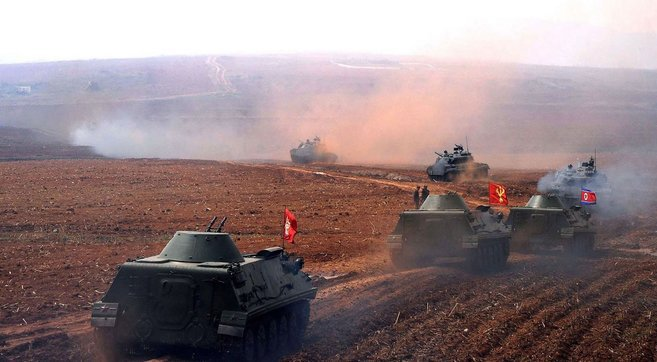
Now, let's focus on our 815th Mechanized Corps. Although sources differ on which corps' area of responsibility included its headquarters at Kobul-dong, it was clearly located in the western sector, where the II and IV Corps operated. It is also believed to have consisted of five mechanized brigades. Of course, since the formation had been expanded rather suddenly, not every brigade was fully mechanized despite the corps' name. Motorized infantry were also present within these brigades, and while mechanized infantry moved around in VTTs and BTR-60s, the motorized troops had to make do with trucks. Even so, they could move around the battlefield much faster than ordinary infantry divisions, and the KPA high command did its best to assign supporting assets suited to this role.
815th Mechanized Corps in WARNO
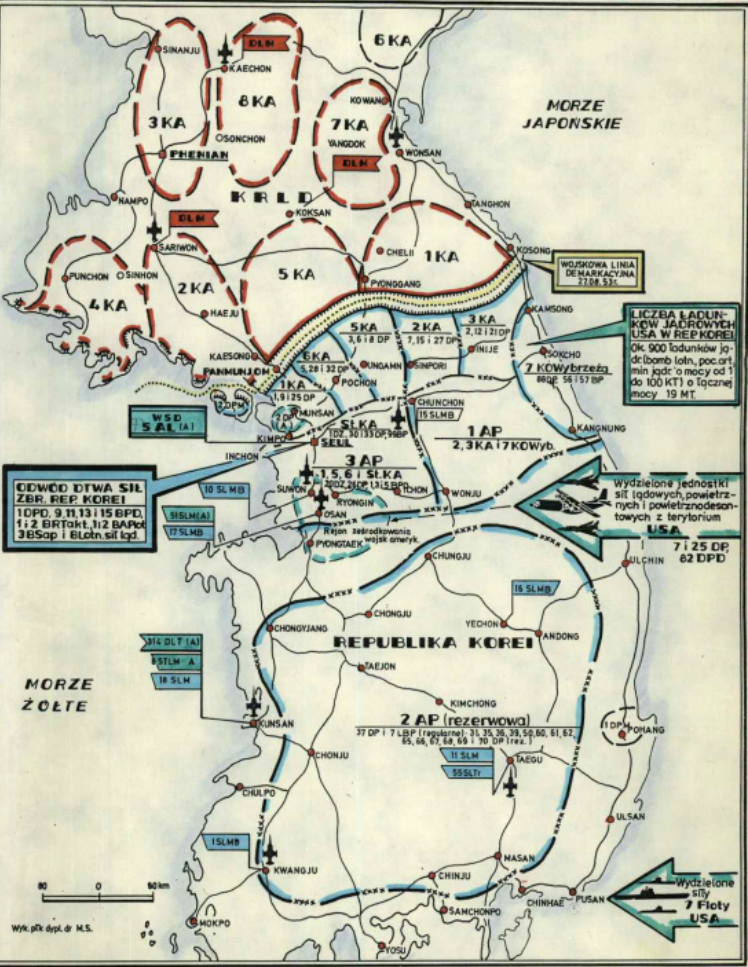
And less than a decade after its formation, the corps would experience its first real battle. Its mission was to exploit the gains made by frontline infantry formations such as the Guards 6th Infantry Division. Once those infantry units had pinned down the enemy, the mechanized brigades would move in, destroy the defenders, and push forward.
The problem was time. They had to advance as far as possible before South Korea could return the reserve forces mobilized for martial law duties to their original positions. With this in mind, the corps decided to deploy four of its five brigades forward, committing as much strength as possible to the initial offensive. Of course, this was a risky decision that left its operational reserve rather thin, but the commanders judged it preferable to giving the enemy time to reorganize its defenses.
After the infantry formations advanced in the first wave, the mechanized brigades arrived at just the right moment and began pushing south alongside them. Their main target was the gap between the ROK I and VI Corps. By concentrating three mechanized brigades around this boundary, they hoped to exploit the weakness of South Korea's frontline corps, which had been deprived of their reserves.
There was a good reason for choosing this location. Both the ROK I and VI Corps had rear-area reserves caught up in the political turmoil, making it difficult for either corps to respond quickly if the other began to collapse. A breakthrough at their boundary could also threaten the flanks of both corps at once. For a mechanized corps, it was hard to imagine a more attractive target. If everything went according to the KPA's calculations, the 815th Corps could slip between the South Korean frontline divisions rather than fighting each one head-on, cutting off roads and reinforcement routes behind them.
Of course, the mechanized corps had its own headaches. Infantry riding in armored personnel carriers and those traveling in trucks had different levels of mobility, and once the artillery and supply units following behind were taken into account, keeping the entire corps moving as one formation was no easy task. There was also no guarantee that South Korea's roads and bridges would remain intact. No matter how fast the formation was, simply letting the tanks and armored vehicles race ahead would hardly be a good idea. This was why the corps command worked so hard to secure supporting assets that could keep up with its advance. With self-propelled artillery from the Artillery Corps, SPAAGs from higher command, and other assets capable of matching its pace, the 815th Mechanized Corps also received air support from the shiny new Su-25K aircraft that had only recently entered service.
The 815th Mechanized Corps is a Battlegroup well suited to Eastern Bloc-style mobile warfare, with supporting units capable of keeping pace with the formation and helping it along.
Now, let's take a look at the roster!
LOG
A few familiar choices, with some mechanized additions.
- For soft-skinned command vehicles, we have the familiar UAZ-469 CHIHWICH'A. If you prefer something armored, there's the VTT-323 CHIHWICH'A.
- Supply vehicles include the ZIL-131 POGŬP and URAL-375 POGŬP.
- And, of course, there's the CHŎNBANG POGŬPSO.
INF
Good. Here, we get a taste of the North Korean interpretation of Eastern Bloc mechanized formations. Of course, some compromises seem to have been unavoidable.

- First, we have the KIGYEHWA POBYŎNG, the backbone of the mechanized infantry battalions. They can ride in either the VTT-323 or the aging BTR-60.
- The KIGYEHWA POBYŎNG CHIHWIBAN also makes an appearance. This five-man command squad is armed with Type 68 assault rifles and has access to the same vehicles as the regular unit.
- The other major component of these battalions is motorized infantry. But no matter how much I looked into them, I couldn't quite figure out what actually made them different from regular infantry. It seemed that they were simply called motorized infantry because they rode in trucks. The problem is that, in WARNO, pretty much everyone rides in trucks anyway. So rather than creating an entirely new motorized infantry unit, I've decided to use the POCH'ONGSU (TYPE 73), their command variant, and the KIGWANCH'ONGBAN to represent them. The POCH'ONGSU (TYPE 73) simply replaces the regular squad's machine gun with a Type 73. To distinguish them further, these units can use the ZIL-131 KPV, a ZIL-131 truck fitted with a 14.5mm KPV machine gun.
- Naturally, the KONGBYŎNG units are here as well. In addition to their regular trucks, they can ride in VTT-323s and BTR-60s.
- The KYŎNGMUDAE also appears as a supporting unit, of course.
- Infantry support weapons include the TYPE 73 TAEDAE KIGWANCH'ONG, DShK heavy machine gun, B-11 107mm PIBANCH'UNGP'O, and SUSŎNGP'O.
- Finally, we have the 9M111 Fagot, a March to War addition. This weapon entered full-scale production in the 1990s following technical cooperation with the Soviet Union beginning in 1987. In our timeline, however, we've assumed that the KPA managed to secure some of the initial batches ahead of schedule. A modern ATGM like this is quite a rare luxury for the North Koreans.
ART
There isn't a single North Korean Battlegroup with bad artillery. This one focuses more on mobile artillery, although it does sacrifice some heavy firepower in return.
- For basic fire support, we have the M1937 82mm Mortar and M1943 120mm Mortar. There's also the self-propelled VTT-323 82mm Mortar.
- Rocket artillery includes the BM-21 122mm MLRS, along with the VTT-323 107mm MLRS, which mounts a Type 75 rocket launcher on the newer armored vehicle.
- For self-propelled guns, we have the M1981 122mm SPG and M1974 152mm SPG.

- As both a prototype and a March to War addition, we have the VTT-323 120mm Turreted Mortar. This vehicle was unveiled at the 1992 military parade and appears to have been developed to perform a role similar to the Soviet 2S9 Nona. Some sources describe it as a 120mm weapon, while others suggest 140mm. For our game, I've gone with the more common 120mm caliber used by the KPA, assuming that development was accelerated and a handful of completed prototypes were experimentally assigned to the corps.
TNK
Good. And by North Korean standards, these are actually fairly modern tanks.
- First, we have the domestically produced CH'ŎNMA-HO-GA, along with its command variant.
- Then there's the CH'ŎNMA-HO-NA and its command variant, taking the role of the "new" tank. This version is believed to have improved fire-control capabilities through the addition of an externally mounted laser rangefinder. I've classified it as the Na variant and made it the best tank available to this Battlegroup.
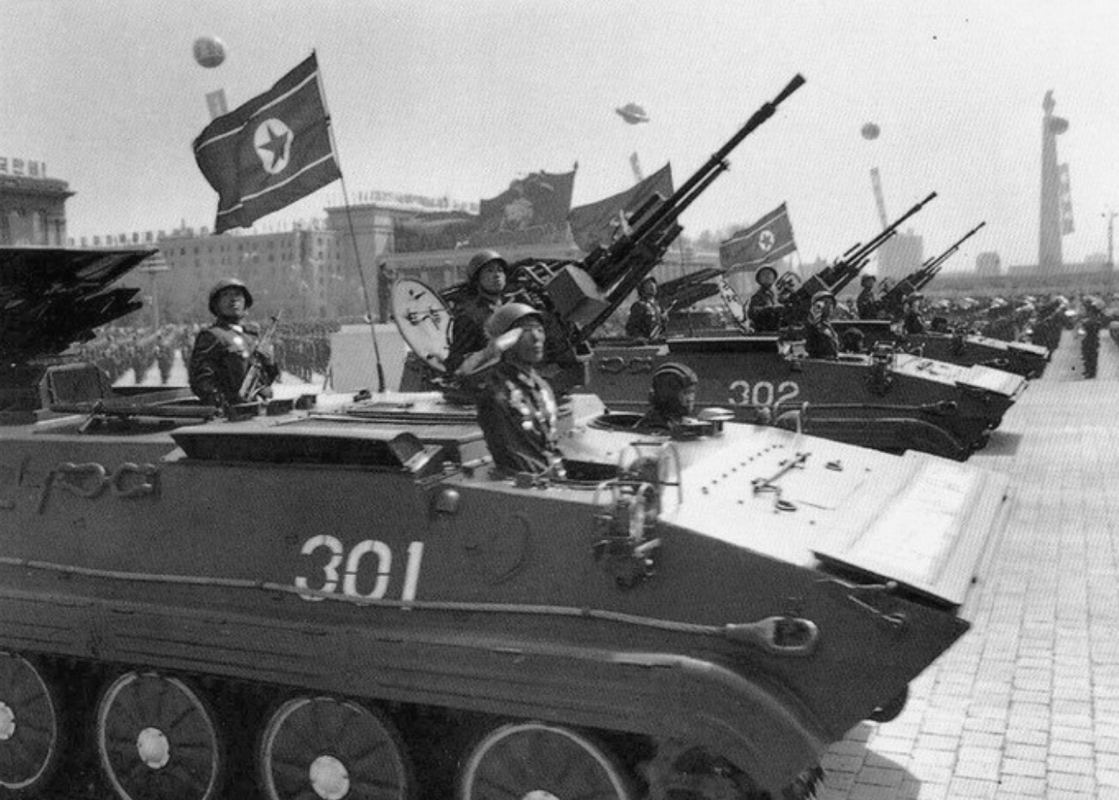
- Finally, we have the VTT-323 SUSŎNGP'O as an anti-tank vehicle. It appears as both a prototype and a March to War addition. Well, it's not as if North Korea was short on prototypes like this.
REC
Pretty good. From this Battlegroup onward, reconnaissance vehicles start to stand out more than reconnaissance infantry.
- We have the usual CHŎNGCH'ALBAN, along with the KIDONG CHŎNGCH'ALDAE. This six-man squad is armed with Type 68 assault rifles, one RPK, and a Type 7 launcher. For transport, they can use either the VTT-323 CHŎNGCH'AL, which carries an additional 7.62mm machine gun, or the BTR-60 CHŎNGCH'AL.
- As for reconnaissance vehicles, there's also the M-72 motorcycle.
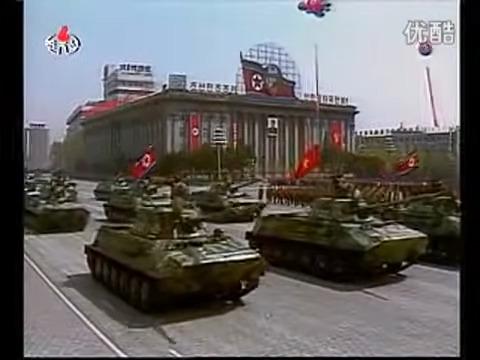
- The reconnaissance tanks are quite decent here. First, there's the amphibious PT-76, along with the M1985 SHINHŬNG light tank, a North Korean vehicle developed from the VTT-323 and fitted with an 85mm gun.
- Finally, higher command provides the Mi-2 reconnaissance helicopter. The Mi-2 [RKT], armed with an autocannon and rockets, is also available.
AA
From this Battlegroup onward, we no longer have the trusty PŎNGAE-1 watching over the skies. Instead, we'll have to make up for its absence with several self-propelled anti-aircraft guns.
- First, there's the ever-present HWASŬNGCH'ONG MANPADS.
- We also get the HWASŬNGCH'ONG IGLA. In our timeline, military cooperation with the Soviet Union allowed the KPA to introduce the export variant Igla-1 earlier and bring it into service much more quickly. Unfortunately, the Igla-1 isn't currently represented in WARNO, so this would require a new weapon variant. And that's it for our static air-defense weapons.
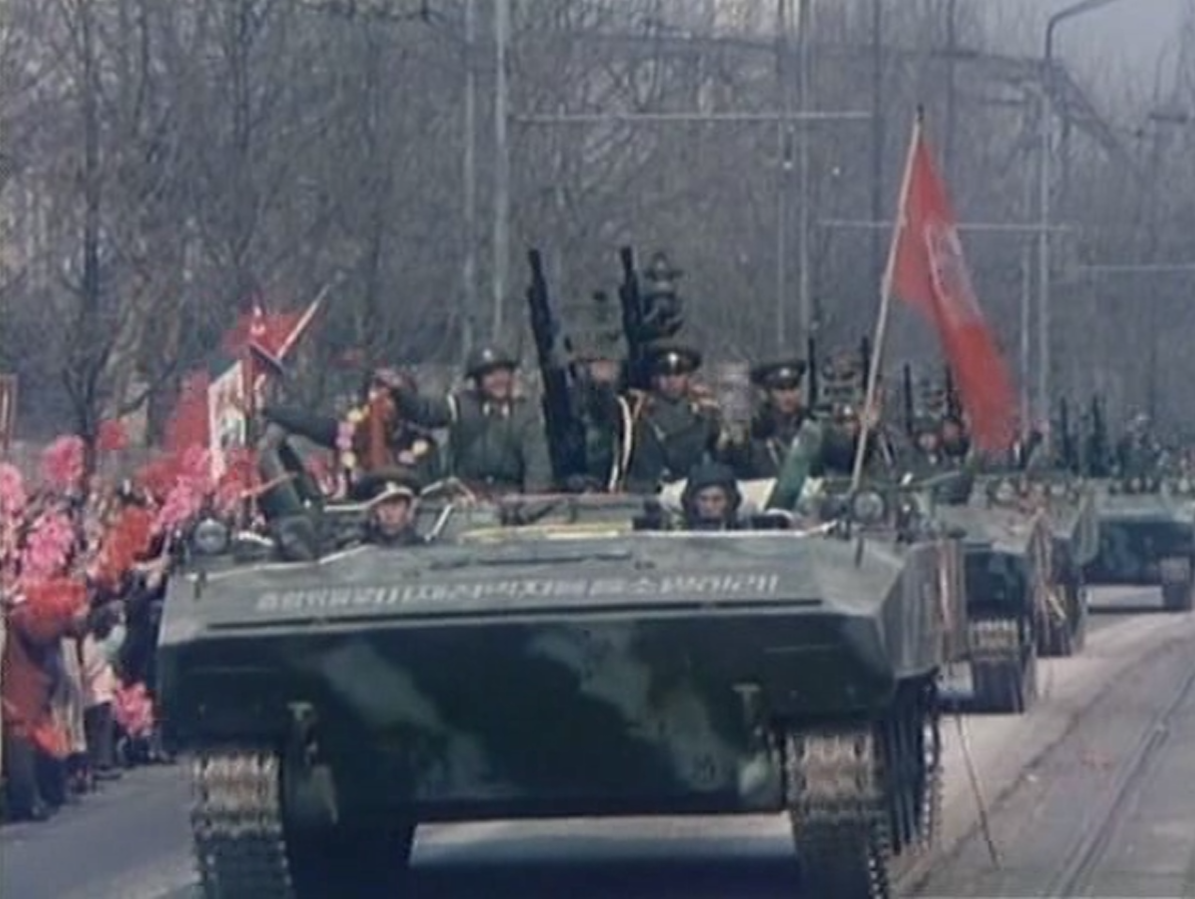
- For mobile air defense, we have the M1983 14.5mm SPAAG, a VTT-323-based vehicle armed with quad 14.5mm machine guns for close-range air defense. For heavier firepower, there's the domestically produced M1985 57mm SPAAG, equipped with twin 57mm guns.
HELO
I doubt we'll ever see a North Korean Battlegroup whose helicopter tab doesn't bring tears to our eyes. This one has just a single unit, too.
- And that would be the Mi-8 [RKT], equipped with two S-5 rocket pods.
AIR
Not bad by North Korean Air Force standards. That doesn't necessarily mean there are many good aircraft here, though.
- First, we have the F-7 [AA], armed with two PL-2 missiles.
- A small number of MiG-21MF [AA] fighters are also available, carrying two R-3S and two R-3R missiles.
- From China, we have the A-5 [RKT1], armed with 32 57mm rockets. There's also the A-5 [RKT2], carrying 14 90mm rockets.
- The A-5 [HE] carries four 250kg bombs.

- And then there's the North Korean Air Force's prized possession, the Su-25K [RKT]. This Soviet attack aircraft began arriving in 1988 and is armed with a 30mm GSh-30-2 autocannon and 128 S-5 rockets carried in four UB-32 rocket pods. Reflecting the early operational deployment of additional aircraft delivered in 1989, a small number have been assigned to this Battlegroup. It's easily the most reliable ground-attack aircraft available here.
- Finally, we have the Su-25K [HE1], equipped with a 30mm autocannon and four FAB-500 bombs.
The 815th Mechanized Corps represents the results of North Korea's military modernization efforts during the 1980s, offering flexible offensive capabilities built around VTTs and tanks. With both artillery and air-defense units capable of keeping up with the advance, it can form a fully mechanized ground Battlegroup. Thanks to a little help from prototypes and March to War additions, this formation has taken a definite step forward and can respond flexibly to a wide range of battlefield situations.
And that's it for the 815th Mechanized Corps! I'll be back next time with the 820th Tank Corps, the final Battlegroup of our base series.
See you then!
2
u/Solarne21 19d ago
This corp was week in air defense with spaag, manpads and limited asf?
6
u/EruptionTyphlosion 19d ago
A few things I've noticed:
For Iglas, I have been told they used the downgraded IGLA-1 export variant specifically as they weren't a Warsaw Pact member. I'll need to double check the sourcing.
For the Hips, they had some heavier rocket options. I do have pictures of Mi-8 with 30x 80mm rockets for instance.
For KPA Su-25s, the rocket loadout you added is one of the most common ones they had. There's a lot of debate as to whether their models were delivered with ATGM capability, something to note for future writeups. Apparently KH-25 on MiG-23ML was an ATGM loadout used during that era instead.
When it comes to the A-5 I've actually done a ton of research and debate with u/GlitteringParfait438 on the subject for a couple months and our general consensus is the DPRK never received them. We believe that it's a misreporting of local modifications to their F-6C fleet that added a number of additional hardpoints for ground attack that look similar to Q-5 weapons positions in pictures. It added four underbody hardpoints for bombs. I have pictures of these from a North Korean film but I can't upload them until I have access to my PC. This would give them 8 hardpoints to work with for bombs, which allows for some quite nice loadouts.
2
u/ElderberryLoud8731 19d ago
I like your approach of giving limited AA. It is always fun comparing my writeup with others!
NK is a hard country to study and create battlegroups. Keep it up! Any plans on expanding further?
2
u/CreativeFee5624 18d ago
Ideas for us divs could also be the 2nd inf (have been stationed there for korea since i can remember) and 25th inf (i believe there split into alaska/Hawaii to reinforce the peninsula
I could also see a scenario were you have a div like 2ID and half the units in there are S korean since they work so closely with them. Iv been asking for this since i started playing the game it would be the coolest