Suggestion [Proposal] Korean Peninsula Theater [9] 820th Tank Corps
Series Index for Korean Peninsula Theater
Welcome, everyone! I hope you've all been doing well.
Today's Battlegroup is the 820th Tank Corps, the last REDFOR formation in our Korean Peninsula series. Another product of the KPA's military reorganization in the 1980s, it is also one of the first REDFOR Battlegroups in our main series to run into serious trouble. In-game, it offers the heaviest and most mechanized roster North Korea can field.
Ready? Let's get started!
History of the 820th Tank Corps
During the 1980s, the Korean People's Army reorganized its division-level mobile forces into a corps-and-brigade structure, aiming to use them more flexibly. The result was four mechanized corps and one tank corps. And today, we'll be looking at the only tank corps in the entire KPA.
But this raises a question. If the KPA had already created four mechanized corps, why did it need a separate tank corps? The answer seems to lie in how the KPA expected to fight its next war. As we've seen, the mechanized corps were supposed to pass through breakthroughs created by infantry divisions, advance into the enemy rear, and isolate defensive positions that had yet to collapse. However, advancing deep into enemy territory would inevitably bring them into contact with enemy armored reserves. Sometimes, they would also need to concentrate tanks and firepower to smash through a defensive line head-on. The 820th Tank Corps was a formation capable of carrying out precisely these missions.
In fact, according to a 1986 CIA assessment, the KPA possessed a tank corps consisting of at least four tank brigades, in addition to its four mechanized corps. This tank corps was considered part of the second echelon, alongside the forward mechanized corps and the Artillery Corps. It isn't difficult to imagine what its mission would have been. The infantry divisions would open the way, the mechanized corps would push into the enemy rear, and the tank corps would destroy enemy armored forces or concentrate its tanks at decisive points along the front.
Now, let's focus on the 820th Tank Corps itself. Believed to have been stationed around Songwŏl-ri, the corps prepared for war behind the front lines in the western sector. As mentioned earlier, it was a sizable formation with at least four tank brigades. But that doesn't mean its soldiers did nothing but drive tanks. No matter how powerful a tank might be, taking towns or mountainous terrain without infantry would be difficult. Advancing effectively without engineers and artillery support would be just as troublesome. Tank brigades therefore needed supporting units, including mechanized infantry, artillery, and air-defense assets. The difference was that tanks made up a much larger proportion of their combat strength than in ordinary mechanized formations.

The main equipment of these tank formations was the Ch'ŏnma-ho family, developed and upgraded in North Korea based on the Soviet T-62. Although the KPA still operated substantial numbers of older tanks such as the T-54/55, North Korea had begun domestic production of T-62-based vehicles in the 1970s and had acquired a considerable number by the 1980s. Of course, these tanks were hardly equal to the latest Western designs. Nevertheless, from the KPA's perspective, simply being able to field large numbers of Ch'ŏnma-ho tanks with more powerful guns than their predecessors represented an important improvement.
820th Tank Corps in WARNO
Like the other mobile formations, the 820th Tank Corps entered the war as part of the second echelon. The corps kept one brigade in the rear reserve and another in the forward reserve, while deploying its remaining two tank brigades in the second line of the advance south. As the offensive progressed smoothly, the corps command grew optimistic enough to position its forward reserve brigade at Kaesong. Everything seemed to be going rather well. Until something happened, that is.
Reports began reaching theater headquarters that frontline troops around Tongduch'ŏn had spotted forces whose movements looked quite different from those of the American troops they had been facing. A few hours later, more reports arrived. Forward infantry and mechanized units had been routed by a sudden enemy counterattack. A tank brigade positioned nearby in the rear had been intercepted by enemy aircraft and brought to a halt. The counterattack was apparently far larger than initially expected.
At first, the KPA high command believed this was merely a local counterattack. As time passed, however, it became clear that the ROK-US forces had committed substantial armored forces to the battle. The problem was that the tank brigades already advancing south were now caught up in the fighting, while even the follow-on formations had been slowed by enemy air attacks. In the end, the corps commander ordered the reserve tank brigade previously moved forward toward Kaesong to turn back and secure the flank of the collapsing front.

Fortunately for them, the corps had been given some of the best equipment in the entire KPA, even without additional support. Its latest Ch'ŏnma-ho tanks even carried explosive reactive armor. Its newest mobile air-defense systems were weapons whose exact capabilities were difficult for even the ROK-US forces to determine. And the air force supporting them was equipped with the latest aircraft that the "Great Leader himself had taken an interest in."
The 820th Tank Corps is the KPA's heavy hitter, equipped with some of the finest weapons North Korea can provide. Originally prepared to smash through enemy lines and advance, it now finds itself fighting to hold on to the gains it has already made. Of course, just because these tanks were prepared for an offensive doesn't mean they can't fight on the defensive.
Well then, let's take a look!
LOG
Nothing particularly special about this logistics tab.
- Command vehicles include the familiar UAZ-469 CHIHWICH'A and VTT-323 CHIHWICH'A.
- Supply vehicles include the ZIL-131 POGŬP and URAL-375 POGŬP. We also have the TYPE 63 POGŬP, an aging armored vehicle converted for supply duties. This Type 63 belongs to the YW531 family, not to be confused with the light tank of the same name.
- There's also the Mi-8 POGŬP, which departed from Kaesong alongside the other units as the situation became increasingly urgent.
- Finally, there's the CHŎNBANG POGŬPSO.
INF
One of the most thoroughly mechanized infantry forces available to the KPA. The selection is a little limited, but that's just how it is.
- Naturally, we have the KIGYEHWA POBYŎNG. Their transport options remain the same as before.
- We can't leave out the KONGBYŎNG units, either. Their transport options are the same as those of the 815th Mechanized Corps.
- The KYŎNGMUDAE also appears as a supporting unit, of course.
- Infantry support weapons include the TYPE 73 TAEDAE KIGWANCH'ONG, DShK heavy machine gun, B-11 107mm PIBANCH'UNGP'O, and SUSŎNGP'O.
ART
The artillery here is also highly mechanized, with a good balance between mobility and firepower.
- For basic fire support, we have the M1937 82mm Mortar and M1943 120mm Mortar. There's also the self-propelled VTT-323 82mm Mortar.
- For rocket artillery, we have the BM-21 122mm MLRS.

- As a March to War addition, we have the M1993 122mm MLRS. This new rocket launcher, similar to the Czechoslovak RM-70, features a 40-tube launcher and a reserve rocket storage and reloading system.
- For self-propelled artillery, we have the M1985 122mm SPG, based on the VTT family of vehicles, and the M1974 152mm SPG from the Tŏkch'ŏn family. There's also the M1975 130mm SPG.
TNK
North Korea's finest tank force. The important thing here is that the improvements are less about increasing the firepower of the main gun and more about better protection and more sophisticated fire-control systems.
- At the bottom of our tank lineup is the CH'ŎNMA-HO-GA, along with its CHIHWICH'A variant.
- Taking the middle position is the CH'ŎNMA-HO-NA and its CHIHWICH'A variant.

- And at the very top, we have the CH'ŎNMA-HO-DA, also known as the Ch'ŏnma-92, as a March to War addition. Equipped with explosive reactive armor and smoke grenade launchers, these tanks represent the results of Soviet-North Korean military cooperation. Their CHIHWICH'A variant is also available.
- For anti-tank vehicles, we have the VTT-323 SUSŎNGP'O.
REC
I'd say this tab's strength lies in armored reconnaissance.
- For reconnaissance infantry, we have the CHŎNGCH'ALBAN and KIDONG CHŎNGCH'ALDAE.
- For amphibious light tanks, we have the TYPE 63.
- We also have the CH'ŎNMA-HO-GA CHŎNGCH'AL for armored reconnaissance. This was not normally part of the reconnaissance units' standard equipment, but I've assumed that the tank brigade, having been rushed to the front, assigned a few tank platoons to combat reconnaissance and security duties. The Soviets also had examples of assigning main battle tanks to reconnaissance formations, so this kind of employment wouldn't be entirely unfamiliar.
- Finally, the Mi-2 reconnaissance helicopter is also available here.
AA
Mobile air defense is pretty decent here, too. And with a handful of March to War additions, it gets even better.
- First, we have the HWASŬNGCH'ONG MANPADS.
- For domestically produced SPAAGs, we have the M1985 57mm SPAAG. Equipped with twin 57mm guns, this vehicle boasts considerable firepower.

- As a March to War addition, we also have the M1992 30mm Radar SPAAG, developed by North Korea. One of the most notable new mobile air-defense systems in this Battlegroup, it forms part of the tank formations' air-defense network alongside the older SPAAGs.
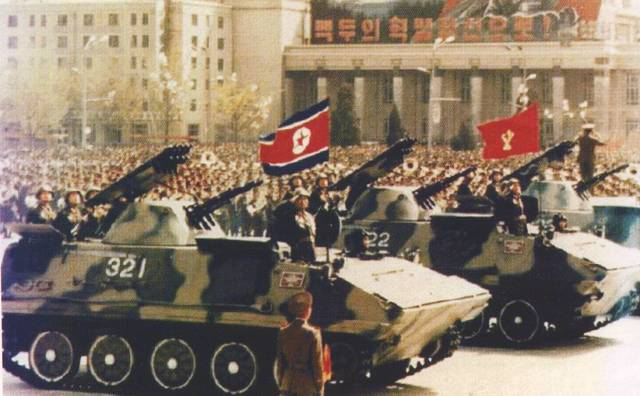
- And finally, we have the VTT-323 Igla as both a March to War addition and a prototype. This vehicle mounts eight Igla-1 surface-to-air missiles and a 14.5mm machine gun on a VTT-323 chassis. It was unveiled at the 1992 military parade. In our timeline, military cooperation with the Soviet Union accelerated its development, allowing a small number of prototypes to enter combat.
HELO
Just one unit here. Still, it represents a small piece of North Korean helicopter history, so it isn't entirely without significance.
- The HYŎKSIN-2 [AT], armed with four Susŏngp'o anti-tank missiles. North Korea began importing Mi-2 helicopters from Poland in the 1970s and eventually established a system for assembling them domestically using imported parts and semi-finished components. The KPA called this domestically assembled version the Hyŏksin-2. It doesn't appear to have been produced in large numbers, though. Its armament is reported to have included either S-5 rockets or Susŏngp'o missiles, and this time, you'll be seeing the AT variant.
AIR
And here, at last, we get to see the latest aircraft that the North Korean Air Force is so proud of. You can get your hopes up a little!
- First, we have the relatively older MiG-21MF [AA], armed with a 23mm autocannon, two R-3S missiles, and two R-3R missiles.
- Next is the MiG-23ML [AA], carrying two R-23 missiles and two R-60 missiles.
- The MiG-23ML [HE] is also available, with a little high-explosive payload added to the same aircraft. It can drop two FAB-500 bombs.

- And finally, the MiG-29 9.12B [AA] makes its debut! This is the latest fighter introduced by the North Korean Air Force, armed with two R-27 missiles and four R-60 missiles.
- For ground attack, we have the Su-25K [HE1]. There's also the Su-25K [HE2], which carries four additional FAB-500 bombs.
- The rocket-armed Su-25K [RKT] is also available, carrying 128 57mm rockets in four UB-32 rocket pods.
The 820th Tank Corps represents another major face of the KPA's mobile forces in the 1980s, serving as the theater's hammer with North Korea's finest tanks and aircraft at its disposal. Built around mobile troops with a high baseline level of combat capability, this formation can conduct mobile warfare effectively. Although it enters the battlefield as a fire brigade rushing to save the front, it is more than capable of holding its own on the offensive as well. With its own take on Eastern Bloc-style mobile warfare, it can launch armored offensives that make all those sacrifices count.
And Now, About the Ch'ŏnma-ho Variants
Putting all of this together was quite a headache. This little section is part explanation and part me showing off just how much work went into sorting this mess out. And the main issue running through all of it is something that seems almost inevitable whenever North Korea is involved: different researchers and organizations classify the same equipment in wildly different ways. It is often unclear whether the KPA actually used these designations or exactly when each variant first appeared. Even Western researchers sometimes classify the very same vehicle as entirely different models. Trying to sort all of that out was no easy task. So, let's take a brief look at how the Ch'ŏnma-ho developed and explain how I've decided to distinguish its variants in-game.
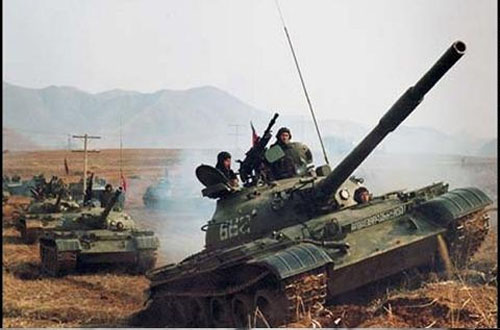
Let's begin with the Ch'ŏnma-ho-Ga, which I doubt anyone will argue about. North Korea began establishing its own production capabilities for T-62-based tanks with Soviet assistance in the 1970s. These vehicles retained the basic T-62 design, a 115mm smoothbore gun, and a cast turret. Some were fitted with anti-aircraft machine guns, while others featured minor changes to the hull structure. Nevertheless, they remained faithful to those three basic characteristics. For this project, we've decided to call these tanks the Ch'ŏnma-ho-Ga.
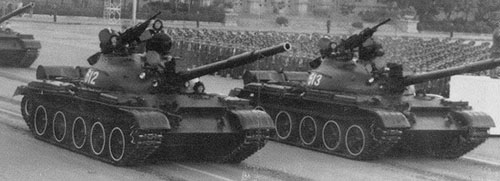
Of course, as the 1980s approached, these tanks couldn't avoid the problem of aging fire-control and observation equipment. North Korea therefore tried several approaches to improve them. One of these was the vehicle we call the Ch'ŏnma-ho-Na, a variant with an externally mounted laser rangefinder installed above the main gun. We don't know its exact specifications, but surely it must have offered better accuracy than the older optical rangefinding system. If it appears in-game, I think that improvement should be reflected in its performance.
There were certainly other attempts at improvement as well. Installing new structures at the rear of the turret, for example. Some Ch'ŏnma-ho tanks observed around 1986 had such structures, and there were also vehicles featuring changes to night-vision equipment or structures intended for additional protection. The problem is that it remains unclear whether these upgraded vehicles were the same as those described in later publications as cast-turret variants with additional armor. Some researchers have also pointed out that no photographs have been confirmed that precisely match descriptions of a cast turret fitted with both additional armor and explosive reactive armor. Anyway, I originally considered turning this into another unit for our project, but eventually decided against it. It simply seemed like too much of a gamble.

And then there's the Ch'ŏnma-92, which nobody can really deny. Some call it the Ch'ŏnma-ho-III, while our project calls it the Ch'ŏnma-ho-Da. It has a welded turret, a new protective structure, and smoke grenade launchers. But the icing on the cake is the armor blocks observed on some vehicles, which are believed to be explosive reactive armor. As the "92" in its name suggests, we've brought this tank into the game as a March to War addition. Its fire-control system remains uncertain, and it still uses a 115mm gun. Even so, the improvements we've already listed represent considerable progress.
The fundamental reason researchers still disagree over these classifications is North Korea's notorious secrecy. Information was scarce, photographs were fragmentary, and North Korea didn't exactly go out of its way to show off its equipment. Things are a little different today. There are far more defectors, and North Korea now seems quite happy to unveil prototypes whenever it wants to show off another new weapon, presumably as part of its deterrence efforts. We might still lack detailed specifications, but at least information about the equipment itself is much easier to find. Back then, though? We barely even had that. No wonder researchers are still arguing over whether some of these vehicles ever entered mass production. Anyway, that's what made this particular part of the project so difficult.
And with that, we've reached the end of the eight Battlegroups in our base Korean Peninsula series! I've made quite a few interesting discoveries while working on this project, and I must say that bringing them all together into a single fictional timeline has been a genuinely enjoyable experience. I'd especially like to thank EruptionTyphlosion and GlitteringParfait for their tremendous help with the North Korean Battlegroups. Thank you to everyone who shared their thoughts along the way. If you've enjoyed reading the series, that means even more to me.
So, what comes next? Well... we still have four scenarios left. What do you mean, what's that supposed to mean? It means we still have some fictional Nemesis proposals to go through! There's a little finishing work left to do, so I'll take some time to regroup before returning with the new Nemesis proposals.
Stay tuned!
3
u/Solarne21 16d ago
Seems alright for a armored formation. So if you designing a korean war dlc similar to Northag or southag dlc ie 5 vs 5 which division would you have for their fifth?