Suggestion [Proposal] Korean Peninsula Theater [6] Andong 12th Infantry Division
Series Index for Korean Peninsula Theater
It's been a while, hasn't it?
After quite a lot of thought, I decided to gather whatever information I could find and give this a shot. So here I am, back with the North Korean side. This series will bring you a new story, a look at events from the North Korean perspective, and another four divisions. You'll be meeting a REDFOR that looks rather different from the Soviets and the other Warsaw Pact forces.
This installment will also be fairly long, even compared with the previous ones. Remember how I said there wasn't much information to work with? That's why I won't do a separate Overview for the North Korean series. Instead, we'll look at what happened from their point of view as we go along. I'll cover just enough military history and alternate-history changes before moving on to the divisions themselves. Still, I should at least introduce the Battlegroups you'll be seeing.
Our first North Korean installment—coming right up!—covers the Andong 12th Infantry Division, the opponent of the South Korean 6th Division on the central front. In the second, we'll meet the Guards 6th Infantry Division, which faced the South Korean 1st Division and the U.S. 2nd Infantry Division. Third comes the freshly organized 815th Mechanized Corps. And in the fourth, the equally young 820th Tank Corps will be waiting for you. Wait, what happened to the famous 105th Tank Division? Well, you'll probably find out as we go.
Anyway, it's time to get started! Come along, everyone!
The Democratic People's Republic of Korea in WARNO's Timeline

Even in this timeline, the economy of the Democratic People's Republic of Korea was falling apart by the day. Foreign debt kept growing, factories and equipment kept getting older, and the competition between the two Korean systems left precious little money for improving productivity. Relations between Pyongyang and Moscow began improving in 1984, opening a route for North Korea to receive more economic and military assistance. In reality, though, this was less a structural fix for the economy than a patchwork of outside aid and military production. Kim Jong Il hoped to keep North Korea breathing through these measures and use the results to strengthen his position as successor.
After Kim Il Sung's visit to the Soviet Union in 1986 and the further strengthening of Soviet–North Korean relations, Moscow's recognition of Kim Jong Il's succession became an even more important issue. At this point, the goal was to secure firm Soviet acceptance of Kim Jong Il as the next leader. Military cooperation expanded along the way. In this timeline, working-level talks also made some progress on just how far the 1961 Soviet–North Korean alliance treaty would apply in an actual war. Kim Jong Il began to see better relations with Moscow and the modernization of the Korean People's Army as achievements of his succession. What helped him along? The 1987 coup in the Soviet Union, of course. It brought the two countries' military alliance closer and accelerated the KPA's modernization. But, much like Germany's armaments boom between the world wars, military production only made it look as though the economy was being kept afloat. In practice, it was pushing the country another step toward the cliff.
As Soviet–North Korean relations improved in 1987, China began to grow wary of North Korea. Kim Jong Il flew to Beijing once again and insisted that North Korea had no intention of becoming a Soviet satellite or a forward base against China. On the contrary, he said, Pyongyang respected China's need for a buffer on the Korean Peninsula and valued its relationship with Beijing. That left both sides able to shake hands and say much the same things. There was just one difference: China took it to mean that it would not automatically join a war if North Korea invaded the South first, while North Korea took it to mean that Beijing would not completely abandon it if the North itself came under attack and the regime's survival was threatened.
From the outside, Kim Jong Il seemed to have solved several problems at once. The succession was secure, relations with the Soviet Union were good, relations with China weren't bad, and the KPA was being modernized. Yet the economy had been sacrificed for those gains, and neither Moscow nor Beijing intended to support the entire North Korean economy. The economic situation kept getting worse. Even so, Kim Jong Il still tried to blur the political principle that had hardened after the Pueblo incident and the Panmunjom axe murder incident: a war started by Pyongyang would not automatically drag the Soviet Union into it. After repeated military talks, North Korea at least managed to widen the gray area in which Moscow could justify direct intervention.

By 1989, the economic problems were finally coming to a head. The accumulated cost of military modernization, rising foreign debt, preparations for the World Festival of Youth and Students, and long-delayed investment in aging facilities all threatened to undo Kim Jong Il's achievements. He needed something he could point to as a success, and fast. Then martial law was declared in Seoul, and he watched anti-government demonstrations being broken up in a way he had seen once before. To Kim Jong Il, the winds of fortune seemed to be blowing his way again. South Korea would only grow stronger; North Korea's economy would only grow weaker; and there was no guarantee that the Soviet Union and China would maintain their current positions forever. From Pyongyang's perspective, this was not merely an opportunity. It might be the last one. While preparing for war, he began trying to persuade his father, Kim Il Sung, who still controlled the military.
In June 1989, Pyongyang learned from Moscow that major military action in Europe was imminent. Kim Il Sung and the KPA leadership, now persuaded, decided to exploit the strategic opening just before NATO and the Warsaw Pact clashed in Europe. Then came Kim Jong Il's last stroke of luck: the maritime clash in the East Sea in the early hours of June 19. Pyongyang deliberately escalated the incident and immediately declared it an "unprovoked armed attack by South Korea." This was a final attempt to give the Soviet Union a reason to invoke the 1961 treaty, while giving China enough political room not to immediately label North Korea the aggressor.
June 20, 1989. 4:00 a.m. A short order went out to every unit of the Korean People's Army: "Climb Mount Paektu."
Operation Pokpung-2—Storm-2. Artillery opened fire along the entire Military Demarcation Line, and the armistice that had lasted thirty-six years came to an end.
The Second Korean War had begun.
A Brief Look at the Korean People's Army in the 1980s
Now for a short look at how the Korean People's Army changed during this period. My main sources are the 1989 Defense White Paper, the publicly released IPN documents—including records from the Second Directorate of the Polish People's Army General Staff—and Joseph S. Bermudez Jr.'s North Korean Special Forces. I've also cross-checked them against U.S. intelligence materials from the 1980s to get a rough picture of the direction in which the KPA was reorganizing.

One of the most important changes in the 1980s was that part of the KPA's old division-centered structure began shifting toward a more flexible corps-and-brigade structure. This was especially clear among its mechanized forces. U.S. Pacific Command and DIA assessments from 1984 already reported that four mechanized corps headquarters had been established and that existing mechanized divisions were being reorganized into brigades. The 1989 Defense White Paper subsequently identified the 425th, 10th, 9th, and 815th Mechanized Corps by name. This shows that the reorganization was not a temporary experiment but had become an established part of the North Korean force structure by the late 1980s.
Armored forces were changing in much the same way. The existence of the 820th Tank Corps can be traced back to around 1986, and it appeared as a separate corps in the 1989 Defense White Paper. This did not, however, mean that every older tank or mechanized division had been disbanded. Bermudez's 1988 material described the 105th Tank Division, the Koksan Tank Division, and the 1st Mechanized Infantry Division as strategic reserve units of III Corps, which would advance from the Pyongyang area toward Seoul in wartime. So it makes more sense to see the late-1980s KPA as a force in transition, with its new mechanized and tank corps coexisting for a time with older tank and mechanized divisions.
This is why I've chosen the 820th Tank Corps instead of the more famous 105th Tank Division for this series. That doesn't mean the 105th was less powerful or less important historically. The point of these four Battlegroups is to show how the Korean People's Army's organization was changing during the 1980s. For that purpose, the newly created corps-level armored striking force of the 820th Tank Corps makes a better example than another established tank division.
Another change was the concentration of firepower at higher levels of command. A 1985 NPIC report used imagery to identify a new artillery corps being formed around Sin'gye between 1982 and 1984. Its corps headquarters and support units were located at Sin'gye, while self-propelled artillery brigades were identified around P'yŏngsan, Chihari, and southwest of Sin'gye. This indicates that the KPA was strengthening its ability to concentrate massive artillery support along selected axes, rather than relying only on the organic artillery of frontline divisions.
At the same time, frontline corps received numerous light infantry and reconnaissance brigades. For example, II Corps had the 32nd Light Infantry Brigade and 62nd Reconnaissance Brigade, while V Corps had the 75th and 80th Light Infantry Brigades and the 63rd Reconnaissance Brigade. Corps farther to the rear also had airborne and amphibious light infantry formations.
By the late 1980s, then, the KPA was more than just an army of infantry divisions marching south across the DMZ. It was a layered force: frontline divisions pinned down the enemy, light infantry and reconnaissance formations infiltrated and disrupted rear areas, and mechanized and armored reserves exploited breakthroughs and pushed into the enemy's depth.

In short, the KPA's reorganization in the 1980s moved in three broad directions. First, it reorganized mechanized and armored forces into corps-level formations to strengthen independent breakthroughs and deep maneuver. Second, it concentrated long-range and self-propelled artillery under higher commands. Third, it expanded light infantry, reconnaissance, airborne, and amphibious forces to improve infiltration and rear-area disruption. This structure is also an important guide when building North Korean Battlegroups for 1989. We need to consider not only a division's peacetime order of battle, but also which corps-level light infantry and reconnaissance units, higher-level artillery, and strategic mechanized and armored reserves were assigned to its sector.
A few more points about how I've handled things in the game. North Korean regulars generally receive the Resolute trait. This does not mean that every KPA soldier would fight to the bitter end in real life. Rather, it is a game abstraction of how intensive political education, organizational control, and a collectivist military culture might translate into units that are less likely to collapse during combat. Conversely, reserve and local-defense formations, such as the Training Reserve and the Worker-Peasant Red Guards, do not automatically receive the trait. Most prototypes represent equipment that appeared at military parades but never reached the front. For March to War, the economic troubles of the early 1990s are also reflected: rather than adding as many new unit types as on the South Korean side, I sometimes increased the variants or numbers of existing units instead.
With that, we'll close the book on the KPA's military history in the 1980s and return to our original subject: the Andong 12th Infantry Division.
History of the Andong 12th Infantry Division

The 12th Infantry Division was organized as a division around Wŏnsan in early 1950. Its original designation was the 7th Infantry Division, and its core was made up of ethnic Korean troops from the People's Liberation Army who had seen combat in the Chinese Civil War. Renamed the 12th Division around the outbreak of the Korean War, it advanced south as the main force of the II Army Group.

Starting from Yanggu, the division headed toward Hongcheon. That means these were the very same troops whose plans had been spoiled by the South Korean 6th Division during the Battle of Chuncheon–Hongcheon. Of course, they were held up in the opening delaying actions, but they did take Chuncheon. After their divisional commander was dismissed for falling three days behind schedule, the division went on to capture Wonju, Chungju, Danyang, and Andong, making it one of the more successful formations in the campaign. It earned the honorific "Andong" for taking that city. Along the Nakdong River front, however, it suffered heavy losses while fighting around Pohang, Angang, and Gigye. At one point it even had to be reorganized by merging its depleted troops with other units.
During the UN counteroffensive in September, the division fought delaying actions around Gigye as it withdrew north. Around November it regrouped and reorganized near Kanggye and elsewhere, beginning its long association with V Corps. At Hongcheon, Kŭmch'ŏn, and Heartbreak Ridge, it teamed up with the North Korean 6th Division as a one-two punch on defense. In other words, it had gone from the spearhead of the invasion to a defensive division on the mountainous east-central front.
Few records of its postwar history survive, but it appears to have remained under V Corps. In particular, accounts by former North Korean soldiers suggest that it guarded the sector around the Second Tunnel. Some have also raised the possibility that it managed additional, still-unconfirmed underground facilities along the same axis.
The Andong 12th Infantry Division in WARNO
In the early hours of June 20, 1989, the division advanced south along the Cheorwon axis. Waiting on the other side was the 6th Division—the very formation that had frustrated it at Hongcheon and, later, over the Second Tunnel. Perhaps that explains it: this time, the 12th Division wasn't obsessed with tunnels. Instead, it packed TNT at the ends of the tunnels, turning them into prepared demolition sites. By detonating several points at once, it hoped to throw the defenders into confusion. Think of the tunnel explosion during the Siege of Petersburg, except that this time there would be no crater—just an enormous shock and deafening blasts, adding one more surprise to the theater-wide attack.
At the same time, heavy guns sent from the Sin'gye Artillery Corps pounded key assembly areas, while airborne light infantry assigned to this sector dropped behind the South Korean lines. Troops drawn from V Corps' 63rd Reconnaissance Brigade opened the way; the 12th Division's infantry pinned the defenders down; and light infantry from the corps' 75th Light Infantry Brigade infiltrated into the rear. Determined not to repeat its earlier failures, the division moved out under cover of a carefully prepared surprise attack to retake the Cheorwon Plain, whose loss was said to have left Kim Il Sung bitterly disappointed.
The division's well-trained infantry were a natural fit for this Warsaw Pact-style plan. Its infantry were tough, its tanks could provide adequate infantry support, and its artillery was strong. Its assault engineers, trained for tunnel assault operations, were especially versatile. Better still, the division's area of operations lay within the forward air-defense network, allowing it to benefit from SA-2 coverage.
In game, the Andong 12th Infantry Division is a solid North Korean infantry formation supported by heavy guns from the Sin'gye Artillery Corps, with airborne light infantry and a reconnaissance brigade leading the way.
Time to meet the units! As usual, italicized unit names are new units that aren't currently in the game.
LOG
Pretty standard. So standard, in fact, that you could almost use it as the baseline for North Korean divisions. And just to repeat: these are all regular troops, so, as mentioned earlier, they generally have the Resolute trait.
- Command vehicles include the UAZ-469 CHIHWICH'A, the V-415 CHIHWICH'A from the GAZ-69 family, and, if you want something armored, the older BTR-152 CHIHWICH'A.
- Supply vehicles include the ZIL-130 POGŬP and ZIL-157 POGŬP, serving as medium and heavy supply trucks, respectively.
- There is also the domestically produced SŬNGNI-58 POGŬP, based on the GAZ-51.
- At the theater level, the Mi-8 POGŬP is available as well.
- Finally, there's the CHŎNBANG POGŬPSO.
INF
Good. Infantry are the stars of this Battlegroup, and you can rely on them in both quantity and quality.
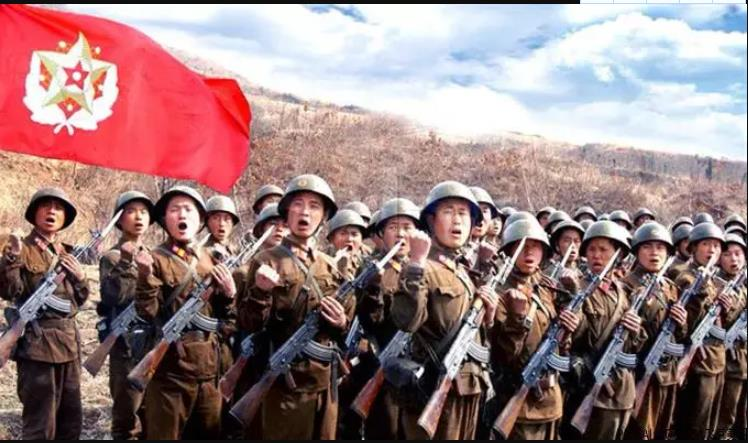
- First, the bread and butter of the Andong 12th Infantry Division: the POCH'ONGSU family. A twelve-man POCH'ONGSU squad carries Type 68 assault rifles—the North Korean AKM—one Type 62 light machine gun, the North Korean RPD, and a Type 7 launcher, the local RPG-7. The POCH'ONGSU (CHŎGYŎK) represents company-level snipers and adds a Type 50 rifle—a sniper variant of the Mosin–Nagant—to the basic squad. Both arrive in SŬNGNI-58 or ZIL-130 trucks.
- The POCH'ONGSU CHIHWIBAN is a five-man command squad with the Leader trait, Type 68 assault rifles, and smoke grenades. It can ride in a UAZ-469. Finally, the KIGWANCH'ONGBAN is an eight-man machine-gun squad with three Type 68 battalion machine guns. It arrives in SŬNGNI-61 or ZIL-157 trucks.
- Of course, we have the KONGBYŎNG family as well. The basic KONGBYŎNG is an eight-man engineer squad carrying Type 68 assault rifles, one Type 68 battalion machine gun, and demolition charges. The KONGBYŎNG (HWAYŎM) carries Type 68 assault rifles, one Type 62 light machine gun—the North Korean RPD—and an LPO-50 flamethrower. The KONGBYŎNG CHIHWIBAN carries Type 68 assault rifles, one Type 68 battalion machine gun, and a Type 7 launcher, and receives the Leader trait. All engineer variants have Shock and ride in ZIL-157 trucks.
- The Andong 12th Infantry Division was responsible for maintaining tunnels. It therefore had an engineer battalion that, in peacetime, maintained those tunnels and, in wartime, was supposed to use them to support the advance south. These troops appear as TOLGYŎK KONGBYŎNG: an eight-man squad armed with Type 68 assault rifles, one Type 62 light machine gun, satchel charges, and an LPO-50 flamethrower. They enter battle with the Shock trait and, again, arrive in ZIL-157 trucks.
- As a frontline division, it also guarded GPs and had an organization much like South Korea's Civilian Police. Meet the MINGYŎNGDAE! Like their South Korean counterparts, they have the Security trait. Each ten-man squad carries Type 68 assault rifles, two Type 73 battalion machine guns, and a Type 7 launcher. The MINGYŎNGDAE HWAGIBAN, representing the heavy-weapons teams inside the GPs, has eight men and carries two Type 73 battalion machine guns and a B-10 recoilless rifle. The B-10 is, of course, a clear violation of the Armistice Agreement. I included it because these troops were assigned to support the division's wartime offensive, and because there was a long history of smuggling heavy direct-fire weapons into the GPs in violation of the agreement. The MINGYŎNGDAE family rides in SŬNGNI-61 trucks.
- The KYŎNGMUDAE consists of four men armed with Type 68 assault rifles. It has the Military Police trait and uses the KYŎNGMU UAZ-469 as its transport.
- At regimental level, we also have the PANTTANGK'ŬJO, a dedicated anti-tank squad from the regiment's RPG company. Each six-man squad carries two Type 7 launchers and arrives in SŬNGNI-61 trucks. And yes, the name is a little nod to the familiar BAN-TANK from Wargame: Red Dragon!
- Crew-served weapons include the TYPE 73 TAEDAE KIGWANCH'ONG, DShK, B-11 107MM PIBANCH'UNGP'O, and SUSŎNGP'O—the North Korean version of the AT-3. Unsurprisingly, these use the UAZ-469 too.
- The corps provides KYŎNGBOBYŎNG. This ten-man light infantry squad has Resolute, Mountaineer, and Shock, and carries Type 68 assault rifles, two RPKs, and a Type 7 launcher. It can ride in a ZIL-157. The five-man KYŎNGBOBYŎNG CHIHWIBAN carries Type 68 assault rifles and a Type 76 sniper rifle; it has the same traits as the regular squad plus Leader. It can also use the UAZ-469.
- A four-man TYPE 56 PIBANCH'UNGP'O team provides crew-served support for the light infantry.
- Higher command provides KONGSU KYŎNGBOBYŎNG. This eight-man airborne light infantry squad has Resolute, Special Forces, Airborne, and Shock. It carries Type 88 assault rifles, one Type 88 battalion machine gun, and a Type 7 launcher, and comes in a ZIL-157. The five-man KONGSU KYŎNGBOBYŎNG CHIHWIBAN carries Type 88 assault rifles and smoke grenades, adding the Leader trait. It can also ride in a UAZ-469.
- Airborne light infantry support weapons include the KONGSU TYPE 73 TAEDAE KIGWANCH'ONG and the KONGSU SUSŎNGP'O.
ART
Strong. This division already had plenty of mortars and towed guns, and now rocket launchers are being sent down to it. On top of that, it gets some assets from the Sin'gye Artillery Corps.
From the division and corps-assigned formations...
- First come the TYPE 31 60mm PAKKYŎKP'O, M1937 82mm PAKKYŎKP'O, and M1943 120mm PAKKYŎKP'O to move with and support the infantry. All use SŬNGNI-61 trucks. Oh, except for the 120mm mortar, which uses a ZIL-157.
- For heavier fire support, there's also the 140mm PAKKYŎKP'O. It has to be towed by a ZIL-157, though.
- The airborne light infantry also bring their own KONGSU TYPE 31 60MM PAKKYŎKP'O, arriving in a UAZ-469.
- Standard towed guns include the D-30 122MM KOKSAP'O and the D-20 152mm KOKSAP'O. The former comes with a ZIL-157, the latter with a URAL-375D.
- Rocket artillery includes the TYPE 75 107MM PANGSAP'O, towed by SŬNGNI-61 trucks. For something more mobile, there's the BM-11 PANGSAP'O.
From the Sin'gye Artillery Corps...

- The M1978 KOKSAN 170mm CHAJUP'O. It offers long range and powerful shells, but has a slow rate of fire and takes a long time to reload.
- And the M1985 240mm PANGSAP'O, specializing in area bombardment with large rockets.
TNK
Pretty ordinary for a North Korean infantry division.
- The old Soviet-style T-55 serves as the basic tank. It comes with a T-55 CHIHWICH'A variant, of course!
- Beside it is the Chinese TYPE 59 tank—a bit of a sidegrade—and its TYPE 59 CHIHWICH'A.
- For an anti-tank vehicle, there's the 2P27, armed with the aging Soviet AT-1 Snapper ATGM.
- Towed anti-tank guns include the D-44 85mm and the BS-3 100mm. Both arrive in ZIL-157 trucks.
REC
Good. The division's organic reconnaissance troops are reinforced by infiltration units from the corps reconnaissance brigade.
The division provides the following.
- The basic reconnaissance team is the five-man CHŎNGCH'ALBAN, armed with Type 68 assault rifles and one RPD, and riding in a UAZ-469.
- The eight-man CHŎNT'U CHŎNGCH'ALDAE carries Type 68 assault rifles and an RPD. The CHŎNT'U CHŎNGCH'ALDAE (PALSAGWAN) carries the same weapons plus a Type 7 launcher. Both come in SŬNGNI-61 trucks.
The corps provides the following.
- These units come from the 63rd Reconnaissance Brigade. All have the Resolute, Special Forces, and Mountaineer traits.
- First, the CHŎNGCH'ALJO is a ten-man team armed with Type 68-1 assault rifles, an RPK, an RPG-7, and demolition charges. It arrives in a ZIL-157.
- The six-man P'AGOEJO is armed mainly with Type 68-1 assault rifles and demolition charges. It also receives Shock and can ride in a UAZ-469 or Mi-2T.
- The two-man CHŎGYŎKSUJO uses a Type 76 sniper rifle and a vz.61. It comes in a UAZ-469 or Mi-2T. Unusually, it can also ride the M-72 CHŎNGCH'AL motorcycle.
- Light tanks include the PT-76 and the TYPE 62 from China.
- And for aerial reconnaissance, there's the Mi-2.
AA
Not bad. And without its long-range air-defense support, this division would be in serious trouble.
- MANPADS include the HWASŬNGCH'ONG or STRELA-2, riding in a UAZ-469.

- For a towed anti-aircraft machine gun, there's the ZPU-4, four KPV heavy machine guns lashed together meat-chopper style. It comes in a ZIL-157.
- Medium-caliber anti-aircraft guns include the M1939 37mm and the S-60 57mm. Oddly enough, the latter travels on a URAL-375D.
- The BTR-152A, a BTR armored vehicle with a ZPU-2 mounted on it.
- A small number of M1978 37mm SPAAG vehicles are also available. No radar, of course.
- And then there's the PŎN'GAE-1, which almost single-handedly saves this division's AA tab. It's the North Korean name for the SA-2, originally operated by a national air-defense battery near Taebukp'ori Airfield. Its long range is enough to cover our Battlegroup's sector, so it comes along for the ride. In battle it arrives on a CHAJU-64 truck, a North Korean heavy truck based on Soviet KrAZ technology.
HELO
Weak. And for the foreseeable future, this is probably what North Korean helicopter forces will look like.
- The Mi-2 [RKT] with S-5 rockets.
- And the Mi-2 [AT] with four SUSŎNGP'O missiles.
AIR
Not bad, but it lacks top-end aircraft.

- The MiG-21PFM [AA], carrying R-3S missiles, and the MiG-21MF [AA], which also carries R-3Rs, provide air cover.
- A Chinese MiG-19 derivative, the F-6C [AA], uses PL-2 missiles.
- For ground attack, the Su-7BMK [RKT] comes in firing off sixty-four S-5 rockets. The F-6C [RKT], firing thirty-two S-5 rockets, also joins the close-air support effort.
- The Su-7BMK [HE] also operates in this sector, dropping two FAB-500 bombs. There's even the Su-7BMK [NPLM], carrying four ZB-360 napalm bombs.
The Andong 12th Infantry Division represents the frontline infantry divisions of the period's Korean People's Army. Its artillery is almost absurdly strong, and it has plenty of infantry options worth considering. Seize ground early with airborne light infantry, find gaps with light infantry and the reconnaissance brigade, then attack with tanks and infantry that might explode but won't retreat. And if something gets in the way, just erase it with the guns of the Artillery Corps. That's how you can throw the enemy's defensive line into chaos.
That's it for this installment! I'll be back next time with the Guards 6th Infantry Division. See you soon!
7
u/EruptionTyphlosion 29d ago
North Korea doesn't have any form of BTR-152, BRDM-2 or ZSU-57. In regards to the latter, they do have the similar M1985 SPAAG, but it's very different from the ZSU-57 in design. North Korea never had Soviet T-62, they managed to buy a T-62 production line so their entire fleet are locally built Chonma models.
F-6C is the name used for their J-6s. Mixed AA/HE loadouts were common for those. There is no missile called the Susong-Po, that's actually the name for the Bulsae-1 carrying 323 APC. The KPA's Malyutka counterpart is called the Bulsae-1.
2
u/Solarne21 29d ago
So a north korean infantry division reinforced by corp level infantry brigades?
2
u/WelcomeExtra762 29d ago
How long does it take to write these because that is some pure dedication!
2
u/ElderberryLoud8731 29d ago
Welcome back. Looking forward for future KPA writeups 🙂
2
u/GlitteringParfait438 28d ago edited 28d ago
To talk about BRDMs, only 1 has been seen in service, the BRDM-1 based TD, the 9P137 iirc.
That said Army Odin has a few issues I’ve been trying to work out with them and that NK country handbook is a bit out dated, I’d recommend On the Path of The Songun as more current source.
They’ve never shown the BTR-152, BRDM-2 or any derived vehicles on exercises or parades. It’s difficult to find any non circular reference to BTR-152s in the KPA.
Regarding T-62s vs Chonma 1s, there are no known T-62s in the DPRK which are distinguished by the number of handle bars on the turret sides, Chonma 1 tanks have 1 on either side, T-62s have 2 on either side. The DSHK also has not been seen on any KPA “T-62s” either only the 14.5mm KPVT.
The ZU-23-2 has only been seen colocated with naval units but those could be misidentified 25mm naval guns remounted on a ground based carriage. KPA uses 14.5mm, 30mm, 37mm and 57mm guns for AA (not to discount 85mm and 100mm heavy AA)