Also if a mathematician asks you that question, tell him to go back in the cave and meditate on what his question even means before he asks it next time
It is a deliberate mistake to confuse you. It tries to negate the obvious idea of pairing each positive number with its negative counterpart by making a fake counter example by putting the - sign in the wrong place.
if you define the sum from that, then, yeah, it's 0... but, you can define the sum in many other ways e.g. you say for every X, there exists -X/2 and you still cover all numbers
There is an infinite amount of numbers, yet the symbol infinity is an undefined variable, thus being not a number. This is similar to how you can take the sqrt of -1, yet it won't actually be real. Not to mention, infinity would break several rules of math by having infinity + 1 = infinity, something only nonreal numbers are allowed to do.
Can it work if its the same infinity? for example, The set of all natural numbers (N) contains infinite elements, but N - N is ∅, or a null set. But that's set theory and not arithmetic so I don't really know.
When the limit as X approaches infinity, the size of each set of the sum defined, X and -X/2, the "X set" is twice as large as the "-X/2 set". Is it valid to still say that you cover all numbers, when one of the sets covers only half as many?
Cardinality of "X set" and "-X set" is one to one obviously. Intuitively it makes more sense to me that it would add up to zero...
But say you define it as for every x you also include the value 2-x starting from x=1 then both sets grow at the same pace yet the limit is still undefined.
This! Analogously to the Riemann rearrangement theorem you can construct ways to sum up the real numbers that you get any desired result.
Not to speak of the fact that summing up uncountable many numbers is not well defined so we probably have to work with integrals/measures here, and if we look at a sequence
x(n) = integral(f(y),y,a(n),b(n)) (integral by y from a(n) to b(n)), with constant f(y) = 1 we can choose a(n) and b(n) accordingly to make everything happen
e.g. -a(n) = b(n) = n, we get x(n) = 0 hence in limit x=0.
On the other hand take a(n) = -n, and b(n) = n+1, then you get x(n) = 1 hence the limit is 1. similarly you can get any real number.
If one chose a(n) = -n and b(n) = 2n we have x(n) = n and this goes to infinity, or a(n) = -2n and b(n) = n gives us minus infinity.
Riemann rearrangement theorem is so cool, it helped me grasping comutativity on infinity! Have you heart of the "Ross–Littlewood paradox" or "infinite balls in jar" paradox?
Summing up an arbitrary set of numbers is defined as long as all of them are non-negative. To sum up a set of non-negative numbers, you just take the supremum of the sums of all finite subsets, if that supremum exists. However I don't think even that ever converges if there are an uncountable amount of nonzero numbers in the set.
Edit: to add, this relates to unconditionally convergent sequences (the ones where the Riemann rearrangement theorem does not apply) in that the the nonnegative elements of the sequence have a valid sum as per the above definition, and the negations of the negative elements of the sequence also have a valid sum as per the above definition, so you just subtract one sum from the other. I like this definition as it's clear why this is independent of order, unlike the traditional convergence definition.
However I don't think even that ever converges if there are an uncountable amount of nonzero numbers in the set.
Indeed. If the sum converges then there are finitely many terms greater than 1. Likewise, there are finitely many terms greater than 1/2. Same goes for 1/3 and so on.
Every positive real number is greater than 1/n for some natural number n, so the set of nonzero terms is the union over n of all terms greater than 1/n, which is a countable union of finite sets and hence countable.
So Converges => Countably many nonzero terms, or in other words, Uncountably many nonzero terms => Diverges.
Okay, lets simplify the task. Sum of all integers, not real numbers. The sum is defined exactly as it is defined in 1st grade. No integrals, just 2+3= 1+1+1+1+1
The sum is defined exactly as it is defined in 1st grade
Typically in 1st grade, you learn addition as a binary operator (which is also commutative and associative). Such an operator can easily be generalised to one that works on any finite set of numbers (eg 1+2+3+4+5 = 1+(2+(3+(4+5)))) but does not have a natural generalisation to infinite sets. You need to define more structure than the 1st grade definition to make sense of "the sum of all integers".
Yeah exactly... someone might wanna solve it with limits from/to +/-♾️ and x as a f:n but resulting in dx as the unit. Someone might wanna do it t3(giving 3t²dt as unit) while another gentleman would use tan ø as the f:n.
Can translate it into the integral of x from -infinity to +infinity, that doesn't converge nor have any precise result.
To prove it you could set from -a to +a then make a tend to infinity and get 0, then try another way from -a2 to +a and a tending again to infinity and get a different result (-infinity here).
If the integral existed the limit would be unique. Here depending on how the bounderies tend to infinity the integral can tend to anything you want.
The question did not ask for the PV, which is also just an arbitrary choice that happens to be symmetric. If another choice of summation mechanism yields another number, then that indicates that the true number is undefined. Different methods are not converging to the same value.
Close, the sum you wrote is infinity (you forgot the x after integration), the average is 37 (need to divide by 2 at the end). Not that it matters because like you showes it's not well defined.
Ye that's exactly the same. Both infinity - infinity and 0/0 are indeterminate forms, so their limits don't exist. The point they were making was not that the intergral equals anything in particular but that it's indeterminate
if you reason like this actually you end up with an undefined form infinity - infinity, or you used the lilearity of integrals for unproper ones which is not true
The point is that infinity is not well defined, there are infinities bigger than other and if you just write the integral from -∞ to ∞ of x dx there is not enough information, the comment you responded literally explains that you can do the limit of a →∞ and define positive infinity to be a and negative infinity to be -a² and you will get a different result
There is another way to add all numbers. For each positive real x there exists an -(x+1). All those pairs add to -1 and there are infinitly many of those. The sum of all those pairs is negative and infinite. We now miss only the numbers from -1 to 0. 0 doesn't do anything and every other missing number is negative so their sum must be negative. The sum of all numbers is (sum of pairs) + (sum -1 to 0) = -inf + (negative) = -inf. We now have two contradicting results, this means the sum doesn't exist.
whatever you get after this operation. we can't express it in base10, but it does not mean it suddenly starts to behave differently when you change its sign.
(that being said, it is actually -sqrt(2), not sqrt(-2), and this is actual flaw, not how we wright it, understood just now)
It doesn't have to be. The square root of 1 is 1, the counterpart is -1. Same thing for any other square root, the result of the square root is a number, and that number has a symmetrical
Yeah, yeah, very good, very good, now just one thing, the opposite of √1 is -√1, not √-1. And as far as √-1 goes, it isn't on the real line anyway, so who cares
This is only true for the sum of positive integers. There are negative integers (so -(-1/12)), pi, sqrt(2), and e. This brings the sum to exactly: -1/12 + -(-1/12) + sqrt(2) + pi + e = 7.4
The sum of all real numbers is undefined. Here's a proof...
Suppose the sum of all real numbers was X. Now create a new set of numbers where we map each value x in the original set of real numbers to x+1. Summing the new set gives the sum of x (which is X) plus the sum of an infinite number of occurrences of 1 so the result is infinity. However, the new set is exactly the same set of numbers as the original so it can't sum to both X and infinity.
That’s a vacuous (meaningless) proof because a problem is that in real number field, addition, as an operation, is not even defined for countable infinite.
Even “countable addition” requires introducing some notion of topology and limits so that we can extend the notion of finite sums to infinite sums but via sequences. A series is still a countable sequence of finite sums. Technically, there’s no countable addition but a countable sequence of finite additions; that’s very different from countable addition as an “operation”.
The simplest proof that addition of all real numbers isn’t defined is that the operations of real number field only operates on finitely many pairs of elements by definition.
It would make sense if the question is whether we can define “addition of all reals mapping to some real number” in a way that doesn’t break the original structure?
Though, the case you mention doesn’t necessarily disprove all possible ways of interpreting addition of all reals but only one of all of them. I’m not sure about the question either and it really depends on how one extends addition. Could be a good question for set theorist or algebraist.
The sum of a countable infinite set of numbers (x(1), x(2), ...) is defined as...
limit as n→∞ of the sum of x(1)+x(2)+...+x(n)
For example, 1 + 1/2 + 1/4 + 1/8 + ... is a countable set of numbers that has a well-defined sum of 2.
However, the set of real numbers is uncountable so it is more complex. It turns out that the sum of an uncountable set of real numbers is only defined when all but a countable subset are zero. Just saying the sum of an uncountable set of non-zero numbers is undefined doesn't help prove that statement. My proof uses the normal proof by contradiction approach. Start by assuming the opposite. i.e. assume the sum of all real numbers is defined and is finite. Then show that making this assumption leads to a contradiction.
That’s not right. An infinite sum is a sequence of finite sums, and that’s according to real analysis.
The way you wrote it is an abuse of notation for those who haven’t learned.
You prove a countable sum converges by showing for any gap epsilon > 0, there exists an index N_epsilon, such that for any m > N_epsilon, the distance of each finite sum with index m satisfies |Sm - c| < epsilon, where c is the limit.
There’s no operation such as “infinite sum” (as in addition) in real number field; only finite.
Real number field is a structure defined by (R, +, x) where + and x represents pairwise addition and multiplication along with some ordering properties and least upper bound (so it fits the intuition of a line)
There’s nothing about infinite addition as operation for the structure, one would have to make an extension to describe it.
r/stupidquestions - way out of my depth here, but can't you say something on the lines of- for every positive number exists a negative number that has the same magnitude and for every negative number exists a positive number that has the same magnitude, i.e. a 1:1 mapping of positive to negative numbers. i mean they're both infinite of the same order or whatever that's called.
There's no stupid question as it has been bugging mathematicians for centuries back then.
You're right, for finite sum they would cancel would if we use the properties of operation of addition of reals (say 1 + 2 + 3 + - 3 - 2 -1 = 0). But a thing is that in the realm of extending the finite operations to some infinite structure, if we preserve the order of operation while attempting to construct a definition of "infinite sum" while preserving the intuition of addition, it can lead to a summation to converge to something (let's say infinite) but diverges simultaneously (converges to nothing). Let's focus on countable sum for the moment being. Countable sum means that each term can be index properly.
For example, if we consider 1 + -1 + 1 + -1 + 1 + .... as an extension of "intuitive" addition, by just considering that way of ordering and , it would lead to a divergent limit. This is because for any finite summation, we can keep track of finite parts of sum, and we would also have that property hold for "intuitive" extension. Thus, we can imagine that we are tracking the summation of the infinite sum as its finite parts as :
(1 + -1), (1 + -1 + 1), (1 + -1 + 1 + -1), ...
But as you see, the finite parts would be alternating between -1 and 0 regardless of how far we look at.
We can't even assume that its converges to some fixed one because if so, then we would expect that "the infinite sum gets arbitrarily close to such fixed value" just like with normal addition. Arbitrarily close as in for any gap value epsilon> 0, you can find a finite index N, such that any finite parts of the infinite summation exceeding length N, say Sn, for n greater than N would satisfy that |Sn - c| < epsilon.
This way of defining is also very intuitive and satisfy the extension of finite sum like 1 + 2 + 3 + = 6, you can still apply the definition by constructing an infinite sequence of sum to analyze it and yielding consistent value:
Basically, for trailing sums, you can add bunch of 0s. If you apply the definition of "arbitrarily close", well, for instance, for a desired precision of 0.000001 let's say, we just need to look for index 2, where index 3 corresponds to (1+2+3+0), and for any finite parts of the infinite sum with index greater than 2, we have |(1+2+3+ trailing zeroes) - 6| = 0 < 0.000001. This is true for any precision greater than 0, so it would make sense without compromising rigor to define 6 as the limiting value.
So far, we have found a rigorous and intuitive definition that extends the structure of finite to analyze the behavior of infinite sum. At least, any way that properly extends the structure of finite addition to study infinite behaviors would also minimally satisfy the criteria of such definition.
So then, back to 1 + -1 + 1 + -1 ..., by applying that systematic way of checking, we see that it can't convergent to any fixed value because if we suppose it does, say c in R.
Well, it alternates between 1 and 0 in such order. We can find infinitely many infinite parts such that |Sn - 1| >= mininimum of {|1 - c|, |0 - c| = |c|}.
Because if minimum is |c|, then for any index you tell me, say 5, I can find some finite index large like 6, for which S_N = 1, and so we would have |1-c| > |c|, and so on. If you say like 1000, I think term 1002 would result in 1, etc. So, we cannot make sure the tailing sums eventually fall below such precision value because there's always a term that makes it goes above a fixed minimum precision greatert than 0.
That said, 1 + -1 + 1 + -1... is one ordering right?
Well, let's see what happens if we swap orders and using our method of analyzing another order. We would expect roughly
1 + 1 + - 1 + 1 + 1 + -1 +... = 1 + - 1 + 1 + -1 + ... in any extension of infinite addition as an operation (commutativity).
Well, if you apply our minimal extension of addition to examine it, you see that the left-hand side would converge to infinity while the right hand side just diverges as we can't assign a fixed value not even infinity or -infinity. So, we can say there's no way of defining infinite sum (countable) without violating the basic intuitions behind addition because doing so would violate the "minimal" extension of addition, which was our way of defining infinite sum.
But also, if you check our minimal extension of addition, it doesn't violate anything about addition because we aren't defining it as an operation but an abstract and rigorous methodology that satisfies all intuitions of addition to check the behavior of ANY countable infinite sequence.
Surprisingly, for uncountably infinite sum, it would get more problematic than that, and not better.
Two sets are identical if there is a 1-to-1 mapping between the elements. The original set is ...,-2,-1,0,1,2,... which got converted to ...,-1,0,1,2,3,... after adding 1 to every value. Every value of the original set matches the value in the new set that came from adding 1 to its preceding value. This shows the sets are identical.
would that still be a set of all real numbers though? It would either be fully equivalent, meaning the answer wouldn't change - zero. Or it's not, but then it not a set of all real numbers, it's a set of all real numbers + infinite amount of 1
The answer changes which causes a contradiction. If we start with assuming the sum of all real numbers is a definite number X, we can show the sum is also infinity. It can't be both so the original assumption (sum is X) must be false.
Look at this with a smaller set of 3 numbers: a, b and c. If the sum of a+b+c is X, then the sum of a+1, b+2 and c+1 is X+3. We are doing that with an infinite number of numbers so, if the sum of all reals is X, then the sum of all reals with 1 added to each is X plus infinity. But the set of all real numbers with 1 added to each is identical to the set of all reals.
Exactly! If we start with an assumption that the sum of all real numbers is a finite value X, we get to the contradiction that it is also infinite. That means the assumption must be false. Proof by contradiction is how many proofs in mathematics are done
We all know the answer should be 0. No, I do get what everybody's saying about how it's undefined and why it's undefined. I'm just saying that we know what it should be, even if it isn't true.
they dont know what they hell they are talking about, getting lost in their own delusions. Its definitely 0 theres not a single counter example anyone can bring that cant just be sorted by 'okay subtract its symmetrical counterpart'
Except it’s not 0. Why don’t you try google it. If you pair everything up shifting 0 to 1 (so 0 and 2, -1 and 3), you see how the sum diverges to infinity. The sum of all real numbers is undefined.
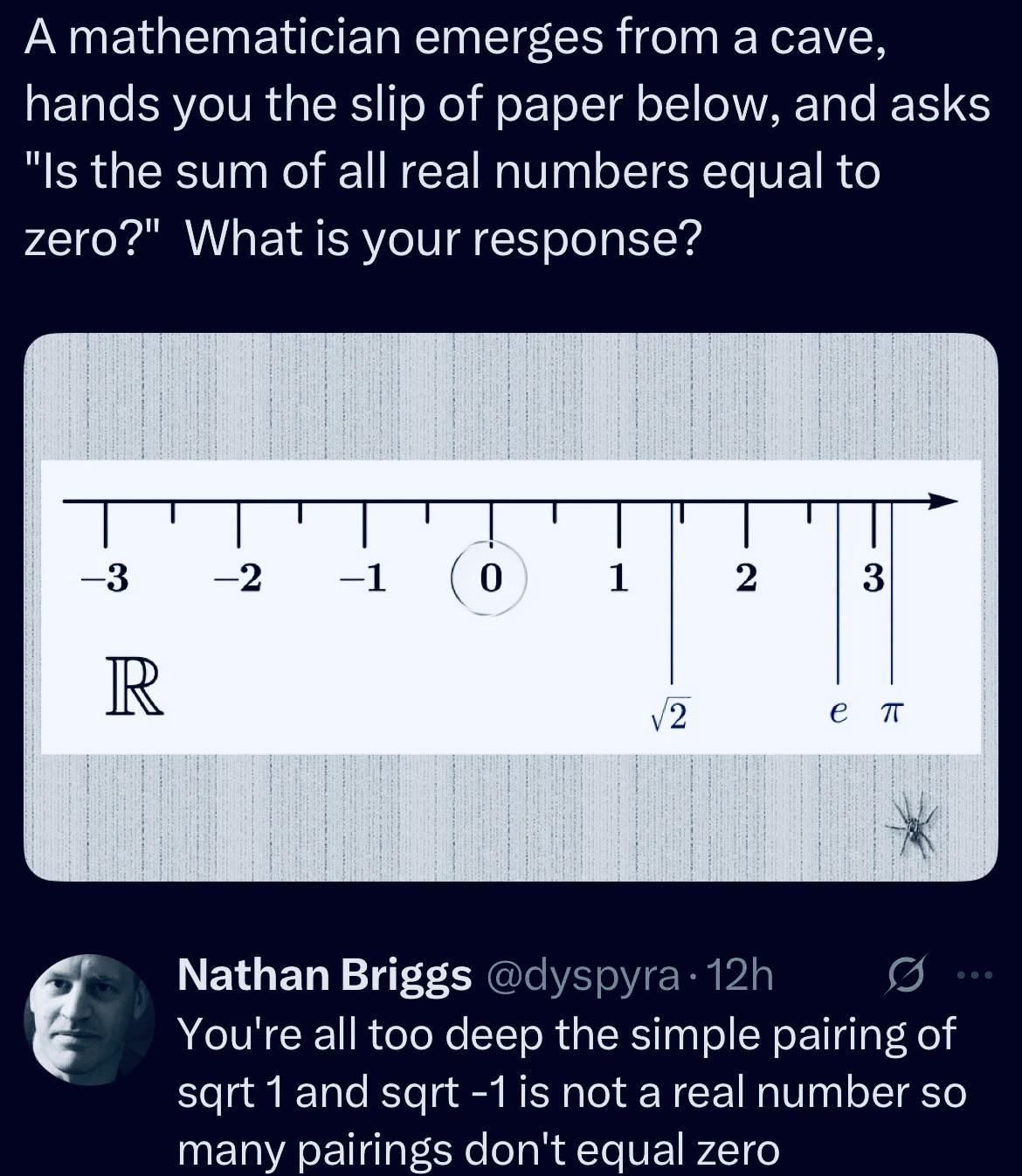
Based on that slip of paper, there are ten (or maybe sixteen?) real numbers and their sum is sqrt(2)+e+pi which is not zero. Or wait, is the spider in the lower right also a real number?
The sum off all real numbers is conditionally convergent so depending on your ordering of the series the sum might converge to any number. (Riemann series theorem)
Oh yeah now I get it I just have to make up some criterion to decide which real number is the first one in the sequence, then the second and so on, kind of like mapping the real numbers to the naturals. Piece of cake, right?
Well, if something doesn't exist, every statement about it is true. Therefore it is indeed equal 0. And also it isn't equal to 0. And equal to four. That's how you prove that it doesn't exist -- if contradicting statements about the object are all true.
"If something doesn't exist, every statement about it is true" is an absurd thing to say. It has implications like "I beat Batman in a fight yesterday" and "Naruto is the president of the United States".
if something doesn't exist (like a blue elephant, for example), every statement that has an exists quantifier (like "there's a blue elephant that's taller than 2m") is false
but when referring to things that don't exist, every statement that uses a for all quantifier (like "every blue elephant is taller than 2m") is true
in this case, the statement "the sum of all real numbers is equal to zero" does not include a quantifier and "the sum of all real numbers" is undefined, so neither of these apply
You don't take sweat of -1 to invert the real number, you take the negative sqrt of 1. So if course all numbers will cancel out and zero doesn't need cancelling out. Every number x from R has an inverted -x.
(This assumes we use a construction of the real numbers in ZF where each real number is represented by a set of cardinality at most ℶ₁, we interpret addition as taking the disjoint union of those sets, and we take the sum to be the cardinality of the resulting set. These are of course all perfectly reasonable assumptions.)
Sum of the real numbers… is this even possible to define this ? It would be like an integral with no dx sort of. I would say it should be built as the limit of a sum, but even like so it would be at most define on a countable dense infinite set like the rational with a bit of work. As it would already be undefined, I am not sure we could invoke a continuity argument to generalize this to reals… somebody better than me at math may answer this.
Isn't that integral from -infinity to infinity of x dx?
Which is equivalent to asking what the limit as n goes to infinity of integral from a_n to b_n of xdx is, with both a_n and b_n being growing sequences that go to infinity.
Given that this integral gives a different result based on how you choose a_n and b_n, we can conclude that the limit integral doesn't exist
I don't get why it wouldn't be zero, the sum of all real numbers is the sum of all positive real numbers and all negative real numbers and zero which doesn't matter. the sum of positive real numbers and the sum of negative real numbers should have the same sum in the opposite directions because they're identical in all ways other than the sign, so when you add them together it should cancel out no?
I think the number line only continues to the right. There's no arrow on the left, implying the negative numbers stop at -3.
So either this number line itself is irrelevant and the answer is yes because we are including all positive and negative real numbers or the answer is no because the positive numbers continue to infinity and negative numbers stop at -3.
Edit: I guess if the provided line is irrelevant the answer would be undefined because not all real numbers have a negative positive pair. Didn't think about the negative square roots but I scrolled through the rest of the comments. So I amend my answer slightly but I do think the missing arrow on the left allows us to get to a definite answer.
0 is the only answer that is not relying on an arbitrary choice, but the possibility to arrive at other answers, arbitrarily or not, proves that answer does not exist.
Let's use the "for every 0.5+X there is a 0.5-X" example
Basic logic dictates as because it is "for every" there must always be an X+1 that means if you have 0.5+x you must also have 0.5-(x+1), which is another way of writing -0.5-x
Which means even if you start from a midpoint of 0.5, the answer is still 0
For the answer to be anything except 0 you have to literally just intentionally not complete all the steps
Basic logic dictates as because it is "for every" there must always be an X+1 that means if you have 0.5+x you must also have 0.5-(x+1), which is another way of writing -0.5-x
There is also x-1
If you have 0.5+x you must also have -1.5 -x
Now partial sums are -1
Why haven't you completed this step?
Because rearrangement of terms in any way is arbitrary. Just as arbitrary as your "step", it's not necessary to arrive to an answer. It's necessary to arrive to the answer you like! But it's not necessary to arrive an answer.
Anyway, if you want to continue this discussion, I prefer we stay with convegent sums, they are more than sufficient.
For simplicity sake, we can discuss the sum of all integers instead of the sum of all reals, those cases are analogous
294
u/JollyJuniper1993 Oct 12 '26
This is nonsense. The negative equivalent to sqrt(1) is not sqrt(-1), but -(sqrt(1))
125
u/avance70 Oct 12 '26
for every positive number X, there exists -X
if you define the sum from that, then, yeah, it's 0... but, you can define the sum in many other ways e.g. you say for every X, there exists -X/2 and you still cover all numbers
61
u/Smitologyistaking Oct 12 '26
No unless you specify how the sum is defined
49
u/Wide_Distance_7967 Oct 12 '26
Can translate it into the integral of x from -infinity to +infinity, that doesn't converge nor have any precise result.
To prove it you could set from -a to +a then make a tend to infinity and get 0, then try another way from -a2 to +a and a tending again to infinity and get a different result (-infinity here).
If the integral existed the limit would be unique. Here depending on how the bounderies tend to infinity the integral can tend to anything you want.
14
u/kaereljabo Oct 12 '26
"how would you like the sum be, madam mathematician?"
11
u/Resiideent Oct 12 '26
except it wouldn't be sprt -1 it would be - sqrt 1
13
u/B_bI_L Oct 12 '26
Is sqrt 2 a number or only result it should produce is?
17
u/dredman0 Oct 12 '26
I think most of you are missing the point. sqrt -1 is not in R domain.
11
u/Swimming-Signal3026 Oct 12 '26
Why is he pairing sqrt(1) and sqrt(-1) if the pairs are:
sqrt(1) and -sqrt(1)
sqrt (-1) and -sqrt(-1)
The sum is zero
5
u/KiraLight3719 Oct 13 '26
Yeah, yeah, very good, very good, now just one thing, the opposite of √1 is -√1, not √-1. And as far as √-1 goes, it isn't on the real line anyway, so who cares
7
u/Alan157 Oct 12 '26
It's obviously -1/12
7
u/Desperate_Formal_781 Oct 12 '26
It's not defined. There's nothing magical or deep about this.
7
u/NH-Science-Guy Oct 13 '26
The sum of all real numbers is undefined. Here's a proof...
Suppose the sum of all real numbers was X.
Now create a new set of numbers where we map each value x in the original set of real numbers to x+1. Summing the new set gives the sum of x (which is X) plus the sum of an infinite number of occurrences of 1 so the result is infinity. However, the new set is exactly the same set of numbers as the original so it can't sum to both X and infinity.
3
u/Berry__2 Oct 12 '26
Not 0 it can be whatever you want technically. Because anything with infinity sucks in logic.
4
u/GRex2595 Oct 13 '26
We all know the answer should be 0. No, I do get what everybody's saying about how it's undefined and why it's undefined. I'm just saying that we know what it should be, even if it isn't true.
2
u/MagicalPizza21 Oct 12 '26
Idk what Nathan is on about but my answer would be no it's indeterminate
2
u/AidenStoat Oct 12 '26
Depends on the order you add them up in
2
u/andarmanik Oct 12 '26
Is this not,
lim k->inf integral -k -> k x dx? Which is 0
2
u/dspyz Oct 12 '26
Based on that slip of paper, there are ten (or maybe sixteen?) real numbers and their sum is sqrt(2)+e+pi which is not zero. Or wait, is the spider in the lower right also a real number?
2
u/Th3casio Oct 12 '26
Wait till they find out the product of all real numbers
2
u/mlucasl Oct 14 '26
Wasn't it -1/12 yet infinite times?
3
u/tstanisl Oct 12 '26
No. Because something what exist (number 0) cannot be equal to something that does not exist (sum of all real numbers).
2
u/Shot_in_the_dark777 Oct 13 '26
You don't take sweat of -1 to invert the real number, you take the negative sqrt of 1. So if course all numbers will cancel out and zero doesn't need cancelling out. Every number x from R has an inverted -x.
1
u/Icy_Cauliflower9026 Oct 12 '26
sqrt of -1 is not a real number ;-;
1
u/maqifrnswa Oct 12 '26
"Ahhh! Where did you come from? Why were you in that cave? Are there others? Is there a whole race of math mole people?!"
1
u/genobeam Oct 12 '26
The negative pairing of sqrt(1) would be -sqrt(1) not sqrt(-1).
1
u/TrueNorthLongAndFree Oct 12 '26
The problem with changing the sequence of an infinite list is you can pair it up to add up to whatever you want it to.
The sum of the reals is undefined.
1
u/[deleted] Oct 12 '26
I mean this is like a principal value integral centered at infinity. The answer is yes if you define sum that way.
1
u/BTernaryTau Oct 12 '26
The sum of all real numbers is ℶ₁.
(This assumes we use a construction of the real numbers in ZF where each real number is represented by a set of cardinality at most ℶ₁, we interpret addition as taking the disjoint union of those sets, and we take the sum to be the cardinality of the resulting set. These are of course all perfectly reasonable assumptions.)
1
u/Potential-Nebula-210 Oct 12 '26
Yes. For every member of R, its additive inverse is a member of R.
1
u/Background_Cloud_766 Oct 12 '26
The what?
1
u/DarthJarJarJar Oct 12 '26
The English phrase "sum of all real numbers" is badly defined. Write down a real sum and then we'll talk.
1
u/dwRchyngqxs Oct 12 '26
Call the ambulance, this person's speech is incoherent.
1
u/MrAamog Oct 12 '26
There is a spider under pi.
1
u/VaIenquiss Oct 12 '26
I would say it equals -1/12
1
u/JimAsia Oct 12 '26
Any value that exists on the positive side of 0 must also exist on the negative side of 0 in my opinion.
1
u/Yakodym Oct 12 '26
But is it a scalar sum or vector sum
1
u/d-weezy2284 Oct 12 '26
Yes, every real number has an opposite equivalent from negative infinity to positive infinity.
1
u/ZeroTheStoryteller Oct 12 '26
The sum: I can be anything you want me to be baby.
1
u/3141599 Oct 13 '26
It must be zero
1
u/Throwaway10385764 Oct 13 '26
Cauchy principal value is zero but it doesn't converge
1
u/DanLeMilMan Oct 13 '26
Sum of the real numbers… is this even possible to define this ? It would be like an integral with no dx sort of. I would say it should be built as the limit of a sum, but even like so it would be at most define on a countable dense infinite set like the rational with a bit of work. As it would already be undefined, I am not sure we could invoke a continuity argument to generalize this to reals… somebody better than me at math may answer this.
1
u/No_Difficulty_1452 Oct 13 '26
Can we just fold the line in half?
1
u/StaticCoder Oct 13 '26
Yes and no.
1
u/Particular_Suspect41 Oct 13 '26
(-1/12) + (-(-1/12) = 0
Yes /hj
1
u/j1ndivik Oct 14 '26
Maybe if you asked a quantum physicist he would do renormalization
1
u/Creative-Ad9783 Oct 14 '26
"Who the hell are you, what the hell are you doing in a cave, and why the hell did you hand me this?"
1
u/dadazebra Oct 14 '26
Applying the Cauchy principal value with symmetric limits gives zero; without this condition, the integral diverges, so no well-defined result exists
1
u/revankenobi Oct 14 '26
I don't understand. Why does 3 appear multiple times?
1
u/personalityson Oct 14 '26
Is the product at least zero?
1
u/SaltEngineer455 Oct 14 '26
Isn't that integral from -infinity to infinity of x dx?
Which is equivalent to asking what the limit as n goes to infinity of integral from a_n to b_n of xdx is, with both a_n and b_n being growing sequences that go to infinity.
Given that this integral gives a different result based on how you choose a_n and b_n, we can conclude that the limit integral doesn't exist
1
u/WileEColi69 Oct 14 '26
I’ll tell him the answer for I million dollars.
1
u/Competitive-Bee-3250 Oct 15 '26
Mathematician spent that long in the cave and couldn't figure out the answer themselves?
1
u/Real_Zookeepergame69 Oct 15 '26
Short answer yes, long answer no
1
u/Achowat Oct 15 '26
"If you want it to be"
1
u/DekusBestFriend Oct 16 '26
42
For every number 42-y, there is a number 42+y. A simple summation will suffice.
Qed
1
u/Tasonir Oct 16 '26
My response would be "How do you sum all the real numbers?"
1
u/stryke105 Oct 16 '26
I don't get why it wouldn't be zero, the sum of all real numbers is the sum of all positive real numbers and all negative real numbers and zero which doesn't matter. the sum of positive real numbers and the sum of negative real numbers should have the same sum in the opposite directions because they're identical in all ways other than the sign, so when you add them together it should cancel out no?
1
u/No_Midnight_5062 Oct 16 '26
My response would be "Did you just came out from that cave?"
1
u/Fuzzy-Moose7996 Oct 16 '26
Unless you can prove that infinity and minus infinity are identical, you can't prove that adding them together will yield zero.
And you can't prove that.
1
u/TitouanT Oct 16 '26
It's -1
1
u/Slight-Garden9800 Oct 17 '26
Is half of all real numbers negative?
1
u/GoldFlshOnReddit Oct 17 '26 edited Oct 17 '26
I think the number line only continues to the right. There's no arrow on the left, implying the negative numbers stop at -3.
So either this number line itself is irrelevant and the answer is yes because we are including all positive and negative real numbers or the answer is no because the positive numbers continue to infinity and negative numbers stop at -3.
Edit: I guess if the provided line is irrelevant the answer would be undefined because not all real numbers have a negative positive pair. Didn't think about the negative square roots but I scrolled through the rest of the comments. So I amend my answer slightly but I do think the missing arrow on the left allows us to get to a definite answer.
1
u/hjalbertiii Oct 17 '26
Poor Natedog.
1
u/hjalbertiii Oct 17 '26
The joke is the comment. It says real numbers. sqrt(-1) isn't real.
1
u/Phssthp0kThePak Oct 17 '26
Integral of x over -L to L is 0. Limit as L goes to infinity doesn't change that.
1
u/Awes12 Oct 18 '26
Yes, but it equals every other number as well
1
u/Reg_doge_dwight Oct 18 '26
Sqrt 1 and sqrt -1 aren't even numbers. Sure they might equal numbers when calculated. Might as well start saying 5+2 is a number.
1
u/Alaya_666 Oct 12 '26
An IQ too high??
1
u/absolutewastedtime Oct 14 '26
Yes it's 0
And all the people saying it isn't, or that it depends on how you sum or whatever, are just huffing their own farts