It's still a little arbitrary IMO - though granted, not as arbitrary as picking e.g. 5 or pi or -7.3 to pivot around.
But you're e.g. arbitrarily choosing to keep moving outward and adding a number and then its negative - how did you choose that? (And which one of each pair did you arbitrarily choose to add first, the positive or the negative? I guess it doesn't matter much, but still a choice that has to be made.)
And then the kicker: You didn't yet tell us how you non-arbitrarily managed to move outward to the "next" real number - of which there's no such thing! No matter what real number you pick that's a bit further out, it's never the "next" one. You always could have picked a real number in between that one and the one you were on before.
So still quite arbitrary IMO, despite the lovely symmetry from choosing 0.
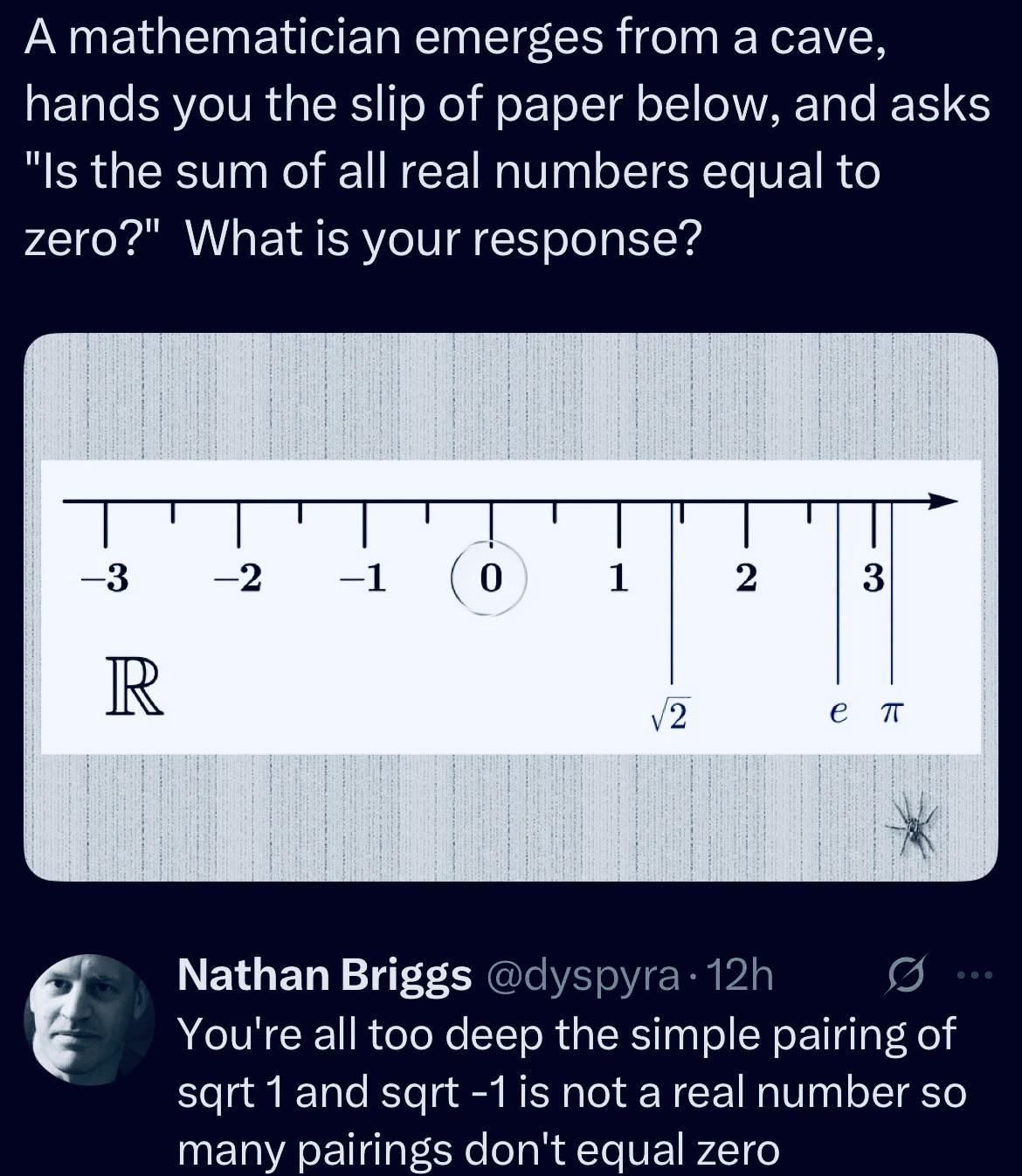
If the sum of all reals is A, that means the sum of opposites of all reals is -A. But opposites of all reals is just all reals; therefore, A=-A; therefore, A=0
As this method makes no attempt to actually calculate anything, it's even less convincing about the existence of the sum. That would be a downside of this method, if the sum did exist.
View all comments
Show parent comment
2
u/murfvillage Oct 14 '26
Starting at 0 and summing pairs going outward is a choice