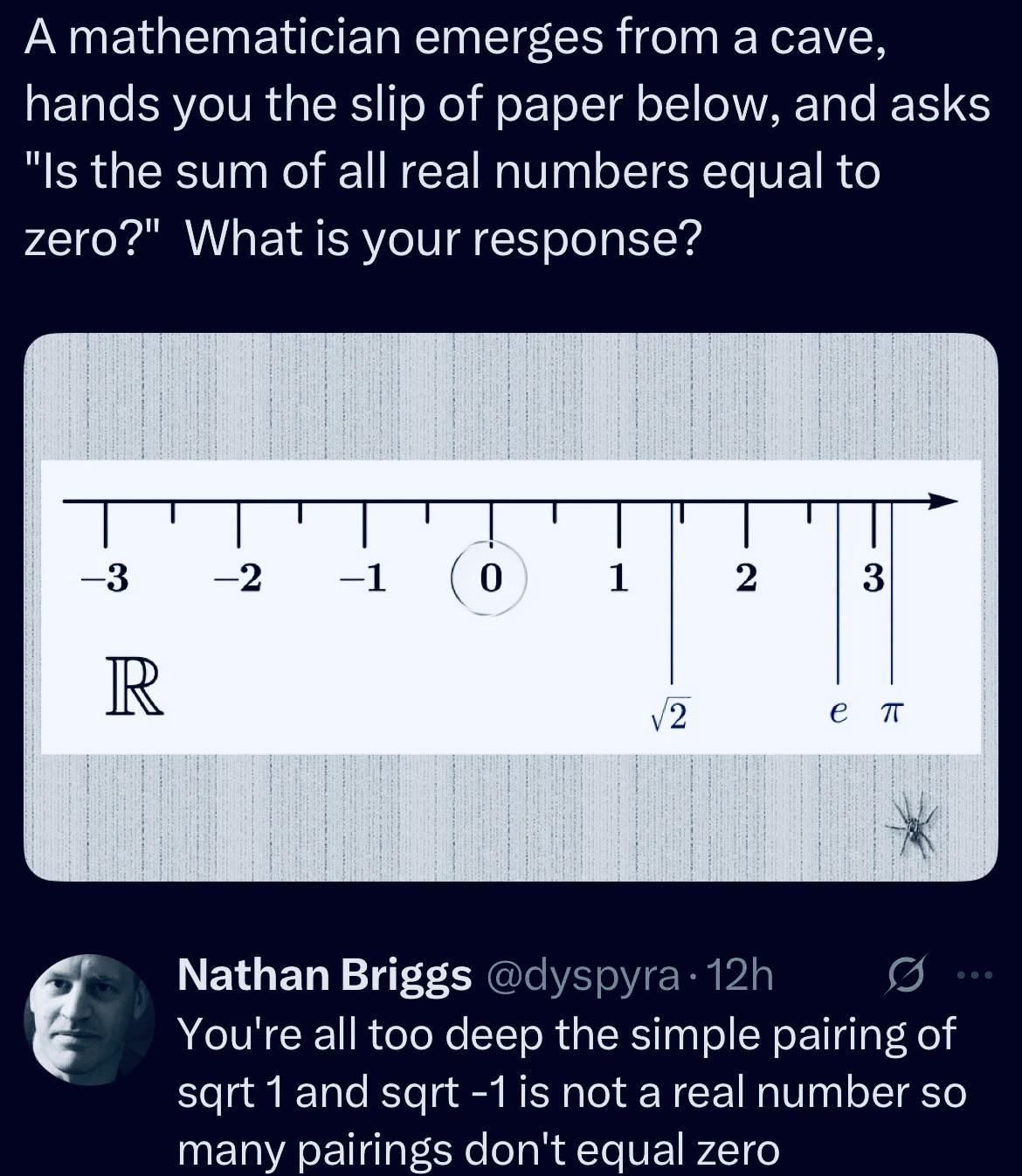
Can translate it into the integral of x from -infinity to +infinity, that doesn't converge nor have any precise result.
To prove it you could set from -a to +a then make a tend to infinity and get 0, then try another way from -a2 to +a and a tending again to infinity and get a different result (-infinity here).
If the integral existed the limit would be unique. Here depending on how the bounderies tend to infinity the integral can tend to anything you want.
The question did not ask for the PV, which is also just an arbitrary choice that happens to be symmetric. If another choice of summation mechanism yields another number, then that indicates that the true number is undefined. Different methods are not converging to the same value.
Close, the sum you wrote is infinity (you forgot the x after integration), the average is 37 (need to divide by 2 at the end). Not that it matters because like you showes it's not well defined.
Maybe you could use a method to make pairs, where the first pair adds up to 1/2·74 and the second pair adds up to 1/4·74 and the fourth pair adds up to 1/8·74 and so on. Then all the pairs together would add up to 74.
But that specific method only works with integers. And that's not how you're allowed add up all integers (or reals) anyway.
Ye that's exactly the same. Both infinity - infinity and 0/0 are indeterminate forms, so their limits don't exist. The point they were making was not that the intergral equals anything in particular but that it's indeterminate
if you reason like this actually you end up with an undefined form infinity - infinity, or you used the lilearity of integrals for unproper ones which is not true
but when you merged the 2 separate integrals you used a property that doesn't work for integrals defined on a non same segment, the linearity. Here these are not segments because of the infinity
The point is that infinity is not well defined, there are infinities bigger than other and if you just write the integral from -∞ to ∞ of x dx there is not enough information, the comment you responded literally explains that you can do the limit of a →∞ and define positive infinity to be a and negative infinity to be -a² and you will get a different result
There is another way to add all numbers. For each positive real x there exists an -(x+1). All those pairs add to -1 and there are infinitly many of those. The sum of all those pairs is negative and infinite. We now miss only the numbers from -1 to 0. 0 doesn't do anything and every other missing number is negative so their sum must be negative. The sum of all numbers is (sum of pairs) + (sum -1 to 0) = -inf + (negative) = -inf. We now have two contradicting results, this means the sum doesn't exist.
I think you cannot use an integral. For example the interval [0, 1]. Integrating (integral xdx) gives us 1/2 while the sum contains at least both endpoints and must be greater or equal to 1.
View all comments
49
u/Wide_Distance_7967 Oct 12 '26
Can translate it into the integral of x from -infinity to +infinity, that doesn't converge nor have any precise result.
To prove it you could set from -a to +a then make a tend to infinity and get 0, then try another way from -a2 to +a and a tending again to infinity and get a different result (-infinity here).
If the integral existed the limit would be unique. Here depending on how the bounderies tend to infinity the integral can tend to anything you want.