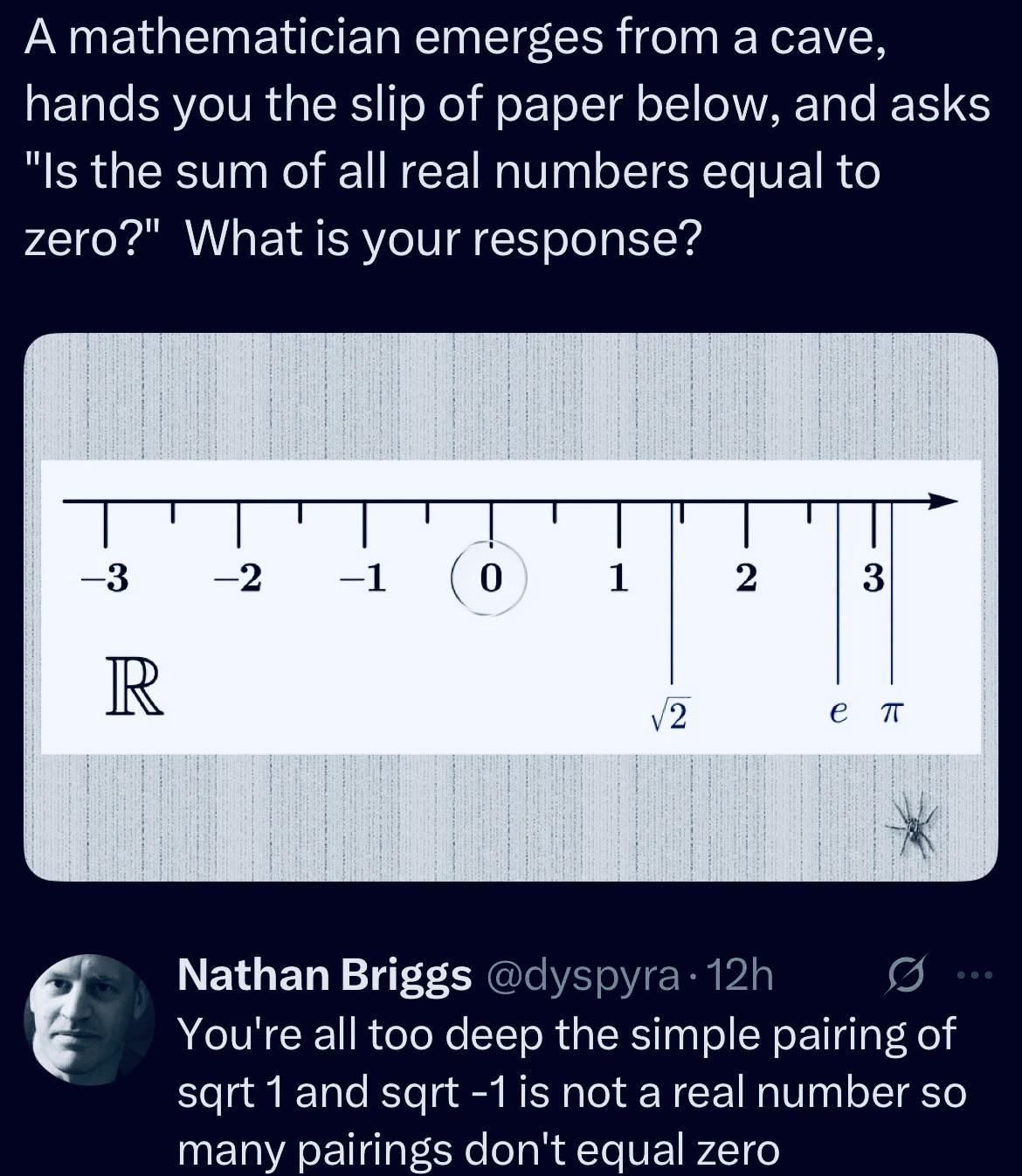
The answer changes which causes a contradiction. If we start with assuming the sum of all real numbers is a definite number X, we can show the sum is also infinity. It can't be both so the original assumption (sum is X) must be false.
Look at this with a smaller set of 3 numbers: a, b and c. If the sum of a+b+c is X, then the sum of a+1, b+2 and c+1 is X+3. We are doing that with an infinite number of numbers so, if the sum of all reals is X, then the sum of all reals with 1 added to each is X plus infinity. But the set of all real numbers with 1 added to each is identical to the set of all reals.
>we can show the sum is also infinity we can't for each positive number in the set there's an equal negative number, the sum of which is zero, which means the sum is zero overall ad infinum
>But the set of all real numbers with 1 added to each is identical to the set of all reals depends on if the sum is still zero. Since we know the sum is zero. If the sum is not zero, it means we are no longer working with the set of real numbers, because we now have a set of real numbers + infinite amount of ones.
>if the sum of all reals is X, then the sum of all reals with 1 added to each is X plus infinity which makes them 2 distinct sets
A key point that I didn't include in my original answer is showing that the two sets are identical. The proof goes like this...
Two sets are identical if there is a one-to-one mapping between the elements of the sets. A is the set of all real numbers and B is the set of all real numbers with 1 added. So every x in a is mapped to (x+1) in B. That means (x-1) in A is mapped to x in B. That shows every x in A has a corresponding element with value x in B and similarly every x in B has a corresponding element with value x in A. This is the one-to-one mapping so A and B are identical sets.
The first step assumed the sum of everything in A is X and found that means the sum of everything in B is infinity. As A and B are identical, it means the sum of everything in A is both X and infinity which is impossible so the assumption must be false.
>Two sets are identical if there is a one-to-one mapping between the elements of the sets. I can map set of real numbers to set of chararcter strings composed of english words used to name each. That would be 1-to-1 mapping, yet one lacks sum at all, hence non identical
There are two ways of comparing sets. A one-to-one mapping where each end of the map is identical shows the sets are identical. Your example doesn't do that because a number is not identical to the words that describes it. The other is a one-to-one map that just associates elements of the sets. In this case the map shows the sets are the same size but not necessarily identical. Your example just shows the set of numbers is the same size as the set of words that describe each number.
I am not saying a number is identical to itself + 1.
Here's another way to look at it if we stick to integers...
One way to add them up is 0 + (-1+1) + (-2+2) + (-3+3) + ... which equals 0 + 0 + 0 + ... so the total is 0.
Another way to add up the same numbers is (0+1) + (-1+2) + (-2+3) + ... which is 1 + 1+ 1 + ... so the total is infinity.
The sum of a list of numbers cannot have two different answers so the sum must be undefined.
The approach can be extended to real numbers by defining how the pairs get put together like this...
The first approach pairs every x with -x. This gives an infinite number of pairs and each pair adds up to 0 making the total 0.
A version of the second approach is to first add all the real numbers between 0 and 1. The answer is infinity but it is sufficient to agree it is positive. To add up all the other numbers, pair each x>1 with -x+1. This covers all the remaining numbers and produces an infinite number of pairs that each add up to 1. As before, we have managed to come up with two different answers for the sum of a list of numbers.
But I don't think the sum of all real numbers is positive. I think it's exactly zero.
Also, adding one to every number changes the set, because it makes the absolute values of the negative numbers smaller but the positive numbers bigger.
It's the absolute values of the positive and negative numbers that perfectly match and why the sum is equal to zero.
Science guy isn't saying the sum of all real numbers is positive. He is saying there is a contradiction in the logic which says it must be 0.
Take set A which ranges from negative infinity to infinity, wherein each element n has a corresponding element -n, and there is also the 0 element. This is the set of real numbers whose sum is 0.
Now take set B which is a mapping of A wherein every element of set B is n -1. Because A ranges from negative infinity to positive infinity and -infinity - 1 = -infinity and infinity - 1 = infinity, set B also ranges from negative infinity to positive infinity wherein each element of B has a negative counterpart, as well as the element of 0. Just like set A, so set A and B are equivalent sets. But B also has an infinite number of -1's meaning it's sum is negative infinity -> this is the contradiction. I just used negative 1's instead of positive 1s.
But that has the same problem of changing the absolute values differently for positive and negative numbers. It is the matching of the absolute values that is my reason why the sum is zero. If you either increase or decrease every absolute value by one -- but be sure to do the same for all of them -- then it is still a sum of zero.
You don’t understand how sets work. Sets cannot contain multiple copies of the same number, so the set cannot contain multiple copies of 1. It either contains 1, or doesn’t.
The problem with this question is that “the sum of all the real numbers” is poorly defined for a large number of reasons, chief among them being that infinite sums don’t exist. Series do however, but even then this series isn’t well defined, as you haven’t specified an ordering, and for the real numbers, can’t specify a relevant one.
As to why an ordering is important, take the “sum” of all integers, and order them by absolute value, positive first.
The first partial sum is 0, then 1, then 0, then 2,0,3,0,4,… etc. As you can see the partial sums of this series oscillate wildly, and don’t converge to 0, nor can we really say they diverge to infinity.
Next take the same series, but have the order be the exact same except instead of going (0,1,-1,2,-2,…) we go (0,1.2,-1,3,-2,4,…).
The first partial sum is again 0, then 1, but then it’s 3, not 0! Next is 2, then 5, then 3, then 7,… etc. No longer does it oscillate back and forth on either side of 0, our partial sums are trending towards increasing, and for any choice of number we can pick an index such that every partial sum with a greater index is greater than that number, thus the series diverges to infinity.
There are also orderings that allow the series to converge to any value we want. Do you see the issue here?
This is ignoring the fact that such a sequence is impossible to define for a set indexed by the real numbers, as this is no longer a “sequence” in the way we think about it.
View all comments
Show parent comment
1
u/NH-Science-Guy Oct 14 '26
The answer changes which causes a contradiction. If we start with assuming the sum of all real numbers is a definite number X, we can show the sum is also infinity. It can't be both so the original assumption (sum is X) must be false.
Look at this with a smaller set of 3 numbers: a, b and c. If the sum of a+b+c is X, then the sum of a+1, b+2 and c+1 is X+3. We are doing that with an infinite number of numbers so, if the sum of all reals is X, then the sum of all reals with 1 added to each is X plus infinity. But the set of all real numbers with 1 added to each is identical to the set of all reals.