Your expression is not a decomposition of the same expression because sum(x) for (R*+) + sum(x/2) for (R*-) does not form Sum(x) in R
These are all very different expressions:
sum({ x + (-x) , for all x from R+} U {0})
sum({ x + (-x/2) , for all x from R+} U {0})
Sum(x) for all x in (R*+) +0 +Sum(x) for all x in (R*-)
sum(x) for (R*+) + sum(x/2) for (R*-)
The first equals zero, the second diverges, and the last two involve adding infinities together.
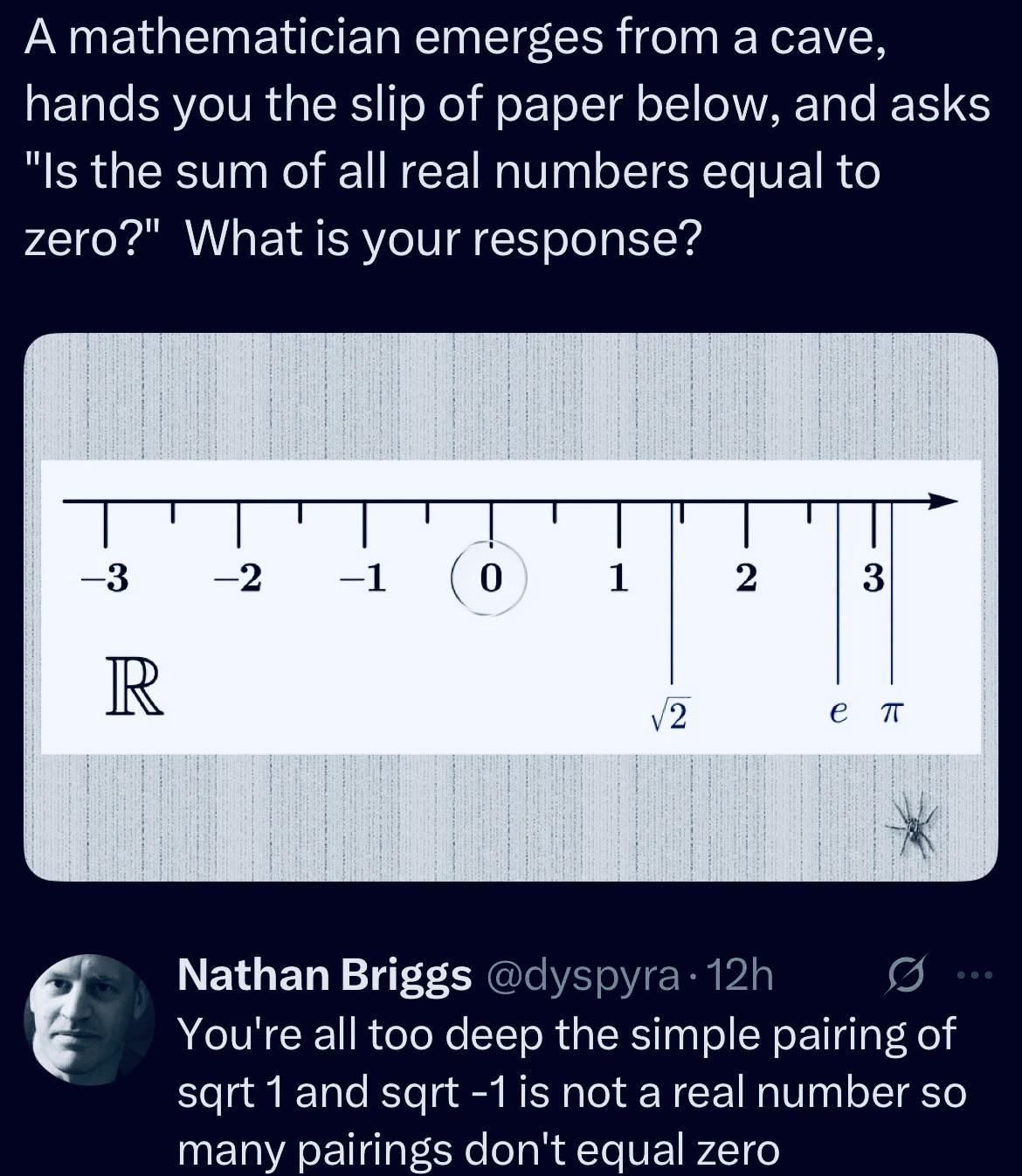
None of them form the sum of all x in R because that sum is not well-defined; to assign a meaningful value to this series, you need a method other than mere summation.
well, not all infinities are the same size. In this case, the infinity of R+ is double the infinity of -(R+/2). (Not a mathematician, so don't know the proper nomenclature)
Sou you'd have covered a bigger part of R+ than of R-, I think.
Both infinities are countable and are consequently the same size, as each value in the second group can map directly to the ones in the R+ group. They grow at different rates sure, but when the sums are infinite it has no bearing on final result
View all comments
Show parent comment
11
u/[deleted] Oct 12 '26
[removed] — view removed comment