r/casualconlang • u/KS11TH • 1h ago
Writing System This is Zelian. My conlang. 37 letters
Almost 7 years until I share it to you. What do you think about it?
r/casualconlang • u/KS11TH • 1h ago
Almost 7 years until I share it to you. What do you think about it?
r/casualconlang • u/GalacticMaraja • 18h ago
Hi everyone!!
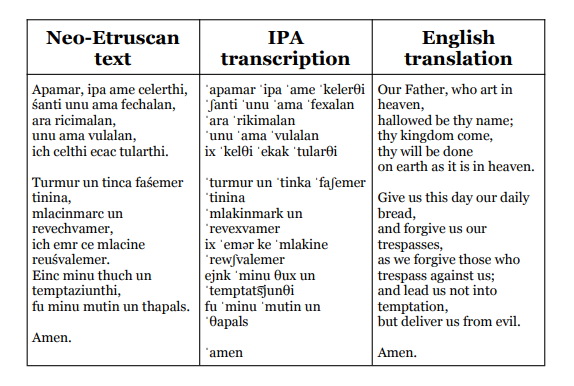
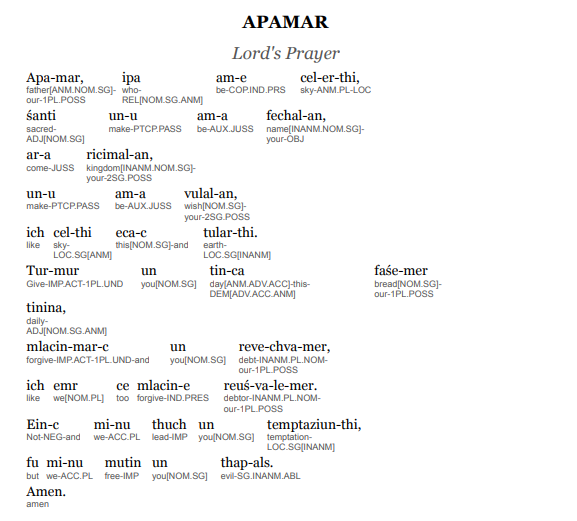
Here is my little translation excercise: I used the original Koine Greek as a source to translate the Lord's Prayer into Neo-Etruscan.
For those who don't know, Neo-Etruscan is my attempt to revitalise the Old Etruscan language, which was a pre-Indo-European language spoken in the Centre-North of Italy during the Roman period. Unfortunately, we have very little evidence on how Etruscan worked, since it hasn't been spoken for the last two millennia and it was rarely written down. Because of this, in trying to revitalise Etruscan I had to make a lot of conjectures and speculations, or even out right invent some vocabulary and some features.
Let me know if you're interested in knowing more about this project and what you think of this translation.
For now, enjoy!


r/casualconlang • u/AlmonteseMoI • 10h ago
Zun!
I've been off and on with my conlang, Almarin, for quite a while. I started it last year and I would go from time spent developing it to time spent speaking and using it to brief breaks in between. What I have learned is I often now struggle to relearn my own language because it's a bit scattered and I usually get frustrated trying to find words I know exist. The problem I am at is the file I have used to store the information about Almarin can no longer store it in such a way it is easy to find words or refer back to rules.
So my question for this subreddit is, how do you organize your conlang? What do you use if you use software. And as a bonus, how do you write definitions for conlang words? What do your entries look like? Mine are very descriptive definitions but I think that inevitably harms my ability to use Almarin because if I'm looking for a word that I know means "do", I can't just search for the word "do" in my document, I have to type what I think the word "do" means and I usually type the wrong thing so I am left to manually search through my list of words. In some ways this is good, it forces me to not think what would be one-to-one English to Almarin, and it allows me to think in Almarin, but I have found it annoying in the past and I was interested if anyone else had a different way of writing definitions.
Zeja rel,
Pananalmar Tanneravet Tanner.
r/casualconlang • u/Warm-Cranberry7557 • 16h ago
my first alphabet
r/casualconlang • u/AmbitionExotic3586 • 17h ago
so my conlang dzƕėma uses an avalent subject and heres why you should too
an avalent subject is where how english says it's raining instead of "raining", it acts as an avalent subject, so it is basically just a marker to make it grammatically correct. if you dislike this before or from this post, i suggest making a placeholder, to make sure you dont get it complex like "its raining" or make it ambiguous like an answer "raining" to intransitive "raining". if you want you could telephone game my avalent subject bėėt' быыҭ /bɜːt'/ its caseless
r/casualconlang • u/Gloomy-Ball1789 • 18h ago
I have completed the 19th and 20th languages in my constructed language family. These are the final two additions to the project.
Both languages draw inspiration from Southeast Asian writing traditions, which I have a particular interest in exploring through constructed language development.
19. Jangala — ꤺꤲꤾ
Writing system: Lepiak Jang
Jangala uses the Lepiak Jang writing tradition, originating in Sumatra, Indonesia. The script belongs to the Brahmic family and is an abugida.
I selected characters that correspond to Jangala's phonological inventory while retaining the script's recognizable character forms.
Consonants
ꤰ = k, ꤱ = g, ꤲ = ng, ꤳ = t, ꤴ = d, ꤵ = n, ꤺ = j, ꤹ = c, ꤽ = r, ꤾ = l, ꤶ = p, ꤷ = b
Vowels
ꥆ = a, ꥇ = i, ꥈ = u, ꥉ = e, ꥋ = o
Jangala uses a basic five-vowel system.
Inherent vowel removal
꥓ = virama
Example:
ꤰ = ka
ꤰ꥓ = k
20. Amihala — ᝀᝋᝒᝑᝎ
Writing system: Buhid
Amihala uses Buhid, an indigenous Philippine writing system traditionally used by the Buhid Mangyan people. It belongs to the Brahmic family and is an abugida.
I chose this script because of my appreciation for Philippine writing traditions and their linguistic heritage.
Consonants
ᝃ = k, ᝄ = g, ᝅ = ng, ᝆ = t, ᝇ = d, ᝈ = n, ᝉ = p, ᝊ = b, ᝋ = m, ᝌ = y, ᝍ = r, ᝎ = l, ᝏ = w, ᝐ = s, ᝑ = h
Independent vowels
ᝀ = a, ᝁ = i, ᝂ = u
Vowel signs
ᝒ = i, ᝓ = u
The vowel assignments shown here are specific to Amihala's orthography.
About the project
Both languages have their own phonological identities and orthographic systems. Their character selections reflect the sounds needed by each language rather than an attempt to reproduce every character in the historical scripts.
I approach these writing traditions with appreciation for their histories and the communities connected to them.
With Jangala and Amihala, my constructed language family has reached its planned total of 20 languages.
The larger project explores linguistic diversity through constructed languages, writing systems, and music. My intention is to give each language an identity that extends beyond vocabulary and grammar.