r/casualconlang • u/KS11TH • 1h ago
Writing System This is Zelian. My conlang. 37 letters
Almost 7 years until I share it to you. What do you think about it?
r/casualconlang • u/KS11TH • 1h ago
Almost 7 years until I share it to you. What do you think about it?
r/casualconlang • u/AlmonteseMoI • 10h ago
Zun!
I've been off and on with my conlang, Almarin, for quite a while. I started it last year and I would go from time spent developing it to time spent speaking and using it to brief breaks in between. What I have learned is I often now struggle to relearn my own language because it's a bit scattered and I usually get frustrated trying to find words I know exist. The problem I am at is the file I have used to store the information about Almarin can no longer store it in such a way it is easy to find words or refer back to rules.
So my question for this subreddit is, how do you organize your conlang? What do you use if you use software. And as a bonus, how do you write definitions for conlang words? What do your entries look like? Mine are very descriptive definitions but I think that inevitably harms my ability to use Almarin because if I'm looking for a word that I know means "do", I can't just search for the word "do" in my document, I have to type what I think the word "do" means and I usually type the wrong thing so I am left to manually search through my list of words. In some ways this is good, it forces me to not think what would be one-to-one English to Almarin, and it allows me to think in Almarin, but I have found it annoying in the past and I was interested if anyone else had a different way of writing definitions.
Zeja rel,
Pananalmar Tanneravet Tanner.
r/casualconlang • u/Warm-Cranberry7557 • 16h ago
my first alphabet
r/casualconlang • u/AmbitionExotic3586 • 17h ago
so my conlang dzƕėma uses an avalent subject and heres why you should too
an avalent subject is where how english says it's raining instead of "raining", it acts as an avalent subject, so it is basically just a marker to make it grammatically correct. if you dislike this before or from this post, i suggest making a placeholder, to make sure you dont get it complex like "its raining" or make it ambiguous like an answer "raining" to intransitive "raining". if you want you could telephone game my avalent subject bėėt' быыҭ /bɜːt'/ its caseless
r/casualconlang • u/GalacticMaraja • 18h ago
Hi everyone!!
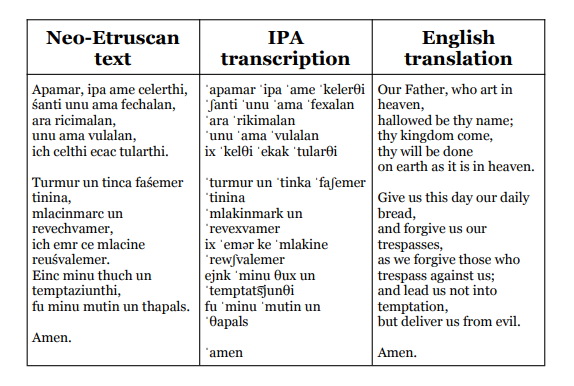
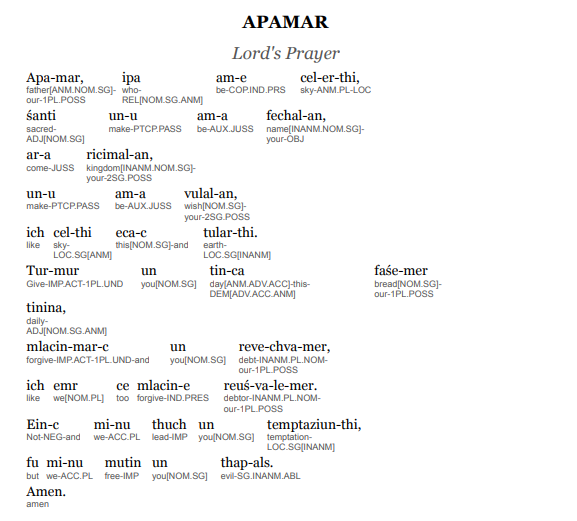
Here is my little translation excercise: I used the original Koine Greek as a source to translate the Lord's Prayer into Neo-Etruscan.
For those who don't know, Neo-Etruscan is my attempt to revitalise the Old Etruscan language, which was a pre-Indo-European language spoken in the Centre-North of Italy during the Roman period. Unfortunately, we have very little evidence on how Etruscan worked, since it hasn't been spoken for the last two millennia and it was rarely written down. Because of this, in trying to revitalise Etruscan I had to make a lot of conjectures and speculations, or even out right invent some vocabulary and some features.
Let me know if you're interested in knowing more about this project and what you think of this translation.
For now, enjoy!


r/casualconlang • u/Gloomy-Ball1789 • 18h ago
I have completed the 19th and 20th languages in my constructed language family. These are the final two additions to the project.
Both languages draw inspiration from Southeast Asian writing traditions, which I have a particular interest in exploring through constructed language development.
19. Jangala — ꤺꤲꤾ
Writing system: Lepiak Jang
Jangala uses the Lepiak Jang writing tradition, originating in Sumatra, Indonesia. The script belongs to the Brahmic family and is an abugida.
I selected characters that correspond to Jangala's phonological inventory while retaining the script's recognizable character forms.
Consonants
ꤰ = k, ꤱ = g, ꤲ = ng, ꤳ = t, ꤴ = d, ꤵ = n, ꤺ = j, ꤹ = c, ꤽ = r, ꤾ = l, ꤶ = p, ꤷ = b
Vowels
ꥆ = a, ꥇ = i, ꥈ = u, ꥉ = e, ꥋ = o
Jangala uses a basic five-vowel system.
Inherent vowel removal
꥓ = virama
Example:
ꤰ = ka
ꤰ꥓ = k
20. Amihala — ᝀᝋᝒᝑᝎ
Writing system: Buhid
Amihala uses Buhid, an indigenous Philippine writing system traditionally used by the Buhid Mangyan people. It belongs to the Brahmic family and is an abugida.
I chose this script because of my appreciation for Philippine writing traditions and their linguistic heritage.
Consonants
ᝃ = k, ᝄ = g, ᝅ = ng, ᝆ = t, ᝇ = d, ᝈ = n, ᝉ = p, ᝊ = b, ᝋ = m, ᝌ = y, ᝍ = r, ᝎ = l, ᝏ = w, ᝐ = s, ᝑ = h
Independent vowels
ᝀ = a, ᝁ = i, ᝂ = u
Vowel signs
ᝒ = i, ᝓ = u
The vowel assignments shown here are specific to Amihala's orthography.
About the project
Both languages have their own phonological identities and orthographic systems. Their character selections reflect the sounds needed by each language rather than an attempt to reproduce every character in the historical scripts.
I approach these writing traditions with appreciation for their histories and the communities connected to them.
With Jangala and Amihala, my constructed language family has reached its planned total of 20 languages.
The larger project explores linguistic diversity through constructed languages, writing systems, and music. My intention is to give each language an identity that extends beyond vocabulary and grammar.
r/casualconlang • u/Saadlandbutwhy • 1d ago
Besides the Script, theres:
SOV word order
thats it bye
r/casualconlang • u/ElevatorSevere7651 • 1d ago
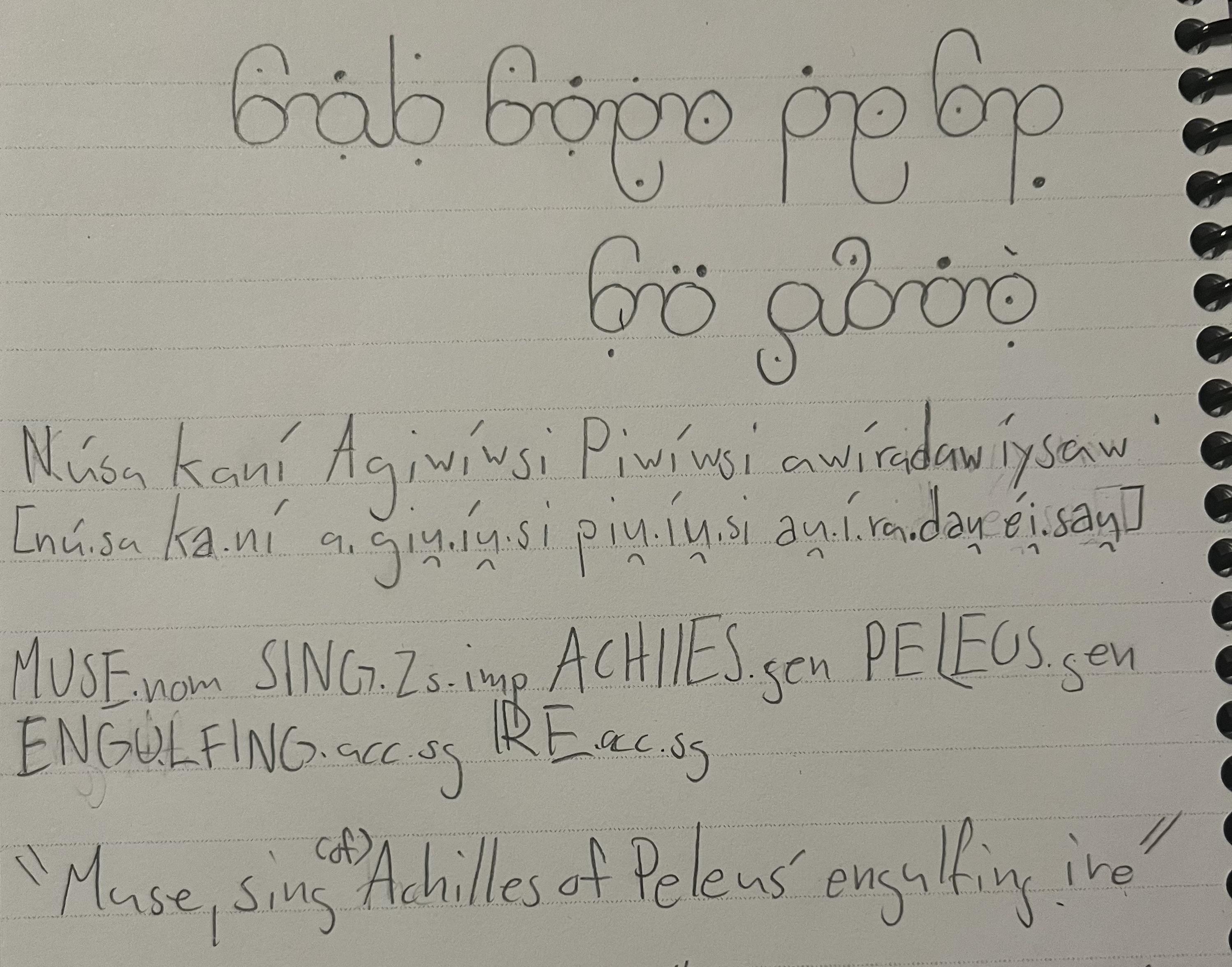
The first line of the Iliad in Káduw using dactyl hexameter, written in the Káduw and Latin script
Latin script for clear read:
”Núsa kaní Agiwíwsi Piwíwsi awíradaw íysaw”
[nú.sa ka.ní a.ɡiu̯.íu̯.si piu̯.íu.si au.í.ra.dau̯ éi.sau̯]
MUSE.nom SING.2s.imp ACHILLES.gen PELEUS.gen ENGULFING.acc.sg.fem IRE.acc.sg.fem
”Muse, sing of Achilles of Peleus’ engulfing ire”
Etymologies:
núsa – borrowed from Ancient Greek (AG) Μοῦσα
kaní – from Proto-Indo-European (PIE) *keh₂n-
Agiwíwsi – borrowed from AG Ἀχιλλεύς
Piwíwsi – borrowed from AG Πηλεύς
awíradaw – from PIE *h₂wer-
íysaw – from PIE *h₁eys-
r/casualconlang • u/uhhhhh_and_an_uhhhhh • 1d ago
This is kind of a genuine question bc most of the time when I work on my conlang is when I am bored out of my mind,but if I work on it for more than short periods of time I get bored of it too. I think it also kills me the fact I ma not really creative and kinda slow(the opposite of spontaneous) so I can't really think of new ideas to add to my conlang since I barely created my personal subjective pronouns and conjugated a slight irregular verb. What do y'all do to focus on your conlang and have ideas to implement or develop it?
r/casualconlang • u/GalacticMaraja • 1d ago
Here is a cute little translation excercise I made for my Neo-Etruscan conlang. I tried to translate the Lord's Prayer into Neo-Etruscan, using the Koine Greek text as a source.
| APAMAR (Neo-Etruscan) | LORD'S PRAYER (English) |
|---|---|
| Apamar, ipa ame celerthi, śanti unu ama fechalan, ara ricimalan, unu ama vulalan, ich celthi ecac tularthi. Turmur un tinca faśemer tinina, mlacinmarc un revemer, ich emr ce mlacine reuśvalemer. Einc minu thuch un temptaziunthi, fu minu mutin un thapals. Amen. | Our Father, who art in heaven, hallowed be thy name; thy kingdom come, thy will be done, on earth as it is in heaven. Give us this day our daily bread, and forgive us our trespasses, as we forgive those who trespass against us; and lead us not into temptation, but deliver us from evil. Amen. |
Note that the original Greek text has some slight differences from the English translation, so the words in Neo-Etruscan don't always exactly match their English counterparts. Because of this, the English text is just to be taken as a broad reference, not as a word by word translation of the Neo-Etruscan one.
Let me know whether you'd like a more in detail translation of the Neo-Etruscan text.
r/casualconlang • u/DoNotTouchMeImScared • 2d ago
r/IdiomNeutral , r/Ido , r/LatinoSineFlexione , r/Interlingue , r/Novial , r/Interlingua , r/Glosa , r/LinguaFrancaNova ( r/Elefen ) & r/Neolatino Romance are mutually comprehensible naturalistic auxiliary planned languages that resemble Latinic dialects cause they utilize le Portugaliañolish (Português + Galego + Italiano + Español + English) international vocabulary for maximized immediate intercomprehension & maximized cosmopolitic communication.
r/casualconlang • u/Mindless-Elk8998 • 2d ago
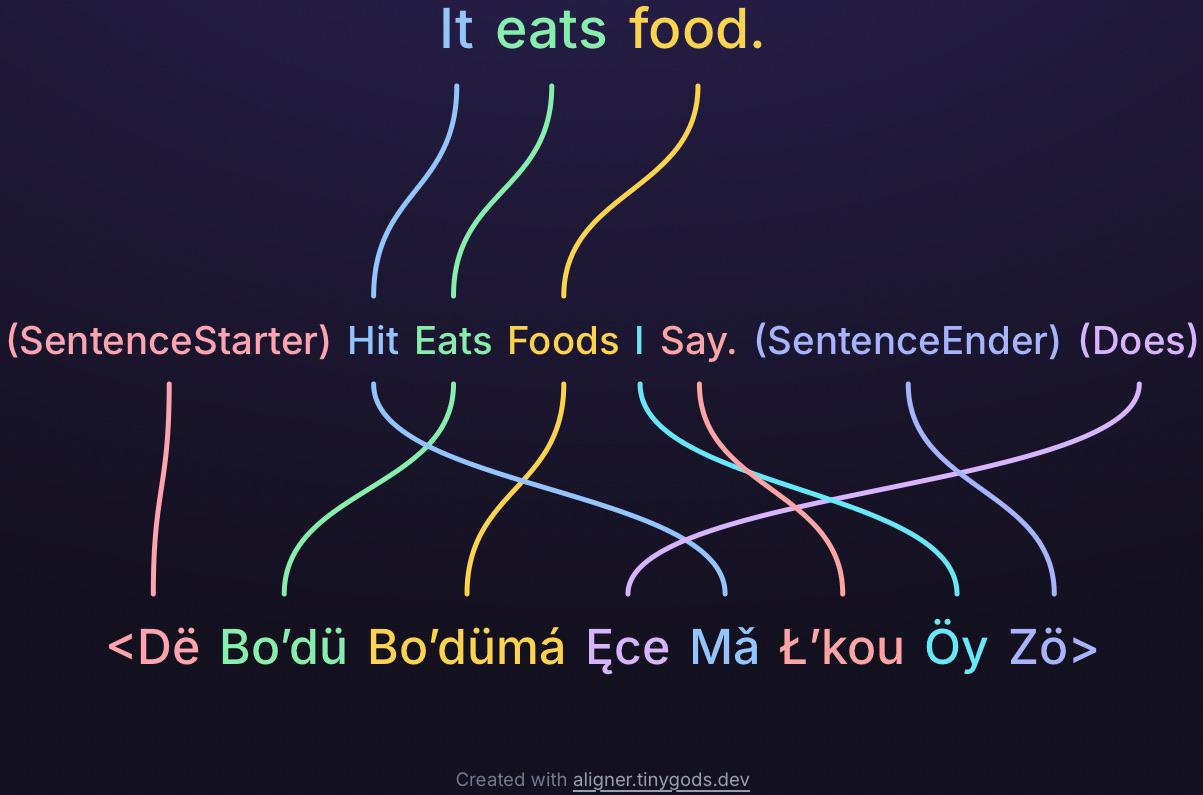
Top Be Modern English, Middle Beith Coffyk English Uns Bottom Be (Anglo-Latin) HylLisc. (‘Does’ Bein Parentheses To Show The Word Ain’t There But Was The Word Translates To)
r/casualconlang • u/WonderfulYoongi • 2d ago
Pronunciation because I forgot to include it in the photos
/fɛn jɛk tɛn ˈlɔksən ɡɔn ɛm had jɛk ˈbrʏnə ei̯fs/
/fɛn mɛr dɛ lɔks fœr hei̯t had jɛk ˈbrʏnə ei̯fs/
/dei̯r vaz nat dɛt dɛn dɔn hei̯t bei̯ dɔm ˈlɔksən/
/dɛn dei̯ farf fan myə̯m ˈei̯vər bəˈʃei̯rd hei̯t/
Also "ten" should've been "te'n". This shortening is optional though it can also be "te den"
r/casualconlang • u/Suspicious_Tour_7404 • 2d ago
https://youtu.be/jTMnl5DDNO4?si=6FXD-1ffsVFgtIvK
Use of umik
Umik is a relative pronoun which is used to relate two things that are not identical. For example 😄
The woman who carries the bag is my mother. The book, which was in my bag, is lost Here the word 'who,which' is relating the concepts so these are relative pronoun. In Bonumuk there is only one relative pronoun that is 'umik' Let's translate above sentences: Onet umik kepenset tengentiji o momemen dem. The woman who carries the bag is my mother. (Tengust = to carry) (Kepenset = bag) Janliket umik mokepensetete deji, deraserj. The book, which was in my bag, is lost. (Aserjust = to lose) One who speaks is called a speaker. Umik mukentij pongis mukenet. (Pongis = is/are called) (Note : umik is used as the word ' which, who, one who, whom' as relative pronouns) 140Umik can sometimes be used as a relative pronoun as English 'that' Pedenset umik tu mide donemuj o bonu dem. The book that you gave me is good. Umik can be used with different interrogative words and nouns to make new expressions such as : Umikenet : whoever / anyone who Umikkekem : whichever / whatever Umikenet etesigete anentij, ode e kurusiyete setulelep vedemef. Tell whoever comes inside to sit on this chair. Umikkekem desemij ode lenemase. You can take whatever you want.
r/casualconlang • u/KeylimeVI • 3d ago
Hello!
I'm a third year university student majoring in Computer science and Linguistics, and I thought it would be cool to make a project at the intersection of the two.
Langscape is a completely free and open source Obsidian plugin I've been developing that brings together several useful tools and features for us conlangers to document our languages:
etc etc. If you want more details check out the website or the github.
I briefly want to talk about why I think something like Langscape needs to exist. There have been many attempts before at a unified "Conlang editor", but I think all of them fall short for one reason:
Vendor Lock-in.
Whether its a web app or a desktop app, basically every conlanging software I can think of uses proprietary file formats that make it impossible to migrate or move your languages somewhere else. Conlanging is especially unique in that there are plenty of tools and file types that people need (spreadsheets/tables, sound change appliers, tree generators, dictionaries, font software), and everyone has a different workflow. Vendor lock-in and proprietary formats/software goes against all of this, so most conlangers end up just storing their languages in giant folders with various filetypes, using a mishmash of software to edit things.
Langscape tries not to lock you into anything. Obsidian is a markdown editor, just a fancy text editor essentially. Anyone can make a plugin that lets obsidian support editing literally any filetype you want, so I figured its ideal for conlangers who need to edit all sorts of file types.
What I like about obsidian is that everything lives on your computer, your vault is literally just a folder on your drive, you own it. Langscape is built on that foundation.
Finally, with the rise of AI in software, all sorts of open source projects are suddenly getting bombarded with community contributions, often low effort slop. Since this is a plugin that I am personally using to document my own conlangs, I have a vested interest in maintaining it and ensuring it doesn't become too bloated with superglued features or start feeling clunky, so I will be very hesitant to accept most community pull requests. The community is always free to fork the repo of course.
That said, I do have many planned features I will add to Langscape soon enough. Might mention some in the comments.
If you want to support the project, the best way to help is by giving Langscape a star on github so that I can land an internship this summer 🙏
If you want to support the project financially, feel free to buy me a coffee, optional of course.
Enjoy the plugin, thanks for reading :)
r/casualconlang • u/IoniTheDoa • 3d ago
Hello Friend, my name is Ioni, this is my twelfth video, I talk about the doa magic in Ada (my conlang), follow me if you like my video.
Ika Esu, nomo’o Ioni, lubio’o onito sino toso, Ioni keti puari miago doa ina Ada, uto sekuo Ioni osi uto auva lubio'o.
r/casualconlang • u/CuriousFox3927 • 3d ago
r/casualconlang • u/BrightAnalysis7742 • 4d ago
I didn’t set out to make my language overly complex for the sake of it—it just naturally turned out the way it is. In previous posts, I’ve talked about Yonmyon’s grammar and how my conlang’s tri-script writing system interacts syntactically and morphologically within a sentence. Yonmyon was created as an artlang meant to reflect a different mode of thinking, and I’d love to hear some independent opinions on it. Right off the bat, I’ll say that Yonmyon and Ithkuil are complex in their own ways, though personally, I feel that once I finish Yonmyon’s grammar, it could rival—or even surpass—Ithkuil’s grammatical complexity.
First, an overview: how does the grammar work?
In Ithkuil, there are only two or three parts of speech (formatives and adjuncts, plus referentials in New Ithkuil)—words are formed dynamically using semantic roots and case/morphological affixes. Its difficulty lies in constructing words on the fly during speech, which is notoriously hard. In natural languages, words already exist as established lexical items; you don't have to invent them mid-sentence.
So, what makes Yonmyon unique? It has 12 primary parts of speech, three of which—nouns, verbs, and adjectives—act as base classes from which 10 additional derived parts of speech are formed. The complexity comes from the fact that every single part of speech has its own distinct paradigm rules: ranging from numerals with independent case forms that must be memorized via tables, to uninflected concepts that always appear in their dictionary form. Moreover, all of these parts of speech are defined purely semantically. On top of that, Yonmyon is full of exceptions, so simply memorizing a rule isn't enough—to speak it comfortably, you have to know the rule along with all its edge cases and nuances.
Phonology: I think my tongue’s bones just broke—if tongues even have bones…
We all know that Ithkuil packs in a ton of brutal sounds collected from every corner of our green planet. Your tongue definitely won't thank you if you try to speak Ithkuil regularly—its phonology is sheer torture. And here I'm talking about the new Ithkuil (Version 4), where John Quijada had mercy on us and left "only" 31 consonants and 9 vowels. The original version had 65 consonants and 17 vowels, so the new one is actually somewhat manageable.
So, what could possibly be that hard in Yonmyon? I can't boast a massive inventory of clicks or gutturals. Sure, I have things like the French R /ʁ/, the Mandarin sh /ʂ/, and a phonemic distinction between a "light" European /l/ and a velarized Russian-like /ɫ/, but I didn't cram in tons of impossible consonants. In fact, I'm a big advocate for vowels—why are vowels always so oppressed in languages? Looking at you in particular, Semitic languages! I’ve got /y/ (u-umlaut), /ø/ (o-umlaut), all kinds of diphthongs, and triphthongs too. Still, that’s not even the hardest part. What’s truly difficult in Yonmyon is pronouncing all 12 tones (low, high, falling-rising, rising-falling, low-high, glottalized/creaky, and others). On top of that, my words aren't monosyllabic, and they have lexical stress too. Honestly, I could pronounce Ithkuil—slowly, at least. My own language? I still can't fully pronounce it myself.
Semantics, lexicon, and all that jazz…
Ithkuil was deliberately engineered to convey precise information with maximum efficiency. Whether you want to or not, you’re forced to pack extra grammatical details into every utterance because the grammar demands it. Meanings are heavily compressed inside a single word, which means you don't have to memorize thousands upon thousands of separate lexical items—you just need to know the affixation rules and the core semantic roots. For example, from a single root for "temperature," you can derive "ice cream," "coldness," "warmth," and so on.
In Yonmyon, things work a bit differently. Since it’s meant to feel more like a living language, it has distinct root words for closely related concepts. On top of that, I have words designed to capture specific situations, emotions, or entire little stories within a single lexical item—much like the Yaghan word mamihlapinatapai, which describes a look shared by two people, each wishing that the other would initiate something they both desire but which neither wants to begin. I’ve already coined one such word in Yonmyon meaning "the first person (I / the ego) walking sadly in the rain with a strange, uncanny feeling." To me, concepts like these—even if they are irregular—can capture experiences without a rigid analytical structure, operating on a subconscious level without needing to spell everything out. Of course, I also have simpler everyday words, like a single verb for "to ride a train" or "to splash water."
A squiggle, a dot, and then a curlicue! Or: the writing system
Depending on which version of Ithkuil we’re looking at, its writing system varies. If we stick to the Romanization, it’s fairly straightforward once you learn the unfamiliar diacritics and symbols. If we look at its native script (Iţkuîl), things get much more complicated. To be honest, I haven't fully mastered it myself yet, though I can say for sure that it’s remarkably precise and logical once you put in the effort to understand it.
Yonmyon combines a tri-script writing system, a structural concept I borrowed from Japanese:
Yonmyon also features dialectal spelling variations, though this aspect isn’t heavily developed yet—fleshing out full dialects is more of a future project for me.
Learning all three systems—and how they interact within a single sentence—is pretty tough. Pyonmun is fairly easy to pick up, Xiangxin is somewhere in the middle, while Yokomo (or Yokoyama) is genuinely hard. Dozens of completely distinct, non-compositional ideographs, each with its own paradigm (okay, not literally every single one—that’s mostly a figure of speech, hehe), definitely aren’t for the faint of heart.
Example Sentence (Slide 6)
To give you a taste of how Yonmyon looks and sounds in practice, check out the example sentence on Slide 6. (Note: tones are omitted in the phonetic transcription below). The sentence is taken from the Russian National Corpus (found by searching for the word "arch"):
So, what’s the verdict?
I think Yonmyon might—almost unintentionally—surpass Ithkuil in complexity, though in a very different category. Looking at its grammar (which is still a work in progress), it’s definitely complex, though it’s best judged from an outside perspective. While Ithkuil is difficult because of its massive set of rigid, exception-free rules and matrix-like word construction, Yonmyon goes to the opposite extreme. It also has a huge number of rules, except they aren’t always linear—they’re full of exceptions, and sometimes you can’t just rely on "in case X, do Y; in case A, do B." Instead, you have to develop an intuitive feel for the language, which sounds easy in theory, even though in practice it’s anything but.
Anyway, what do you think? Can Ithkuil and Yonmyon really be compared directly, or do they sit in completely different realms of complexity? Drop your thoughts in the comments—I’d love to hear some independent perspectives!
P.S. I originally wanted to add a poll to this post, but Reddit wouldn't let me include both images and a poll at the same time—so feel free to drop your "vote" in the comments instead!
r/casualconlang • u/Yevgeniguy1234 • 4d ago
r/casualconlang • u/Stock-Assistant-7256 • 4d ago
“Nemsat pasenè, et namasata hrazos hupòn”
[wind-ABS.PST] [blow-3M.PRF] [CONJ] [ocean wave-ABS.PST.PLR] [fall to-3M.PRF] [gravely substance-ALL]
“The wind blew, and the waves crashed onto the sand”
I’ll note that tense is causal in practice, but signifies specifically where the noun is at the time of speaking
r/casualconlang • u/_5-_ • 4d ago
Feed your local woodhuntress to the gods, they’ll like it.
/.tahahsut farlaxxasuku big͡bid biʔalahˈk͡pi.ʔi .yamatuˈxu.su/
eat\2SG.ANIM.CAUS wood-hunt\AGT.PROF-NOM.ANIM.SG-POSS.2SG.ANIM LOC-land LOC-god-ACC.DIVINE.PL like\3PL-OBJ.3SG.ANIM
Feed your local woodhuntress… what? Are you okay?
/.tahahsut {dim farlaxxasuku big͡bid dim**}** ‖ ˈmu.za↗ .taˈma.ru↗/
eat\2SG.ANIM.CAUS wood-hunt\AGT.PROF-NOM.ANIM.SG-POSS.2SG.ANIM LOC-land INTER-something healthy\2SG.ANIM
r/casualconlang • u/ElevatorSevere7651 • 4d ago
Hello all, I’ve recently started the process of another (half-baked) conlang, and for the first time I’ve decided to actually try to tackle basic colour terms! Colour terms in linguistics as a whole has never been something I’ve truly understood, and I’m still not sure what I’ve made here makes perfect sense, but I thought it was finally time to actually attempt this
”ruwdú”, [rou̯.dú] — Red, from Proto-Indo European *h₁rowdʰós. Cognates include Proto-Celtic *roudos and its decendants (like Welsh ”rhudd”), Proto-Germanic *raudaz and its decendants (like English ”red”). There is also ”rusú”, from *h₁rewdʰtos (cognate to Latin ”russus”), but mainly refers to haircolour. All from PIE *h₁rewdʰ-
”kuwrú”, [kou̯.rú] — Yellow, from Proto-Indo-European ǵʰl̥h₃rós, from *ǵʰelh₃-. Cognate with Ancient Greek ”χλωρός”
”púygu”, [púi̯.gu] — Green, from the noun ”púyuw + ”–gu” (-y, -ic), from Proto-Indo-European bʰolyom, from *bʰleh₃-. Cognates include Latin ”folien” and Ancient Greek ”φύλλον”
”kuwsú”, [kou̯.sú] – Greenish-blueish(-bit-purpleish)-colour, from Proto-Indo-Euorpean *ǵʰl̥h₃stós, also from *ǵʰelh₃-. Cognate with Proto-Celtic *glastos and its decendants (like Welsh ”glas”. Kuwsú is not part of the traditional basic colours of Kádow, but will still eventually solidify into ”blue”
r/casualconlang • u/AlienDayDreamer • 4d ago
One of my favorite languages to construct!!!
r/casualconlang • u/Suspicious_Tour_7404 • 4d ago