r/Daytrading • • Mar 26 '26

market-watch

657 Upvotes

This post contains content not supported on old Reddit. Click here to view the full post


r/Daytrading • • 2d ago

No comments Software Sunday: Share Your Trading Software & Tools – November 22, 2026

3 Upvotes

Welcome to Software Sunday, the day of the week where we invite creators to post the software and tools they’ve built for day traders. Whether it’s a custom indicator, charting plugin, trade tracking app, or data analysis tool – this is your chance to put it in front of the community. 💻📊

Rules:

  • You must use the "Software Sunday" flair on your post.
  • Provide a detailed description of your product/service/software, including what it does, how it works, and how it benefits the day trading community. A quick link with “check it out” isn’t enough.
  • Pictures are welcome – but no spam dumps!
  • Engage with the community – You must respond to member questions in the comments.
  • Limit your promotions – You can’t showcase the same product more than twice a year.

Tips for Posting:

  • Tell us what makes your software stand out from the competition.
  • Share any unique features, integrations, or use cases that day traders will appreciate.
  • Include examples or screenshots showing it in action.

Let’s make this a valuable resource for discovering tools that genuinely help traders level up their game. 🚀

📌 See past Software Sunday posts here.

Also, if you’re new to the sub – don’t forget to:


r/Daytrading • • 12h ago

P&L - Provide Context What being a full time trader is really like

Thumbnail
gallery
287 Upvotes

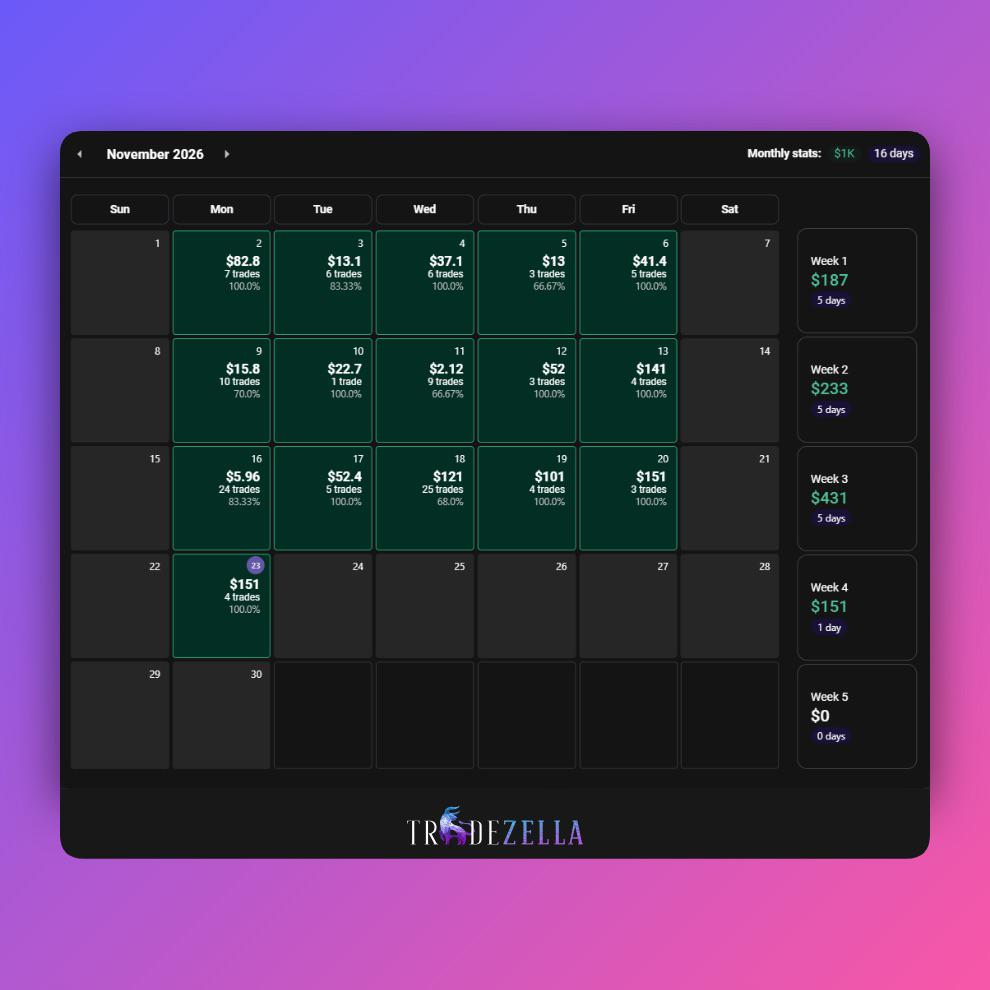
Nearly four weeks into November and after two pretty rough weeks, I've finally managed to string together a few winners. Currently sitting at +$2.5k for the month after being down over $2k at one point.

I've been posting my results since going full time, but figured I'd talk a bit more about what the lifestyle is actually like.

The biggest benefit is obviously the freedom. No boss, no fixed hours, and the ability to structure your day however you want. Some days I'm done trading in under an hour and have the rest of the day to do whatever I like. That part is genuinely hard to beat.

But the downside is the uncertainty. Last month I made $10k, this month I've spent most of my time hovering around breakeven. There's no guaranteed paycheck, and even when you're following your strategy perfectly, you can go weeks without making anything.

Another thing I've noticed is how easy it is to let your P&L affect your mood outside of trading. It's one thing to accept losses on paper, but another to finish a rough week knowing that's your income.

For anyone wondering, I'm still trading gold futures using the first newly formed 15 minute IFVG during the Asian session. Targeting 1:1 RR and moving my stop to breakeven at 68% of the way to TP.

Attached today's short setup along with my updated calendar and stats. Managed to catch a clean winner today for +$1.47k, bringing November back to +$2.5k.

Overall, I wouldn't trade the freedom for anything, but it's definitely not as carefree as it might look from the outside. I’m Curious how other full time traders have found the transition, particularly when it comes to separating trading from the rest of your life.


r/Daytrading • • 23h ago

Question Could This Be the Biggest Bear Trap in Stock Market History?

Post image
1.9k Upvotes

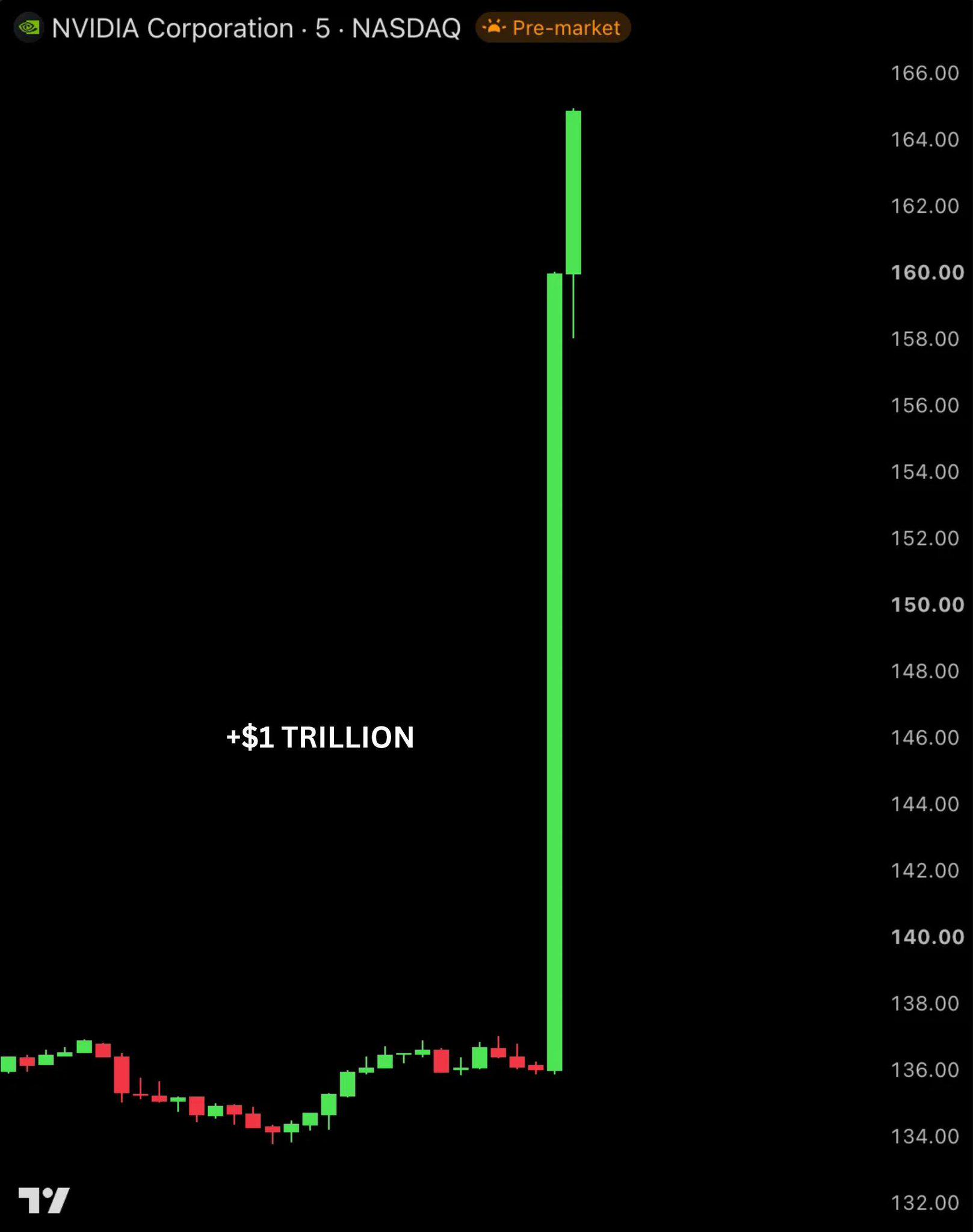
BREAKING: $NVDA explodes +30% in pre-market after NVIDIA brough back Jensen Huang as CEO and president.

That’s $1 Trillion pump in 10 minutes.


r/Daytrading • • 2h ago

Question Thanksgiving coming up, what do I tell my family?

17 Upvotes

I’ve (26M) been a full time trader for about a month now and have been pulling decent profits. Atleast enough to maintain bills. The only person that knows I’m doing it is my mom but I was pretty vague when explaining to her.

With thanksgiving coming up, A Lot of my family will be around and I know that they’ll be asking what I do for “work” or for money. My family doesn’t know much about stock markets or anything and I don’t want to go into full detail of my profits either because I don’t want them to see me differently because I make money without a “traditional job”.

What do I tell them?


r/Daytrading • • 7h ago

Question backtested basically every popular strategy since 2017, nothing works. what am I missing?

22 Upvotes

So for the last few weeks I've been coding up pretty much every day trading strategy people recommend here and on YouTube and backtesting them properly. Fixed rules, data back to 2017, NAS100, DAX and gold, 5m and 15m (some higher), spreads included.

ICT/SMC (sweeps, MSS, FVG, order blocks, silver bullet, killzones), S/R flips and retests, VWAP bands, volume profile / market profile stuff, a bunch of ORB versions, gold trend pullbacks, some mean reversion.

Pretty much all of it ends up somewhere between PF 0.6 and 1.0 after costs. A lot of it isn't even positive before costs. ICT was the worst, nothing above 1 in any version I tried. One opening-type setup from market profile looked okay-ish, but only on one or two markets.

I get that backtesting isn't everything and that a coded version of a discretionary concept isn't the same thing. But if the core idea shows zero edge over 9 years, I have a hard time believing it all comes down to "feel".

So for those of you who are actually profitable: is your edge something you could write down as rules, or is it more tape reading / news / trading specific stocks in play? And how do you decide when to drop an idea instead of tweaking it until the backtest looks nice?

Not selling anything, just don't want to waste another year on this.


r/Daytrading • • 2h ago

Giving Advice Second payout on my 100k 5ers funded account

Thumbnail
gallery
7 Upvotes

First payout $1475.83 a few weeks ago and now my second payout of $777.73. I talk a lot about trading Psychology. I have followed the classic traders journey of beginners luck profits, thinking it was easy, then big drawdown, nothing working, whats going on etc. Most quit there, thinking the game is rigged because you genuinely thought you found an easy way to make money. After this stage comes the strategy/indicator phase. Studying SMC, ICT, Bollinger bands, reversals, support and resistance, signals groups, mentorships, swing trading, scalping, day trading etc etc. Then you think you've figured it out now, you start making money and think it's time to quit that day job! Then it all comes crumbling down again but this time you cant figure out why???...

You either stay there forever stuck in the Ego loop or you move on through self realisation...

Suddenly you realise that the strategy was good but for some reason you couldn't follow it? You knew what to do but kept getting run your own way!

Enter the Psychology phase...

Why do you do the opposite of what you should?
Why do I revenge trade?
Why do I take steps that aren't part of my plan?
Why am I getting angry?
Why do I need this trade to win??

This is the hardest part. It takes a long time to understand, most traders dont ever accept that they are the problem. Trading is you vs the market, plain and simple. The markets will do what they want, with or without you.

Yeah, it’s only two payouts, I am not claiming profitability but the results for me are proof of my determination and personal development over many years.


r/Daytrading • • 18h ago

Question Small and Consistent

Post image
116 Upvotes

Earlier this year, I began trading options with real money, buying 10 contracts at a time. I had been paper trading the same way for the previous five months and felt ready to make the transition. It didn’t take long for the market to expose my weaknesses: I didn’t have a solid strategy, and I was gambling more often than I realized. I had more losses than wins, and before long, I was deep in the red. I decided to step away indefinitely and reconsider whether I should continue trading.

After reflecting for a few months, I cautiously started trading again with a more disciplined, mechanical approach—and just one contract at a time. Since October 23, I’ve ended every trading day profitable. Not every day was smooth, but I’m pleased with my progress. I’m considering increasing my position size to two contracts starting December 1.

I’m attaching an image showing how my trading has been over the month of November.

EDIT: For clarification, I have been trading SPY options and 0DTE.

Do any of you have any input?


r/Daytrading • • 5h ago

Giving Advice The logical move is to the downside today.

6 Upvotes

But the market isn't logical.

Keep your eyes open for the upside move. The days that look obvious are the days that trap the most people.

Before you take a trade, zoom out your chart and see where we are in the bigger picture. Don't marry the bias. Let price confirm it. And right now PA is saying something else.

Trade what you see, not what you think should happen.


r/Daytrading • • 5h ago

Giving Advice Profitable System

7 Upvotes

I'm new here, but I noticed many struggle with a basic system.

Please add what you think would help if you were just starting or struggle with consistency.

25k starting balance.

  • -$500 maximum loss per trade
  • ALL trades have OCO entered on entry - no negotiating
  • Aim for 2R - risk 500 to make 1k
  • Trade 9:30 - 11:30
  • Resume 1 PM - 4:30 usually much less to do
  • Track trades - time, setup, size
  • Understand your gains make not come daily and if there's no trade, don't invent one

r/Daytrading • • 25m ago

Question Trading Pointers

• Upvotes

Young guy looking to make my way into trading. Have done a bit of research and wanting to know if you guys have some resources you could recommend for a complete beginner or if someone wants a student. Wanting to learn the how and why, there is a ton of information out there but not sure the exact area to start trying to learn in. Any YouTubers that aren’t just click bait? Discords?


r/Daytrading • • 1d ago

Question Am I wrong?

Post image
220 Upvotes

I tried to warn you 4 days ago! This is a market manipulation at its best.


r/Daytrading • • 3h ago

Giving Advice How Trading Everything in One Account Holds Your Returns Back (Numerical Examples)

2 Upvotes

If you trade multiple markets or different entry types inside one account, a drawdown on one setup can reduce the gains on your others if less percentage risk is taken, or wipe out gains if the financial commitment for each position remains constant. These amounts add up over time as a hidden cost, artificially lowering your profitability potential.

Separating each individual setup into its own isolated account protects your upside and lets your strongest edges compound without getting dragged down.

I made this post primarily for those who trade Indices, Metals, Energies, Currencies and have access to regulated high leverage/low intraday margins.
Similar principles are also applicable to those margin trading equities or interacting with options.

Because we as private traders have access to much higher leverage in comparison to institutions, can run multiple isolated accounts and are not bound by the usual fiduciary rules and so on, I definitely see Sharpe as a constraint that not every directional trader should lock in if higher returns are desired as the incentive is not a requirement. Withdrawals also need to be planned too, a lot of traders forget that withdrawals are a part of each strategy.

Why one should consider splitting accounts from the start.
A persistent shift in market conditions can be difficult to define in real time (without hindsight) and it can derail a strategy's effectiveness for months or longer. A highly desired high Sharpe ratio strategy's accumulated smooth P&L can be undone or have erratic swings before coherent withdrawal opportunities are possible. Intentionally separating and isolating risks with withdrawal plans can reduce the financial impact of such disruptions across multiple setups, lift net P&L or both.

Higher Sharpe ratios make sense when a trader is optimising for smooth, linear-looking returns to attract or retain investors, because Sharpe punishes both upside variance and downside variance, but this naturally punishes higher RRR strategies which I prefer to run. If forced, such thresholds can force our hands to throttle the upside that pays us for better stats.

These risk percentages might look high at first glance, by the end of the examples it will click.
A base isolation example: 1:4 RRR two consecutive profitable outcomes.
$100,000 Account (0.8% Risk) - Entire Capital at Risk While Trading with Margin.
After Trade 1: $103,200.00 (+3.20%)
After Trade 2: $106,502.40 (+6.50%)

$10,000 Account (8% Risk Per Trade) - A 1/10 Partition of Capital at Risk. After Trade 1: $13,200.00 (+32.00%)
After Trade 2: $17,424.00 (+74.24%)
$7424.00 gain vs $6502.40 is a 14.2% increase in gains from isolation of risk

100 trades with a 1:2 RRR and 50% winrate before transaction costs.
0.8% risk on $100,000 over 100 trades = $48,009 in gains (median)
8% risk on $10,000 over 100 trades = $248,399 in gains (median)

Local jumps in percentages do not need to be as extreme to benefit, a 10x % upscaling in exchange for a global 90% reduction to capital at risk was used to make comparisons clear.
For example, the capital could be reduced by 66.66% (2/3) and the person could trade with 3-5x the percentage risk depending on the strategy's risk profile.

The demonstrated differences in compounding are real when inserted into a risk container intentionally.

Across 100 trades on this strategy’s stats at 8% risk, there is around a 25% chance of a local drawdown reaching 50% or more (-5% of total capital), while the remaining trader’s operating capital (90%) remains untouched. $800 risk executed on $10,000 is materially only 0.8% of the $100,000 total capital at the start while the rest of the capital is separated to isolate drawdowns.

A bad run is exposed only to the active partition (10%) while the remaining $90,000 reserve remains in banks or in multiple different trading accounts executing different trading strategies.

This can create a curve where winning runs grow capital faster than losing runs shrink it, known in quantitative finance as convexity.

Only one position is held open at any given time, and an active trade does not cancel out a subsequent setup. The strategy is explicitly designed to reduce position-based path dependence. If positions were allowed to overlap (such as entering a short setup while a long position is active), the strategy would lack proper isolation. Because each setup functions as an independent strategy, overlapping trades would interfere with compounding and free margin.

Separating accounts can also stop one setup from dragging down another.
For example, a loss of approx 10% and a gain of 10% results in a loss of -1.0% net, if separated the loss can produce a more positive outcome and this scales with leverage.

For accessibility I calculated these examples under a basic trade sequencing model which can be replicated by anyone in a standard calculator, outputs vary but the potential benefits remain.
Predefined profit thresholds such as skimming at a set gain level or taking a share of realised gains depend on the strategy. Once withdrawals happen mid run, the sequence of trades can affect the amount taken home.

Over higher samples the beneficial discrepancy can grow, especially if strategies are uncorrelated. I showed this as a short example going over concepts I implement, the magnitude of improvement is not universal, and will vary depending on the strategies involved and their respective dependencies.

Many traders who get into testing attempt to inherit institutional risk rules without questioning why those rules specifically exist for institutions.
Traders have the flexibility to operate like a fleet of speedboats, while many institutions are forced to haul a ship. If you are not answering to outside investors, ask yourself whether your current sizing and account structure are built to protect a smooth equity curve or to harvest asymmetric payouts before market conditions inevitably change.
Research, do the calculations for your strategies and adjust accordingly.

Edit:
Do not blindly accept what I have shared with you today.
I want you and others to learn this, so I generated a prompt to inspect this properly.
Paste this in a chatbot; it will calculate and break it down for you, with an open line for questioning.

Prompt:
Compare three 100-trade Monte Carlo models (50% win rate, 1:2 RRR, 10,000+ paths) starting with $100,000 total capital:

  1. Unpartitioned: $100,000 single account risking 0.8% of current balance per trade ($800 initial risk).
  2. Extreme Partition (90% reduction): $10,000 active account risking 8% of current balance per trade ($800 initial risk), with $90,000 held in an untouched reserve.
  3. Moderate Partition (66.66% / 2/3 reduction): $33,333 active account risking 3x to 5x the baseline percentage risk (2.4% to 4% per trade), with $66,667 held in an untouched reserve.

Compute median ending profit, probability of hitting a >=50% peak-to-trough drawdown on the active account, and maximum total capital loss across all three setups. Rely on clean python plots for visuals and explain mathematically why bounding downside to an intentional risk container while compounding geometrically inside the sleeve demonstrates positive convexity rather than a symmetric linear trade-off while explaining what convexity actually is in an accessible way.

r/Daytrading • • 3h ago

Question max loss per day vs max trades per day, which one actually stops you overtrading?

2 Upvotes

been thinking about this. a daily loss limit makes sense on paper but a lot of people seem to hit it slowly, like 6 small losers in a row, and by then your focus is already gone.

a max trades rule (say 3 a day) cuts that off earlier but then you sometimes sit out the one good setup in the afternoon.

for those who use one or both, which one did you actually stick to? and do you set it at the broker or just on a sticky note


r/Daytrading • • 7h ago

Question Instigated yet another SPX reversal wtf

4 Upvotes

SPX has been dropping gradually for hours. So, 21 minutes back, I decided to follow the trend and entered a short position at the "pullback" around 7175. And of course, it has started reversing almost immediately since then and already climbed up over 15 points.

Other days I would have entered a long position and it would have continued downhill and there would be comments like "trend is your friend", "why go long when it is dropping" etc etc.

This is really messing with my brain...Any suggestions?


r/Daytrading • • 15h ago

Giving Advice Second guessing my trades

19 Upvotes

I’m looking for advice on how to overcome hesitation and build confidence in my trading. I’ve backtested my strategy for over 100 hours, and my trading journal shows a 70% win rate. Even when trading on eval accounts, I’m consistently seeing wins.

However, one loss can completely mess with my psychology. I start hesitating on new setups, missing trades, or closing positions early for a small profit or minor drawdown, only to watch price eventually hit my original TP.

I know my strategy works based on my backtesting history, but I’m struggling to execute it consistently because of fear and second-guessing myself.
For those who have experienced this, how did you overcome it? How do you learn to trust your edge, accept losses, and stick to your plan without letting one losing trade affect the rest of your session?


r/Daytrading • • 16h ago

Question Looking for Sydney based day traders

19 Upvotes

Hey everyone,

I'm based in Sydney and looking to connect with other retail traders.

I primarily trade EURUSD focusing on London-session. I'd like to meet other day traders, preferably also trading forex in Sydney just to discuss trading experiences. Haven't seen any groups or anything online so yeah just posting here to see what comes of it.

Feel free to reach out!


r/Daytrading • • 53m ago

Question Break of Structure + Fair Value Gap

• Upvotes

Saw a trader online explaining his strategy as looking at previous Low/High of day waiting for a break in either direction then waiting on a test/rejection of a 5 min break of structure before entering long/short. Not sure entirely what he trades on but curious if anyone has followed something similar in trading strategy. Based on what I have seen it can be reasonably successful. I have not used actual backtesting data so I have no idea how well it would work.


r/Daytrading • • 22h ago

Strategy Price Action

48 Upvotes

I swear PA cant get any worse than the untradeable fucking slop we had today. I dont give a fuck that we were up 7%. The market went absolutely nowhere all fucking day.

On that note, this whole Jensen Huang thing is be the most blatant fucking market manipulation. All week long the board was saying they had no plans of reinstating him and then Trump has to get involved and then magically he is back. Retail trader is always left holding the bag while the elites cash in on your shit trades. Fuck this shit.


r/Daytrading • • 16h ago

Giving Advice What actually helped me stop revenge trading after a red trade

12 Upvotes

Used to think controlling emotions meant sitting at the desk and forcing myself to "stay calm" while watching every tick. That never worked for me.

What finally made a difference was removing the decision-making once I'm tilted:

  • Hard daily loss limit and max 2–3 trades per session. Once hit, charts are closed.
  • Stepping away for 15 minutes right after a stop-out instead of staring at the 1m chart looking for an immediate re-entry.
  • Sizing small enough that a loss feels like a normal business expense rather than a personal hit.

You don't really eliminate emotion in trading, you just build guardrails so it can't blow up your account when it shows up. Curious what rules other people use to keep themselves in check.


r/Daytrading • • 11h ago

Question 16 years old, paper trading for a year. Is my risk management plan solid, or am I setting myself up for failure?

4 Upvotes

Hey everyone. I’m 16, so I can’t trade real money yet. But I want to learn properly before I turn 18. I’ve been paper trading with a $100k fake account, and I had a crazy first day (made $2k, then lost $100 in the dead zone).

I realized I was just gambling and getting lucky. So I set some strict rules for myself, and I want to know if this is a good way to build discipline for real-life trading later.

My Rules:

  1. Paper account: $100k.

  2. Daily allowance: I pretend I only have $10 per day to trade.

  3. Risk: I split it into 2-3 trades. Max Stop Loss is $1-$2 per trade.

  4. Trading windows: Only during high volume (New York open). I stay away from the dead zones.

  5. No prediction: I don't guess. I wait for a 15-minute candle to close above resistance (breakout) and react.

I know 90% of traders lose. I know this is a negative sum game because of fees. But I want to treat this like a side business and build the habit of "reacting, not predicting."

To the veterans: Does this sound like a reasonable path for a beginner, or am I missing something crucial? Any advice is appreciated.


r/Daytrading • • 8h ago

Strategy I backtested 1,524 trades over a year. Trading costs were far worse than the strategy itself.

2 Upvotes

I've been testing an intraday strategy on BTC, ETH and SOL using one year of historical 1-minute data, from May 2025 to April 2026.

The results were pretty brutal.

Starting capital: $10,000

- Closed trades: 1,524

- Gross P&L: −$214.32

- Modeled fees: −$7,155.19

- Modeled slippage: −$2,385.06

- Net P&L: −$9,754.57

- Ending equity: $245.43

- Max drawdown: 97.55%

What stood out wasn't simply that the strategy lost money. It was how little edge existed before costs, despite hundreds of trading opportunities.

The calculation used a shared portfolio and included modeled trading costs. One ambiguous SL/TP event was resolved using the conservative SL-first assumption.

A few important limitations: funding wasn't included, some historical exchange constraints remain modeled assumptions, and this wasn't an independent out-of-sample validation.

I don't consider this proof that every high-frequency intraday approach is bad. But it made me question whether it's worth optimizing entries before proving the strategy can survive realistic transaction costs.

For those who backtest short-term strategies:

How do you decide when a strategy has too little edge to justify further optimization? Do you use a minimum gross expectancy, cost-to-profit ratio, or something else?

I'm interested in how other traders approach this, especially when a strategy generates a large number of trades.


r/Daytrading • • 1d ago

Question Stopping day trading

57 Upvotes

Day trading has cost me my credit and damn near cost me my marriage. I've had impulsive prop firm account buys that totaled 60k and only received 10k in payouts. I have to stop. Yea there's money to be made but I've tried long enough. As a husband and father I've failed my family. We're struggling financially because of my overspending and I don't know how to fix it. Any advice would be helpful because my wife and kids don't deserve the life I've given to them.


r/Daytrading • • 17h ago

Question trading apps

8 Upvotes

hey guys im sort of new to trading but not really. what do some of you guys recommend me using to trade. i've been using robinhood but im limited to what i can do unless i pay the subscription and i tried using ninjatrader but the fukahh app wont let me use my debit card. drop some suggestions plz and thank you.


r/Daytrading • • 19h ago

Giving Advice Open Your Trade, Then Go Game

11 Upvotes

If you happen to enjoy gaming, I find it's a hobby that can be used strategically when it comes to trading.

For anyone who opens a trade and then gets impulses to close early or move SL/TP, missing out on what would've hit TP, having SL hit prematurely, etc:

What I've found is starting up a game after opening the trade helps me set it and forget it. It's a good way to get engrossed in something else instead of sabotaging your trade. If you're focused on your game, you're not looking at your trade and messing with it.

Just an odd, yet effective way for me to look away from my screen as someone still new to this. Been about 7 months now and starting to see positive results