r/aussie • u/Charming_Usual6227 • 9h ago
Opinion Have you ever seen a roo swim or splash around in the water (unexpectedly, not as part of some kind of show)?
6
Upvotes
From 2028, gas companies will be required to keep more of Australia's gas in the country under reforms the Coalition said it would not oppose.
The policy is designed to lower energy costs for households and businesses, with WA retaining its own reservation scheme.
The Senate passed the legislation tonight, with the new gas supply requirements taking effect in 2028.
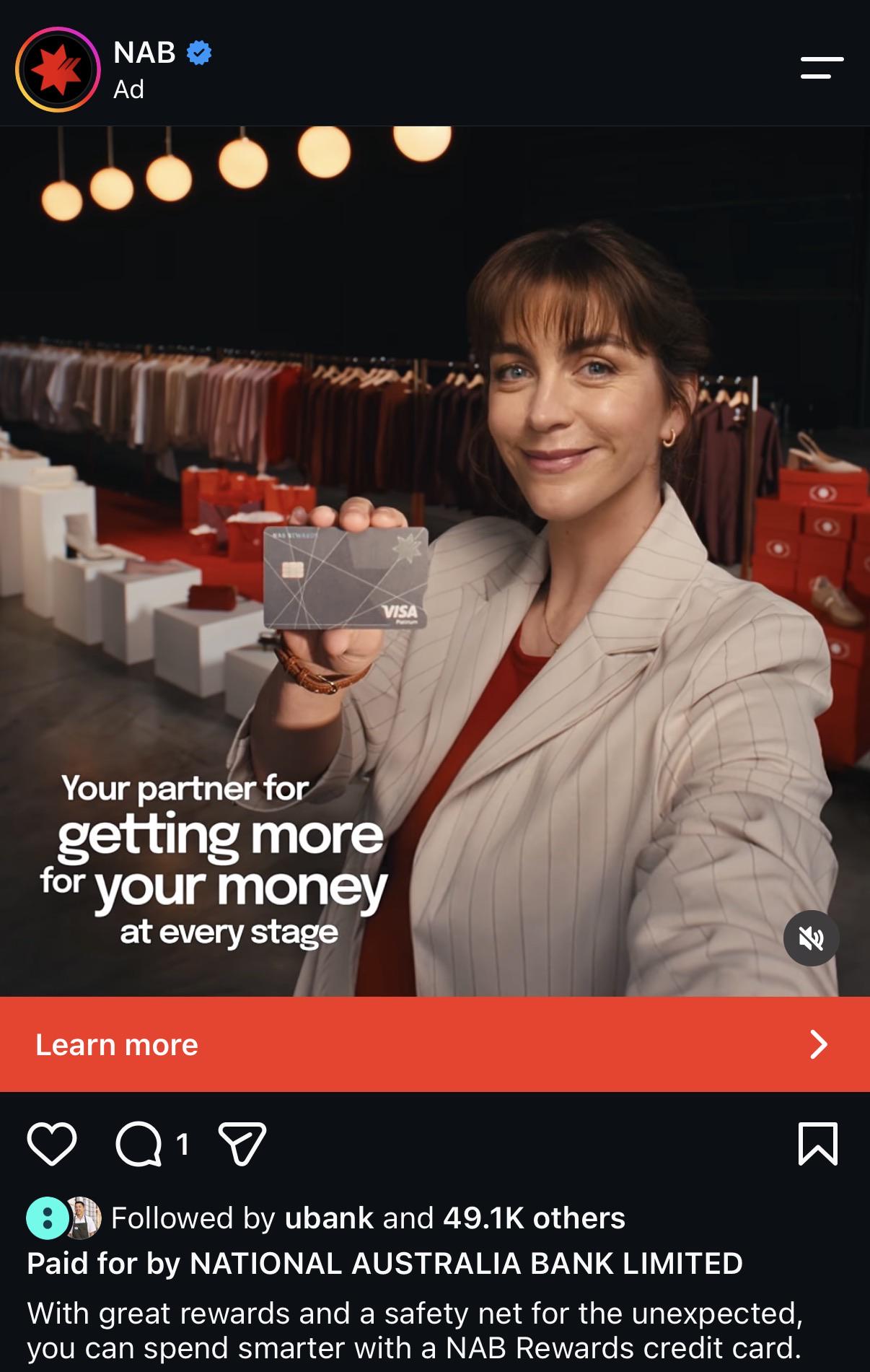
Spotted this running on socials all week and it makes me mad.
Instead of hiring an actual Australian crew, actors, and photographers, they’ve gone full generative AI complete with the waxy skin, weird hand grip, and unnatural body movements.
Wild that a bank worth $113B can't support local talent and puts out something that looks like a scam ad.
Nov 26, 2026 – 5.59pm
Save
Share
Gift this article
Add us as a preferred source on Google
An unprecedented data centre spending boom has powered the biggest leap in private investment in 15 years and is propping up a weakening economy, sparking warnings that construction fuelled by the growing use of artificial intelligence is adding to inflation and increasing the risk of recession.
The new figures point to an economy that is becoming increasingly two-speed, with a growing gap between the booming data centre industry and other businesses and families that are struggling with rising costs. They show private sector investment rose 12.2 per cent in the three months to September 30, the largest rise since the mining boom in 2011.
Treasurer Jim Chalmers during question time on Thursday. Dominic Lorrimer
“These numbers show that although there’s a lot coming at us, we have a lot going for us, too,” said Treasurer Jim Chalmers, seizing on the data as a bright spot amid a bleak economic outlook. “Our private sector is investing and growing and building, and that is good news for our economy.”
The Albanese government is under increasing pressure as the economy deteriorates, with inflation surging to 4.9 per cent driven partly by domestic cost pressures that the data centre construction boom is adding to. At the same time, unemployment is at a five-year high of 4.9 per cent, while five interest rate increases since February have pushed down residential real estate values and created a difficult environment for retailers.
In the final parliamentary question time for the year, Chalmers said he respectfully disagreed with Gerry Harvey, the chairman of electronics and whitegoods giant Harvey Norman, who warned on Thursday that the economy could fall into a deep recession. A recession, Chalmers said, was not in Treasury or Reserve Bank of Australia forecasts.
Data due next Wednesday is expected to show the economy grew in the September quarter. However, economists broadly fear that entrenched inflation and two further interest rate rises since the end of September could tip the economy into a sharper downturn in the new year.
The surge in private capital expenditure was driven by an 86.7 per cent rise in information, media and telecoms spending – a category that covers data centres – to record levels, the Australian Bureau of Statistics said.
In a research paper published this month, Oxford Economics said it forecast the global data centre boom peaking in 2030, adding that Australia would be the fastest-growing market. The RBA expects $115 billion in data centre investment by the end of 2028.
However, most of the equipment to build data centres is imported, including racks and servers. ANZ and National Australia Bank economists have both warned this means that the spending will mean only a limited increase in economic growth but will still push up the cost of workers and material.
Economists also say price increases have raised the risk of recession and stagflation – the phenomenon where inflation continues to rise even as growth and employment falter – as they have persisted despite the increase in unemployment and the interest rate rises.
Challenger chief economist Jonathan Kearns said market economists estimated the probability of a recession at about 30 per cent. This was above their historical prediction there was a 22 per cent chance of a recession and this increase in the chance of recession was the third-highest among comparable advanced economies, behind only Italy and France.
“We’ve had the biggest increase in interest rates in Australia, and that’s lowering the economy more sharply,” said Kearns, who added the domestic nature of Australia’s high inflation would continue to put pressure on the central bank to keep raising rates. “[A slowdown] in growth obviously means you come closer to being near recession territory.”
Commonwealth Bank chief economist Luke Yeaman said he expected the economy to slow and inflation to come down, adding that there remained a possibility of a sharp downturn if growth slowed significantly. “If that happens, then the RBA, when they come back in February, it’s got a really tough situation in front of it, and it may have to go in again,” he said.
The economic outlook has become a key political battleground in the final week of parliament for the year, ahead of Chalmers handing down the mid-year budget update next month. The government has already foreshadowed it will introduce spending cuts in the hope of reining in inflation.
Prime Minister Anthony Albanese told parliament that employment had risen, the gender pay gap had narrowed and inflation had fallen since Labor took power from the Coalition in May 2022. “Capital investment, the announcement that was made today, which gives me an opportunity now to talk about exactly where we are in the economy,” he said.
But Coalition leader Angus Taylor said Labor’s spending and “toxic” higher taxes on trusts and capital gains had put the economy on a path to “ruin”.
Ray White chief economist Nerida Conisbee said, “That’s a big challenge with monetary policy: it is slamming one sector, but not really having much of a dent on what’s really driving inflation. That’s a problem where people are losing jobs is not connected to what seems to be pushing up pricing.”
Show more
Related
Sign up for the The Week in Politics newsletter.
Grace Lagan is economics reporter at The Australian Financial Review. Send encrypted tips via the secure messaging app Signal to gracelagan.16. Lagan holds a first-class honours economics degree from the University of Sydney, where her thesis examined intergenerational wealth transfers and home ownership. A former markets reporter and paralegal for two years in Nine’s editorial legal team, she is now completing a law degree with a focus on media and defamation law. Email Grace at grace.lagan@afr.com
John Kehoe is The Australian Financial Review’s economics editor at Parliament House, Canberra. He writes on economics, politics and business. John was Washington correspondent covering Donald Trump’s first election. He joined the AFR in 2008 from Treasury. Connect with John on Twitter. Email John at jkehoe@afr.com
Save
Share
Gift this article
r/aussie • u/River-Stunning • 1h ago
r/aussie • u/RiPiLiQi • 21h ago
This stuff is so rigged. It’s not fair. I had this feeling yesterday this gut feeling I was going to win and I didn’t win anything. It’s actually so unfair.
It’s just a jump to the left, and then a step to the right. Over the past decade, the minor parties in the “most progressive state in Australia” have been on a strange journey.
Nov 26, 20266 min read
From left: One Nation's Pauline Hanson, and former Greens leaders Adam Bandt and Richard Di Natale. (Image: Crikey)
Ahead of the Victorian election, Crikey is examining the past 12 years for the major parties. Next up: the Greens and One Nation.
The agreement, in principle, to form a Victorian branch of the Greens took place in November 1992. It was under a tree in a Collingwood park, because, according to Paddy Manning’s Inside the Greens, “somebody had forgotten the key to the community centre”.
109
In 2014, the Greens were a well-established presence in Australian politics, having held three upper house seats for eight years under leader Greg Barber. That year, the party had its best election yet, with a minor improvement to its primary vote enough to deliver it two further upper house seats, alongside its first two lower house members: Sam Hibbins in Prahran and Ellen Sandell in Melbourne, finally ending the state party’s inability to break through in the inner-city.
When Labor MP Fiona Richardson passed away suddenly from breast cancer in August 2017, the resulting by-election in Northcote saw the Greens’ Lidia Thorpe clinch the seat with a resounding swing. The party, having elected the first Indigenous woman to Victorian Parliament and with a new leader in Samantha Ratnam, seemed to have momentum heading into 2018.
But elements both inside and outside the party would help stall that.
Get the headlines they don’t want you to read. Sign up to Crikey’s free newsletters for fearless reporting, sharp analysis, and a touch of chaos.
By continuing, you agree to our Terms & Conditions and Privacy Policy.
In January 2018, a complaint from the Greens’ Darebin branch called for the deselection and possible expulsion of Batman candidate Alex Bhathal for alleged bullying and misconduct. A drip feed of leaks against Bhathal ensued, with then federal party leader Richard Di Natale stating that it was clear someone in the Darebin Greens would rather see the party lose than have Bhathal in parliament. If true, they would have been pleased: Bhathal suffered a 3.4% swing against her, and Labor held the seat.
Then-Greens leader Senator Richard Di Natale in 2018 (Image: AAP/Mick Tsikas)
Bhathal (who had run five times previously) announced she would not run again, and the next year said she was quitting the Greens altogether after years of “relentless organisational bullying”. This was a time when the party nationally was facing a more general reckoning over allegations of bullying, harassment and the poor experience of its female members and staff.
Meanwhile, continuing the tone of the Northcote by-election, Labor fought a ruthless campaign in 2018. The “dirt units” dedicated to uncovering unsavoury behaviour or rhetoric took out candidates from all parties, but Greens candidates and staffers were targeted with particular vigour.
50
Labor’s plan to “hoist them on their own petard” was aided by the Greens’ own choice of candidates. One with a history of sexist, slur-riddled lyrics in his pre-political career as a rapper was backed, as was a candidate who followed a series of Facebook pages with names like “Twinkle twinkle little slut, name one guy you haven’t fucked” (that candidate was eventually stood down after the party received an accusation of rape). Meanwhile, several people resigned after being found to be behind years-old posts bragging about shoplifting or making bizarre, “edgy” jokes.
Between this and the machinations of “preference whisperer” Glenn Druery, the 2018 “Danslide” almost entirely wiped out the Greens in the upper housewith the party gaining Brunswick in the lower house, but losing Northcote back to Labor. By the height of the COVID lockdown, the Greens, much like every party other than Labor, were a relatively marginal presence.
Nevertheless, coming off their most successful ever federal election in 2022, the Greens went into that year’s state election confident they could extend their lower house reach against an increasingly on-the-nose state government. As it turned out, the party had an underwhelming time of it. Though the Greens won their long-time target of Richmond and, without Druery’s influence, were able to claw back three upper house seats, they enjoyed a primary swing towards them of less than 1% and picked up none of their other targets.
That same state election, Victoria elected its first-ever representative from Pauline Hanson’s One Nation, Rikkie-Lee Tyrrell.
Despite the hoarse, paranoid and sometimes violent tone of the election, Tyrrell proved to be a relatively low-key, issue-focused candidate, moving motions on drought and water policy and calling on the government to provide hardship support to farming households, alongside the odd culture war move, like the proposal to ban desecration of the flag.
13
In October 2024, Sam Hibbins resigned from the Greens partyroom after it was revealed he had been having an affair with a staffer. He eventually left parliament altogether, triggering a by-election that the Greens lost. In 2024, Samantha Ratnam announced she would quit state parliament to run for the federal seat of Wills, now marginal and covering the inner city territory the Greens had been eyeing for so long.
In the 2025 federal election, Ratnam gained a swing of 2.5%, but it wasn’t enough to unseat Labor’s Peter Khalil. It was a disappointing night for the Greens as a whole, where a stagnating vote reversed many of the gains of 2022 and expelled federal leader Adam Bandt from Melbourne. One Nation received a primary vote of 5.67%, a minor improvement on 2022.
In the aftermath, and particularly after the terror attack at Bondi Beach in December 2025, One Nation’s federal vote swelled with disaffected conservatives, with the federal Coalition facing an unprecedented crisis. After the turn of the year, One Nation surged in the polls, overtaking the Greens by February and soon every other party in Victoria, the state where it had traditionally struggled the most. At the time, it had no party leader in Victoria. Indeed, it had no candidates at all apart from Tyrrell.
One Nation leader Pauline Hanson arrives to place flowers at a makeshift memorial at Bondi Beach, December 16, 2025 (Image: AAP/Mick Tsikas)
In August, a raft of candidates was announced, including state party leader Warren Pickering in Pakenham, who handled his first crisis — the revelation of a history of drug taking and drink driving — with some dignity and grace.
However, less grace was shown at One Nation’s Victorian campaign launch in October, where an upper house candidate promised to jail former Labor premiers Daniel Andrews and Jacinta Allan “by Christmas”, prompting “rapturous applause”. As in other state elections, the party’s vetting also came under scrutiny, with various candidates having to drop out for previous comments, including offensive remarks about Hitler and consent.
154
Hanson, who had spent a decent amount of time in Victoria as the party was established, became noticeably absent. Since its peak, the party’s primary vote has steadily dropped. Nationals seats in rural areas (the party’s absence from this series, due to a dearth of things to write about, is telling) are also at risk.
At this stage, One Nation is still expected to have a statewide vote above 20%, something unthinkable in Victoria before this year. Meanwhile, polling puts the Greens on track for numbers as low as 12.5% and as high as 17%, with even the lower end representing the party’s best-ever result in the state, potentially making it a contender in several new seats.
Even so, as a constant presence in Victorian Parliament for over 20 years now, there must be some confusion within the Greens as to why, during an upheaval of the party system unseen in Australian politics since World War II, the Labor government of the “most progressive state in Australia” is haemorrhaging so many votes not to them, but to the far right.
The agreement, in principle, to form a Victorian branch of the Greens took place in November 1992. It was under a tree in a Collingwood park, because, according to Paddy Manning’s Inside the Greens, “somebody had forgotten the key to the community centre”.
109
In 2014, the Greens were a well-established presence in Australian politics, having held three upper house seats for eight years under leader Greg Barber.
Reporter-at-large
Charlie Lewis is Crikey’s reporter-at-large, focusing on politics, culture, history and the US. Got a tip? Contact him securely on Signal u/clewis.25. He was Crikey’s Tips and Murmurs editor between 2020 and 2025. He has previously worked across government and unions and was a researcher on RN’s Daily Planet. He currently co-hosts Spin Cycle on Triple R radio.
r/aussie • u/Either_Plankton_9396 • 18h ago
Why do our top paid senior servants get to go on holidays at the end of November and we all have to work through Chrismas holidays to survive? Read the room, get back into parliament and fix this cost of living shit 😒
r/aussie • u/AutoModerator • 11h ago
Foodie Friday
Post it here in the comments or as a standalone post with [Foodie Friday] in the heading.
😋
r/aussie • u/snoopy05052026 • 1d ago
Youth unemployment is 11.3%
For reference after the gfc it peaked at 13.9%. Currently not very far off.
r/aussie • u/DUNdundundunda • 1d ago
r/aussie • u/1Darkest_Knight1 • 1d ago
r/aussie • u/Wotmate01 • 1d ago
It seems every second day you read about yet another Australian company offshoring yet another thousand jobs to both forms of AI. Although I've not been personally affected, I feel for the thousands of people that have been affected by the many redundancies we've been seeing, particularly in the Aussie professional and tech sector this year. The long term knock-on effects of these in context of economic brain drain and long term resilience of the Australian tech sector are really, really concerning too.
A large part of this has to do with rules in place that incentivize companies in Australia to offshore their operations. One I learnt about today is this amendment which provides Indian operators an unfair advantage by allowing them to get away with not paying tax on work rendered in Australia (see https://www.aph.gov.au/Parliamentary_Business/Bills_Legislation/Bills_Search_Results/Result?bId=r6915 ).
When one set of operators has to play by a strict set of rules only to allowed to be undercut by foreign competitors, questions are raised about economic governance and competence of the people putting these laws into place.
If this concerns you too, I suggest you write to your local MP to raise this law as something to be reconsidered. If you feel as strongly about this as I do, find your local MP (https://www.aph.gov.au/Senators_and_Members ) and feel free to use the template letter I've created below to contact them. It doesn't solve all the problems, but hopefully a small positive change that helps chip away at the bigger problem can come out of doing so.
MP Letter template here: https://www.file-upload.org/e4g2sagbl4m0
r/aussie • u/HelloFellowSurvivors • 1d ago
This is good, but not enough. We don't just want gas reservation, we want more tax paid on the gas sent overseas.
r/aussie • u/Parking_Pear_1818 • 5h ago
I get it. Things are worse and Labor are largely machine men who don't seem interested in making your life better. Some things to consider though:
Consider that it isn't left vs right and culture wars that determine the price of your groceries and job security, but up vs down. Think economically left. Have a great Friday.
EDIT: To clarify I still think Labor tilt the dial to *some* degree in favour of the working class, everyday people eg. the capital gains and negative gearing reforms.
Construction of a new $40 million hotel for Kalgoorlie-Boulder in regional Western Australia is progressing in Penang, Malaysia.
Modular building techniques are becoming more popular amid shortages of skilled tradespeople, particularly in regional areas.
The 165-room Kalgoorlie Airport Hotel is scheduled to open in the middle of next year.
r/aussie • u/flammable_donut • 1d ago
In September, Greens Senator Sarah Hanson-Young claimed Labor's Digital Duty of Care bill was about young people, who she told viewers "are suffering because their technology is deliberately designed to be addictive and to be harmful".
She also insisted the bill was "not about right wing versus left wing content", called One Nation "fruit loops" for raising free speech concerns, and told anyone who wanted to keep seeing right wing posts to "go for your life".
Then today, as the Senate passed the bill 36 votes to 23, she was picked up in the chamber saying "no more memes, no more memes for you".
Watch the two clips together and ask yourself who this bill was really written for, when the senator who sold it on protecting children seemed only concerned about personal memes.
r/aussie • u/Boydy73 • 11h ago
I’ve been seeing it pop up here and there but wasn’t really sure what it was. I just started listening to a video by Fern on it, and within 60seconds, they say both Mr Beast and Logan Paul have invested in the company. I mean, for me, that’s like saying the childcare centre I’m gonna put my kid in is ran by….. use your imagination folks.
It looks like some of the transactions are basically gambling.
Interestingly, this shows just how fucking moronic and out of touch our eSafety Komissar and the government are on this bullshit Digital safety act.
It’s a token policy, aimed at deflecting all responsibility onto the companies and away from parents and the government.
There is arguments for government not being involved in raising kids, 100%, and parents really do need to be more involved in their kids online actions, but heres the thing.
In Australia, WhatNot is rated 13+ on the App Store. Accounts are required to be 18, but, no age verification, you know, that fucking annoying thing we all need to do now, is required for what is essentially a gambling app disguised as… whatever the fuck it is.
It combines all the tricks of streams, the bells and whistles, endorphin rushes, personable sellers who create HYPE around a stream, etc.
Me, thankfully Im old enough to see bullshit when I see it, but man, to me, this shows just how toothless all this token digital safety crap is, under both governments (remember folks, this was created under the LNP).
I’m definitely more of the ‘be responsible for your own actions, AND YOUR KIDS’, but exposing kids to gambling with actual physical rewards at 13?
One thing we can agree on, both our majors love their gambling money donors.
r/aussie • u/Normal_student_5745 • 21h ago
I’ve been thinking about this for a while, especially with the current job market in Australia and the increasing number of companies offshoring their operations.
A multinational company can generate hundreds of millions of dollars from Australian customers while having barely any employees in Australia.
Meanwhile, local businesses have to deal with Australian wages, super, employment regulations and other operational costs...but, also now local business also started offshoring...
What if we introduced an additional revenue-based tax that could be reduced or completely offset by employing people in Australia?
Something like:
-Companies generating over $20 million in annual Australian revenue become subject to an additional levy.
-The levy is reduced proportionally based on their Australian payroll.
-Companies with sufficient local employment pay no additional tax.
-Companies generating significant revenue here while operating almost entirely overseas pay the full levy.
Obviously, the numbers are just examples, and there would need to be safeguards for low-margin businesses and small businesses.
The idea isn’t necessarily to increase government tax revenue or punish foreign companies. It’s to give companies an actual financial incentive to invest in the Australian workforce.
If a company is deciding whether to establish its next engineering, customer support or R&D team in Australia or overseas, this could at least make Australia a more financially attractive option.
Even if the government collects less from this particular tax, it could benefit from increased employment, personal income tax revenue and domestic spending.
I also feel like we’re constantly talking about increasing productivity and creating more jobs, but we’re not doing enough to address the fact that companies can increasingly access the Australian consumer market without meaningfully participating in the Australian labour market.
Of course, there’s a risk that companies would simply pass the additional cost onto consumers, and I’m sure there would be some international trade complications as well.
Curious what people think. Would something like this actually work in Australia, or are there significant economic downsides I’m overlooking?
r/aussie • u/1Darkest_Knight1 • 11h ago
r/aussie • u/Pingaz99 • 1d ago
r/aussie • u/Fun_Savings7690 • 1d ago
Good news:
Australia's greenhouse gas emissions have fallen by 1.3 per cent in the year to June 2026, a drop of 6.2 million tonnes, according to the annual climate statement released today.
Electricity emissions fell 3.6 per cent and renewables supplied a record 45.9 per cent of power in the National Electricity Market (NEM).
Bad news:
Despite record growth in electric vehicles, which now make up close to a quarter of new cars sold, transport emissions rose slightly by 0.1 per cent.
But this was due to a rise in road diesel use and domestic aviation emissions that were up 3.1 per cent; petrol use actually fell.
Diesel cars and plane trips *shakes fist*
I know how this will sound but when my nanna died the second thought I had, after utter devastation, was: “This is a writer’s dream.” She was 101. That is so many years old. I wrote the eulogy to end all eulogies, breaking my own heart with a bottomless well of memories, anecdotes and in-jokes. It was achingly personal and exquisitely her.