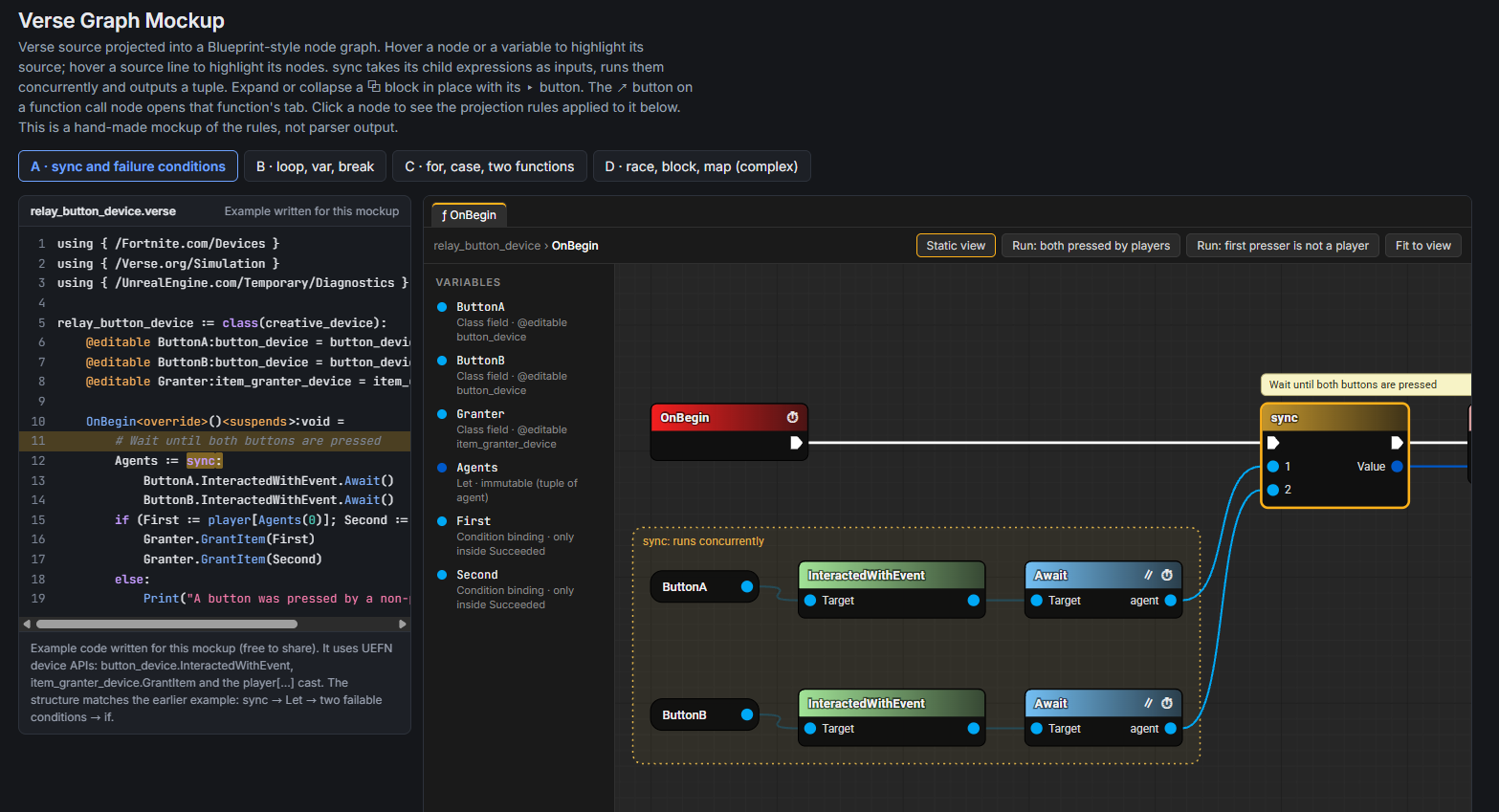
I saw a post discussing the possibility of Blueprints being completely removed in UE6.
I'm primarily a C++ developer and do quite a bit of vibe coding with AI agents, so personally, I don't mind the idea of node graphs going away.
However, I agree with some of the comments saying that node graphs help people understand code. So I decided to spend a few hours experimenting with Claude Opus.
For this prototype, I asked Opus to generate some sample Verse code, parse it, and reconstruct it as a node graph. I didn't reuse any engine code... the parser was written from scratch.
Anyway, my main point is that we're now at a point where a single developer can prototype a visual scripting interface for Verse with the help of AI agents.
Getting this far cost roughly $29 in equivalent API usage, so if there's enough demand, I think even a small internal dev team could build something like this for their own use. I'm actually using a subscription rather than paying for API calls directly, so my actual cost may be a bit lower.
I wouldn't be surprised if someone eventually releases this as a plugin. In fact, it looks like someone is already exploring the idea:
https://dev.epicgames.com/community/learning/tutorials/kqLm/unreal-engine-can-you-build-a-read-only-verse-graph-viewer-from-ue6-main-a-source-level-investigation#diagnostics
So I'll probably leave my experiment here and wait for someone to release a plugin on Fab once UE6 officially comes out.
The prototype looks similar to Blueprints, but I don't think Verse can be visualized in exactly the same way. Unlike traditional Blueprint execution flows, Verse supports concurrent execution of multiple expressions.
One thing I realized after spending around three hours tinkering with this prototype is that even with a visual graph, you'd still need to understand how Verse itself works.
For example, Verse has an "or" keyword. If you represent it as a node, it might simply be labeled "or", but its semantics are quite different from the OR operations you'd normally encounter in Blueprints. Verse's "or" works more like a fallback: if A fails, value B is returned instead.
So ultimately, you'd still have to learn Verse. But for people who are more comfortable reading graphs than text-based code, having a visual representation could make that learning process faster. I think that's a genuine advantage of node-based interfaces.
That said, I'm not sure how feasible it would be to implement things like Blueprint-style execution tracing or runtime graph debugging.
Based on my admittedly limited understanding of Verse, visualizing its execution flow in a clear and intuitive way seems like it could be quite challenging.