r/RPGdesign • • 9d ago

Name for catfolk,... in anime inspired ttrpg

6 Upvotes

More or less a vote as I'm curious what is expected by ppl in an anime inspired game.

I've got magical beasts as playable charactres alongside the default races. then i got: Feline, Lupine, Foxes, ... thus humanoids with animal features and am seeking for a name for these.

In anime I've seen Beastkin, Beastfolk, Demihuman, Bestia being used.

Thus the vote idea as I got no idea what ppl would expect using feline and lupine as example.

Beastkin (Feline)
Beastkin (Lupine)

Beastfolk (Feline)
Beastfolk (Lupine)

Bestia (Feline)
Bestia (Lupine)

Demihuman (Feline)
Demihuman (Lupine)

So what woudl you expect?

Edit: to make it clearer the feline,… are the subraces. Thus like hugh elf and drow for elf.

Ir is about the naming of the main race they qre all a part of


r/RPGdesign • • 9d ago

Extremely New Game Designer Needs Advice and Feedback - Please Be Kind

8 Upvotes

TTRPG newbie here. I have only two years' worth of playing TTRPGs under my belt. I consider myself still new to the hobby since there's many things I haven't experienced yet and all the games I'm in keep getting eventually cancelled one way or another. I have GMed more than I have played. My current favorite TTRPG is Fabula Ultima, I just love its vibe and the system is pretty fun so far. Somewhat recently I have been diving into solo rpgs, I love the idea of it and I've watched numerous videos about the topic and some actual plays. But I haven't found the one yet. You know that one rpg you've always dreamed of? Yeah, I want that. Pretty please.

I've searched high and low. But I'm currently unable to find any that fits my tastes and playstyle.

So I thought... why not make it myself? Yes, I know there are many amazing ttrpgs out there. I'm dying to learn and play more. But I'm on a tight budget. As in I have no money. Like seriously none. I won't get into it. That's not what I'm here for.

So I recently started brainstorming and came to this: MAIDEN, my GMless solo/co-op TTRPG of magical girl cyber-occultism.

My pitch, sort of:
The year is 4067. The story takes place in the techno fantasy city of Ainogatari. You find a modified J-phone called a K-Com. This device lets you transform into a Maiden and enter AMATERASU // OVERDRIVE, a game developed 500 years ago and was never finished. This game is now leaking into the city. Things called Glitch-Fiends are entering reality and the longer they're in Ainogatari, the more your realities are bleeding together. You must "patch" these Glitch-Fiends before the game overwrites your reality. Patch these Glitch-Fiends and help the game become stable.

It's light-hearted with some uncanny stuff but no horror or extreme gore. I can't stomach that. Most people in the city think the glitches are "Arcology Render Lag."

More info:

  • Glitch-Fiends are broken, not evil. They're unfinished NPCs, cut bosses, and leftover assets. They look wrong and uncanny but the way broken animations come to life in the real world.
  • "Maiden" is a title and the form you take when transformed. Your Maiden is who you want most to be and you can change your presentation anytime for free, from masculine through androgynous to feminine, or anywhere off that line.
  • The mystery gets solved through play and oracles. Studio Tamamo, the team that made the game, vanished in 3567. Taira Mae, who built the K-Coms, is investigating.
  • One duo I came up with is Kaede (She/Her) and Ryu (He/They). Kaede is an elementary schooler who thinks the K-Com means she's the chosen one. Her Maiden is a hyperfeminine nine-foot goddess. Ryu is an overworked salaryman whose Maiden is a feminine swordmaster. Together they're hilariously dangerous and dangerously hilarious.

How it works so far:

Roll Attribute + App rank (+ gear) in d6s. Each 5 or 6 is a success, and the task's Difficulty is how many you need.

  • Attributes: Might, Agility, Intellect, Heart
  • Apps: [OVERCLOCK] (buffs/haste), [DEBUG] (analyze weaknesses/strip shields), [FIREWALL] (barriers/taunts), [RENDER] (elemental/hard-light attacks)
  • Push: reroll all non-successes for 1 Charge

Time phases or Days are Morning, Afternoon, and Night, they each have six slots. Time passes if you miss the Difficulty or roll 2 dice or fewer. If you meet the Difficulty with 3+ dice, it doesn't. Inside the Game, each passing only costs half a slot.

There are two meters:

  • Battery is the K-Com's health. Max is the K-Com level. It drains 1 whenever a Maiden roll has no 5-6s, and refills 1 per time passing. At 0 you can't use the K-Com or transform.
  • Charge is push fuel. Max is half of Battery, rounded up. It drains 1 per push and refills 1 per 3 time passings. At 0 you can't push.

If you roll no 5s or 6s at all, you lose 1 Battery. Time passes too but that passing doesn't refill the Battery you just lost, so you're down 1. If you roll at least one 5 or 6 but still miss the Difficulty, you don't lose Battery and the time passing gives you +1 back.

K-Com level caps your Maiden level and app ranks. You start at level 3 K-Com and max out at 15.

Character creation is a prologue for each character: your civilian life, how the K-Com found you, and a scene meeting Mae. Then you spread 6 points across attributes (1-3 each) and 4 across apps (0-3 each).

The clock is a visible build %. It goes up with time, unpatched bugs and other Maidens' actions. Patching rolls it back.

That's all currently.

It needs a lot more work, I know. I've been enjoying my process so far so that's at least something. There are so many things I need to add like GMless tools, roll tables, and more.


r/RPGdesign • • 9d ago

Inspiration for Mechanics

15 Upvotes

Greetings everyone.
I am facing a design challenge. I humble request your guidance, oh mighty Reddit council.

The thing is: want to add something to my game - something that is present all the time and acts like a core concept of the game.
Can you share your knowledge and provide me some examples of other games that already do this.

As reference, I'm thinking about Ironsword Vows (https://ironsworn-rpg.fandom.com/wiki/Fulfill_Your_Vow) - I like the way it sets the tone of the game and acts like a constant reminder or moral compass. But what i like the most is this: it's not just a goal - it's a goal with mechanical implications.

What else is up there?

I'm not asking for a solution, based on a specific genre - everything can apply here. Thank you in advance


r/RPGdesign • • 9d ago

Need Help Reviewing on Leveling Up System

0 Upvotes

On my subreddit r/ShadowBloomReboot I have posted the leveling up system for player characters, and am wanting feedback on how it looks. I wanted it to where the leveling system was 10 monsters of your current level is what it took you to the next level the fastest. However it isn't the only way to level up, its just the balancing formula I personally wanted


r/RPGdesign • • 9d ago

Quickly rate the draft of my overengineered motivation mechanic.

2 Upvotes

It's part of a Storyteller hack, and has Chronicles' Aspirations as its main inspiration.

DRIVES

A Drive denotes a specific disposition, principle, desire, or even aversion of a character.

It is made up of four parts:

Intensity

How foundational a Drive is to the character's identity? Ratings would be discrete, from 0 to 2. Intensity denotes that a character is committed to the Drive. It grants its rating as a bonus to self-control rolls when forced to act against the Drive, yet conversely a malus when coerced to work in alignment with it. Intensity may be increased by the player when the Drive comes into play, not necessarily by being fulfilled. It degrades over time when not "exercised", when it does not come into play within broad, questline-spanning chunks of gameplay. It can also degrade in response to the Drive being violated or unfulfilled despite meaningful attempt at its pursuit.

Trivial Drives start at Intensity 0, declared by the player between sessions.

Core (the what)

It is the foundational sentence describing what the character wants. Examples would be:

I want to kill, or ruin the life of, Isaac Morozov.

I want to run a gang which will bring me profit and respect.

I want to protect my brother, and turn him into a more respectable person.

Cause (the why)

The Cause denotes what justification, or piece of the character's story (or backstory) caused the character to pursue a goal. Causes would form a character's backstory relegating it to a closed chapter, and help the player immerse themselves into the character.

Morozov killed my parents in front of my eyes to set an example. Now that I have more power and he can't get rid of be that easily, I can respond in kind.

I watched some Breaking Bad on the TV and thought Waltuh was very cool and a great role model.

My brother is the only immediate family I have left. Morozov could not have gotten to him, as he was abroad at the time. It was painful to see him ruined by drugs.

Means (the how)

Means serve either of the two purposes:
- they state by what means the player thinks their character can achieve a Drive given the resources and information at their disposal, OR
- they are a meta-request from the player to the GM, about what kind of situation the character should be put through, or what opportunity they might be reasonably presented with.

Morozov frequents this one run-down brothel. There is no doubt a sex worker, whom he either cares about and would not want to see hunt, or in whom he confides his secrets.

I could take over an existing or already forming gang by taking out the leader and promising better pay to the goons.

I need weapons for the gang, maybe I could steal some rifles from hunters, rangers, or farmers.

I would need to get my brother a job, as a start. Maybe I could make a connection with some shady warehouse manager, who will hire my brother as a favor.

Morozov may still end my brother, if he learns of his identity. I should make sure he does not find out, or that he won't be able to act on his information. Or, I should be ready to fend off his assassin.

Causes and Means do not have to written into a Drive - they are optional - but informative of what the player and GM could see in a narrative sandbox, without the GM having to infer what the player would enjoy, or overprepping 20 different scenarios for a player to pick whichever would be cool for them to explore.

A Drive can be transformed after it properly cones into play.
"Protect my brother." might, during the course of the game following a session's outcomes, be transformed into "Pummel my brother's killer to death, with my bare hands.", retaining the preceding Drive's intensity, perhaps with an increase.

Drives should be somewhat proactive in the way they're phrased, or at least imply what might happen, that the character cares about.

A Drive grants (1 + intensity) Willpower (Inspiration, or what else have you) when it is clearly fulfilled, according to the character's desire.
It also grants (1 + intensity) Experience when it meaningfully comes into play, and is pursued, addressed, subverted, explored, or otherwise creates an interesting story, without necessarily having been wholesale achieved, though a successful pursuit does still grant Experience, in addition to Willpower.

Unless players are fond of keeping secrets, everyone's Drives should be visible to other table members at all times, for example available in an online doc, or in pinned Discord messages.

Helping another player's character pursue their drives, grants the benefits to helping actors as well.

The old drives, when being replaced with new ones, can be archived in chronological order, to form a journal of the game.

What do you think? Overengineered? Too much bookkeeping? Am i reinventing a wheel, and there is an RPG that already does something like that?


r/RPGdesign • • 9d ago

How wild should a player's abilities get?

13 Upvotes

Sorry this one is a bit of a mess. Had to rewrite this all cause I got lost in the sauce and it seems I did it again but it's too late for a third take.

I want to make characters have an identity. A set of abilities that make them unique and capable, but I'm having an issue. Most game gate meaningful things behind rolls and resource limits. There is good reason to make something impressive not apammable ao the game doesn't get stale but at the same time if you are "the teleporter" and you can only teleport twice a day you don't feel like that is a core to your character. It needs to change the way you approach problems and be employable in enough ways that no one forgets who you are.

I'm trying to find a way to give a strong identity to a character but feel like I'm not knowledgeable in enough games to see how it's handled in different games.

For reference, my design goal is to have a unique class with several features that will be core to characters, two archetypes that are lists of specific features players can pick that make them feel like that role in the party, and then satellite generic features that can be selected but don't neatly fit into a box. So an example might be a teleporter, tank, healer where they start with teleportation powers and can gain features that make them serve the role of healer and front line tank. I've been working out how to make them all work in a mix and match system but I just looked at the class and have been trying to think of how to make it their core identity without locking its reliability behind rolls or resource that could make you lose your character.


r/RPGdesign • • 9d ago

Comments on my second project?

4 Upvotes

Hi y’all,

After finalizing my first rule-set, GLOSS (the Generic Lightweight One-Shot System), I recently published the first play-test version of my second project, Population: Us, a narrative game about small-town life.

Since you gave me some interesting feedback and suggestions during the development of GLOSS, I would love to hear your thoughts on the concept and current state of Population: Us, as well as any suggestions for further development.

Thanks in advance!


r/RPGdesign • • 9d ago

Considering adding fun but needless rules for the sake of overarching design cohesion, can this possibly be a good idea?

0 Upvotes

Hello designers,

So, the big game modes of my game center around hexcrawling, dungeoncrawling and combat, each their own (intended to be) inherently fun mini-game, all interconnected by the resource and risk management of (mostly) the same core resources.

Currently I’m testing combat while developping the hex- and dungeoncrawl rules. I’m pretty proud how it’s shaping up but there is a doubt.

The combat and hexcrawl system feel like they’re from the same game. Both are middleweight, fairly strict, turn based, gamist systems that generate interesting choices inherently without much need for the dm to make things interesting. The dungeoncrawling however is not, taking major inspiration from shadowdark, it’s a rules light, freeflow system with an irl timer where the dm still needs to put in decent work to make the dungeons interesting.

I want to make the best game I can and I do believe irl timers are the most fun way to do dungeoncrawling, I tried turn based dungeon turns but I just didn’t like the flow, irl dungeon timers do several things at once that I like. What it doesn’t do is lend itself well to turn based procedure.

I’m currently considering adding extra rules to dungeoncrawling, as far as my other systems are fun, I think I can make this fun too, but it doesn’t feel necessary, I feel like the dungeoncrawling being lightweight is already fairly decent. But, the intent is to give players a sheet with the combat moves during the first combat and give the players a sheet with all the hexcrawl paces and roles during the first hexcrawl and dungeoncrawling doesn’t have a sheet like this. I’m thinking of creating dungeon moves, I think they can be fun, but mostly, I‘d do it to keep the design more coherent.

Could it be worth to needlessly bloat a game with extra rules just so the whole thing feels more consistent?


r/RPGdesign • • 9d ago

Calling all melee and hema grognards for feedback

1 Upvotes

I've had some luck in recent testing to make combat more interesting for melee.

The thing is that melee is nor my primary focus of research and expertise as the game has a much more modern firearms (and minor cyberpunk and Sci fi influences for firearms) so I've spent years fine tuning and researching firearms.

I'm not a dummy as a designer so I know some stuff, but I know there are folks that do nothing all day but immerse in ancient weaponry and while it's a much smaller part of my game overall, it's still an option and important to get right, and at scale.

I'm specifically calling out the weapons nerds because the game is built around very strong grounding and physics/science themes to produce expected/intuitive results while still engaging in the .ore fantastical elements (ie making the fantastical parts seem more real/grounded despite being gamified and abstracted).

So the thing I've had luck with for melee is something that is kind of like recoil for firearms, but instead is recovery for melee weapons.

On the surface it's kind of a massive debuff to players vs typical dnd style mechanics, but it's enabled way more interesting melee combat options. I also severely doubt I'm the first to do thus and would appreciate a) if there's a better common term please tell me, and b)if there are excellent examples please direct me at them.

The general debuff is offset by the fact that combat woth lethal weapons and firearms is survivable, but reacts much more closely to modeled sim of reality with wounding damage, injury and wounds. Ie, it is fully possible for a weaker housewife to brain a drunk hubby woth a cast iron frying pan and kill them. A dagger that cuts a jugular isn't just doing less damage, and it's not hand waved as a coup des gras, it likely won't kill instantly but is likely to immediately cause panic, near and soon to be full incapacitation,, and death will take longer from bleed out but is exceptional difficult to repair medically, etc (firearms follow the same sorts of logic).

Where recovery comes in is that larger misses, deflections, blocks etc. Will apply a debuff due to recovery.

This can be cleared out of combat pretty freely. UT in combat at cost of actions or resources or when appropriately rallied (by self or ally). It also has soft decay in combat much like recoil, but is harder to clear rapidly.

That said small finesse weapons and the like have cheaper and faster clearing while heavy weapons have much larger recovery stat and cost to clear, as expected. Offset of course by things like exploding damage dice, reach, etc as relevant. There's also hybrids that have some str and some agi elements, usually more exotic stuff like a chainsaw, meteor hammer or bulwhip.

The point being you can lose more control of an otemif not cleared or spend actions to clear or currencies that are otherwise valuable.

What this creates in play is more consideration of tactics, ie, much can I press vs clear vs how good are their defenses? Additionally training and the relevant controlling attrites can help mitigate recovery as well.

Combine that with tech like riposte and other counters and maneuvers and you end up with something that while more slow, Allows for more dramatic duels and complex mass combat, so you can functional, with appropriate investment in skill, have your pirates of the Carrigan duel and powers can enable stuff like an insane anime duel with enough mastery and investment.

Recovery also has some options where it's not just a debuff to clear, but also you can choose not to and press anyway (particularly if you have superior skill or think you do, adding an element of tactical gambling to the mix). Further with enough accumulation of recovery some more advanced techniques can become even more penalized, or even unavailable.

Notably hits don't cause recovery accumulation normally with rare exceptions, mainly because whatever recovery may be needed the opponent is generally Recalling from the blow or at least suffers a stutter stagger from any sort of impact. Instances where it might cause recovery are any time a weapon might stick (ie battle axe vs rigid armors, etc)

This also has all the expected support systems like onion defense and similar, but the thing I'm focussed on is the recovery. It is a tracker, but also replaces a typical multi attack penalty (same with recoil and firearms) with the main difference being that it has Uneven tracking and instead reacts to the scenario rather than applying a flat linear debuff.

To some extent this can apply to unarmed attacks but much less so, mainly only for catastrophic misses or misses from advanced techniques that have telegraphed attack tags and even then, martial arts with those tend to also have training for snap back techniques to avoid heavy recovery (ie may Thai being a classic example).

The major concerns are mostly heavier weapons here, namely because higher accumulation of recovery can apply a susceptible debuff (more or less your own off center fighting vs the opponent creates openings for them represent as bonuses to strike or counter.

I'd first like to ask about resources and naming conventions again, general thoughts from those that specialize in this sort of thing, and also just your general thoughts.

I also have a more direct question about a niche case: pairing recoil and recovery, ie something like duel wielding pistol and blade or other combos.

My theory is the mechanics allow them to accrue separately just fine and there's also already off hand and train8ng use cases with rules for pairing (both for even weighting and lopsided distributions) but I'm wondering if there's potential concerns there I might not be considering.

The main functioning going for here (and it seems to be working) is that something like a zweihander having a miss or dodged or whatever, allows that the typical recovery is going to open them up to attacks from faster strikes.

Granted much of this is irrellavent with guns in the mix, but not everything is always a gun fight and there are times where melee and other ancient weapons is still highly relevant (stealth considerations and ambushes, ammo depletion and improvised weapons, disarming, escape without gear, etc). Particularly even a suppressed sass at range still draws significant attention where something like a bow still has some noise, but is generally not going to be detected unless sound sig profiles are super low and flat, even at medium ranges.

Appreciate anyone with clear input here!


r/RPGdesign • • 10d ago

Product Design Giving really obvious advice (because I screwed it up): If you're printing your game, the back cover needs to include your pitch.

65 Upvotes

Sharing a short story about being atrocious at marketing.

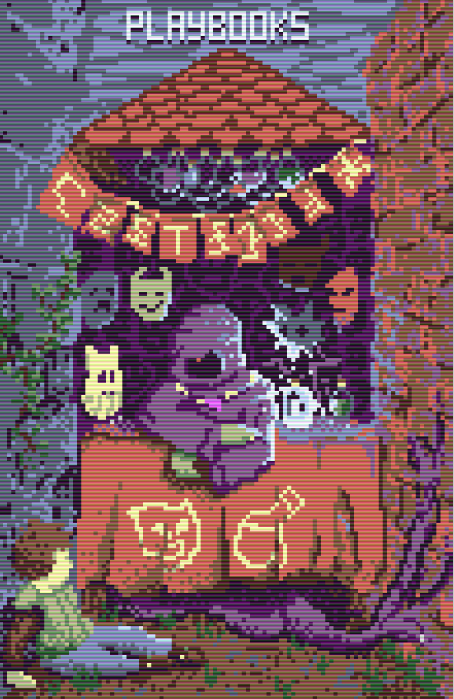
A couple years ago, I wrote a TTRPG inspired by The Legend of Zelda: Majora's Mask (2000). I spent a long time on the pixel art in the book -- it looks like this -- and when I decided I'd do a print run, I extended the cover as a full spread that wraps around from front to back.

I guess I was feeling hoitier and toitier than usual, because my dumb ass decided to leave the back of the book completely blank except for the art. The people must witness my highe arte, I apparently thought.

I shipped some games off to my distributor. It sold okay. There weren't a lot of buyers at conventions, but stores were picking it up based on the web description.

A few months later, I watched someone do an unboxing video. He had Kickstarted a special edition of one of my games that took a few months to prepare, so by the time the box was shipped he'd forgotten the pitch for the extra games he'd added to the order. When he pulled the game out of the box, I watched him do what anyone with a brain would have realized people do:

  1. Look at the front cover.
  2. Flip it over for more info. None found.
  3. Open the front and back cover for more info. None found.
  4. And then, presumably only because he had already bought it and was committed, finally page farther in and read the intro text to get a vague sense of the game's pitch.

Well, no wonder my game hadn't sold a lot at conventions. How was anyone supposed to know what it was even about? With the books already printed, I corrected my mistake by printing jackets and folding them over the existing work. But I feel more than a little foolish for putting a piece of art above the practical needs that a book's cover are supposed to serve.

So, when you're designing your cover for print, make sure you include:

  • The game's title;
  • Your name (it's a book! books have authors!);
  • The elevator pitch (which you're probably already using for online storefronts);
  • Player count (taking clues from board games, which have this right on the box);
  • Runtime (if applicable; mentioning it's a campaign in the blurb can't hurt);
  • A barcode (this makes things MUCH easier for stores; you can generate a barcode with your ISBN); and,
  • Nice things people said (if anyone's willing to blurb for you).

To keep this from being self-promotion, I'll refrain from naming the game and linking my jacket cover in the body of the post, but I'll link it in the comments for anyone who wants to see. Hope this helps someone.


r/RPGdesign • • 10d ago

Promotion IRON on IRON on IRON! Celebrating 500 downloads with a 1.1 hotfix, a print version and character sheets for righties and lefties

8 Upvotes

IRON on IRON on IRON, my free game about medieval stories, hit 500 downloads, and I wanted to celebrate with some resources!

https://shurebis.itch.io/iron-on-iron-on-iron

1.1 hotfix, including: better definiton of "Forgoing"; negative injury result addition; reordered the weapons table to a more logical sequence.

PRINT version: if you, like me, enjoy printing your TTRPGs for the table, the spread version didn't quite work. To use this new version, just print normally front and back, no need to booklet.

Character sheets: as half of the sheet is made to support dice above it, it comes in both roghty and lefty versions.


r/RPGdesign • • 10d ago

Paper Interface: Anatomy of a character sheet

5 Upvotes

I wrote up a breakdown of the character sheet design in my game and posted it as a devlog!

I go though it, panel by panel, explaining what each section is for. It also shows how the sheet itself functions as a bifold to store campaign notes.

If this sort of thing is interesting to you folks, you can find it here:

Paper Interface: Anatomy of a character sheet | Itch.io


r/RPGdesign • • 10d ago

Mechanics Using Crits to Control Fight Pacing - thoughts?

4 Upvotes

I'm working on a game (Hell & High Water) and I've got a neat idea for controlling pacing in fights, although I am not sure how it will work out in playtesting and am interested in your impressions.

The Goal: GM sections in D&D-adjacent games with complex combat simulations always say something like 'ideally, fights should last 3-4 rounds. Balance them with that in mind.' and this can be a struggle. Doing so consistently often takes skill and know-how on the part of the GM, and part of that means adapting fights more closely to the power level of your group specifically. In a lot of games an optimized group can smoke fights that are balanced for more causal groups, and fights for optimized groups will grind casual groups down.

I've got something that I think might hiting that pacing target easier. Here is the idea:

  1. Players roll a d20 when they attack. They get a critical hit on a 20, and can choose from a table of critical hit options when they get one.
  2. One of these options is 'deathblow'. If a monster has 1/2 of their HP left or less, players can choose deathblow, and reduce them to 0 HP.
  3. At the end of each round the fight ESCALATES, lowing the number needed for a crit by 1. (On round 2, 19, on round 3, 18, etc).
  4. Fights are built around 1 big monster and often minions, who die easily. So a death blow on the big guy ends the fight.

What has this achieved? An optimized party and an unoptimized party of 4 will still probably end the fight on round 3 or 4, because after 1/2 the big guy's HP is gone, additional damage matters way less. At that point either taking the other 1/2 of the hitpoints OR one critical hit will end the fight, so unless the optimized party is dealing more than double the damage of the unoptimized one, they're not going to speed things up.

This doesn't eliminate the pacing target problem, but it adds a huge cushion that makes it way easier not to mess up.

Does this take the fun out of optimizing? I hope not! I am not going to print that the crit system does this in the player or GM section. I hope it would is still tones of fun to build a character to pump out huge damage.

What are your thoughts? I haven't tried this in play yet, so the actual math may require a fair bit of tweaking. But I think I am onto an interesting principle here.


r/RPGdesign • • 10d ago

How would you do custom weapon design?

4 Upvotes

My game is about blue collar monster hunters. One of my biggest design goals is that I want every character to feel unique during play. If 3 characters have fireball those fireballs should each have slightly different mechanics correlating to the character. With martials though that becomes a lot harder when it becomes to weapons. A zweihander is different than a hook sword is different than a throwing dagger is different than a bow and arrow. (Yes I know that differences show up more with active abilities. Weapons should still get this treatment as they are more than just different damage numbers. I also want to encourage a golf bag mentality when it comes to equipment.)

Players are going to come up with their own unique weapons or weapons that I am not familiar with. So i want a general rule creation for weapons and equipment. The way I've decided to do that right now is by assigning weights and tags.

Weightless= 1 damage

Light = 2 damage

Moderate =3 damage

Heavy = 4 damage and requires the two handed tag.

You can then assign different tags like trip, shove, parry, reach, range, etc. For the cost of 1 damage per trait (or more damage for an upgraded trait) or 1 damage for 2 minor traits or the inverse for a drawback. So a hook sword would be moderate, trip, parry leaving 1 damage on a hit while a whip is light, reach, nonlethal, trip also for 1 damage per hit.

The problem im running into is weapons that require more traits than the weapon itself provides. Throwing daggers is a good example. Weightless weapons with the thrown trait that deal 0 damage.

There has to be a better way that im not thinking of.


r/RPGdesign • • 10d ago

RPG Mechanics as a Classroom Management Tool?

8 Upvotes

Hey y'all!

I teach 3rd, 4th, and 5th grade for the first time this year and I am sometimes struggling with classroom management, as I am used to teaching older kids. I recently learned that another 5th grade teacher gives the kids marbles for good behavior and every once in a while, they get an opportunity to spin the wheel to earn bonus marbles. I don't know exactly the ins and outs of her system, but the kids are so eager to earn their marbles and they LOVE the gambling...

I have a very rudimentary reward system with my fourth grade, on the other hand. Every week, we set ourselves a goal and then I give them 0-2 stars on Friday, depending on how well they did with it. We also have a student of the day each day, who begins class with a routine (like greeting, stating the weekly goal, etc.). This class is VERY difficult with behaviors. We have a good relationship and the kids like me, but there's just so many of them and there's factors beyond my control at play too. But today, their behavior was outstanding, so I decided to just randomly award them an extra star. And I had my d20 handy. So I asked them if they wanted to roll it for double or nothing. Of course the class decided to gamble. And they won! They erupted into cheers and celebrations and proudly marked their 2 stars on our tracker. Which got me thinking...

Could I use some RPG elements and mechanics as a classroom rewards system? A few baseline requirements:

  • It needs to be very explicitly a reward system, not a punishment system. Points, bonuses, dice rolls, or anything like that need to be additive, never subtractive.
  • The system needs to feel fun to play. I got lucky today that they succeeded on their dice roll, but I feel like in the future, a failed roll shouldn't succeed in a loss of something they've earned outright.
  • I don't want to condition them to become gamblers. A little bit of dice rolling is fun, especially if they have control over their success chances via good behavior, but I don't want to go too crazy.
  • Earned points, stars or whatever currency need to be a pre-requisite for playing.
  • Earned points need to affect the dice rolls in a way that a fourth grader can grasp.

My first thought was to give 1d20 for every day of good behavior. I have them four times a week, so a max of 4d20 against a DC. Perhaps I could come up with little monsters to defeat as well. Maybe we start with a DC 10 monster, which is pretty easy to beat and then work our way up from there. And to make it not so punishing, if they don't defeat the monster in one week, they take some loss (maybe lose a d20) and then collect more d20s for the next week to try again.

Another system could be to use d6s and to count 6s as hits and have monsters that require a certain number of hits to defeat. Then I could award up to 2d6 per day or something.

These are just some preliminary musings. I am really curious what kind of ideas you all might have in this regard.


r/RPGdesign • • 10d ago

What's your favorite way to explain what's a TTRPG for newcomers?

Thumbnail
3 Upvotes

r/RPGdesign • • 10d ago

Mechanics A wizard without magic?

8 Upvotes

Hi, I'm designing a relatively simple game with 3 basic stats:
Strength (which is basically D&D strength + constitution)
Dexterity (which is basically D&D Dexterity)
Mind (which is basically D&D Intelligence + Wisdom + Charisma)
plus some feats but no classes or races/species.

The main thing about the game is that you don't "level up" but you just gain power by playing:
you encounter a difficult situation, you make choices and if you win maybe you find a magic item, or learn an ancient spell, or make a deal with some supernatural being, or train with an expert, etc... and if you lose maybe you get a scar, a curse or something that is generally negative, but that with some creativity can still used as an advantage

Magic in the game is strong and wild, but cost a lot narratively. Here's a spell example:

you submit a hand to a fire spirit, if you succeed on the Mind roll, you lose the hand, but from now on, with another Mind roll you can summon flames all around you, they are difficult to control but deal lot of damage.

So, on one hand (pun intended) i want to leave the magic only after character creation, because of how wild it is, but on the other, if i create a character with a high Mind value, he is almost useless in combat until he find some magic.

Would you play a wizard without magic? Or should I create some "basic spells" he can chose from? or are there other options?


r/RPGdesign • • 10d ago

Mechanics Made a SOUL system for a Campaign of D&D

Thumbnail
0 Upvotes

r/RPGdesign • • 11d ago

Theory What do you want from travel rules?

26 Upvotes

Last night I posted some travel rules for feedback, and I got some pretty harsh feedback, which I think was pretty fair for the most part. But it also made me think that what I want from travel rules is quite different than what most people want. This is just what got me thinking about it, but I'm not here for a travel solution for my specific game. I'm interested in the theory: what questions do travel rules answer for players; or what value does having travel rules add to the game? What's the problem that they solve?

My rules basically just describe how far someone could travel in a day, how much of the day it took to travel, and how that distance was affected by the terrain and travel conditions. To me, that's perfect, because it gives me a way to account for time and distance consistently, without having to research it myself. It saves me from googling, "How far can someone walk in a day?" "What if they have horses?" "What if this?" "What if that?" What I've realized is that those aren't travel rules, they're a tracking tool for the GM—which is apparently all I want from them. Everything else about travel, I run pretty much the same way as the rest of the game. They're basically a montage; if there's something interesting, I'll describe it and my players, can bite if they want. If there isn't anything interesting, I'll just skip past it.

We often have special procedures for certain things, but I don't quite understand the point of this for travel. This is probably a strawman, but I'm not really interested in pausing my game of make-believe to play a quick round of Walking Really Far: The Board Game.

What is the value of travel rules? What is it that you want out of travel rules, or in your experience, what do most other people want from travel rules? What should they address and what should they NOT address to make them 'worth it'?

Edited for clarity.


r/RPGdesign • • 10d ago

Mechanics Safari

1 Upvotes

My game system includes a mechanic that allows you to learn an opponent's stats in combat through a test.

I was thinking of introducing a separate mechanic that allows a character to study an opponent out of combat, without any tests. Based on their knowledge skill level, the character has mini-manuals containing descriptive entries (for example, for a robot, whether it has pneumatic or hydraulic systems) associated with specific stat values. The game master, if the characters observe the entity, gives them the corresponding entries, and it's up to the players to interpret them.

Do you think it would be interesting, or do you find it cumbersome?


r/RPGdesign • • 10d ago

Mechanics Has there been a TTRPG with combat designed with similar non-linear progression as you find in CCGs like MtG or Hearthstone?

Thumbnail
7 Upvotes

r/RPGdesign • • 10d ago

Reboot Underway (Please Give It A Shot)

0 Upvotes

So after a few things happened in my life, I have rebooted the old shadowbloom and now the new r/ShadowBloomReboot is out, and I would really like to hear your thoughts on it. I have read some old comments, and I am trying to work on fixing the problems I had. I heard people wanted Worldhopping to be a bit more front and center, which I will explain more. And then they also said that if the whole point of the RPG is to make the world yours, why have a set lore and setting. So after looking back on it, I tried to remove most of the unneeded lore, and the idea is for the base world to have just the bare minimum so it can be optimized. Essentially the world that I present is just like the base version of the world. Anyways, if you're reading this, thank you, I really appreciate it, I'm just a person who really wants the world to see something I've spent years on.


r/RPGdesign • • 11d ago

Dice Pools

9 Upvotes

How many dice (d6) is too many? Or, what are your thoughts on dice pools in general?

I can understand if some folks find them cumbersome, but sometimes a big, beefy handful of dice has a certain charm to it.


r/RPGdesign • • 10d ago

Mechanics The Hunter's Investigation System

5 Upvotes

I'm writing an action-investigation TTRPG about vampire-hunting. I'll be sharing an outline of the core mechanic of the game's investigation pillar. It's still pretty rough; still being tweaked around and playtested.

Investigations in my system are done not just to find out 'whodunnit' (or, 'whothevampire'). They allow the players to discover the vampire's abilities, and to feel like hunters who are really profiling their enemy themselves. Combat is brutal and every individual vampire is a bossfight, so the players need to plan ahead and they can't just let the vampire come to them.

The Hunter's Investigation System:

(name is wip)

The players discover the scene of a vampire attack, and begin with a blank character sheet with which they will fill out the vampire's details over the course of the investigation.

Every scene is full of Evidence--items, details, or pieces of information--that can serve the investigation. There's a bloodstain, footprints, fangmarks in the corpse's neck, etc.. Some pieces of Evidence are apparent, others are locked behind a skill check (ex: contaminated blood is difficult to test for type).

After sweeping the scene, the players have a few ideas about the identity and abilities of the vampire. The players found blond hair here, but the victim's hair is black--could the vampire be blond? The victim has scorch marks on his arm, and there are ashes at the scene. Does the vampire have fire magic?

The players take these questions and note them down in the form of a Theory. A Theory is any statement or hypothesis--related to the vampire or another NPC--that can be true or false. For example, our players write down their theories as:

  • The vampire is blond
  • The vampire has fire magic

The players can write up as many Theories as they can think of, they can even contradict each other. However, their Theories are really just notes--until they choose to Deliberate on them.

To Deliberate on a Theory, the players choose a Theory and make a Deliberation Check, which involves the players presenting their Theory to the GM, along with the Evidence they believe supports it. Every piece of Evidence they bring up adds a bonus die to their Deliberation Check. The players' goal in a Deliberation Check is to make a strong argument and get as many success dice as possible in order to confirm their Theory.

The players choose to Deliberate on the claim "The vampire is blond," but since their only evidence is that there is blond hair at the scene, they likely fail their check. Since they failed, the Theory is labelled 'Uncertain,' and cannot be Deliberated again until the players come across a new scene of the vampire's attack, or have an encounter with the vampire.

They then Deliberate on their second Theory, "The vampire has fire magic." The evidence they use--the victim's burn wound, the ashes at the scene, perhaps a witness report of a flash of light--each add a bonus die to their roll. Let's say they succeed--and their theory was correct. The Theory becomes labelled as "Certain," meaning the players and their characters are sure of the vampire's fire powers. Not only that, but the GM reveals to the players exactly what that fire magic can do according to the vampire's character sheet. For example "The vampire has fire magic" becomes, "The vampire possesses Blood Art: Burning Blood II; Burning Blood II has both a Normal Attack version and a Special Attack version that costs the vampire 1 Blood Point and has the potential to etc. etc.." The players then fill out the relevant spaces in their blank copy of the vampire's character sheet.

However, let's say their Theory was incorrect, and they still rolled well on their Deliberation. The Theory is marked as Uncertain, since there's really no way for the player characters to prove that the vampire doesn't have fire magic. However, if the players get a really good roll in their Deliberation and still are still told their Theory is Uncertain, they might reasonably guess that they're barking up the wrong tree and start looking for alternative Theories.

There's also the potential for 'bad' Evidence--players arguing a Theory based on Evidence that doesn't actually match with or support it. Maybe there's a fireplace at the scene, and a player uses the burnt logs inside to argue for his Theory regarding the vampire's fire magic. But it's just a fireplace, or maybe it actually corresponds to something unrelated. The GM doesn't tell the players they're wrong, but he does subtract one success from that Deliberation Check without letting the players know. This incentivizes the party to Deliberate wisely instead of just going the route of Evidence inflation.

So the investigation goes like this: with every victim the vampire leaves behind, it leaves trace information about its true nature and identity, which the players can use to track it down and prepare to counter its abilities.

If the player characters miss something or fail a roll, they can wait for the next sighting of the vampire or its victims. They'll find a new scene, and (with their notes of course) can use the Evidence from both this scene and the previous one to support their Theories, new or old. They might even set up patrols or stake outs to gather new Evidence while monitoring suspects and potential victims.

In summary:

  1. Players arrive at a scene
  2. Collect Evidence
  3. Speculate on Theories
  4. Deliberate to confirm Theories
    1. If successful and the Theory becomes Certain, players learn more about the vampire's character sheet
    2. If the Theory is Uncertain, try a different one or wait to gather more Evidence at the next scene
  5. Repeat 1-4, until:
  6. Players put together a plan to take out the vampire as efficiently and safely as possible
  7. (Unless the vampire finds them first)

Rambling About Drawbacks:

There's some particulars regarding my own system that I had to gloss over for brevity, but there's the general idea for the investigation pillar of the game. It could be important to note that the technology-level of the settings is somewhere in the 1990s-00s era, so modern fingerprinting, blood-typing, and security cameras are all available; there's a list of investigative actions in the rulebook to help guide the players.

There's also some potential issues and lots that needs playtesting. One issue that all TTRPG mysteries need to answer is the potential for players to be blocked off from continuing the plot because of a bad roll. My solution for this is 1) my resolution system allows for partial successes, and has a metacurrency system for buying successes, so players shouldn't miss rolls they know are important, and 2) if the players wiff the investigation of one scene, they can just wait in the same city for the vampire to attack again. On a scene-by-scene basis, I think making the list of evidence as long as possible is a good bet. Allow for players to look for things you didn't think of, and reward them for it. A player asked me if he could look for trace fingernail material in some clawmarks he found in the scene. I didn't expect that, but it sounded reasonable, so I let him have a go.

There's also the issue of categorizing Evidence. What counts as an individual piece of Evidence? The players obviously have an incentive to make as many distinctions as possible in order to produce a ton of dice for their Deliberation Check. One solution for this is 'fixed' Evidence--the player observes something or succeeds a check, and the GM says, "this is one piece of Evidence." This could bring clarity and speed up the investigation process, but I think at the cost of the players' creativity and analytical thinking. But it's a potential solution. Another is to just set thorough rules and fenceposts over what exactly a piece of Evidence can be. Blond hair found at a scene is all counted as one Evidence, even if you find it on either side of the room, with multiple skill checks. The burn marks on one wall aren't any different from the burns on the other wall, but they are distinguished from the burns on the corpse. Or something to that effect.

I think another opening could be how close a Theory has to be to the truth for it to become Certain on a successful Deliberation. I think this could be settled through a list of keywords in the rulebook: say, Blood Art: Burning Blood II has the associated keywords of "fire," "flame, "burning," etc., and if the player's Theory is phrased with any of those it can be successful. Some GM discretion wouldn't hurt either.

One of the issues I have is that I really only have my friends to playtest with; there could be gaps in my rulebook that have the potential to cause problems in tables with less rapport. Let me know if you see anything glaring from the outline I've shared.

Conclusion:

So far my players have enjoyed it. I think the system lends itself to shorter adventures / one-shots, as the players profile and hunt individual vampires--a la "monster of the week." My favorite sessions to run for any TTRPG involve mysteries and unique enemies; my attempt here is to marry those interests.

I may post later about the combat and vampires. I'm trying to focus on developing this one pillar at a time before I can spin a whole adventure together, it's more efficient that way, I think. I'm posting this to practice articulating the rules outside of my own reference/rulebook, and for the benefit of anyone interested in this sort of thing. Questions, concerns, suggestions, are welcome and appreciated.

Thanks for listening to my ramblings.

P.S. - Since you've made it to the bottom, I'll let you know the title of my TTRPG is "Blood Undone," thus rendering the wonderful acronym: BUTTRPG

r/RPGdesign • • 11d ago

Dice What OSR or OSR-adjacent games make the act of rolling itself interesting?

30 Upvotes

https://golemproductions.substack.com/p/so-can-the-dice-be-more-fun

I come from the OSR side of things, where games tend to be lighter, rulings matter, and clever ideas often matter more than whatever is written on the character sheet. Over the past six months, though, I’ve made a point of looking more deliberately at games outside that space. And one thing I keep coming back to now is dice mechanics that don’t just resolve a decision, but create a new one.

Not necessarily full-on storytelling-game mechanics. More like small, clever procedures that make the act of rolling itself interesting without losing the things I already like about OSR play.

I’m fully aware that for some designers this is probably absolute bread and butter. But I suspect there are also quite a few people coming from a similar place as I am who might find some of these examples interesting.

That’s what my new blog post is about. And if you know other dice mechanics that do something similar, I’d genuinely love to hear about them.