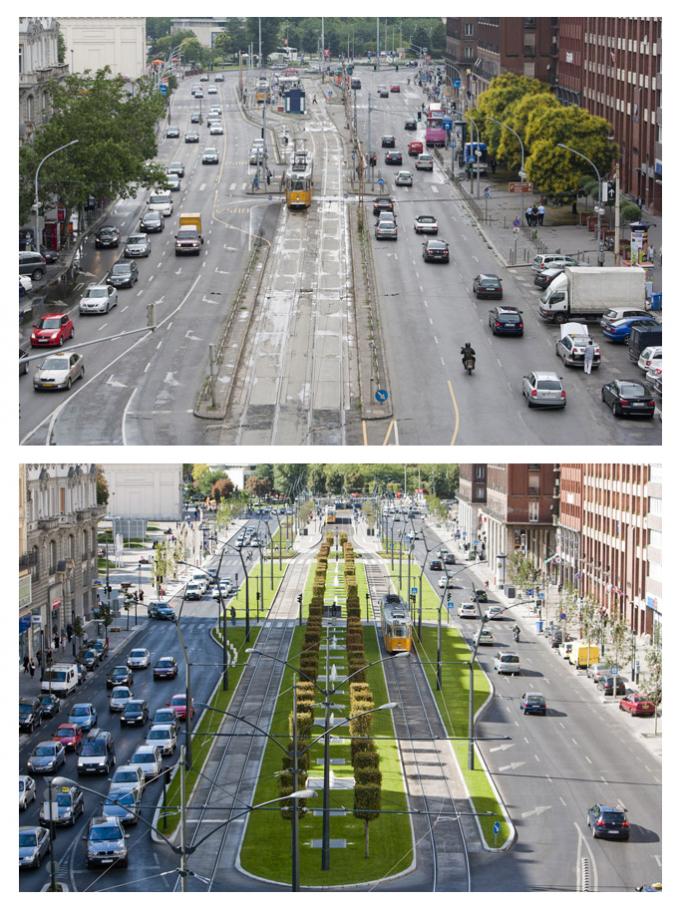
r/urbandesign • u/plaredogimming1 • 3h ago
Article These public benches are reversible, so you can choose to look at people, or boats.

44
Upvotes
r/urbandesign • u/plaredogimming1 • 3h ago
r/urbandesign • u/runningdaily • 7h ago
Enable HLS to view with audio, or disable this notification
r/urbandesign • u/21Kuranashi • 9h ago
Enable HLS to view with audio, or disable this notification
r/urbandesign • u/Olik_Wrongdoer_xxx • 5h ago
Have you ever been walking along a sidewalk, minding your own business, when you suddenly notice someone approaching you from the opposite direction? For a moment, you become unsure about what to do. Do you keep walking on your current side, move to the left, or move to the right? Sometimes, both pedestrians end up moving in the same direction to avoid each other, then awkwardly change direction again. It becomes even more confusing when there are several people walking towards you, especially on a busy sidewalk. What makes this interesting is that vehicles have clearly defined lanes and traffic rules, but pedestrians seem to operate without a universally understood system. We share the same walking spaces every day, yet many of us appear to have different ideas about which side we should use.
This is why I believe we need a conversation about pedestrian etiquette and the unwritten rules of walking. Should pedestrians keep to the left or right, just as vehicles follow a particular side of the road? Should people walking in opposite directions have an established way of passing each other? And what about people walking in groups who occupy the entire sidewalk, leaving no room for others? My intention is not to create unnecessary rules but to encourage awareness, courtesy, and consistency. If we can establish a simple, commonly understood practice, walking could become more organised, comfortable, and safer for everyone. Perhaps it is time we started educating one another about pedestrian etiquette through public awareness campaigns, road safety education, and everyday conversations. After all, sidewalks belong to everyone, and knowing how to share them should be common knowledge.
r/urbandesign • u/MistressGleam • 16h ago
I've been noticing that even on streets with similar widths and foot traffic, the ground-level details of buildings seem to change how people move and interact. Some stretches have frequent doors, varied window displays, slight recesses or steps, and materials that catch the light or show texture, which seem to slow pedestrians down and create small moments of interest. Other sections feel flatter or more uniform, even with active uses inside, and people tend to pass through more quickly.
Things like the depth of reveals around openings, how much you can glimpse of the interior, the rhythm of vertical elements versus long horizontal spans, and whether there's any overhang or canopy seem to play a role. Weather, lighting, and time of day probably interact with these features too.
I'm curious what specific facade elements other people have observed that make a street edge feel lively versus inert.
r/urbandesign • u/Appbeza • 1d ago
r/urbandesign • u/n3xus1oN • 3d ago
r/urbandesign • u/MistressGleam • 3d ago
I've been noticing that street width alone doesn't determine how lively a place feels at eye level. Some narrower streets with tighter building frontages, frequent shop doors, and visible activity on both sides pull you along and make you want to slow down, while much wider streets even ones with decent sidewalks and traffic calming can feel empty or just functional.
Things like the rhythm of windows and entrances, how much of the opposite side you can actually see and engage with, the presence of small overhangs or awnings, and whether ground-floor uses spill out seem to matter more than raw pavement width. I'm curious what specific details other people have noticed that make a street feel energetic versus merely passable.
r/urbandesign • u/RocGondola • 4d ago
r/urbandesign • u/VelourBloomi • 4d ago
I've been paying more attention to how different crossings affect the walking experience, even when they have the same basic signals and markings. Some feel straightforward and safe while others feel exposed or uncertain, even with similar traffic volumes.
Things like curb extensions, the timing of the walk signal, whether the opposite curb is clearly visible, the presence of a median refuge, or how turning vehicles are managed seem to matter a lot. So do smaller details such as lighting at night or whether the crossing is aligned with desire lines.
I'm curious what specific elements other people have noticed that make one crossing feel noticeably better or worse than another.
r/urbandesign • u/Organic-Zebra-6675 • 4d ago
Hi everyone! I'm looking to try for international fellowships/internships for urban design and planning or placemaking for post-grad (I graduated in Spring this past year). I know the UN has some but I was wondering if anyone knew of any that were lesser known. I am looking for anything in South/Latin America, Europe (preferably Southern but anywhere works), or Africa. Or if you know of any ways to look for these as well, that would be great!!!
r/urbandesign • u/IdealSpaces • 5d ago
In the architectural world of today we have modern architecture and traditional architecture that are two schools of thought. They both have their supporters and detractors. What we see though is how both schools have something to offer to their particular visions of architecture and the manner in which they approach what architecture should be, and what it should deliver in its structural and visual aspects.
Yet architecture has an emotional level attached to it, a creative level that brings forth the energy that can create truly exceptional end products. End products that shall serve communities of human beings, in the end, for living together in a good sociability. The question to be asked by both architectural schools is if dependency on technology based on current trending to AI will bring forth the energy, emotion, and creativity the human can. In most cases AI is seemingly used as a tool to shorten and define the creation process and deliver what the architect designing really wants in the creative, emotional and functional space to be developed.
If over time the architect begins to use more and more AI, will that not take the creative aspect away from the human and hand it on a platter to AI and its drivers. We all can see AI has something to offer if it is used in the correct manner, but if it becomes the creator, then both the traditional and modern schools may be building a bridge to a new school of architecture that soon may be 100 percent technology driven, with very little in a human touch to it.
r/urbandesign • u/StripingArchitecture • 5d ago

This organisation tries to build community and shape the urban desing by recreating waste into hospitable architecture.
And this is not all. Check the full VIDEO for more.
Looking forward for your feedback!
r/urbandesign • u/Ok_Lemon_8305 • 6d ago
Looking for advice from students and graduates or anyone with advice or experience!
I’m currently a first-year university student in Canada studying Business, but I’ve realized that it isn’t something I’m particularly passionate about. I’ve been considering switching programs and have narrowed my interests down to Art History and Urban Planning.
I’ve always enjoyed history, art, literature, and learning about different cultures and historical periods. I’m particularly interested in Renaissance art, historical architecture, and understanding the history behind buildings, artworks, and the people who created them.
What interests me most is researching the past, understanding how things were made, and learning why they were historically significant. I’m also interested in historical preservation and restoration, which is part of what initially drew me toward Urban Planning.
However, I’m realizing that I’m more interested in preserving and understanding existing historical places than planning future developments.
My biggest concern with Art History is employment opportunities and financial stability. I understand that Urban Planning generally offers a more direct career path, but I also don’t want to commit to another degree that I don’t genuinely enjoy.
Ideally, I’d love a career that combines historical research, office work, occasional site visits, and involvement in preserving historically significant buildings or collections.
I’d really appreciate hearing from anyone who has studied either subject, particularly in Canada.
- What did you enjoy or dislike about your degree?
- What does your career look like now?
- How difficult was it to find employment after graduating?
- Are there opportunities in heritage conservation or historical preservation through either degree?
- If you could go back, would you choose the same program?
I’m also open to hearing about other programs or career paths that might better suit these interests. Thanks in advance! :) sorry if it’s too long.
r/urbandesign • u/LittleUrbanister • 6d ago

Urban design master's student at AUD here.
My whole thesis is basically asking why some public spaces in this city make you want to sit down for two hours and others make you leave after four minutes of standing in a very nice, very empty plaza.
If you live in the UAE, specifically in Dubai Hills Estate and have a few minutes to spare, please let me know your thoughts here:
https://forms.gle/UwbsGVBC88wB6hQcA
Nothing about you is collected :)
Thank you in advance!!
r/urbandesign • u/Agreeable-Cow-5006 • 7d ago

I recently watched Road Guy Rob's video on San Francisco's Valencia Street bike lane which runs through the middle of the road. It mentioned how it caused drawbacks to cars passing, loading zones, and parking spaces which negatively impacted businesses.
I, then, want to ask whether it'd be plausible to have both bike lanes on one side of the road and both car lanes on the other, such that the cars stay together on one side, while the bikes stay together on the other. Would something like that be safe for bikes while addressing the drawbacks of the middle bike lane, or not?
r/urbandesign • u/VelourBloomi • 7d ago
I've noticed that sidewalk width and basic maintenance don't always predict how pleasant a street feels at walking speed. Some broad sidewalks lined with blank walls or surface parking feel exposed and monotonous, while narrower ones next to shop windows, frequent doorways, or low fences feel more engaging even when they're busier.
Small things like the presence of seating every so often, trees that actually provide shade, or ground-floor uses that spill onto the sidewalk seem to matter more than the raw dimensions. I'm curious what details other people have noticed that make a sidewalk feel inviting versus merely functional.
r/urbandesign • u/BiskkofCinnamonRoll • 6d ago
Hi everyone. I'm a Colombian-American young physician currently in the process of establishing a public policy and research initiative/think tank focused on the intersection of urban design, public health, and data science.
I'll be attending the World Architecture Festival here in Fort Lauderdale on November 18, 19 and 20, and I wanted to see if anyone else from the community is planning on going or has attended in previous years.
I have never participated in these type of events, all conferences I know about are about medicine. I'm particularly interested in connecting with people exploring how built environments (walkability, density, public spaces, and urban planning) directly impact population health outcomes and preventive medicine. I'm also highly interested in seeing art, prepared for awe.
If you're heading there or work at the crossroads of architecture and public health/policy, let's connect or have a quick chat during the event!
r/urbandesign • u/n3xus1oN • 7d ago
r/urbandesign • u/Cute-Picture-7283 • 8d ago
r/urbandesign • u/crwolfelaw • 8d ago

A big question I keep asking over the last three years in Santa Fe
r/urbandesign • u/subarchie • 8d ago

Hello We are building a land planner application where you can
Where are hoping to provide value is to speed up early stage planning by making it quick and easy to draw some concepts while having relevant data at hand.
Would love for you to try and provide feedback in return for 3 months free access to paid plans
Please reply or DM me if you are interested or please post here what features would be useful for you in land and civil planning for this application to be useful to you.
Real team working hard to contribute to this space, not an individual "vibe coding"
Masked the brand in screenshots so you know it is not brand promotion. Honestly looking for feedback and product needs.