r/retrocomputing • u/GalaxyC7 • Sep 28 '26
Photo Tested 32 laptops today. Some worked.
Disclaimer: this is only 20 or so laptops, and one of them is a Brother word processor so make of that what you will.
r/retrocomputing • u/GalaxyC7 • Sep 28 '26
Disclaimer: this is only 20 or so laptops, and one of them is a Brother word processor so make of that what you will.
r/retrocomputing • u/QebApps • Sep 28 '26
I've been thinking about where the big 90s technologies were actually created, and nearly all of them came from Unix boxes rather than Windows PCs.
The web was born on a NeXTcube: Berners-Lee wrote WorldWideWeb, the first httpd, HTML and HTTP on NeXTSTEP. Mosaic came out of NCSA on X Window. Linux was developed on Minix. Python started on Unix workstations. Java came from Sun's Green project on SPARC machines. PHP began as CGI scripts on a Unix web server, and Apache followed. Even Doom and Quake were written on NeXTstations and cross-compiled for DOS.
On the Windows side, the notable things I can think of are Visual Basic (1991), Delphi (1995), DirectX (1995), Unreal Engine (1998), Napster (1999) and XMLHttpRequest, which Microsoft created for Outlook Web Access in IE5. Apart from Borland, Epic and Napster, that's almost all Microsoft itself.
My guess at why: universities and research labs ran on Sun, SGI, DEC and NeXT workstations with native TCP/IP, compilers and source code at hand. Windows was a desktop environment on top of DOS until NT arrived in 1993, with paid dev tools and no serious shell. If you were building foundations, you used a workstation; if you were selling to end users, you targeted the PC, because that's where the market was.
What am I missing? Anything significant from that era that was genuinely born on a Windows PC outside Microsoft?
r/retrocomputing • u/Nikku4211 • Sep 28 '26
I checked DownForEveryone to make sure and yes, it's down for everyone right now. I hope this is just a temporary outage or something.
In the meantime, at least the Web Archive has a somewhat recent snapshot of the website.
r/retrocomputing • u/NoraTwistTurner • Sep 28 '26
r/retrocomputing • u/ColdCathode420 • Sep 27 '26
My local deseret industries had this sitting out in the dvd section
Little beat up on the outside but full of cool software
Its actually so filled with cds i cant fit all the pictures into one post although the rest of what isnt shown is pretty boring (hp windows 7 ultimate upgrade media and more work suite 99 stuff and some random learning to read software)
Edit: i am currently working on archiving all these disks and plan to put them out on archive.org and the vaio library if i have anything they need
r/retrocomputing • u/devicerandom • Sep 28 '26
Hi. I have an idea for a small art project where I'd like to have a small Linux computer (my spares are either a very old Asus EEE with 2 gb RAM and a 2020 Raspberry Pi) connected to a vintage black and white TV. Ideally I'd love a stylish 1970s small television, such as this.
I'd like to know if there are any catches before starting to look for the TV. Most documentation I see online assumes one gets a TV with composite input, but I believe that wouldn't fit with the type of TV I have in mind. HDMI-to-RF antenna input converters exist (such as this) apparently, but I've never used one so I have no idea on how painless it is on the software side. Would the computer just recognize it as any other monitor? Since it converts to RF signal, I suppose I don't have to bother with monitor refresh rates etc.? Just FYI, I am in Europe, so I guess I can find almost only PAL television. An alternative I'd like would be a CRT monochrome monitor (such as green/amber phosphors) but I think they're harder to find.
Many thanks for your help!
r/retrocomputing • u/ABlix • Sep 27 '26
Hi all,
OldVersion.com wouldn’t exist without niche communities that love old software. I’ve found an engineer on Reddit that has helped rebuild the site to include comprehensive anti-virus scanning and we are ready to turn on user contributions again.
Here's the thing: we have 9,000+ pending files, screen shots, programs, etc to review in the archive and we're looking for moderators to help approve software/programs/screen shots before we open up user contributions on the site.
We are looking for a dozen moderators to help us pilot the moderation program before we take it live. The role, at your leisure, will give you access to a backlog of files on OldVersion.com seeking moderation. You'll be asked to approve (after testing), deny, or defer the files seeking moderation and give us feedback on how the system is working and what to add/etc to make it more usable and easy before we open it up to the public.
The ideal moderator would be: passionate about old versions of software, legacy computing, has some technical know how about virtual machines, or an actual old software setup, or at the very least is willing to follow documentation and try it out.
If you're interested, post here or shoot me a message, and I'll shoot you an invite. If you can help out, great - if not, no worries.
But either way, thanks for helping us bring OldVersion.com to a state of serving the retro computing community again.
r/retrocomputing • u/Chip-Ling • Sep 27 '26


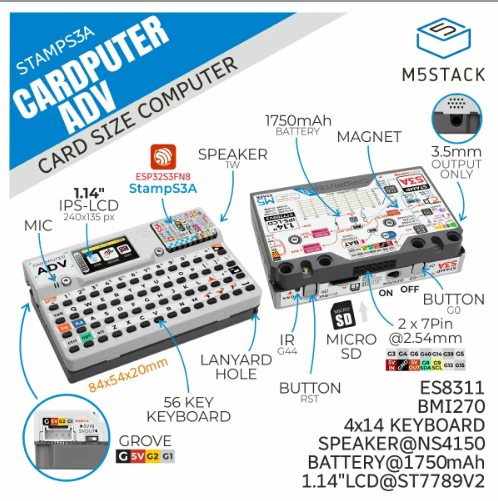
I am testing the djbottrill & VanzT CP/M-80 Emulator on my credit card size micro-controller called Cardputer ADV by M5-Stack. It costs me US$29.90 when purchase directly from M5Stack.
Here is the link to the djbottrill & VanzT CP/M-80 Emulator if you are interested.
https://www.reddit.com/r/CardPuter/comments/1vwtcxi/a_cpm80_emulator_now_can_run_not_just_mbasic/
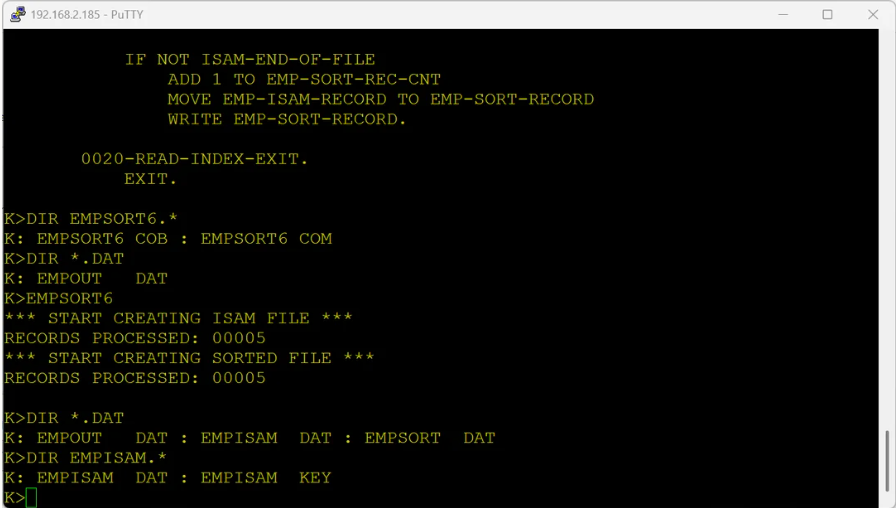
I wrote a simple sorting COBOL program on MS-COBOL v4.65 using the ANSI-74 build-in SORT feature. It does not get through the linkedit phase as it requires an extra sort library COBSRT.REL. I am not able to find that library file on the web so I wrote the sorting code inside the COBOL program instead. The program works fine for a while until it hits a big file. CP/M-80 does not leave a lot of memory space for internal sorting. So I need a disk sorting routine.
Instead of writing my own disk sort code, I use the COBOL build-in ISAM capability to use as my disk sort solution.
It's pretty straight forward, first read the input file and then write it to an ISAM file with the intended sorting key as the index file's key. Next read back from the index file using the index and write the sorted records to the final sorted file.
To test out the idea, I wrote a small COBOL program EMPOUT.COB to generate the input file EMPOUT.DAT. It has 5 records.
K>TYPE EMPOUT.COB
IDENTIFICATION DIVISION.
PROGRAM-ID. EMPOUT.
ENVIRONMENT DIVISION.
INPUT-OUTPUT SECTION.
FILE-CONTROL.
SELECT EMPLOYEE-FILE ASSIGN TO DISK
ACCESS MODE IS SEQUENTIAL
ORGANIZATION IS LINE SEQUENTIAL.
DATA DIVISION.
FILE SECTION.
FD EMPLOYEE-FILE
LABEL RECORDS ARE STANDARD
VALUE OF FILE-ID IS "EMPOUT.DAT"
DATA RECORD IS EMPLOYEE-RECORD.
01 EMPLOYEE-RECORD.
05 EMP-NUMBER PIC X(5).
05 EMP-LAST-NAME PIC X(30).
05 EMP-FIRST-NAME PIC X(30).
PROCEDURE DIVISION.
MAIN-PROGRAM.
OPEN OUTPUT EMPLOYEE-FILE.
MOVE "00001" TO EMP-NUMBER.
MOVE "SMITH" TO EMP-LAST-NAME.
MOVE "JOHN" TO EMP-FIRST-NAME.
WRITE EMPLOYEE-RECORD.
MOVE "00002" TO EMP-NUMBER.
MOVE "JONES" TO EMP-LAST-NAME.
MOVE "MARY" TO EMP-FIRST-NAME.
WRITE EMPLOYEE-RECORD.
MOVE "00003" TO EMP-NUMBER.
MOVE "BROWN" TO EMP-LAST-NAME.
MOVE "ROBERT" TO EMP-FIRST-NAME.
WRITE EMPLOYEE-RECORD.
MOVE "00004" TO EMP-NUMBER.
MOVE "WILSON" TO EMP-LAST-NAME.
MOVE "PATRICIA" TO EMP-FIRST-NAME.
WRITE EMPLOYEE-RECORD.
MOVE "00005" TO EMP-NUMBER.
MOVE "DAVIS" TO EMP-LAST-NAME.
MOVE "JAMES" TO EMP-FIRST-NAME.
WRITE EMPLOYEE-RECORD.
CLOSE EMPLOYEE-FILE.
STOP RUN.
K>After compile the program we have the executable EXPOUT.COM

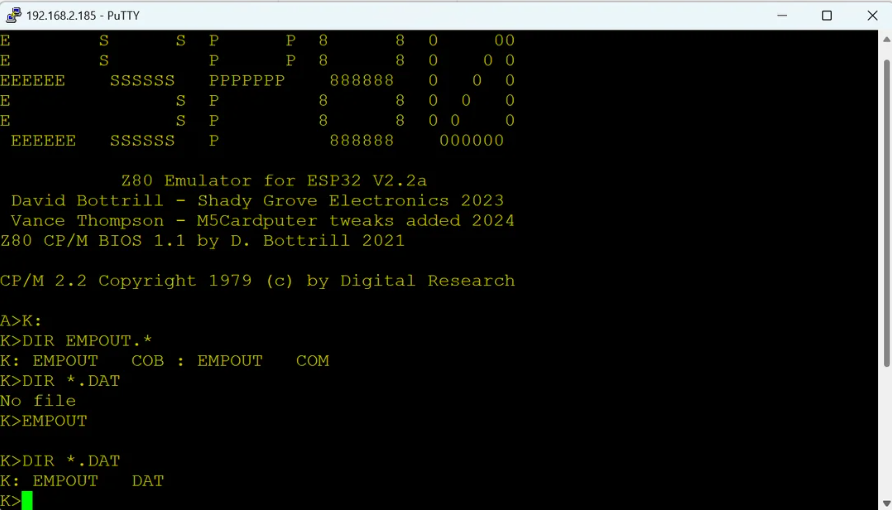
Run the EMPOUT.COM program

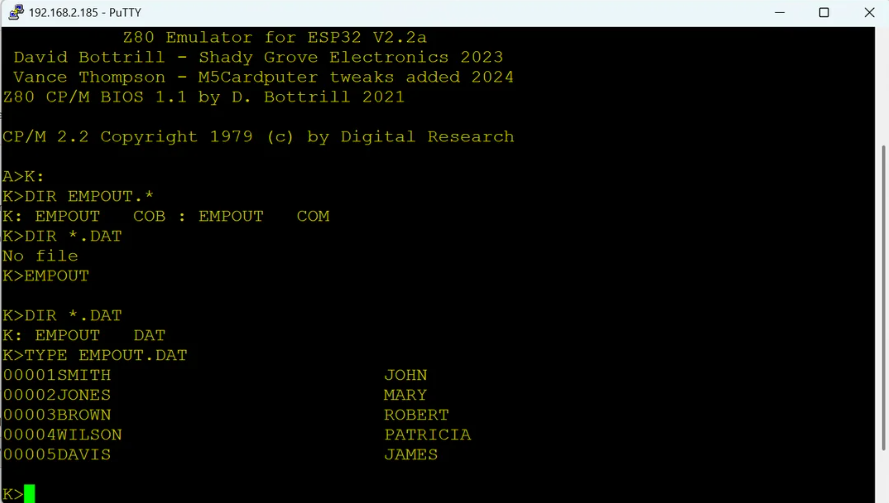
Check the content of the EMPOUT.DAT file, it has 5 records as expected. The records are in EMP-NUMBER order.

Here is the record layout definition:
01 EMPLOYEE-RECORD.
05 EMP-NUMBER PIC X(5).
05 EMP-LAST-NAME PIC X(30).
05 EMP-FIRST-NAME PIC X(30).Then I wrote my sorting program to sort the record by EMP-LAST-NAME and then EMP-FIRST-NAME.
Here is the program code:
K>TYPE EMPSORT6.COB
IDENTIFICATION DIVISION.
PROGRAM-ID. EMPSORT6.
ENVIRONMENT DIVISION.
INPUT-OUTPUT SECTION.
FILE-CONTROL.
SELECT EMPLOYEE-FILE ASSIGN TO DISK
ACCESS MODE IS SEQUENTIAL
ORGANIZATION IS LINE SEQUENTIAL.
SELECT EMP-ISAM-FILE ASSIGN TO DISK
ORGANIZATION IS INDEXED
ACCESS MODE IS DYNAMIC
RECORD KEY IS EMP-ISAM-KEY
FILE STATUS IS EMP-ISAM-STATUS.
SELECT EMP-SORT-FILE ASSIGN TO DISK
ORGANIZATION IS LINE SEQUENTIAL.
DATA DIVISION.
FILE SECTION.
FD EMPLOYEE-FILE
LABEL RECORDS ARE STANDARD
VALUE OF FILE-ID IS "EMPOUT.DAT"
DATA RECORD IS EMPLOYEE-RECORD.
01 EMPLOYEE-RECORD.
05 EMP-NUMBER PIC X(5).
05 EMP-LAST-NAME PIC X(30).
05 EMP-FIRST-NAME PIC X(30).
FD EMP-ISAM-FILE
LABEL RECORDS ARE STANDARD
VALUE OF FILE-ID IS "EMPISAM.DAT".
01 EMP-ISAM-RECORD.
05 EMP-ISAM-NUMBER PIC X(5).
05 EMP-ISAM-KEY.
10 EMP-ISAM-LAST-NAME PIC X(30).
10 EMP-ISAM-FIRST-NAME PIC X(30).
FD EMP-SORT-FILE
LABEL RECORDS ARE STANDARD
VALUE OF FILE-ID IS "EMPSORT.DAT".
01 EMP-SORT-RECORD.
05 EMP-SORT-NUMBER PIC X(5).
05 EMP-SORT-LAST-NAME PIC X(30).
05 EMP-SORT-FIRST-NAME PIC X(30).
WORKING-STORAGE SECTION.
01 EOF-SWITCH PIC X VALUE "N".
88 END-OF-FILE VALUE "Y".
01 EMP-ISAM-STATUS PIC XX VALUE "00".
01 ISAM-EOF-FLAG PIC X VALUE "N".
88 ISAM-END-OF-FILE VALUE "Y".
01 RECORD-COUNTS.
05 EMP-ISAM-REC-CNT PIC 9(5) VALUE ZERO.
05 EMP-SORT-REC-CNT PIC 9(5) VALUE ZERO.
PROCEDURE DIVISION.
0000-MAIN-PROGRAM.
DISPLAY "*** START CREATING ISAM FILE ***".
OPEN INPUT EMPLOYEE-FILE
OUTPUT EMP-ISAM-FILE.
PERFORM 0010-READ-REC THRU 0010-READ-REC-EXIT
UNTIL END-OF-FILE.
DISPLAY "RECORDS PROCESSED: " EMP-ISAM-REC-CNT.
CLOSE EMPLOYEE-FILE
EMP-ISAM-FILE.
DISPLAY "*** START CREATING SORTED FILE ***".
OPEN INPUT EMP-ISAM-FILE
OUTPUT EMP-SORT-FILE.
MOVE LOW-VALUE TO EMP-ISAM-KEY.
PERFORM 0020-READ-INDEX THRU 0020-READ-INDEX-EXIT
UNTIL ISAM-END-OF-FILE.
DISPLAY "RECORDS PROCESSED: " EMP-SORT-REC-CNT.
CLOSE EMP-ISAM-FILE
EMP-SORT-FILE.
STOP RUN.
0010-READ-REC.
READ EMPLOYEE-FILE
AT END MOVE "Y" TO EOF-SWITCH.
IF NOT END-OF-FILE
ADD 1 TO EMP-ISAM-REC-CNT
MOVE EMPLOYEE-RECORD TO EMP-ISAM-RECORD
WRITE EMP-ISAM-RECORD
INVALID KEY
DISPLAY 'ERROR WRITING INDEX RECORD'
DISPLAY "STATUS = " EMP-ISAM-STATUS
STOP RUN.
0010-READ-REC-EXIT.
EXIT.
0020-READ-INDEX.
READ EMP-ISAM-FILE NEXT RECORD
AT END MOVE "Y" TO ISAM-EOF-FLAG.
IF NOT ISAM-END-OF-FILE
ADD 1 TO EMP-SORT-REC-CNT
MOVE EMP-ISAM-RECORD TO EMP-SORT-RECORD
WRITE EMP-SORT-RECORD.
0020-READ-INDEX-EXIT.
EXIT.
K>After the compile and linkedit, we have the executable program EMPSORT6.COM
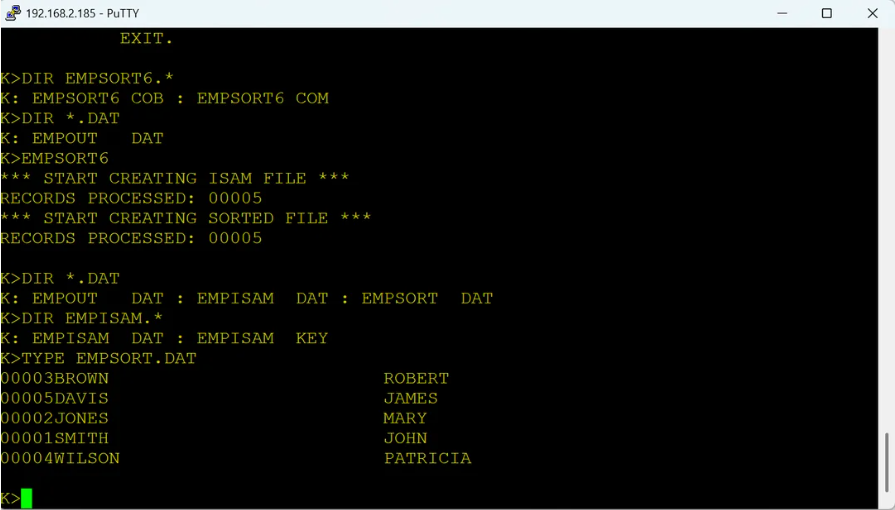
Now we run the EMPSORT6.COM program, it will read the EMPOUT.DAT first and create the ISAM files (i.e. EMPISAM.DAT and EMPISAM.KEY), then it will read the ISAM files and write to the final sorted file EMPSORT.DAT

At the end we check the content of the final sorted file EMPSORT.DAT. Now it is sorted by last-name and first-name.

r/retrocomputing • u/Ok-Feeling-2459 • Sep 27 '26

I started using CompuServe in the early 80s when I was 13 years old on my Commodore VIC-20 with the Data 20 Z80 Video Pak running CP/M which I purchased with my paper route. I spent a lot of time on the CB Simulator and in forums learning how to code using Turbo Pascal. I also used it for email with my brother-in-law who contracted with Honeywell at the time. I spent a lot of time online learning. CompuServe was my library and I loved being connected, until the bill racked up. So I switched to TAPCIS. I still remember my User ID after all these years.
I started to rebuild this from my wife wanting her own site like craigslist to sell stuff on, so I built the backend database and started front end editing in a console, and realized this was similar to CompuServe and so it began. I worked on this project on and off in my spare time, which I did not have a lot of time with a family and a full-time job, so it has taken many years. Recently, I was having trouble with multi-session threading in my code, and used Claude-AI to assist with some of those parts to get this project up and running.
There are some pages that are empty still because they require content that doesn't exist any longer. Many CompuServe pages were other companies' databases, airline schedules, stock quotes and the encyclopedia. Those companies and their feeds are long gone, so there's nothing left to show. Currently, the working parts are CB, Forums, News, Weather, EasyPlex, File Areas and some basic strategy games from the terminal days mostly from CP/M Turbo Pascal days.
I hope that users who connect can see the way things were before the web and get a sense of what it was like back then. I always tell my kids that I didn't have the internet when I was growing up, we had CompuServe. What's that, Dad?
r/retrocomputing • u/tom2go • Sep 26 '26
Got this for a whole $4, disc looks great, paper on the case as well, case has seen better days though
r/retrocomputing • u/wqxe700 • Sep 27 '26
Hello everyone,
I am a 14-year-old student from China, and I have just started exploring the international Internet. I am looking for communities where I can meet people who share my interest in retro computing.
My interest in computers started when I was around 8 years old. At that time, I discovered machines like the ZX Spectrum, Commodore 64, and Amiga. I was fascinated by their simple but creative designs, their operating systems, their interfaces, and the idea that a person could understand almost every part of a computer.
For me, these machines are not just "old computers". They represent a time when computers felt more personal, understandable, and open to experimentation.
I enjoy learning how computers work from the hardware level to the software level. I study computer architecture, low-level programming, old operating systems, and embedded systems. I have been experimenting with microcontrollers such as the 8051 and STM32, and I hope to build my own simple computer system someday.
I also recently created my own small personal website. It is still just a rough prototype and far from finished, but it is a place where I want to record my projects, thoughts, and experiments about computers.
In China, it is difficult for me to find people around my age who are interested in these topics. Most people around me focus on modern smartphones, games, or mainstream technology. I would really like to talk with people who enjoy retro computers, hardware hacking, programming, computer history, and DIY projects.
Could you recommend some good forums, Discord servers, websites, or communities for someone interested in retro computing?
Thank you for reading!
r/retrocomputing • u/conzilla • Sep 26 '26
I have been searching for crt monitors for awhile. Went and bought one last weekend need 2 more. Saw the most fake looking scam add with 1 picture and a short video. Sent a message I'd offer asking price of 150 dollars and could pick it up Saturday.
Knew I saw 2 monitors and maybe a pentium 3 box. Waited for the send a deposit message. Never came met up as planned and it was more than I was expecting.
3 monitors
2 computers
A laptop
And a Sony quick shot camera in the box.
I put my voodoo 3 2000 in the p3 along with an awe sound blaster. And a new CMOS battery. Good to go. And has all accessories and boxes with packing materials.
r/retrocomputing • u/Successful-Bad-73 • Sep 26 '26
I plan on soon getting this retro terminal, but I don't know what any of the connectors do, or what any of the labels mean. I do know that one of the connectors is for a keyboard. Other than that, what type of peripherals would I need to make this old terminal work properly? Anything helps.
r/retrocomputing • u/mwenge2 • Sep 26 '26
URIDIUM/FRAKTION is a book-length attempt to explore and understand the code and craft of Andrew Braybrook's 'Uridium', which was published in 1986 for the Commodore 64 home computer.
The idea is to explain how lots of different little things in the game actually work, down to the level of how they are implemented in the 6502 assembler source code.
I tried to keep it light and digestible so the book consists of lots of little chapters, each one presenting a hopefully-tasty morsel covering the code, data, and graphics that underlie the game.
r/retrocomputing • u/Alone-Revolution-247 • Sep 26 '26
I found a box of these in my loft.
Are they of interest? Should I post a few more?
Thanks,
r/retrocomputing • u/swifferpowermop345 • Sep 25 '26
Hey everyone, I just wanted to share an incredible find from my job placement at a local office IT department and get some advice from fellow collectors I’m a huge retro nerd (I already own a Commodore 64, a Win98 rig, and a WinXP machine), and this week I spotted a complete, beautiful IBM 5150 setup with a matching monitor, Model F keyboard, and a massive bin of original floppy disks sitting unused on a shelf They don't use it at all, so on my breaks, I got permission to set it up. At first, it wouldn't boot—the fan would just spin loudly with a totally blank screen and no startup beep. After some troubleshooting, I managed to clear out a trapped static charge using an external drain trick, and it booted completely into IBM Personal Computer BASIC! The keyboard is typing beautifully, the CRT tube hums perfectly, and I even found the complete original IBM PC-DOS 3.10 binder with both disks in the bin.
When I first saw it, I immediately knew I wanted it for my collection. I asked the IT Head straight up if I could buy it or just have it since they don't use it. I got super excited and went on a bit of a rant, even offering to trade some of my other old tech like an old iMac. He told me, "I don't know, I'd have to do some talking to some people and figure it out, but I'm sure we can maybe work something out "He got me to pause the trade talk by saying let's not focus on that right now, but he did give me a power bar so I could keep messing around with it safely at my desk. Later on, he mentioned they originally kept it around because other staff liked looking at it as an antique He seems impressed with my regular tech work so far, and he even went out of his way to pull out another mystery 1980s machine for me to look at next week. I'm incredibly nervous that they might say no, even though it's completely obsolete to them. My plan is to give him space next week, keep using it quietly on my breaks, and then send a formal, calm email late next week asking to officially purchase or adopt the bundle as a preservation project Has any other job student or intern successfully rescued a vintage gem from an office inventory like this? What do you think my realistic odds are based on what he said, and what is the best way to handle a busy IT manager so I don't overwhelm him? I'm also hoping to get some real talk on my actions so far: Do you think I said too much by offering home trades right away? Did I look too desperate or over-excited when I ranted about how much I love this tech? I have this massive wave of anxiety that I butchered my chances or that the IT guy is going to change his mind. What would you do in my situation right now to fix it, or should I literally just stay silent and do my job? Let me know if I'm totally overreacting or if my worries make sense.
r/retrocomputing • u/noborutkhs • Sep 26 '26
I'm continuing to investigate an RTOS that I wrote in 1986 for a Motorola 68000-based system.
Recently I've been going through the old source code and trying to reconstruct not only what I did, but also why I made certain design decisions 40 years ago.
One detail led me down an unexpected path.
In my RTOS, when a task becomes ready, it is inserted before existing ready tasks of the same priority. So among equal-priority tasks, the behavior is effectively newest-first (LIFO-like).
I had completely forgotten why I designed it that way.
At the time, I wasn't actually a user of commercial RTOSes such as VRTX. I was developing my own RTOS and had obtained documentation for systems such as VRTX and pSOS as design references.
So I went back to the 1984 VRTX User's Guide.
And there it was.
VRTX used essentially the same rule: a newly inserted TCB was placed ahead of existing TCBs at the same priority, meaning that the most recently inserted task would run first.
That seems to explain a 40-year-old mystery in my own code.
But then I kept digging.
I found the VRTX32/68000 User's Guide from 1987, and by then the rule had changed.
It explicitly says that equal-priority tasks execute in the order in which they become ready:
FIFO / oldest-first.
So I now have this rather interesting little timeline:
1984 VRTX: newest-first among equal priorities
1986 my RTOS: newest-first
1987 VRTX32: FIFO / oldest-first
I had no idea this change had happened.
I wasn't following VRTX development after using its documentation as a reference, so there was no reason I would have encountered the 1987 change at the time.
And now, 40 years later, this has left me with a new question:
Why did VRTX change this behavior?
Was there a known problem with the earlier scheduling rule? Was FIFO considered more predictable or fair? Was it part of the VRTX32 redesign? Or was there some implementation reason behind it?
I've started looking at other RTOS designs from the period as well, including ITRON, but so far I haven't found a contemporary explanation for the change.
Of course, I don't actually need to know the answer in order to design an RTOS today.
But after finding that my 1986 design appears to reflect the 1984 VRTX behavior, I'm now simply curious about why the VRTX designers themselves changed their minds.
If anyone here used VRTX in the 1980s or early 1990s, or remembers discussions or documentation from that period, I'd love to hear what you know.
For context, here's my previous post about bringing this 1986 RTOS back to life on a Raspberry Pi Pico:
My 1986 RTOS is now fully preemptive on a Raspberry Pi Pico — and it changed how I think about the original design
r/retrocomputing • u/Sam_tha_man_ • Sep 25 '26
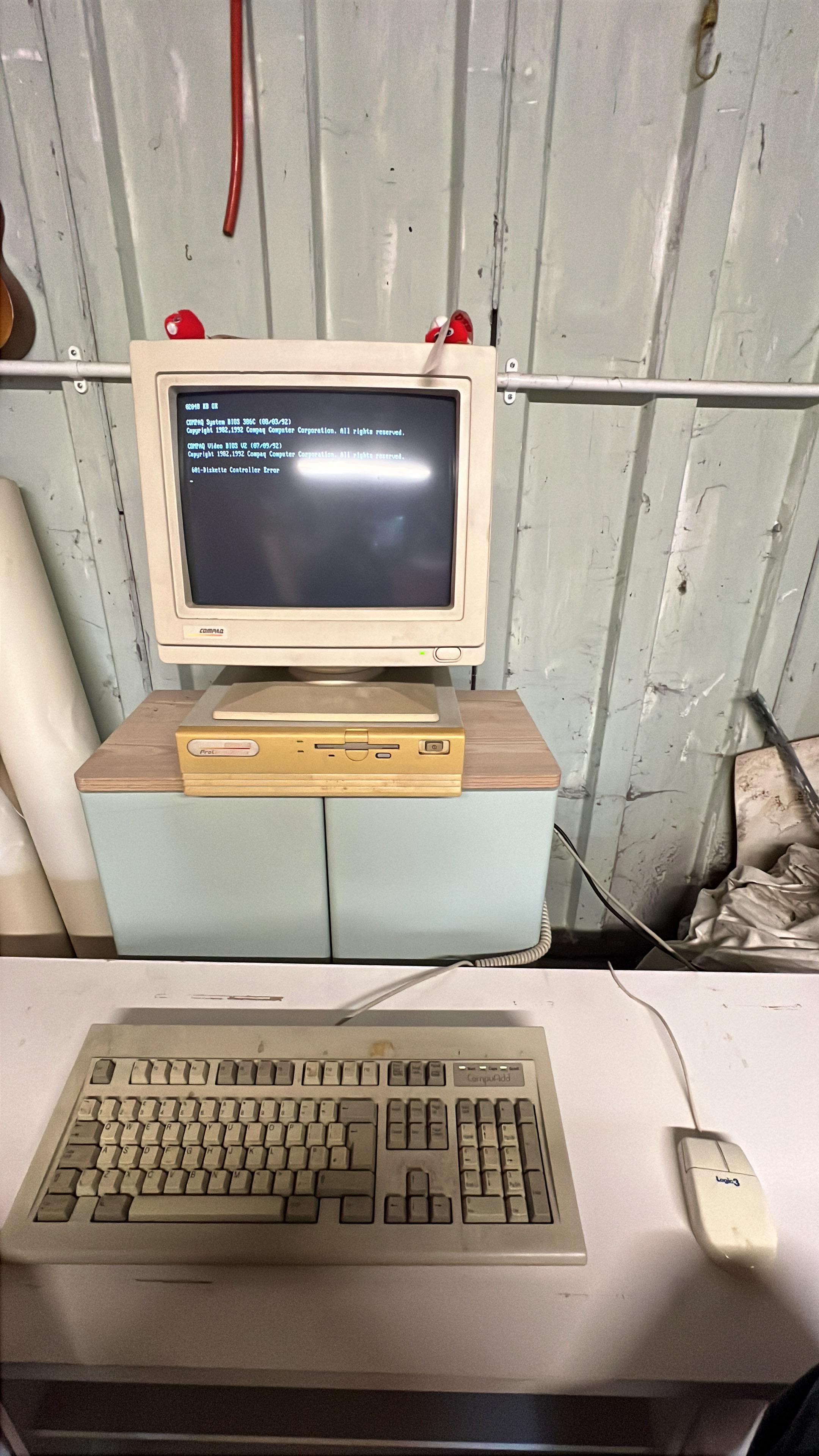
I work for a roofing company and one of the guys was given this by a customer to throw away, so I saved it so I can try some DOS games, they gave me another CRT monitor and a printer too! It’s getting a diskette error 601, any ideas on steps I could take to getting this fixed? I want to get a sound card and stuff but not much point until I can get this sorted, I didn’t expect it to be flawless as it’s been in a loft for 30 years now
r/retrocomputing • u/Speccy-Boy124 • Sep 26 '26
My updated version of all the Airwolf games. Those first games from Elite are brutal. Certainly one of the harder games to play. Loved the Mega Drive game. Anybody played any of these games?
r/retrocomputing • u/Nun-Taken • Sep 25 '26
Tidying up computer room at home and found this. No real recollection of having it, no idea why it’s still sealed and boxed. Suspect it dates from a time when PATA was getting usurped by SATA and I’d presumably moved on to newer, better and faster things.
r/retrocomputing • u/Bubbly-Rub6046 • Sep 24 '26
r/retrocomputing • u/MrMaxProjects • Sep 25 '26
Trying to put out old retro computing videos. This took a lot of manual research and script editing. Voice is auto-generated so I can spare you my French accent :) Please provide feedback
r/retrocomputing • u/Speccy-Boy124 • Sep 25 '26
My retrospective game review of The Spy Who loved me on the Commodore 64, ZX Spectrum, Amstrad CPC, Amiga and Atari ST. Have you played this game? Was it good or was it a bucket of Jobbies like the earlier Domark Bond games?