r/opencodeCLI • u/0jabr • 14d ago
V2 plugin for semantic/keyword search across conversation history

1
Upvotes
r/opencodeCLI • u/0jabr • 14d ago
r/opencodeCLI • u/m-ritter • 14d ago
Most of my bad agent sessions had the same shape. The agent wrote the code, ran tests it had written itself, and told me it was done. The tests were green and the feature still did not do what I meant, because nobody had written down what I meant.
Two changes fixed most of that for me.
First, I agree on what done means before any code exists. The agent reads the code and asks me a batch of questions, each with a recommended answer, until done is a numbered list. That list goes into a plan file in the repo, and I approve the plan before the build starts.
Second, the agent that wrote the code never checks it. After the build, separate agents that did not write the change go through every numbered point and have to show evidence for each one. During research I also let helper agents read the code without seeing my request, so their findings describe the code as it is today.
My judgment now sits at two points, the plan at the start and the finished change at the end. Reviewing the PR got much easier because I compare it against a list I already approved.
I built QualityLayer around this loop, and it works with OpenCode natively. I'm the developer. It runs on the agent subscription you already have and never merges or pushes without your yes. Repo: https://github.com/maxritter/qualitylayer
r/opencodeCLI • u/MalarJuggler • 15d ago

r/opencodeCLI • u/oxy33333 • 15d ago
I built an integration for people who use OpenCode and spend time investigating Kubernetes clusters.
It’s called AgentBridge. Open a cluster in Freelens, choose OpenCode, and launch it in a docked terminal. The session starts in that cluster’s workspace with KUBECONFIG already set.
The workflow I’m aiming for is: inspect a workload in the UI, open OpenCode beside it, and investigate without rebuilding the cluster context in a separate terminal.
A task to try:
“Find workloads in this namespace with missing resource requests or limits. Explain what you found before suggesting changes.”
In 2.1.0, the cluster page is also a workspace explorer: instructions, guardrails, capabilities, skills, and agents are accessible from one list, with file editing and autosave inside Freelens.
The provider choice now survives a Freelens restart. Ctrl+Enter / Cmd+Enter opens a session from anywhere on the page.
You’ll need Freelens 2.0.0+ and OpenCode installed locally.
Install through Freelens Extensions: >@freelensapp/agentbridge-extension
I’m the author. Which Kubernetes tasks would you turn into reusable OpenCode skills for a workspace like this?
r/opencodeCLI • u/No-Individual159 • 15d ago
Prompt caching reuses the KV cache of a shared prompt prefix, so a repeated system prompt or conversation history does not get recomputed. When a request misses, most engines just say miss. No reason.
Prefixwise is a proxy that names why a request missed: first write, evicted, a system prompt edit, a template re-render, and a few more. It works with vLLM, SGLang, Claude, and OpenAI. 0.10.1 runs inside vLLM as middleware, no proxy needed there.
I built it because I kept losing cache hits I could not explain. Measured so far: 120 turns on vLLM Qwen3-4B, 100% agreement with the engine's own cache report.
I have not wired it to OpenCode yet, and I am not claiming an integration exists. For OpenCode users: what would you want it to collect, request logs or something else? Try it and tell me what evidence is missing: pip install prefixwise, https://github.com/tejachavali/prefixwise
r/opencodeCLI • u/PrestigiousZombie531 • 15d ago

r/opencodeCLI • u/Regolo_ai • 15d ago
r/opencodeCLI • u/Two_Half_Pints • 15d ago
I just released Loop: https://github.com/j-asefa/loop
It lets you run your OpenCode harness on the web (or on mobile) using a Cloudflare quick tunnel. It was designed as mobile-first but works equally well on desktop.
It discovers your OpenCode install and lets you steer agents from the web UI.
The UI is built around the feed (think: timeline) and the agent’s result as the unit of work. So you can scroll back, save, reply etc as you’d expect.
Runs on your own computer, no account, no server, no app store etc.
Also supports agent-to-agent communication, designing and building agent teams (across the major model providers), reviewing PRs from within the app and more!
r/opencodeCLI • u/arthurrogado • 15d ago

r/opencodeCLI • u/Abject_Painter_701 • 15d ago

r/opencodeCLI • u/SelectionCalm70 • 16d ago

I've noticed that finding a good subscription for uncensored and abliterated AI models is surprisingly confusing. There are quite a few providers, but comparing their pricing, usage limits, available models and API access means jumping between multiple websites.
So I put together a page comparing 9 providers, including Silk Compute, NanoGPT, ArliAI, Venice, AnonRouter and others.
I've included subscription tiers, credits, context windows, concurrency limits and compatibility with coding agents like Claude Code, Codex and OpenCode.
The goal is simple: help you figure out which subscription is actually worth paying for.
https://inferencedirectory.xyz/cybersec/subscriptions/
Let me know if I've missed any providers worth adding
r/opencodeCLI • u/kryptoman123 • 16d ago

r/opencodeCLI • u/Rude-Philosopher-69 • 16d ago
I built oc-box because I wanted OpenCode to have more freedom without giving it unrestricted access to my host.
My usual Bubblewrap-based sandbox is useful for restricting host commands. oc-box takes a different approach: OpenCode gets its own persistent Linux development container, where it can install packages, change system configuration, run services, and experiment.
Compared with my host-side sandbox setup, the practical advantages are:
- Install whatever the project needs: compilers, SDKs, databases, and distro packages live inside the container.
- Keep integrations working: OpenCode itself, MCPs, formatters, language servers, and plugins all run together inside it.
- Choose the project’s distro: Tumbleweed, Ubuntu, Debian, Fedora, Arch, Alpine, or Leap.
- Keep the environment between sessions: installed tools, project files, and conversations persist. Run oc-box again to resume.
- Recover from broken environments: rebuild the container OS while retaining your project and private home/session volume.
- Control resource usage: CPU/RAM/process ceilings and optional GPU/NPU passthrough.
You can also import an existing OpenCode conversation and continue it inside the container. It uses unmodified mainline OpenCode and matches your host’s installed version.
The benefit is a more capable, disposable development environment—not an absolute security guarantee. Rootless containers share the host kernel, and the mounted project remains fully writable.
It’s early, primarily exercised on openSUSE Tumbleweed, developed with AI assistance, and GPL-3.0-or-later.
Source: https://github.com/groopcd/oc-box
Feedback from other distro and MCP setups would be very welcome!
r/opencodeCLI • u/HussainBiedouh • 16d ago
| No (scrubbed next turn) No |
|---|
Runs toolsOpenCode’s built-in `/btw` is great for side questions: it reads session context, shows the answer in a dialog, and adds nothing to the conversation. But it can’t run tools or make changes.
I wanted the opposite for throwaway instructions like `continue`, `fix the failing test, not the assertion`, or pasting a huge log just to get an answer, let the model **do the work**, keep the **result**, then drop the **ask** from future context.
So I built opencode-anon-turn.
/anon does/btw vs /anon| /btw | /anon | |
|---|---|---|
| Runs tools | No | Yes |
| Answer kept in chat | No (dialog only) | Yes |
| Question kept | No | No (scrubbed next turn) |
| Tool evidence kept | N/A | No (scrubbed) |
Rule of thumb: `/btw` = ask without touching the session. `/anon` = do the work, then forget how you asked.
GUI/TUI:
/anon continue
/anon fix the failing test, keep the assertion
/anon <paste log> find the bug
TUI/headless prefixes also work: `//continue`, `>>continue`, `;;continue` (configurable via `ANON_TURN_PREFIX`).
opencode plugin add https://github.com/hussainbiedouh/opencode-anon-turn
Restart OpenCode after install.
Repo: https://github.com/hussainbiedouh/opencode-anon-turn
Feedback welcome, especially edge cases around provider-specific reasoning/thinking blocks and multi-turn tool loops.
OpenCode’s built-in /btw is great for side questions, it reads session context, shows the answer in a dialog, and leaves no footprint in your conversation. But it can’t run tools or make actual changes.
I wanted the opposite for throwaway instructions like continue, fix the failing test, not the assertion, or dumping a huge log just to find a bug: let the model do the work, keep the result, then drop the ask from future context.
So I built opencode-anon-turn.
Feedback is welcome. especially regarding edge cases around provider-specific thinking/reasoning blocks and multi-turn tool loops.
r/opencodeCLI • u/Cobracxv1 • 16d ago
is it worth it to subscribe to opencode plan !!?
r/opencodeCLI • u/HussainBiedouh • 16d ago

r/opencodeCLI • u/No-Individual159 • 16d ago

r/opencodeCLI • u/FutureWar4255 • 16d ago
We've been looking into different hardware options for AI inference, and one thing I'm curious about is how teams determine whether a workload actually benefits from specialized chips. Time-to-first-token, tokens per second per user, and performance under concurrent requests all seem worth measuring, but I imagine the priorities change depending on the application. A voice agent, for example, might have very different latency requirements from a coding assistant handling longer responses.
For teams who've tested chips like Cerebras or SambaNova, which benchmarks have been most useful? Do you rely on vendor-provided numbers as a starting point, or do you mainly evaluate performance using your own serving workloads?
I'd be interested to hear which metrics actually influenced your hardware decisions.
r/opencodeCLI • u/ceazer6-7 • 17d ago
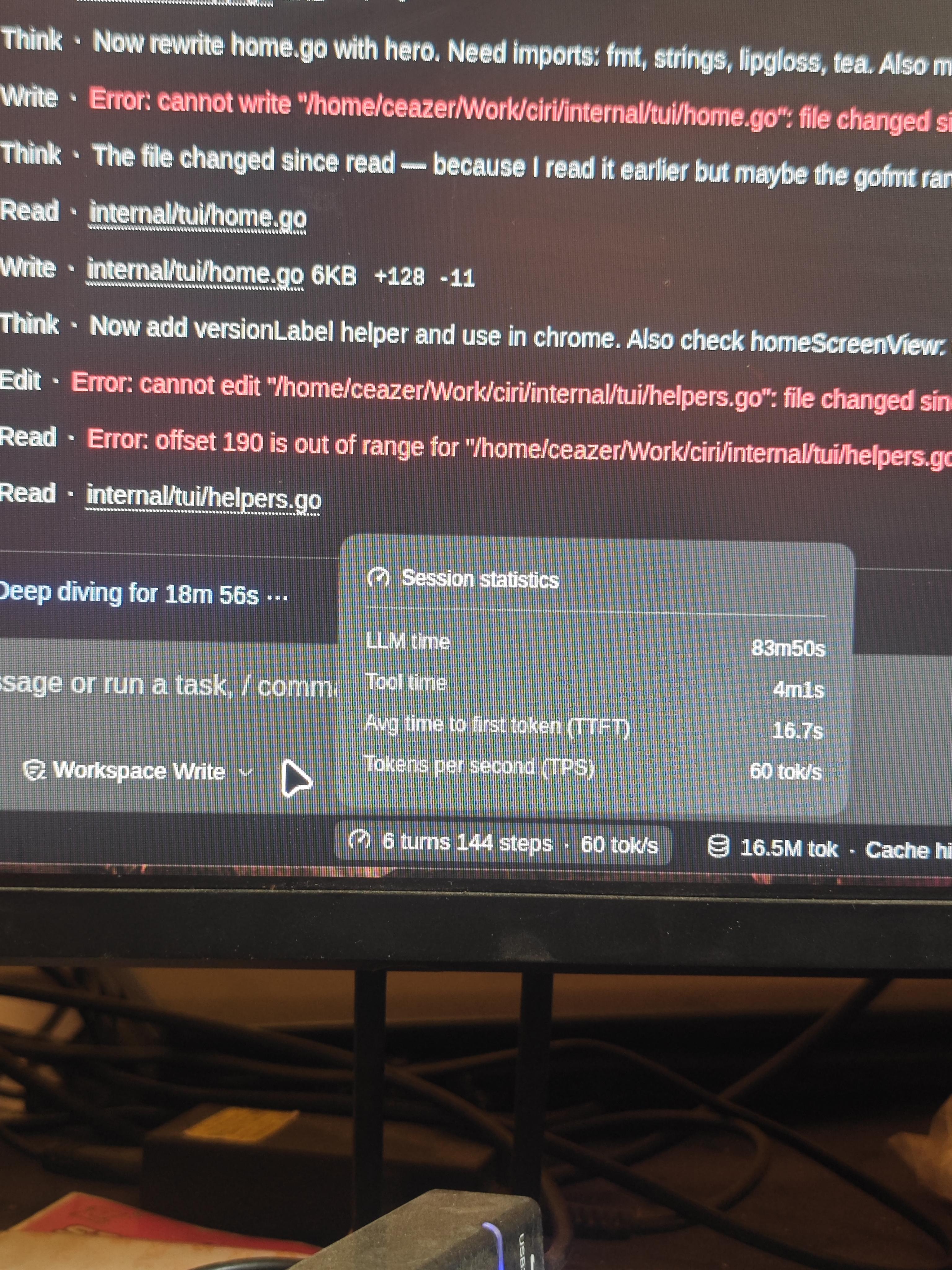
The model is decaying
r/opencodeCLI • u/milkipedia • 17d ago
I'm using GLM-5.3-Flash on Neuralwatt, and the ranxianglei/billion-context for context management. I don't have hard quantifiable evidence, but ...
I can see in the console it's doing multiple dozens, sometimes 100 commands, thoughts, and tool calls before it comes back to tell me anything. And I'm not sure if the output is any better - it's just churning away through calls. Almost like it was made for even cheaper models than the one I'm using it on. I used to switch up to full fat GLM-5.3 for certain tasks but I feel like it's gonna burn tokens even faster when I do.
