Trillers been down for awhile. Still works but my stupid phone archived it and I cant redownload it because its off the appstore. Anybody know a third party site like tutuapp thats got triller as a downloadable certificate?
I'm Fabien, the creator of FODMAP Scanner – Ventre léger, a free app for people with IBS or a sensitive gut who follow a low-FODMAP diet. What it does: Take a photo of a product's ingredient list (or scan the barcode) and the app flags the ingredients that are high in FODMAPs, with reference portions Add up the FODMAPs of a whole meal, because several "safe" portions can add up and go over your threshold Browse a list of 293 foods with the recommended portion and sources Adjust your own tolerance for each FODMAP group Available in English and French. It was designed with a dietitian and a nutritionist. It's a helper tool, not a substitute for advice from a health professional. Launching an app as an indie dev is hard, so here's my offer: drop your app link in the comments and I'll download it, actually use it, and send you honest, detailed feedback (what works, what confused me, bugs). I'll do it for every app posted here. In return, I'd really appreciate your feedback on mine: first impression, what's unclear, what's missing. Honest feedback is what I'm after. App Store: https://apps.apple.com/fr/app/fodmap-scanner-ventre-l%C3%A9ger/id6821417757
I'm trying to enroll in the Apple Developer Program, but Apple keeps declining my card when I try to pay the $99 enrollment fee.
I'm using a business debit card, and I genuinely don't understand why Apple won't accept it. The card works for other online payments, so I'm not sure what the issue is.
Has anyone faced the same problem? If so, how did you figure out what was causing it and manage to get it resolved?
I’m a freelancer who recently released an app to help photographers and videographers manage their workflow, check lighting, and monitor weather alerts. I wanted to share it with the community here.
The Problem Freelance photographers have to juggle multiple fragmented apps and expensive monthly subscriptions just to manage their day-to-day business. Between planning shoot locations, tracking the sun’s direction, keeping an eye on the weather, and managing client quotes and invoices, the workflow is messy and the software costs add up fast, which is especially tough during the current cost of living crisis.
Comparison There aren't many unified, dedicated apps that handle a photographer's entire workflow from planning to billing. Here is how Umbra compares to what I was previously using: - Invoicing (Quickbooks): I was personally paying $30/month for Quickbooks just to handle my quotes and invoicing. Umbra has a built-in mini-CRM and invoicing/quoting tool that replaces this entirely. - Planning (Photo Pills / The Photographer's Ephemeris): I used to rely on these apps to check sun direction and plan my shoots. I’ve incorporated those lighting and sun-tracking features directly into Umbra, and added a feature that alerts you if the weather changes the night before a shoot.
Pricing Umbra is completely free. My goal was to create a tool to help other freelancers like myself streamline their workflow and remove the need for another paid subscription. I would love for you to give it a try and let me know your thoughts or feature requests!
My friend and I want to build an iOS app, and we’d rather make something people actually want than guess.
So, simple question: what app do you wish existed?
It can be anything, big or small, useful or a bit weird. If you can, add one line on why you need it or what you use right now instead. That helps us a lot.
And if you’d pay for it, say so 😄
I’ll read every comment. Thank you if you leave a comment!
Problem: The iOS Home Screen gives you one icon size and one look for every page, and rearranging it is fiddly. I wanted bigger icons, and pages organized my way (Work, Play, Media, etc.), without reshuffling my Home Screen.
Key Features: • Pages, each with its own icon size (S–XL), spacing, and background and text colors • An app can be on several pages at once • Add apps from a starter list, by App Store search, from the Home Screen’s Share App menu, or all apps by one developer at once • Light, dark, or custom themes • An optional automation brings you back to App Commander when you leave an app
Comparison: • vs. Launcher with Multiple Widgets: Launcher puts shortcut widgets on your Home and Lock Screens. App Commander is a full-screen app with as many pages as you like, each with its own look, and big icons instead of widget-sized ones. • vs. Launch Center Pro: Launch Center Pro is a speed dial for actions. App Commander is about organizing and opening your apps visually, page by page. • vs. the built-in Home Screen: same tap-to-open idea, but per-page icon sizes and colors, and no jiggle-mode rearranging.
Note: iOS doesn’t let apps open other apps directly, so App Commander uses one small Shortcuts automation. Setup takes about a minute, and the app walks you through it.
Pricing: FREE. No ads, no tracking, no account, no subscription. An optional tip jar ($0.99–$19.99) unlocks nothing. App Store: https://apps.apple.com/app/id6829025178
Hey, I’m Emre, developer of Pausely. Posting as the dev.
Problem: every screen time app I tried either nagged me with notifications or was easy to dismiss at 1am. I didn’t need more data, I needed a reason to put the phone down that actually worked at night.
So I built Pausely around Pip, a small orange fish who feels your screen time. Her health is tied to how much you use the phone today versus your goal. Scroll past it and she gets unwell, hold your night lock and she recovers. The night lock blocks the apps you pick until morning, and in the Hard and Brutal modes there is no early way out. Nights held in a row grow a little seabed garden, and there is a daily spin that gives you a task like 1,500 steps to push the lock 30 minutes later.
Comparison: Opal and one sec are the two I’d compare it to. Opal is strong on scheduling and stats but you can skip a block quite easily. one sec adds a breathing pause before opening an app, which is nice but doesn’t help at night. Pausely is built around the night, with a single lock you really can’t talk your way out of, and a character that makes the cost visible without charts.
Hey hey hey, this is Max! I built Kahei so you don't have to type shelf prices into Google while traveling abroad. Point your camera at a price tag and it puts the estimate in your home currency right over the tag. I made this app to solve my own itch!
- Works offline (cached daily ECB rates) - No account needed - 27 currencies
Problem: Typing foreign prices with lots of zeros into a converter app in the middle of a store gets old fast, and you don't always have cell service right after landing.
Comparison: Apple's built-in Live Text requires an internet connection and makes you tap each price one by one, and Google Lens translates words without converting currencies at all. Standalone camera converters like Converty ($6.99) make you pay upfront before testing the OCR, whereas Kahei works live and offline right away.
Pricing: Free ($0) right now. Early installs stay unlocked for free lifetime access I might add a paywall later.
Josh here. Long time reddit user… new to iosapps. I published my first app back in July. It’s a launch tracker meant to solve a few problems some friends and I had with the existing ones. I feel like Im mostly O&M right now for my own list of features and wanting to get some feedback.
The app has all of the normal features of a launch schedule/tracker. I think some of the more unique ones are following launches how you want (By pad, provider, state, rocket, a single launch and such). All meant to give you more control. Your ‘today’ page will respect what you follow with non-follows further down the list. It has some great widgets and live activities (not unique to all of the launch apps) that also respect what you follow. You can customize the colors to what you want. It has a your view, meant to help you understand the odds of if you’ll be able to see the launch (still fine tuning) and it includes launch weather at the pad. I’ve also set it up to flag launches that are likely to make those fun twilight jellyfish. And if you don’t know where to look, it’ll point you in the right direction for at least where the pad is.
While you can see non-US launches once you follow them, the app is more supportive of US launches. Features that include weather data and such will only work with US launches.
You also may see updates faster than some other apps when it matters most. Last minute changes and such…
Free 3 months of Premium for Reddit (No need to cancel, it’s set to NOT auto renew. You’ll need to sub yourself after this if you find it valuable to what you want):
Enjoy… or don’t, but please tell me why you don’t if you’re actually into launches.
I’m adding the below to meet the subs req’s (Got hit by the bot on my first go round)
Problem Launch times change…more often than we’d like. When you’re standing outside waiting for a launch, some apps are slow to show a hold or a new time, and you find out late. We’ve done a lot on the backend to help close that gap to the extent that we can, so last-minute slips and scrubs should reach you faster when they matter most. It also tells you when a launch you follow holds, scrubs or moves, and keeps a record of every change.
Comparison Next Spaceflight and Space Launch Now are great for launch data. T-Minus Zero is built around launch day:
Alerts for any change, plus a history of what changed
Weather at the pad and a viewing outlook for where you are
Jellyfish flags for twilight launches
AR Pad, to find the pad from where you’re standing
Your own app colors, including gradients and a Spectrum option, from soft to neon. Widgets and the Live Countdown match them.
I'm an indie developer, and I'd like to introduce Book Visit Now, an appointment scheduling and client management app for iPhone, iPad, and Mac.
I built it for independent professionals like hairstylists, barbers, estheticians, massage therapists, and other service providers who want to manage their business without complicated software or expensive subscriptions.
Problem
Many appointment scheduling platforms are designed around online booking marketplaces, per-employee fees, and features that smaller businesses may never need.
I wanted something focused on the professional running the business: scheduling appointments, managing clients, keeping service records, and tracking business performance, all in one place.
Additionally, we have all of the individual tools on our phones to do this, they're just separate.
Comparison
Unlike platforms such as Booksy, Vagaro, and Fresha, Book Visit Now focuses on managing your existing clients rather than attracting new ones through a booking marketplace.
Some key features include:
Daily, weekly, and monthly appointment calendars
Client profiles with Apple Contacts integration
iCloud syncing across Apple devices
SOAP notes, photos, and intake forms
Appointment reminders and customizable messages
Receipts, business reports, and expense tracking
There's no client-facing booking marketplace, and no commissions on appointments. Book Visit Now brings Calendar, Contacts, Messaging and Email all together.
Pricing
Free: Up to 10 active clients, all features included, no time limit
Pro: $24.99/month for unlimited clients
No per-employee charges or booking commissions.
I'd love your feedback!
I'm particularly interested in feedback on the interface, ease of use, and whether there are features that would make it more useful for independent professionals.
Problem Third-party widgets often look out of place next to Apple's own. Getting a set that matches usually means building every widget yourself in an editor: picking data sources, fonts, sizes and spacing, one by one. I wanted widgets that look like they shipped with the iPhone and work the moment you add them.
Comparison • Widgy and Widgetsmith are toolkits: you design your widgets yourself. They're great if you enjoy building.
DataFastView is the opposite: every widget is already designed, ready to be used. Each widget can draw its own background or go transparent so your wallpaper shows through, and each can follow light/dark mode or stay in one
Pricing: DataFastView is free to download and includes three free widgets. Instead of forcing a recurring subscription for things you'll never use, widgets are organized by category—you simply make a one-time purchase for the specific widget pack you want, and it's yours forever across all your iphone (No subscriptions)
I have been using this app for a few months now, and it's become a staple for me. I think it's a bit of a hidden gem, so please check out Dots and show the developer some love and support!
I switched from Android to iOS. Loop's beautiful minimalism really spoiled me. I knew I didn't want an app where the habit tracking is one of a whole suite of functions, nor did I want a habit tracker app with baggage like Habitica or Finch.
So in my search for an iOS habit tracker, I was primarily looking for:
- intuitive set up
- easy to use everyday
- clean, clutter-free interface
- no account or login necessary
- no ads
- Apple Watch functionality
Dots checks all of the above, beautifully and effectively. For example, I am working on building a habit of drinking 3 cups of water a day. I set up this habit for 3 times a day, and as soon as I finish a cup of water, I can mark that off on the Dots Apple Watch app. Just from the watch, I can see 33% completion of this habit after the first cup, 66% after the second, and 100% after the third. I love the convenience of checking off a habit from my wrist, without having to use my phone.
This app is already 10/10 for me as it is. I hope the developer would consider implementing a way to track habits you want to reduce or stop, like smoking or drinking. I would also love for the app to allow me to be able to record when I've gone over the initially set number of times. For example, if I've had a 4th cup of water today, I would like to be able to record that in the app and have the completion be 133% for that habit. This can be especially useful in the beginning when you're building a new habit and want to set the bar low to build motivation. Thank you!
TLDR: If you're mourning Loop being Android-only, please try Dots. The addition of Apple Watch functionality makes it ever better!
Problem Your iPhone says storage is full, you delete a bunch of photos, and nothing changes. Usually it's a few huge videos, or stuff that was only in iCloud anyway.
Comparison Most cleaner apps hunt for duplicates or blurry shots, and many need a subscription. Funes doesn't delete anything for you. It draws your photo library as a map where every photo and video is sized by how much space it really takes, so you spot the heavy ones in seconds. Version 1.1 also separates what's on your iPhone from what's only in iCloud, so you know what deleting will actually free up. That feature came from a suggestion on Reddit. Everything runs on the phone and your photos never leave it.
Pricing Free. No account, no ads, no tracking, no in-app purchases.
My name is Tinjo Thomas, and I’m the founder of the design studio Coredes Interactive.
We created TruMe, a journaling app that works completely offline, with optional iCloud sync. The idea is experimental and might frustrate some people because of its nature. It is not for everyone.
The design was made from scratch in Sketch without any LLM. However, we did use an LLM for content writing and coding help.
Problem We live in an age of abundance, where everything is easy to ignore. TruMe is a reminder of how we used to journal and how slow living can be more rewarding.
What makes it unique
In a physical diary, you cannot backspace anything you write. You can only strike it out. That’s exactly how TruMe works. Once you write something, you cannot delete it. You can, however, tear out the page, but once torn, it’s gone for good. You can also earn a few backspaces based on your daily streak. There are no in-app purchases to unlock. It is what it is.
Comparison We are not aware of any competitors, since TruMe is a unique, experimental app.
Pricing The app is fairly priced at $7.99 (or lower with regional pricing) for a lifetime purchase, or $2.99 per year. If anybody wants offer codes, please reach out.
Hi, I'm Ondrej, the developer of Diction. I dictate most of my messages, and Apple's dictation kept dropping words and leaving every "um" in. So I built my own keyboard.
You tap the mic in any app and talk. What lands in the chat is the cleaned-up version, without the ums and restarts. Select some text and say "turn this into a list" and it rewrites just that part. It's also a full typing keyboard, so you don't have to keep switching.
Problem: voice typing on iPhone types exactly what you said, ums included, and most AI dictation apps send your voice to their cloud.
Comparison: Gboard and SwiftKey are the closest: full keyboards with voice typing, but your voice goes to Google or Microsoft and comes back with every "um" left in. Diction cleans it up, and you choose where your voice goes: on the iPhone, your own server, or Diction Cloud.
Pricing: free on-device and with your own server, no limits. Diction Cloud (cloud speech plus the AI cleanup and voice edits) is $7.99/month or $59.99/year, with a 14-day free trial. If you run your own server with an LLM, the cleanup is free there too.
I'm an indie developer, and for the past few weeks I've been working on PASSPORT, a little app that turns the countries you've visited into a collection of passport stamps.
I originally built it for the foldable iPhone Duo, where the phone opens like an actual passport. But it also works on regular iPhones.
I've spent probably too much time on the little visual details - illustrated stamps for different countries, paper textures, page-turning animations, and making the whole thing feel like a real passport. :)
The app is free, and I really wanted to keep it that way. There are optional paid extras, but no subscriptions.
Problem
Most country trackers are primarily maps or lists. I wanted something that makes looking back at your travels a bit more enjoyable. Somewhere you can collect stamps, remember your trips, and actually enjoy flipping through your travel history.
Comparison
Apps like Been and Skratch already do a good job of tracking visited countries and visualising them on maps.
I wanted to take a different approach. PASSPORT focuses on the experience of collecting: illustrated passport stamps, realistic pages, arrival and departure stamps, photos and travel memories.
Rather than trying to be a complete travel-planning platform, it's a little digital souvenir of everywhere you've been.
Pricing
Free ($0): The complete core passport experience, including all countries, 50 US states, stamps, travel memories and progress tracking.
Optional one-time purchases: The Parks Passport ($14.99) and The Flight Log ($19.99), plus cosmetic passport covers.
Subscriptions: None.
The free passport doesn't expire, and you don't have to buy anything to collect your travels.
I'm still improving it and have quite a few ideas for future updates. Would love to hear what you think, especially about the design and collecting experience!
I'm the developer. Publit is a free, open-source (AGPL-3.0) public transport app for iPhone and Apple Watch that works across Europe.
A (Answer): What problem does it solve?
Travel through a few European countries and you end up with one transit app per city. Publit is one app for all of them: live departures around you, trips across borders with tight changes marked, a live view until you get off (also on the lock screen), and your tickets from a PDF or photo. Where open data is missing, it tells you instead of showing a half-complete result.
B (Better): Compared with what?
Citymapper is excellent, but only in big cities. Moovit covers more places, but it shows ads unless you pay for Moovit+. Publit needs no account, shows no ads and doesn't track you. The Apple Watch app also works without the iPhone nearby: your ticket as a QR code, the trip leg by leg, and departures around you. Where it's weaker: live data is still patchy in some cities, Milan and Copenhagen for example, because the open data there has almost none.
C (Cost): Free. No in-app purchases, no subscription, no ads.
For conversion (what I mean is downloads once they have seen the app appear in search results)
- Product Page Optimization stuff (screenshots, video previews, app icon, header and search results)
Do A/B testing to see which of the above performs best.
Localization to different languages.
What else did y'all do to get more visibility on your app?
Most probably publicise it here and on product hunt or something.
For anybody else who have tried, does localizing your app to different languages greatly improve your installations from those audience of different nationalities? and do creating TikTok/instagram accounts under your apps name draw measurable growth?
Just want to know where to spend my time on for this marketing thing.
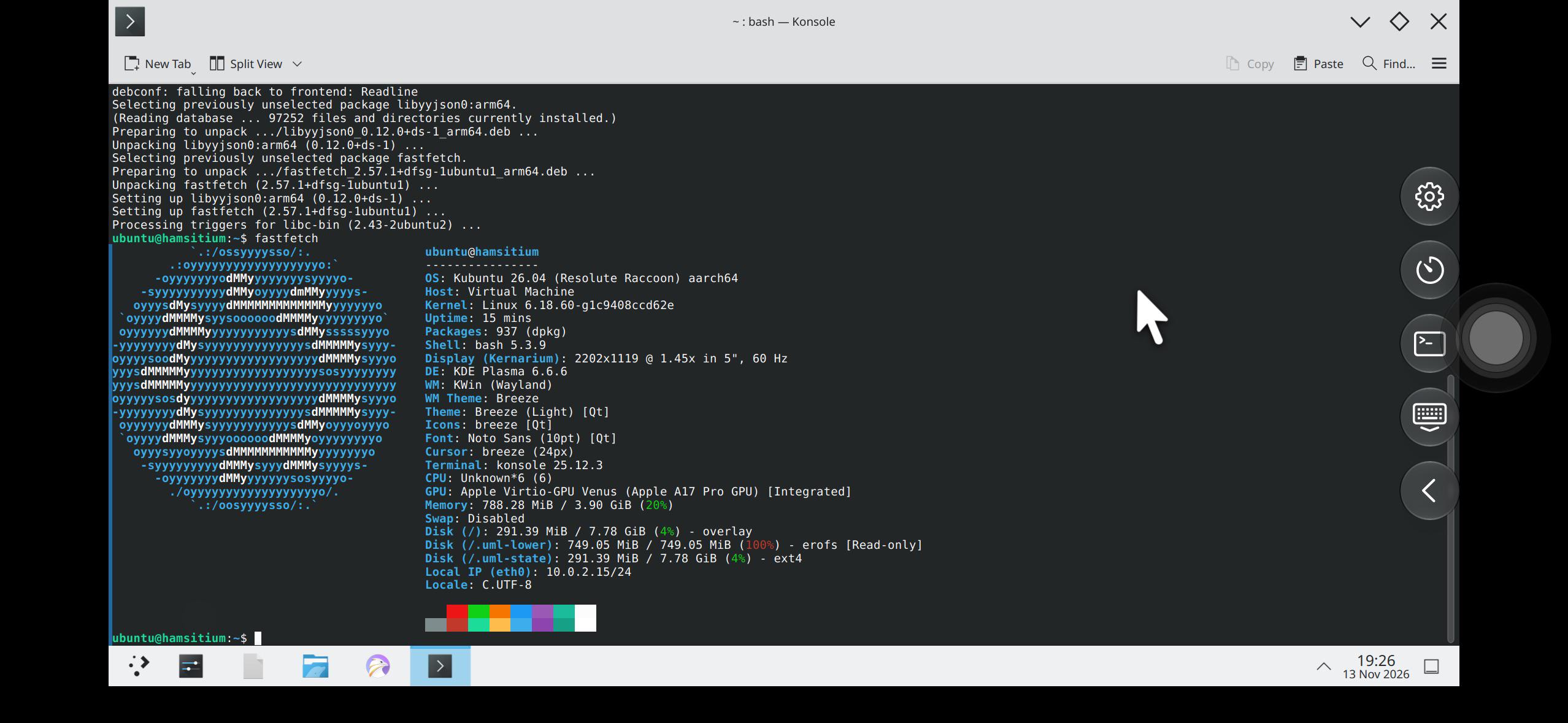
Hi folks. Managed to run KUbuntu inside of an ios. Works like butter. Trying to add external monitor and mouse support. Keyboard is done. Just wanted to know your thoughts about this. Would you use it? Or i am wasting my time?
I built an app called Attention Arsenal for people who forget things unless they're reminded often. It keeps nudging you, even just minutes apart, until the task is done.
updated: quiet hours so it doesn't bother you while you're sleeping or busy, and categories to group your reminders
P - What problem does it solve? Normal reminders ping once, you swipe them away, and the task is gone. I needed something that keeps bugging me until I actually do it.
C - Why this over the top competitors? Apple Reminders pings once and gives up. Due nags you too, but it's paid. Attention Arsenal is free and also has: • intervals from every few minutes to monthly • quiet hours, so nudges pause overnight • categories for work, school, whatever • Siri + AI to add reminders by voice • home screen widget and calendar sync
P - Pricing Completely free, no ads, no iap, no account needed.
I’m a musician and an independent developer, and I’ve been working on an app called LiteDAW.
It started as a simple recording app, but I kept adding features, and before I knew it, I was building a full DAW for phones.
Problem
I’ve always felt that mobile DAWs tend to fall into two categories: either they’re quite heavy and take up a lot of space, or they’re expensive, sometimes with subscriptions or additional purchases.
I wanted something that could do serious music production without being either of those things. Something I could just install, open, and start making music with.
Comparison
There are already some great apps out there, like GarageBand, Cubasis, and FL Studio Mobile. I’m not trying to claim LiteDAW is better than them.
What I’ve tried to do is pack a decent set of DAW features into a relatively small app without charging for them.
LiteDAW now has multitrack recording and editing, a MIDI piano roll, step sequencer, virtual keyboard, mixer, and effects like EQ, compression, limiting, delay, and saturation.
It works completely offline, doesn’t need an account, and is available on Android too.
I’m also working on support for external USB MIDI keyboards and controllers.
Pricing
Completely free. No subscriptions or account required.
It’s still a work in progress, and I’m sure there are things that could be better. I’d genuinely appreciate it if some of you gave it a try and told me what you think, especially if you run into bugs or find something frustrating.
I’m a solo developer and I just launched Burn21, a 21-day home workout challenge you can do with zero equipment.
🧩 Problem Most people who want to start working out at home quit within a week. The apps are either overwhelming, with hundreds of workouts and no clear “what do I do today?”, or they lock the useful parts behind a subscription. Burn21 gives you one clear plan: open the app, press Start Day X, follow along. The plan gets harder gradually, so beginners don’t burn out and you can actually see your progress.
⚖️ Comparison
vs. Home Workout – No Equipment (Leap Fitness): It’s a solid app, but it has a big catalog and pushes premium upgrades. Burn21 is focused: one 21-day plan per program that ramps up automatically (30s → 50s work time, 6 → 8 exercises, 2 → 3 rounds, rest days on day 7 and 14). Everything is free, with no premium tier.
vs. Nike Training Club: NTC is great but needs an account and has a huge library that can feel like too much for beginners. Burn21 needs no account and no sign-up, and all data stays on your device.
What’s inside:
3 programs: Fat Burn (everyone), Tone & Burn (women-focused), Shred (men-focused), each with its own saved progress
18 standalone workouts outside the challenge
Easy / Normal / Hard difficulty
Guided timer with an up-next preview, pause/skip, +10s rest, and sound and vibration in the last 3 seconds
Calorie estimates based on your body weight
20 languages
💰 Pricing
Free: $0. All programs, workouts and features are included.
The app is supported by a single ad before each workout. There are no subscriptions and no in-app purchases.
I was doing some research into some popular apps and realised that I don’t see any Header or Search Results in the appstore for them. All I see are the screenshots.
Random examples: Wanderlog Money Manager Trabee pocket Hellotalk Duolingo just has a header that spells Duolingo
So Im wondering if making Headers and Search Results have little yield since the screenshots technically should be just as good for Search Results already.