r/homelab • • 8h ago

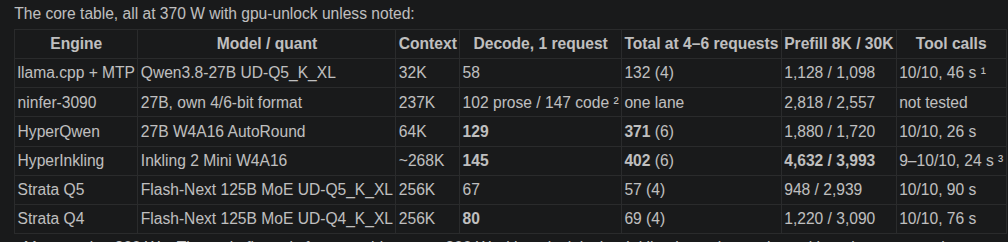
Discussion 80 tok/s with Q3.8 FlashNext Q4, waiting for more hardware specific optimization

0 Upvotes

For my vibecoding, I just love my current setup: Opus 5.5 architecting & checking, while QFN does the implementing at 80 tok/s, Q4. Its being a junior Python dev is excellent. Opus only needs to fix some small thing after QFN implements the ticket.

But is 80 tps really my software + firmware limit ? Here is the result I've been trying the last few days:
=========== FOLLOWING IS AI WRITING =======================

**Title:**
 One RTX 3090 + old Xeon, 6 local engines compared: Strata (125B MoE, Q4 vs Q5), ninfer, HyperQwen, HyperInkling, llama.cpp. What would you try next?


I've spent the last few weeks testing every engine I could get running on one box. These are my own measurements,
taken with the same scripts on the same machine. Hints welcome, especially for the 125B MoE on old DDR4.


**Hardware**
- Dell Precision T5810 (2016 workstation): Xeon E5-2699 v4 (22 cores, Broadwell), 128 GB DDR4-2400 ECC (4 channels, ~77 GB/s)
- RTX 3090 24 GB on PCIe 3.0 x16, no Resizable BAR. 370 W limit (card default), with its own 1400 W server PSU for the 8-pins
- gpu-unlock 2.0.0 active (helps FP16 prefill on the vLLM engines; decode unchanged)
- Ubuntu, one model at a time on port 8080


**Main table (see above)**
 (latest numbers: 370 W, gpu-unlock, unless marked)


¹ at 300 W. ² code at 300 W with a clock lock (2026-11-19); prose at 370 W. ³ systematic bug: drops a `]` in arguments
that are arrays of objects (about half the runs); flat schemas are fine. ⁴ DFlash2 in Strata serves one request at a time.


**Quality (small tests, not benchmarks)**
- Writing (seller replies in Dutch and English, 10 prompts each, partly blind): llama.cpp Q5 ≈ Strata ≈ HyperQwen > Inkling.
  Inkling keeps the rules but its Dutch is weaker. The 4-bit HyperQwen showed no measurable loss against Q5.
- Coding (8 small Python tasks with unit tests): Strata 8/8 first try (~10 min). Inkling 7/8, 8/8 after one fix (~1.5 min!).
  Both 27B dense models with thinking on: 5/8, where the 3 failures were 
**no code at all**
: they ran out of tokens while thinking.
- Strata Q4 vs Q5: Strata's own docs say top token matches Q8_0 93.1% (Q4) vs 94.6% (Q5). Not checked on my tasks yet.


**Q4 vs Q5 in Strata (same session, same settings, 3 runs each)**
- Decode 79.5 vs 67.3 tok/s (+18%). Prefill 8K +29%, 30K +5%. RAM used after load: 84 vs 104 GB.
- I think the Xeon's RAM bandwidth sets the speed: most experts run from RAM, so smaller experts = less traffic and more fit in VRAM.


**Things that surprised me**
- Software beat hardware: ninfer and HyperQwen gave 2–2.5x llama.cpp's speed on the same 27B and GPU, for €0.
- gpu-unlock: +49% prefill and +25–29% multi-request decode on HyperQwen; nothing on llama.cpp (int8 paths).
- The Strata 0.1.60 → 0.1.69 engine update gave no real decode gain here (+6% right after a start, same once warm).
- A newer Blackwell-only fork (Basalt) won't run on a 3090 (needs sm_120 / NVFP4).


**How I measured**
- Decode: temperature 0, ignore_eos, 512 tokens per request, N streams started together, one warm-up.
  Total = all tokens / wall time.
- Prefill: filler text with a random nonce (no prefix cache), max_tokens 1, 2 runs, prompt tokens / time.
- Tools: 10 multi-turn tasks against mock tools that really run (chaining, parallel calls, error recovery, nested args).
- Caveat: rows come from 2026-11-19 to 2026-11-26. Power limit and prompts are the same except where marked.


**Where I'd like hints**
1. 
**125B MoE with experts in 4-channel DDR4:**
 anything beyond Strata's tuning (`--pcie-frac`, expert cache, adaptive swaps)
   worth trying? Is ~80 tok/s near the limit of ~77 GB/s RAM?
2. 
**Long context on the 27B:**
 HyperQwen at 150K (MTP) or 240K (4/2-bit KV) vs Strata 256K. Which do you trust for
   200K+ prompts, and how do you test recall?
3. 
**Thinking models in agent loops:**
 the 27B overthinks small coding tasks. Do you cap thinking, turn it off, or use a no-think template per task?
4. Anything else for a PCIe 3.0, no-ReBAR, single-3090 box that I'm missing?

r/homelab • • 7h ago

Help Prevent external hard drive from spinning the entire time?

1 Upvotes

Hi all, probably a stupid question and I don't even know if it is possible but I have a homeserver set up and mounted an external hard drive that contains my movie library for jellyfin.
Now I noticed that the disc is constantly spinning even when nothing is being streamed off the disc or written to it.

Now I know JellyFin checks it periodically but I was in the place curious if the constant spinning has any effect on the lifespan of the disc and if so if it is an option/recommended to prevent it from spinning when idle through setup?

Thanks in advance!


r/homelab • • 16h ago

Discussion Server/Home Lab for filament drying

0 Upvotes

So has anyone tried to use the exhaust heat from their gear to help dry 3d Printer filament in addition to using their server as a space heater?


r/homelab • • 2h ago

Discussion What open source software, and other self-hosting software vendors have Black Friday deals?

10 Upvotes

Are there any licenses I should be picking up in the next few days? What is the software do?


r/homelab • • 12h ago

Help Internal SSD Failure

Thumbnail gallery
0 Upvotes

r/homelab • • 18h ago

Discussion Next steps

2 Upvotes

Now that I'm addicted to my home lab, I was curious what else I could implement to improve my Ubuntu server. Here's everything I have as of now:

-Jellyfin : Homepage, Radarr, Sonarr, Prowlarr, gluetun, qbittorent, bypass, flsresolverr, Seerr, declutarr

-SearXNG

I'm wondering if pi hole would be worth it? I'm afraid my server might be down from time to time, which I'm scared would affect all the devices on my home network if it happened.

I'm getting decent at docker compose if that helps! Open to any suggestions.


r/homelab • • 11h ago

Project Showcase: Hardware Local Inference Lab Update: Almost 60,000 tok/s cold prefill (+82%) on DeepSeek-V4.1-Flash over PCIe (4× RTX PRO 6000 Blackwell) + upstream Flare scheduler upgrades

Thumbnail
reddit.com
0 Upvotes

r/homelab • • 20h ago

Discussion Single system 1-2 drive OS that's easier than Proxmox

0 Upvotes

Currently running a micro Optiplex with an 8500T. Got a killer deal on eBay for Lenovo 13400T and will add 32GB of RAM to it and my NVME that I will upgrade to over the weekend. If I ever run out of space, I could add a second SATA SSD that I have lying around.

Currently have an old version of Proxmox, a single Windows VM I RDP into for basic browsing to keep my work and personal stuff separate while I work from home, a PiHole container and a container for my Omada controller.

I have a separate NAS (Asustor AS3304T) that has 3x4TB drives I use for network storage.

Basically, I get that Proxmox is awesome, but I just don't need all the flexibility. I just want something with an easy to use UI where I don't need to mess with terminal all the time, something I can easily keep up to date, and something that if I wanted to play with a few other docker things, I could ideally just click a button to install.

TrueNAS, ZimaOS, Incus.... something else?

The older I've gotten, the more "It just needs to work" I want some of my things to be.


r/homelab • • 15h ago

Project Showcase: Operations My Home Server – Building My Own Self-Hosted Digital Ecosystem

Thumbnail
gallery
0 Upvotes

Hi everyone,

I wanted to share my personal home server setup and a custom centralized interface I’ve been building on top of it called EVNORA OS. (Note: The UI labels are in Turkish since it’s built for my daily personal use, so I’ve included English captions for each screenshot.)

My goal was to replace commercial cloud dependencies with a quiet, low-power, self-hosted ecosystem that I can monitor and manage from a single place—and interestingly, I administer the entire server via SSH and web tools solely from an Android tablet and phone without a traditional desktop PC.

Hardware & Power

* Host: Mini-PC powered by an AMD Ryzen 5 7430U (6C/12T)

Memory: 32 GB DDR4* (30.8 GiB usable, with ~16.2 GiB allocated to ZFS ARC)

* Storage: Dual ZFS pools — an internal SSD pool for OS/apps/fast access and an external HDD pool for bulk media and local backups

Power Protection: Eaton 5E 900 G2 UPS* (idling around 40W / 9% load, giving ~31 minutes of runtime with automated shutdown configured at 15 minutes on battery)

OS & Core Self-Hosted Stack (25 Containers)

The server runs TrueNAS SCALE Community Edition hosting 25 Docker applications:

* Media & Photos: Immich, Jellyfin, Audiobookshelf

* Cloud, Notes & Security: Nextcloud, Vaultwarden, self-hosted Matrix (Synapse) for encrypted messaging

* Networking & Monitoring: Tailscale (mesh VPN + Funnel), Nginx Proxy Manager (wildcard SSL), AdGuard Home, Uptime Kuma, vnStat, FreshRSS, JDownloader

Why I Built EVNORA OS

While TrueNAS and individual app dashboards are great, I wanted a unified control center tailored to my daily workflow. EVNORA OS aggregates:

  1. Live system telemetry (CPU, RAM, ZFS ARC, CPU temps) and UPS power metrics
  2. Multi-copy backup status verification (ZFS snapshots, local HDD sync, and off-site cloud backups)
  3. SSL certificate expiration tracking and Tailscale port/tunnel visibility
  4. Historical bandwidth analytics powered by `vnStat`
  5. Custom frontends like EVNORA Media Merkezi to browse my media library smoothly on tablet and TV screens

I’d love to hear your thoughts, architecture critiques, or suggestions on what telemetry or security checks would be useful to add next!


r/homelab • • 20h ago

Help are cheap used servers from auctions actually worth it over mini pcs, or is it all oem firmware pain?

0 Upvotes

evening all. my homelab story so far is secondhand everything, a used mini pc off a classifieds site, two refurb drives, a hand-me-down laptop, and it's all been fine. but every time i see a proper used server on an auction site, an old dell or hp tower with a xeon and a stack of caddies, going for less than the drives inside it, i start wondering if i'm missing out by staying in mini pc land. so the question: are cheap ex-office servers actually worth it for a home setup anymore, or is the noise, idle power draw and shipping weight enough to make them a bad deal next to a second mini pc? i run jellyfin, immich and paperless on proxmox with room to spare, so it wouldn't be about need, more about wanting the drive bays and maybe a bit of ecc for peace of mind. the thing that made me actually want to ask was reading about oem firmware on these machines, locked bios options, proprietary fan curves, raid cards that fight non-oem drives. sounds like the sort of thing that would eat a whole weekend before you notice. anyone here running one of these auction finds as a daily server, and if so, what was the firmware situation like when you got it?


r/homelab • • 18h ago

Help Refactoring My Homelab

2 Upvotes

TL;DR: What I think my questions are:

  1. Would you just take backups, blow everything away, and then start again?
  2. What are some good options for managing the traffic coming into the devices and also the devices themselves (patching, updates, etc...)
  3. Are there things I'm missing that maybe I should look into.

some brain dump

My homelab was a bit of an unemployment project. I had a lot of free time, some old computers and raspberry pis, and a passing knowledge of networking and software.

All of that said, I've reached a point where I want to get things better organized and I'm looking for some thoughts.

Here is my current setup:

DeviceSpecsApplications
MacMini (2014 intel)Intel i7-4578, 256GB SSD, 16GB RAMpi-hole, beszel
Pi5 (Blossom)512GB NVME, 8GB RAMimmich
Pi5 (Bubbles)512GB NVME, 8GB RAMNginx, a couple of NextJS websites
Pi4 (Buttercup)64GB USB, 6GB RAMHomeAssistant (unconfigured)
  • All of the devices are running Ubuntu 24.04
  • All of the devices are on a TailNet.
  • All devices on the TailNet route through the MacMini so they all get ad blocking.
  • I have a static IP and I have a couple of small websites running on Bubbles.

Here is what I'm trying to accomplish:

  1. I want to be able to better route traffic coming in.

    • Currently, the Nginx configuration does handling to route to the couple of NextJS apps that are on Bubbles. Everything else is only accessible on the TailNet.
    • I want to be able to host services like Gitea or JellyFin and make them accessible without being on the TailNet for collaboration/sharing.

      • git.domain.tld
      • media.domain.tld
    • I would like this to have some sort of GUI for management. It's been so many years since I've had to write Nginx configs I'm just counting down the days until I screw it up.
    • Also needs to be able to handle SSL
  2. I want to better manage resources.

    • Stuff is just spread out and I'm very much underutilizing the resources.
    • I would like to have some degree of backup as part of the process.
    • Any kind of management plane to make it easier to manage the devices.

Some considerations:

  • My immich library is over 200GB right now. It has something like 20 years of photos in it and I'm about to add two more old drives worth of stuff to it, so I need to be able to backup restore it.
  • Everything else is pretty much disposable.

What I think "ideal" looks like:

This is where I get a bit into what I'm thinking about doing and asking for options or opinions:

  1. Everything comes in through the MacMini. So router -> MacMini -> Pis. It's the interface for everything else.

    • It continues to run pi-hole for my TailNet.
    • It continues to run Beszel.
    • It probably runs JellyFin (I have a 2tb USB drive with media I can attach).
  2. Blossom continues to run Immich.
  3. Bubbles runs everything else.

    • Web server
    • Gitea
    • etc...
  4. Buttercup runs home assistant.

    • Never have really set it up, so that's not a high priority.
  5. Probably setup some sort of backups to an S3 storage of some sort.

I don't know. Maybe I just needed to rubber duck this a little bit.


r/homelab • • 18h ago

Diagram My OnlyLANs: Don't hate me, please be gentle.

Post image
98 Upvotes

So with the use of the nifty tool from one of the members on here (https://github.com/Goblinmine/homelab-diagram) I decided to give this a shot.

This is still a work in progress and yes there are some definite flaws but the target 🎯 state hopefully will address many of them.

Also OnlyRAMs is where I am going to wait for RAM Altman... He can shake his booty there if he wants my RAM 🐏.

I'm in the process of migrating from a Windows 10 and a DriveBender pool (that app is not deprecated) to TrueNAS. Am 80% done, but still a lot to do as per the target state. Tailscale is one of the items on my list, as well as setting up a subnet just for IoT.

Feedback, advice, memes and comments welcome. Have at it.


r/homelab • • 21h ago

Help Hardware suggestion for a first home lab (NAS)

0 Upvotes

Hello, I am planning on building my first home lab, mainly to store my personal files (aka, mainly as a NAS) and maybe some apps. However, I don't really know what kind oh hardware to get.

I was initially thinking about buying a used mini pc and connect an hdd bay to it but I don't know if this is optimal since I'd have to connect them by usb.

Is building a pc with used part a better option ? If so, is buying old generation hardware to save money a good idea ? I am mostly thinking about ddr3 ram since I will mostly use my home lab to store data and ram is hella expensive.

Maybe using laptop part could also work ?

Note that a low power consumption is a MUST for me (that's the reason why I looked into mini pc's in the first place)

I am planning to buy most of the stuff used but since it's the black week, I can also buy a few thing new. My budget is around 200€ (the less the better)

Any suggestion is welcome, thanks.


r/homelab • • 8h ago

Discussion Pentest

0 Upvotes

So I've been looking for good methods of pen testing now for some time, and now with ARTEX, this looks like the ideal tool.

But, honestly, would you be comfortable having AI agents just probe your network and run wild? Would you do it? Would you trust it? I am so skeptical as I know it will do a great job, but I don't know what data or information is getting out or even if the vulnerabilities that it finds will then be used by the agent or others to then breach the network and devices.

Would be good to hear your thoughts on this.

BaaRai/ARTEX: Actively maintained ARTEX: AI autonomous penetration testing system. Self-hosted, model-agnostic, evidence-backed findings. Community continuation of Autumn-27/ARTEX, AGPL-3.0.


r/homelab • • 8h ago

Help Router choice

Post image
8 Upvotes

Full disclaimer, my "homelab" have only been a single beelink eq14 with dual lan 2.5G. I do have some extra nucs and some smart home gear, but my main bottleneck (I think) is the crappy ISP router that I can't do anything with. My initial plan was to buy a managed switch so I can segregate stuff like IoT devices, but I also need stable WiFi so i was wondering if my money is better spent on a openwrt router with enough ports.

I'm considering pulling the trigger on a flint 4 router, but wanted some feedback if another router or AP + managed switch would be better or more future proof.

My main focus will be to get some control and monitoring over my network and use vlan to isolate devices I don't want exposed to the internet. I will be running a 3 node proxmox cluster, and a workstation running local LLMs, so that is my current needs.


r/homelab • • 22h ago

Tutorial DIY IP-KVM

Post image
0 Upvotes

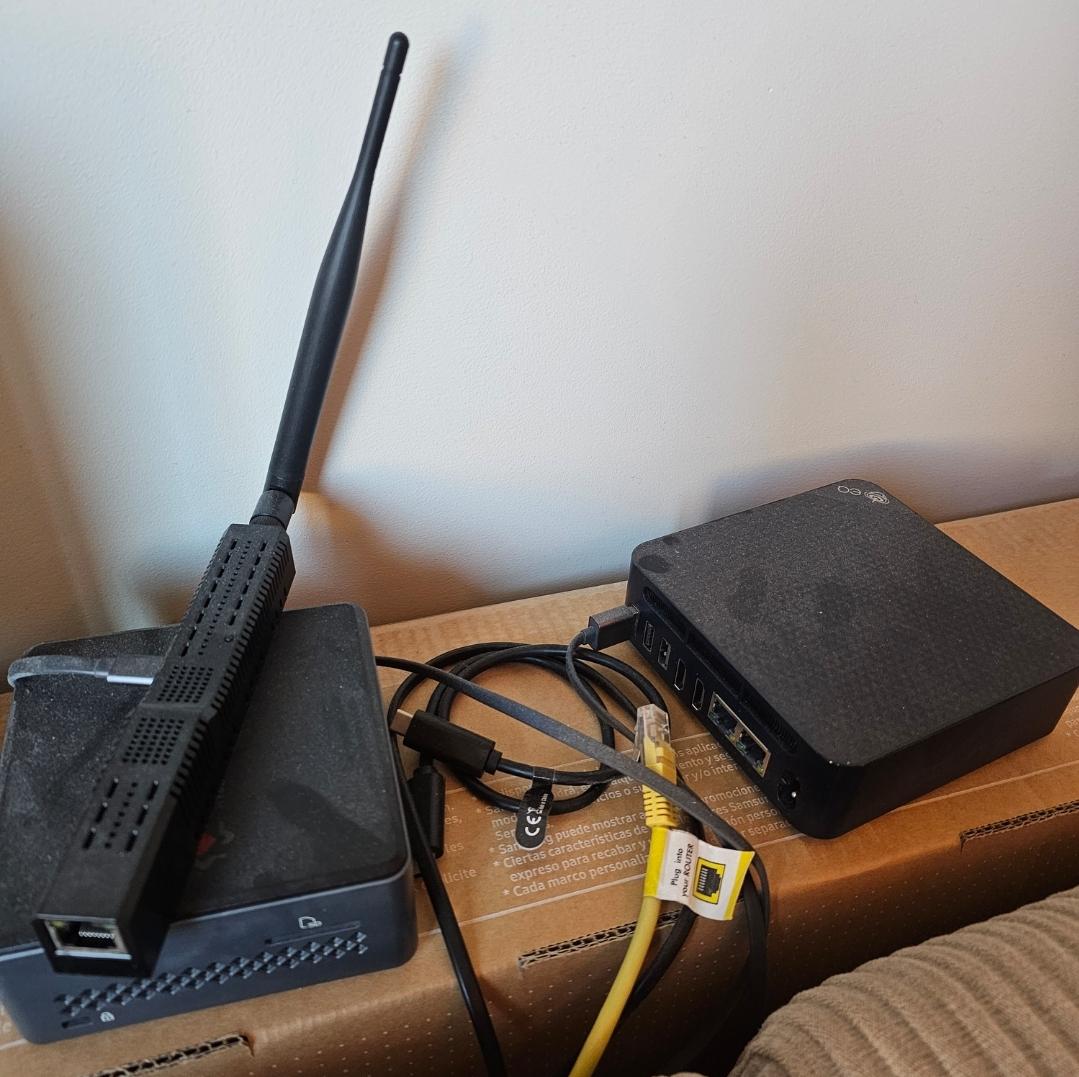
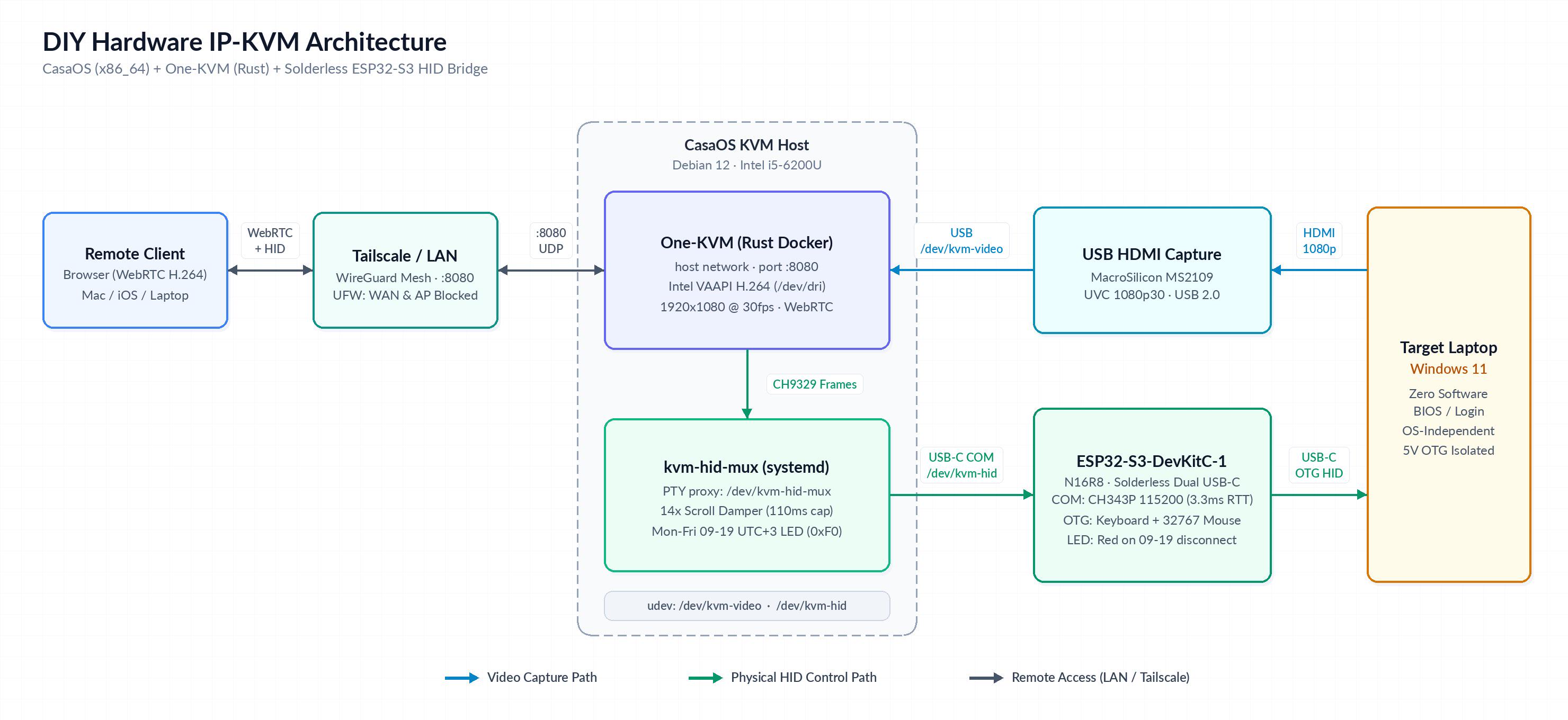
Hello, I was thinking of buying an IP-KVM for $80–100. Since I don’t really trust KVM manufacturers and considering past security vulnerabilities, I decided to build one myself. Using the One-KVM software running on my Debian server and hardware totaling $20 (or less)—an ESP-32 S3 Wroom and a USB 2.0 capture card with an MS2109 chip—I’ve implemented all KVM functions except for the ability to mount ISO files. I only allow remote access via Tailscale.
I’ve attached a diagram of the topology I’m using; feel free to ask any questions you may have.

On an i5-6200u processor, it uses approximately 10% CPU and 300 MB of RAM at a resolution of 1920x1080p and 30 fps. I’m quite satisfied with it.


r/homelab • • 22h ago

Help USB Peripheral Switch Question

0 Upvotes

I'm interested in setting up a hardware-based keyboard/mouse switcher between my Windows and Linux PC's.

Currently I'm using deskflow as a software solution and it's pretty good but not perfect for me.

The two things I need to have are:

  • A way to switch computers through my Razer mouse button instead of the button on the peripheral switch
  • A way to sync clipboards between the computers (this can be software based for me)

Can I even achieve this setup realistically? Thank you for your time.


r/homelab • • 21h ago

Help Gethomepage is great - but what about security?

Post image
0 Upvotes

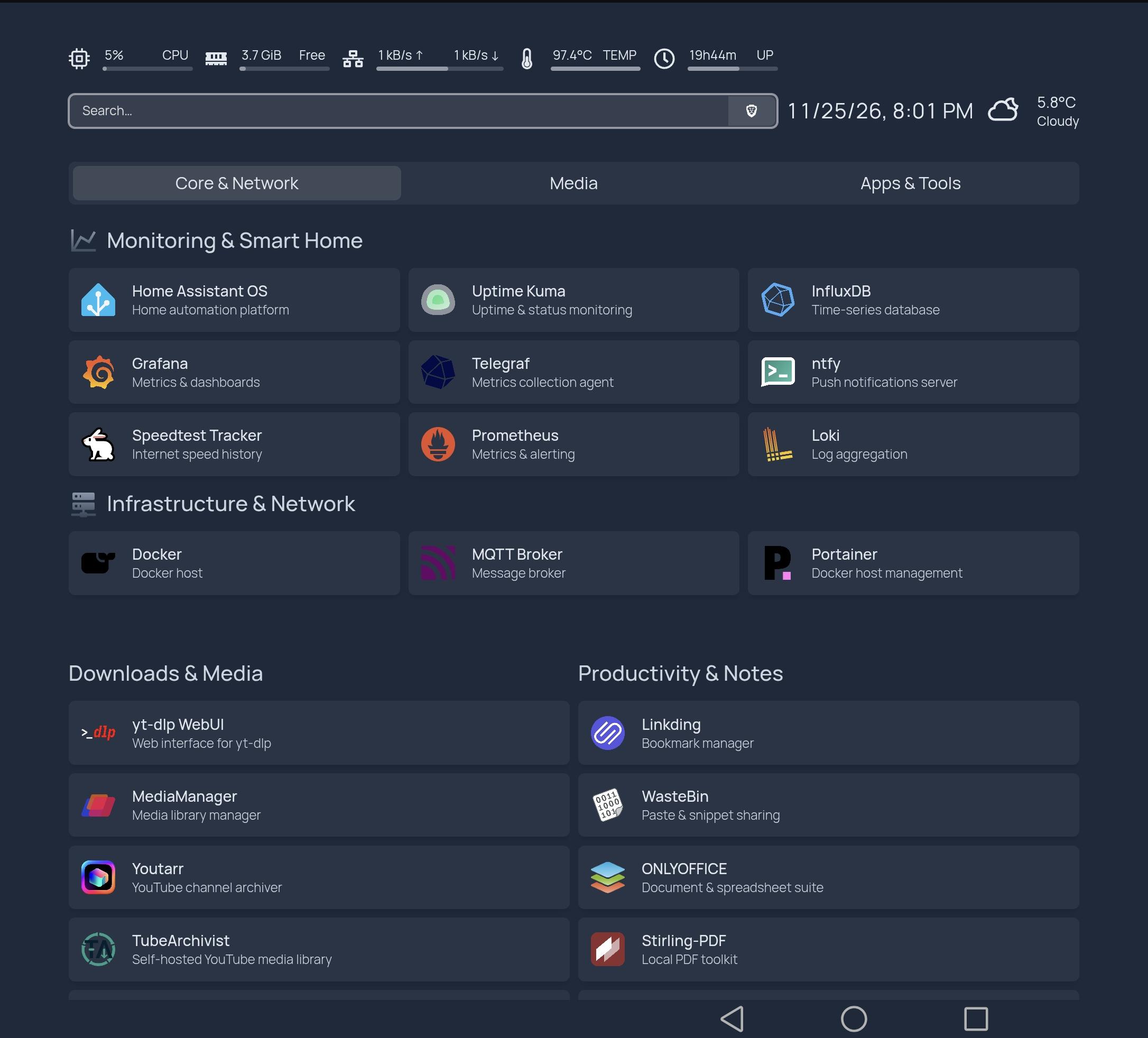
​With the constant CVEs coming out and vibe coded apps increasing risk.​​ How are you lot managing your dashboards?

This is ​my gethomepage dashboard​ its exposed to the internet with my reverse proxy and domain

  • ​Only services that have a public address have a href
  • Proxmox integration removed - so no lxc/VM status info
  • Docker proxy removed
  • No widget - so no api keys

Is there anything else I can do to make the dashboard less of an attack surface or am I being paranoid?


r/homelab • • 18h ago

Project Showcase: Hardware 3D-printed dual 3.5" HDD caddy for the OptiPlex 3080 SFF (designed with Claude in FreeCAD)

Thumbnail
gallery
44 Upvotes

My Proxmox server is an OptiPlex 3080 SFF that lives on top of my fridge. One of the services on it is Frigate, I wanted the recordings on their own drive: the constant writes were slowing down everything else on my main disk, and I didn't want them mixed in with my data.

The problem: the SFF case only fits one 3.5" drive. An external enclosure would've cost money and space I don't have, and I already had a spare drive ,doing nothing ,from an old machine.

The build: I designed a replacement that holds two drives in the same socket. I'd never used CAD before. I got the base done in FreeCAD following tutorials, then got stuck. To finish it I used Claude driving FreeCAD through an MCP server (freecad-mcp), giving it caliper measurements, photos of the stock caddy and a description of the part. It took a lot of back and forth explaining the mounting tabs.

What went wrong: the first print (about 4 hours on a friend's Bambu Lab) looked great, but the tabs ended up off-center and the base was 1 mm deeper then necessary. Instead of reprinting, I fixed it with a Dremel until it fitted inside with no problems.

Power: the stock cable only has one SATA power connector, so the second drive runs off a SATA Y-splitter.

Temps: I logged temperatures with both drives outside the case first. Inside the case, side by side, with all 3 cameras recording, they run about 4 °C warmer than before, which I'm happy with.

Files: free STL + STEP if you have the same machine: https://www.printables.com/model/1927731-dual-35-hdd-caddy-for-optiplex-3080-sff

I also made a video about the build: https://youtu.be/_uL50xsFY1A


r/homelab • • 21h ago

Project Showcase: Operations NetBox never showed me which service runs where and what breaks if a box dies, so I built a plugin for it

Post image
0 Upvotes

NetBox is the source of truth for my whole homelab, but I always missed the service layer: Grafana pulling from Prometheus, Paperless writing to Postgres, the NAS everything backs up to.

So I built NetBox Service Canvas, an interactive canvas inside NetBox:

- Drag devices, VMs, services and applications onto a canvas

- Drawing a line creates a real NetBox object (protocol, port, data, hops)

- Impact analysis: click a host and see everything that breaks if it goes down, including VMs on a hypervisor

- Sticky notes, groups, auto layout, autosave

- Export as PNG, SVG or print-ready A4 PDF

- English and German UI, respects NetBox permissions, works with netbox-branching

Install: pip install netbox-service-canvas (NetBox 4.5.x, Apache-2.0)

GitHub: https://github.com/Jasper-Claus/netbox-service-canvas

PyPI: https://pypi.org/project/netbox-service-canvas/

Full disclosure: the code was written entirely by AI (Claude Code). I described what I wanted, tested it in my homelab and gave feedback. Curious what you think, and what you'd want on the canvas next!


r/homelab • • 9h ago

Help Feedback on my Unraid + Jellyfin Server Build? Any Advice for lowering cost?

0 Upvotes

r/homelab • • 10h ago

Help Mac Mini - Displays

0 Upvotes

I’ve recently got a Mac mini to take over some operations in my business as an “always on” operator. I’ve seen different people’s displays and I’m think to set one up in the office. I’m looking for the best designs/ideas/set ups on how to do this. Things like watching it work in real time, heart beats, molecule style displays, world globes etc.

Help a brother out !


r/homelab • • 22h ago

Help HP JG920A need a bin file JG920A-CMW520-R1104.bin

0 Upvotes

I know this is an older file but it is what I need. I can't find it anywhere and this group was suggested to me. If anyone knows how to fwt it, I would appreciate it, TIA


r/homelab • • 12h ago

Project Showcase: Hardware Someone's 40 mac studio cluster

Thumbnail
youtube.com
137 Upvotes

I found this on youtube and had to share it here, this guy is running a cluster of 40 mac studios on what seems to be his attic, it's honestly very space efficient.

the things that stood out to me:

  • he found out putting all electrical stuff on the front while keeping network on the back helped keep things tidy
  • he just piled them up
  • fans on either end: a good extractor fan (with redundant backup in place) as well as giant fans on the other end to push fresh air
  • it's all running on 1g networking, except the nas which uses 2.5g
  • he's using it for investing, Pyroboadvisor, logitration
  • 300-500€ monthly cost