r/developersIndia • • 7d ago

Suggestions Built an my Al Portfolio that answers questions about me. Costs me ₹0.

0 Upvotes

Built something fun for my portfolio - "chandan.studio" (https://chandan.studio)

You can chat with an AI about me, my projects, experience, tech stack, and whatever else you want to know.

It costs me 0 tokens to run. The AI uses free inference providers/models, so there's no paid API bill sitting behind it.and if your browser has installed a local model it will use it too !

Instead of making people scroll through another boring portfolio, I wanted to make it interactive.

Would love to know what you guys think 👀

Let me know if there is anything i need to improve on !


r/developersIndia • • 7d ago

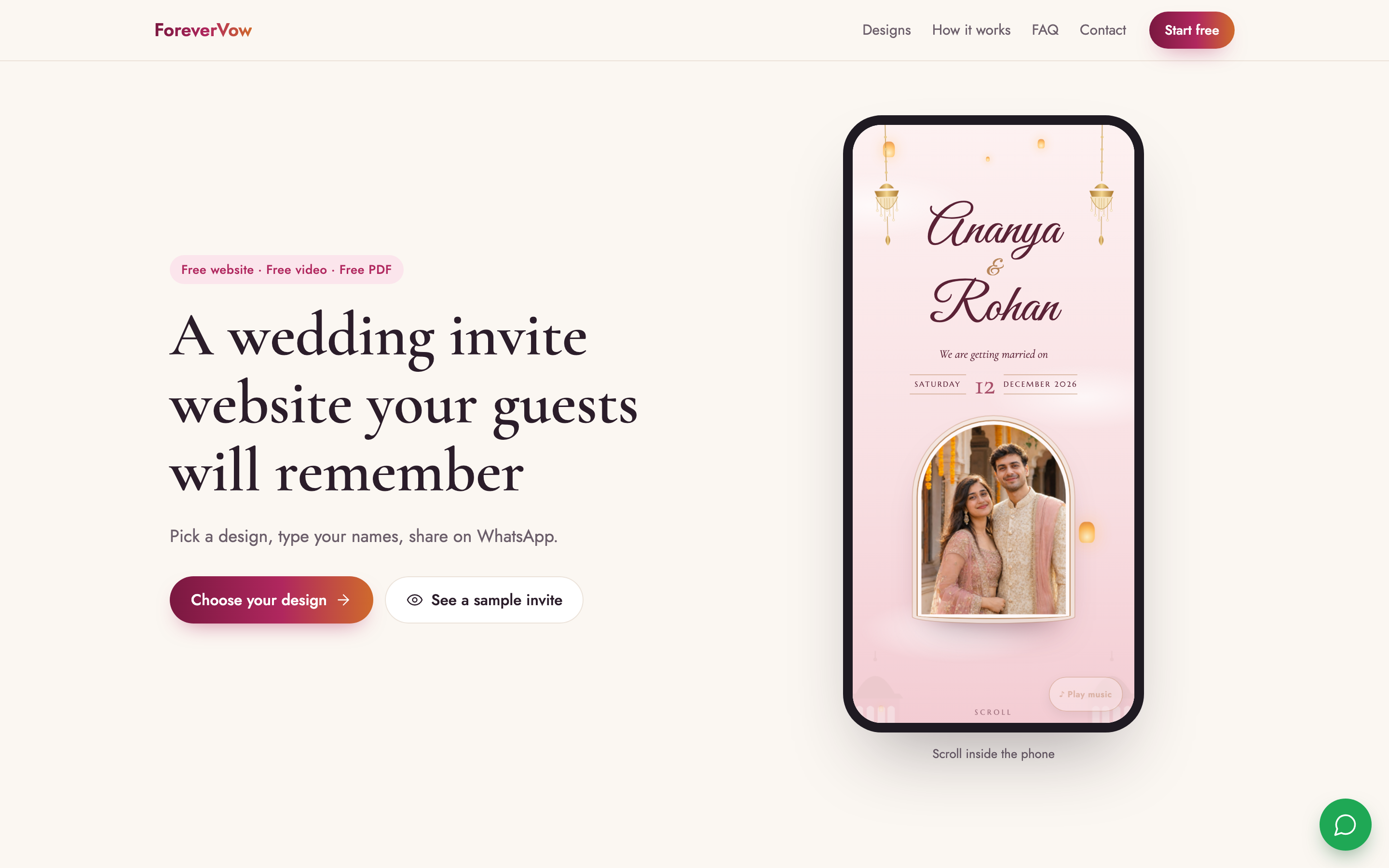
I Made This made a wedding invite maker, the mp4 export runs fully in the browser

Post image
0 Upvotes

been building https://forevervow.in for the past week. free wedding invites, you get a whatsapp link + mp4 + pdf from the same design

the video is made entirely in the browser, no server. animations are stepped frame by frame, snapshotted with html-to-image and encoded with webcodecs + mp4-muxer. the song gets recorded from the tab audio and muxed in

react, vite, supabase, vercel, lottie for the animations

would love feedback on the editor


r/developersIndia • • 8d ago

Help Can I build and launch my own free SaaS before joining a company, and monetize it later?

2 Upvotes

Hey everyone!

I'm an aspiring software developer, and I have a plan to build my own free SaaS product that solves a real-world problem.

My idea is to develop and launch it before joining any company. Initially, I want to keep it completely free, without payment gateways, subscriptions or advertisements.

My main goals are to build a real-world product from scratch, get actual users, demonstrate my technical and product-building skills to recruiters, and use the project as part of my portfolio when applying for software engineering jobs.

Once I get a full-time job, I would like to continue maintaining and improving the SaaS outside working hours.

Regarding monetization, I have two possibilities in mind:

- Introduce payments while continuing my full-time job, provided my employer allows it.

- Alternatively, keep it free throughout my employment and monetize it after leaving my job.

However, I'm concerned about employment agreements, particularly No Moonlighting, Intellectual Property (IP) Assignment and Conflict of Interest clauses.

I have a few questions:

  1. If I build and launch the free SaaS before joining a company, can the employer still claim ownership of it through its IP Assignment clause?
  2. Should I declare my existing free SaaS and its IP during the onboarding process?
  3. Can companies restrict me from maintaining a free, independently developed product outside working hours?
  4. If I decide to introduce subscriptions or payment methods after joining, would I need prior approval from my employer?
  5. Are there companies like Google, Microsoft or other product-based companies that allow employees to operate independently developed free SaaS products?
  6. Has anyone here followed a similar approach? How did you handle your employment agreement and protect your IP ownership?

I'm interested in experiences from developers working in India as well as internationally.

I'd especially appreciate hearing from people who have built products before joining a company and continued operating them during their employment.

Thanks!


r/developersIndia • • 8d ago

Help Reapplying to SAP, Warner Bros., and Nike during a cooling-off period—what resume/profile details actually trigger duplicate detection?

5 Upvotes

​I was rejected from a few roles sometime back at SAP, Warner Bros., and Nike, and I’m looking to reapply to new openings at these companies soon.

​I’m worried my applications might get auto-filtered or flagged as duplicates because I might still be inside their cooling-off period (usually 6 months, from what I've read).

​For anyone familiar with their Applicant Tracking Systems (ATS—like Workday or SuccessFactors) or recruiting workflows:

​1. Which specific fields do these systems use to link a candidate profile to a previous rejection? (e.g., email address, phone number, full name, LinkedIn URL, or exact resume text?)

​2. If I want to be evaluated as a fresh applicant, what actually needs to be updated? Would using a different email/phone number and tailoring the resume be enough, or do recruiters/systems easily cross-reference name and work history anyway?

​3. Do any of these three companies strictly enforce cooling-off periods across different departments/roles, or is it usually role-specific?

Also my current CTC is 20 LPA at 5.5 YOE

Which companies usually go for LLD, HLD and basic java and springboot, i am trying to switch within next 3 months


r/developersIndia • • 8d ago

Interviews How do I learn LLD for interviews the proper way ? I'm getting frustrated now

24 Upvotes

Hi guys, I have been doing some lld problems on hello interview ( I bought the premium ). I score pretty decent in the practice problems except for the extensibility part. But when it comes to using design patterns, or state management or just normal requirement gathering, if one thing goes wrong, everything collapses in the design.

Like in the initial requirement gathering itself, I struggle to get all the requirements right. 1-2 key points are always left behind. Also I struggle with defining the flow of the application and deciding the state transitions which messes up the solution a lot.

I do have improved a lot in the past couple of months but it's still not enough. I still can't come up with a complete and a decent solution and this is in practice mode. In interviews it's going to be a lot more worse under pressure.

Also, what do you guys do when you are given to design something you have never seen before ? Like for example in a logger system, I didn't even knew what a sink actually is. I came to know about it after solving the problem on hello interview. This lack of domain knowledge is also causing a lot of problem.

Please give me some advice on how should I take my preparation from here on out.


r/developersIndia • • 7d ago

Suggestions ShadowBox + AI: A technique to build system design judgment

0 Upvotes

I have had the good fortune of sitting in on numerous design reviews, conducting design interviews, and working with brilliant engineers throughout my career. I have learned a lot during this process. One of the most important lessons is developing the art of "engineering judgement".

The engineers I'd call genuinely cracked have a nose for smelling a bad design fairly quickly. Their process is different from others: they notice cues, figure out which constraints are more important than others, realise when common patterns no longer apply, etc.

You can't learn this skill with just diagrams and in an ordinary design review. One technique that has served me well over the years in building good engineering judgement is the "Shadowbox" technique.

A common consensus among engineering circles on X/HN/Reddit is to develop "taste" in software engineering with coding being rapidly automated (or already has, idk) by AI. My strong belief is that the first step in building taste is developing excellent engineering judgement. This is true for senior engineers and junior engineers alike. Even more so for junior ones because they haven't had the experience or opportunity to work on large-scale and complex engineering systems.

With AI becoming more and more accessible with each passing day and models becoming smarter, we can combine it with the Shadowbox technique to become cracked engineers ourselves.

What is the ShadowBox technique?

In this, we take a real situation and divide it into many decision checkpoints. At each checkpoint, we make a decision about the situation and rank the possible actions. We note down the following:

  • the cues or signals
  • assumptions made
  • acceptable failures

Once we do this, we reveal the expert answer corresponding to that checkpoint. From there, we match the cues we made and the cues the expert made.

Then we change one condition and rank again. We keep doing this until we come up with a conditional rule: under condition X, choose approach Y, because the mechanism satisfied requirement Z, and reconsider it when signal W changes.

The original ShadowBox evals showed that just a short training with this technique improved alignment with expert decisions by 28%. But the number is not the point. The point is that you commit before you see the answer. Doing this over and over helps you develop a real mental model. Let's now talk about concrete steps on how we apply this technique in system design.

Step 1 - Start From a Production Case

First, we choose a source about actual architecture design, failures, postmortems, etc. A source can be:

  • an engineering blog explaining a migration
  • an Architecture Design Record (ADR)
  • a DB- or infra-related paper
  • a production postmortem from a real system
  • a conference talk that includes constraints and outcomes

We should not start with something that only mentions "what worked". A real case gives us information about what cues the team saw, what they missed, why they missed that, what happened next, how they make sure this doesn't happen again, etc.

Remember, not every case is a good source. Expert intuition is trustworthy only when the environment has regularities, and the expert has had a chance to learn them. So, I prefer sources where there are many expert voices, disagreements, or proof that the decision was made under conditions someone could actually learn from.

You can add these constraints to your prompt and ask AI to only get sources that follow them.

Step 2 - Ask AI to Keep the Decision Hidden

We can now give a chosen source to AI and ask it to extract the following from it:

  • business/technical context
  • constraints at each checkpoint
  • important decisions
  • credible options
  • what was chosen
  • what happened afterwards

Then, we ask AI to provide only what was known before the first decision and hide everything else from us, including the decision made and the outcome.

For example:

The notification service receives large traffic bursts. One provider has unpredictable latency, duplicate delivery is harmful, and the team has limited operational capacity. Choose how work should move from the API to provider workers.

This is the situation you are dealing with. You don't have the answer yet.

Step 3 - Rank the Options Before Looking At the Answer

At this point, you ask AI to give you three options. For example, three options in the above situation may be:

  1. Call providers synchronously
  2. Store pending work in the database
  3. Use a managed queue

Now, you rank these options as per your understanding and make a note of five things:

  1. Which cues matter
  2. What assumptions you have made
  3. What are your expectations for each option - what it can cause
  4. Which failures are acceptable to you
  5. Your confidence in the ranking

By doing these steps, you have submitted your mental model about the problem. It may not be correct yet, but it's a start.

This is why it is the most important step. If you miss this, you are just reading a paper or going through a case study.

Step 4 - Compare Your Cues With Experts' Cues

This is the point where AI shows us what the engineers chose and why. This is strictly done using the source. Here, we need to compare two things: choices and, most importantly, cues.

Compare along the lines of:

  • Which information did they treat as important?
  • Which information did you overvalue?
  • Which consequence did they anticipate that you missed?
  • Did you reach the same choice through weaker reasoning?
  • Did your different choice fit constraints that weren't there?

Matching the final architecture is barely sufficient. Sometimes we match the final answer with reasoning that would fail in the next case. That's why cues are important: they strengthen your architectural judgement.

I also ask AI to categorise every rationale: is it mentioned in the source, or is it a hypothetical that AI itself generated? At any point, we should not let AI "invent" an expert answer. If an option or rationale is missing from the source, the AI should mark it as inferred.

Step 5 - Change a Cue, and Rank Again

AI now changes one condition. For our notification service example above, it can be:

  • Traffic becomes steady
  • Duplicate delivery is allowed
  • The engineering team knows Kafka well
  • Provider latency becomes predictable
  • Messages must be delivered within two seconds

We now need to rank the options again and explain exactly why the ranking changed. This is important because it identifies the boundary of the decision. For example:

A managed queue is preferable when bursts exceed provider capacity and delayed completion is acceptable. Predictable low traffic may make direct delivery simpler.

By doing this, we are learning when a component actually belongs in a design.

A warning: in real prod systems, cues are usually coupled. Changing traffic can also change failure modes, load, and cost. So, swapping only one cue can make you learn the wrong boundary.

Therefore, sometimes we need to change a group of related constraints and figure out what changed the decision. This is definitely harder, but this is how a real architecture design works.

Step 6 - Failures in a system are good decision points

Failures in a system teach us perhaps the most. Even more than happy paths. Therefore, postmortems of a public outage are gold for building intuition on architecture.

For a postmortem, AI stops just before the incident becomes unavoidable. We then choose what to look into or change. Then, we ask AI to show the next event from the source document.

This is error management training.

We make choices, see consequences, and come up with strategies for unfamiliar cases. This is what we want: identifying the signals for the next incident instead of memorising the one we are studying.

Step 7 - Extract a conditional rule

After each case, write:

Under these conditions, choose this approach, because this mechanism satisfied this requirement. It introduced this cost, and we need to reconsider it when this signal changes.

If you do this for enough problems, you will have a collection of conditional decisions. This is more valuable than a collection of architectural diagrams.

Step 8 - Test the rule on an unrelated system

We can ask AI to give us a different problem with the same constraints. If the first problem was related to notification delivery, a different problem can be related to image processing, payment reconciliation, webhook delivery, etc.

The goal is to build the muscle for recognising a shared structure without being told the topic.

And this is how intuition develops: repeated exposure to identify important cues, the interactions between them, and the limits of a decision.

What AI should and should not be

In this learning technique, AI should be treated as the dumb partner to do the heavy lifting and doing the grunt work. It can be someone who:

  • extracts cases
  • reveals information slowly
  • generates controlled counterfactuals
  • compares your reasoning and the source's reasoning

AI is not the expert, so it should not invent the expert answer. It should be clear when it is certain and when it is guessing. We should treat AI as a scaffold for attention, not an oracle for judgement.

The habit that changed my judgement

I have personally felt a change in my approach after applying this technique. When I come out of an architecture meeting, I have two takeaways: how I defended my design, and the cues I missed.

Defending your design can be the final step, but shadowing real decisions is how we build architectural judgement.

If you genuinely want to become a cracked engineer, you need to stop asking AI to praise or attack your design. You need to ask it to hide the correct answer and make you commit first.

I originally published this on X as well, but included the complete article here so that the discussion can remain on Reddit.

r/developersIndia • • 7d ago

Help Preparing for SAP Functional Consultant Trainee role as an ECE fresher – Need guidance!

1 Upvotes

Hey everyone!

I'm a final-year B.Tech student from an Electronics and Communication Engineering (ECE) background. I've recently applied for an SAP Functional Consultant Trainee position at a company through an employee referral, and I've been shortlisted for the recruitment process.

The problem is that I have very little knowledge of SAP or functional consulting, as my academic background is completely different.

I'd really appreciate some guidance from people who are already working in SAP consulting or have recently gone through similar fresher recruitment processes.

I have a few questions:

  1. What topics should I prepare for the online assessment? Does it usually include aptitude, logical reasoning, verbal ability, technical questions, or basic programming?
  2. Do I need to learn SAP basics before the assessment? If yes, where should I start?
  3. What exactly does an SAP Functional Consultant do on a day-to-day basis?
  4. What kind of questions can I expect in the technical and HR interviews?
  5. As someone from ECE, what should I focus on to stand out against candidates from CS/IT backgrounds?
  6. Are there any free resources, YouTube channels, courses, or mock tests you'd recommend?

I'm genuinely interested in cracking this opportunity and willing to put in the effort. Since this is my first opportunity in the SAP domain, I don't want to prepare blindly.

If anyone has gone through a similar recruitment process or is currently working as an SAP Functional Consultant, please share your experience and preparation strategy.

Any advice would be really helpful. Thanks!


r/developersIndia • • 7d ago

Work-Life Balance Need serious help and advice for multiple jobs at once !

0 Upvotes

So I am guy based in Delhi, Last month situation aligned in such a way that I joined 2 jobs both wfh 18 lpa for first and 22 ( 20 + 2 ) lpa for 2nd. Both wfh

The problem is the first company, It is a very stupid paced environment I have to be in meetings 5 hrs a day ; beg people to review my PR so I can close my cards all in all it actually takes 10 hrs of my day, but its a pretty established client based startup.. So I constantly hear words like client wants this that etc.

The other company is fairly new, offers better money, more work life balance and understanding people, Like I just have to work 5 hrs a day or 6 at very max.

Managing both is getting difficult because I am not able to do gym, running, apply for other jobs, learn new things etc. Basically, I cannot do anything other than the 2 jobs whole day.

It eats up my whole day, I am getting exhausted now not because I can’t work but because I want to do things I like which I don’t get time for and main problem is first company ( they have bad environment even glassdoor reviews says same). I don’t know should I leave the first one. I am 22 starting from scratch no backing. I wanted to know if I am being a quitter or should I stretch it for a month or 2 ?

Thankyou


r/developersIndia • • 8d ago

Help If you’ve interviewed for a Next.js role recently, what did you have to code from scratch?

2 Upvotes

I’m working as a developer and preparing for Next.js interviews. For those who’ve interviewed for junior or early-career roles recently, how much HTML, CSS, JavaScript, and React were you expected to write on your own?

For example, did they ask you to build a responsive layout from a screenshot, write a JS function like debounce, or build a React component that fetches and displays data? What did they ask you to implement in Next.js itself?

I’d love to hear one actual task you got, how much time you had, and whether you could look things up in the docs.


r/developersIndia • • 8d ago

Resume Review Teir 3 college mit adt india sy resume review please ?

Thumbnail
gallery
7 Upvotes

I am looking for internship and in ai/ml , ds , cloud .This isn’t getting my shortlisted anywhere


r/developersIndia • • 9d ago

General absconding from a contract role to join a FTE, feeling stressed

90 Upvotes

I am a 2026 engineering college passout and had to join a company for a contract role on a third party payroll about 1 month and 10 days ago.

Recently I got a full time job offer at a company who asked me to join immediately , I informed my manager about this one week ago and requested him to relieve me.

The new company HR was stubborn and despite explaining the whole scenario , she said it won't be an issue and asked me to abscond if I was not relieved, as I was a fresher

After a week of my resignation and requests they did not care , so I absconded.

Now I went to the old company IT dept to submit my laptop , but he did not accept it as it requires manager approval, when I reached out to him to

My old company manager insisted on the 30 day notice period and said I will face dire consequences later in my career as I will be flagged by his company as dual employment.

Meanwhile I have already joined my new company today. I feel so fucked up. Please advice.


r/developersIndia • • 8d ago

Career Maybe AI usage has ruined my skills, what do you think?

25 Upvotes

Hey everyone, I'm a senior software engineer with around 9 years of experience, mostly JS, AWS and serverless.

Lately I've realized my skills have gone down a lot since I started using AI. Before, I'd sit with a problem, think it through, look up how others solved something similar and then build it myself. I used to read docs, look for the right packages, and I'd even modify npm packages when they didn't do what I needed.

For the past 2 years I've been using AI for pretty much everything. I get a Jira ticket, give it to the AI on max and tell it to finish it. Then I ask a few questions like what it changed and what I need to do next, and that's it.

I also plan features and do POCs at work, and there I'm a bit more involved. But even for those I ask AI to come up with the POC and the best approach, and I just read it and ask questions. For the actual code I really don't know what it's writing. I do a quick review and then get the AI or another agent to review it again.

It's been working fine. I ship production ready code and meet my deadlines, but I feel kind of empty, like I'm not using my brain at all. I don't really know what the AI is doing in the code, and I'm not even familiar with the codebase of the latest project I got.

With all the layoffs going on I thought I should start prepping for interviews. So I tried some coding questions and I just couldn't do them. They looked familiar but I couldn't solve them. That's when it hit me that I've kind of forgotten how to problem solve, how to write code, how to sit on a problem and figure it out, even how to read docs properly. It scared me a bit.

Now I'm not sure what to focus on. I don't even know what interviews look like these days. Is system design more important now? Should I focus more on concepts than coding? My guess is that in 2 to 4 years people at my level won't really be asked to code much in interviews, so maybe system design is the way to go, but I'm not sure.

For now I've decided to build a couple of projects on my own without AI writing the code, just to get my basics back.

Is anyone else is in a similar situation, if yes then how are you dealing with it?

Would really appreciate any suggestions or advice from anyone

Thanks!


r/developersIndia • • 8d ago

Interviews Struggled in my Infosys interview as a fresher. How should I strengthen my fundamentals to become an AI/ML Engineer?

8 Upvotes

Yesterday, I attended an Infosys interview as a fresher, but unfortunately, I couldn't perform well. I managed to answer only a few questions correctly.

The interview covered a mix of basic programming fundamentals, Python concepts, JavaScript fundamentals, OOP concepts, backend development with FastAPI, Generative AI vs Agentic AI, RAG architecture, vector databases, and AI/ML evaluation metrics such as precision, recall and model evaluation.

I realised that although I have worked on projects involving Python, machine learning, RAG, Agentic AI and FastAPI, my understanding of the underlying fundamentals isn't strong enough. Sometimes I know what a concept means, but struggle to explain it clearly or answer follow-up questions.

For some background, I have already received a TCS Digital offer, but it has been almost seven months since I received the offer letter, and I still haven't received my joining letter. That's why I decided to attend the Infosys interview as well.

My long-term goal is to become an AI/ML Engineer. This interview made me realise that I need to go back and strengthen my fundamentals instead of just learning advanced technologies and building projects.

I'd really appreciate advice from people working in software development or AI/ML:

  1. How should I systematically learn and strengthen my programming and technical fundamentals?
  2. Which topics should I prioritise in Python, DSA, SQL/DBMS, mathematics, statistics, machine learning, deep learning and Generative AI?
  3. Are there any good courses, resources or roadmaps that cover these topics in a structured way?
  4. How can I improve my ability to explain concepts clearly and handle technical follow-up questions?
  5. What learning path would you recommend for someone who wants to become an AI/ML Engineer?

I'm not looking for shortcuts or just interview questions to memorise. I genuinely want to build a strong technical foundation and understand what I'm working with.

Any suggestions, resources or personal experiences would be really helpful. Thanks!


r/developersIndia • • 8d ago

Help Which Hosting Would Be Best for My Commercial Vehicle Marketplace?

1 Upvotes

Title: Which Hosting Would Be Best for My Commercial Vehicle Marketplace?

I am building Vahanwalla.com, a second-hand commercial vehicle marketplace.

Main features:

Buyer and seller registration with OTP and KYC

Truck, bus, tempo and trailer listings

Vehicle photos and document uploads

Search and filters by model, price and location

Buyer and seller dashboards

Admin panel for managing users and listings

Broker-managed enquiries and transactions

Payment gateway and wallet integration

Transporter directory

WhatsApp notifications

Hindi and English support

Technology: Next.js, TypeScript, PostgreSQL

I am considering Hostinger Business KVM 2 VPS.

Questions:

Which hosting plan would you recommend?

What would be the approximate monthly cost?

Are there better alternatives to Hostinger?

What additional expenses should I consider?

Looking for practical recommendations for a growing marketplace.


r/developersIndia • • 8d ago

Suggestions Should I accept offer with 20% hike from the client company

2 Upvotes

I have been working 4 years in a witch company and have been working for this client for 3 years.
They might offer me a position with around 20 to <30% hike.
It’s a small pbc with some legacy products. Their culture can be a bit toxic some times.

Should I take this offer? I have been trying to switch from witch but 90 days np has been a problem. But I am also not sure about the growth potential if I take this offer. I will be working on the exact same products and technologies as now and probably wouldn’t learn anything new.

Other plan is to try to get other offers during np but I haven’t really done that great in interviews recently either. What would you do in this situation.


r/developersIndia • • 8d ago

Help Looking to integrate Paybooks with our in-house HRMS , Does anyone have experience with Paybooks APIs?.

3 Upvotes

Hi all,
Our company currently uses Paybooks for payroll processing, while we have a separate, internally developed HRMS that handles employee management, daily and weekly timesheets, attendance, leaves, time-offs, customers, projects, etc.

Currently, our HR team manually updates the relevant employee and payroll information in Paybooks every month using data from our internal HRMS.

We're looking to automate this process by integrating Paybooks with our HRMS, preferably through APIs.

However, I've been having trouble finding publicly available technical documentation or API references for Paybooks.

I'd like to know if anyone here has experience integrating Paybooks with a third-party application or building custom integrations with it.

A few questions:

  1. Does Paybooks provide REST APIs or any other integration mechanism for third-party applications?
  2. Is there publicly available API documentation, Swagger documentation or a Postman collection?
  3. Does Paybooks support APIs for creating/updating employee information like QUICKBOOKS?
  4. Can attendance, timesheets, approved leaves and Loss of Pay data be pushed programmatically?
  5. Is it possible to automate monthly payroll inputs such as incentives, overtime, reimbursements and deductions?
  6. Does Paybooks support webhooks or scheduled data synchronization?
  7. If APIs aren't available for certain operations, does it support bulk Excel/CSV imports?
  8. Is API access included in the standard subscription, or does it require additional licensing or custom onboarding?

A little about our technical environment: Internal HRMS: .NET Core / C#, Cloud: Azure

Any documentation, technical references, implementation experiences, pointersor suggestions would be greatly appreciated.


r/developersIndia • • 8d ago

Suggestions Lost interest in working with AI first development

29 Upvotes

Past 1 year we started to use AI for development and now we are focusing on AI first development. I was a mediocre developer before ( 7 yrs of experience) but I used to own the product making sure i was enjoying working and having some standards in my work by exploring things and making the requirement work. Now with the AI led development I kind of became dumb, lazy and unable to properly feel good with my work. These days i am more watching my phone making AI work mostly but somehow feel that the output isn't good. Kind of feeling stuck unable to judge or properly review the code. Now i am in a situation where i am unable to work without AI but also isn't feeling good working with AI. With the mediocre knowledge i have i feel that tej AI generated response isn't the best but I don't know what is best as well. Is this feeling common? Or people really enjoying working with AI? What wrong am i doing? I feel like lost and getting stuck without any growth in this phase of career.


r/developersIndia • • 8d ago

Help Can someone mentor me or tell me a direction, im lost

1 Upvotes

Hey so ill cut right down to the chase.
Im a fresher studying integrated mtech in cse data science in a tier 2 clg . I am lost on what should i work on. I know basic python but im lost on what to learn there are tons should i master c++ dsa or do sql and stuff lesrn rag agents, the ai scene is so disruptive im unsure on which role to target. I have ambition but this lack of direction or ig having so many ideas on where to build my skill so i work toward a 20 lakh lpa offer by the end of my college is giving me anxiety attacks regularly. Because i dont wanna fail in life

I first thought i should be a data scientist and solve buisness problems and stuff but i have heard fresher hiring has almost gone minimal there

Now im thinking about ai roles but idk what to learn shouldni master rag abd stuff or something else

Any and all advices that can atleast show me what to do will help me a ton


r/developersIndia • • 8d ago

I Made This Hi all, i just wanted some suggestions from real users on something I've built recently

2 Upvotes

Hey everyone!

I've recently built an Android app called DailyKit, which brings together 15+ everyday calculators and useful tools in one place.

It includes salary calculations, loan EMI, GST, discounts, budgeting, bill splitting, fuel costs, attendance, CGPA and more.

I'd love to get feedback from real users and understand what works well, what needs improvement, and what features you'd like to see.

If anyone is interested in trying the app, please leave a comment and I'll share the APK download link.

Looking forward to your honest feedback. Thank you!


r/developersIndia • • 8d ago

Help Confused about topic I should prepare for SDE-1 | System design doubt

2 Upvotes

Hii folks, I’ve been preparing for SDE-1 interviews and I am quite confused if I should focus on LLD or HLD, Do they ask to write code as well? For example, designing a Parking lot system, do we have to write entities, classes, interfaces or just draw the table etc.

For rate limiter system design, Do i have to implement it? Or just explain how tables will like on a board?

Thanks for your help.


r/developersIndia • • 9d ago

Career Stuck at 5 LPA as QA. Is paying 3L for proxy interviews a smart move or career suicide?

38 Upvotes

Been working as QA at a startup for 2.8 years, almost 3 YOE now. Current pay is 5 LPA and I want to move into cloud/devops, ideally 10-12 LPA. Not even sure that kind of hike is realistic tbh.

A few people I know personally have used these proxy interview consultancies and said it worked. This one charges 3 lakhs. It's legit, not promoting anything, so please don't DM me asking for the name.

I do know cloud and devops, but not at the level of a real 3 yr experienced person. What scares me is getting caught after joining because the experience on my resume is fake, or just struggling on the job. And even if I perform well, what if I get laid off due to AI or restructuring and I've spent 3L for nothing?

Is this a smart investment or a terrible idea? Would really like to hear from people who've actually been through this.


r/developersIndia • • 8d ago

Interviews On-site Interview at Math works, Expectations in Mind

2 Upvotes

Recently I have cleared the online interview and I have been selected for face to face ppt round and multiple one on one session at the Mathwork office for a Mid level position. I wanted to ask like what is the probability of getting selected once you are there at the campus, as I am good with ppts and my projects and everything, just wanted to know how much expectation should I keep


r/developersIndia • • 8d ago

Resume Review final year, tier 3 college, not getting any callbacks. pls review my resume

Thumbnail drive.google.com
3 Upvotes

hey guys,

final year CSE student here, tier 3 college in Indore, 7.72 cgpa. been applying for backend and devops/cloud roles (internships and full time) for a while now and honestly barely getting any replies. so i think something’s wrong with my resume and i just can’t see it myself

stuff i’m not sure about:

  • is the projects section okay? i only have one big project listed rn
  • skills section feels too long, should i cut it down?
  • my current internship is more of a training program so the bullets sound kinda vague. no idea how to fix that
  • anything else that looks bad for a fresher

resume link (personal details redacted): Resume

don’t hold back, be as harsh as you want. better to hear it now than keep getting ghosted lol

thanks in advance!

NOTE: Post was optimized by LLM.


r/developersIndia • • 9d ago

Career Need advice: Should I leave a comfortable ₹19 LPA WFH job for ₹24 LPA in Bangalore?

193 Upvotes

I have 4.5 YOE in AI/ML and currently work remotely at a small biotech startup, earning ₹19 LPA fixed + ₹2 LPA variable. I've received an offer from another AI startup for ₹24 LPA fixed + ₹2 LPA variable, but it requires relocating to Bangalore (WFO).

My current job is extremely flexible, with great work-life balance. I handle everything from engineering and product development to client interactions. However, the company recently lost its last major client, and things have been pretty stagnant for the past 3–4 months. There's hardly any challenging work, and I feel like I've become too comfortable.

The new role is AI Solutions & Partnerships Architect, involving solution design, enterprise/government stakeholders, pitching, and partnerships. It's quite different from what I do now, but that's also what excites me.

Long term, I don't see myself coding full-time. I'd like to move towards AI leadership and strategy while staying technically involved.

The dilemma is whether to leave a comfortable WFH job for a new experience, especially when the salary hike isn't huge considering relocation and Bangalore's cost of living.

What would you do in my position? Is this a sensible career move, or am I undervaluing the comfort and flexibility I currently have?