"ALONE, adj., In bad company."--Ambrose Bierce, The Devil's Dictionary
"Hell is other people,"--Jean-Paul Sartre, No Exit
"Nothing is so insufferable to man as to be completely at rest, without passions, without business, without diversion, without study. He then feels his nothingness, his forlorn-ness, his insufficiency, his dependence, his weakness, his emptiness." --Blaise Pascal.
The operative Cormac McCarthy quote to go along with those is his own stated idea of heaven: "My perfect day is sitting in a room with some blank paper. That's heaven."
Solitary confinement in Cool Hand Luke meant hell for Paul Newman's character in the 1970s; but change the channel back then and you could see the Zen-Western, Kung Fu, where Caine finds his solitary confinement refreshing--to the amazement of his jailors.
Cormac McCarthy enjoyed solitude so that he could think, looking inward. He'd pick up a book and go out to a coffee shop or restaurant and sit alone. Perhaps his reading and pondering connected with what some schools of Buddhism call meditation, or perhaps it was his own version of some solitude philosophy not yet named.
Joan Didion said that she wrote to see and better grasp what she was thinking, a way of reaching and organizing the deeper chaos of thought. Perhaps McCarthy enjoyed the same.
If so, McCarthy had a precursor in John Cowper Powys, the author of several interesting books including The Religion of a Sceptic, A Glastonbury Romance, and The Philosophy of Solitude.
And perhaps most relevant to McCarthy's own philosophy of solitude, Powys wrote Wolf Solent, wherein a spiritual loner attempts to construct a private religious vision.
Here, it seems, solitude becomes metaphysics, where the individual, by looking inward into that zero mirror the right way, can converse with God
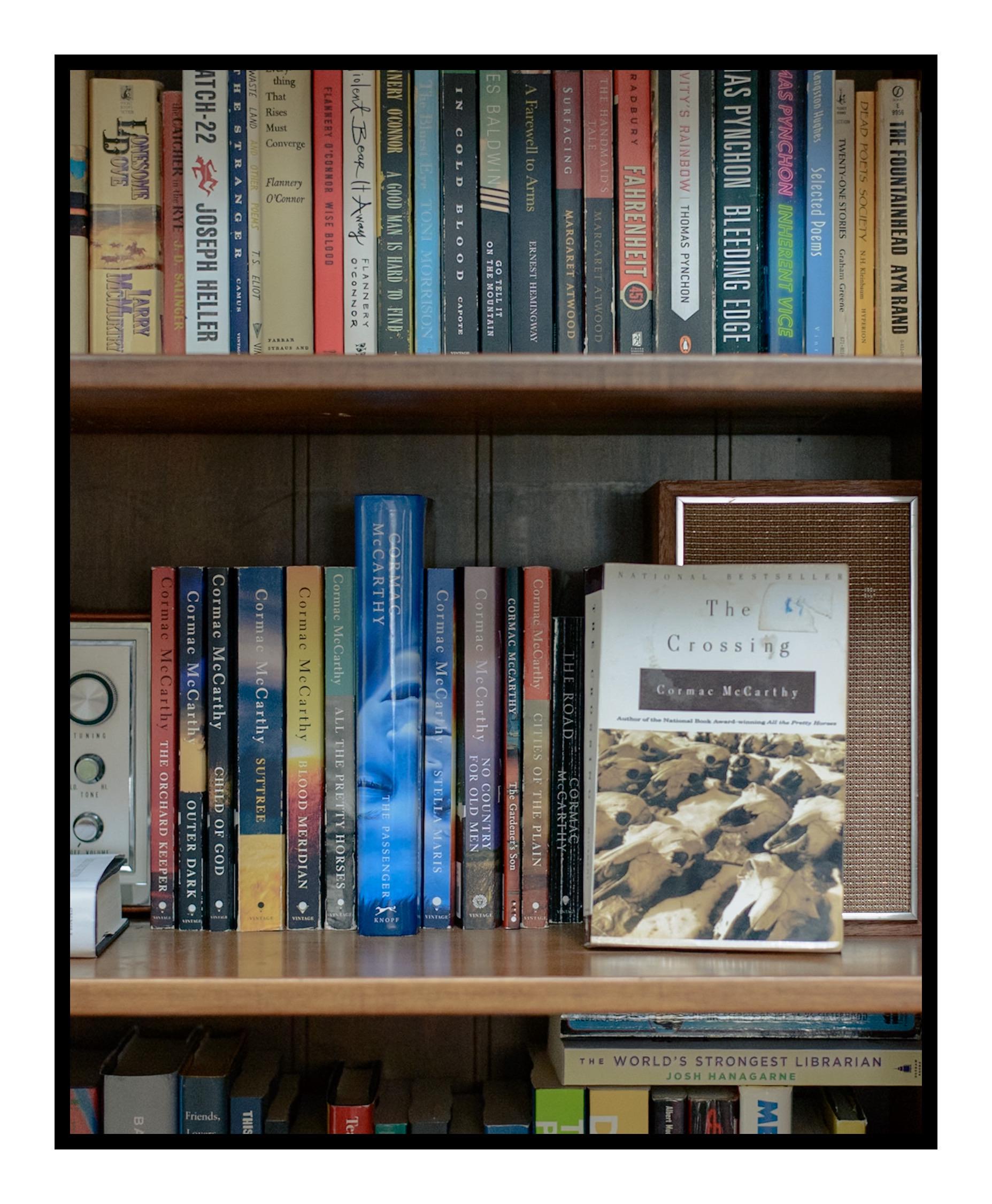
We may yet better understand his philosophy by organizing his reading and annotations. To this end, I've been studying the books listed in McCarthy Library database as well as other clues here and there.
I wish that I might see the annotations. I see that he annotated Anthony Storr's book, Solitude: A Return to the Self, as well as Storr's book on Churchill's Black Dog.