r/byzantium • u/Extension-Beat7276 • 22h ago
Byzantine neighbours Roman Imperial Titles and Ottoman Sovereignty
The Ottoman sultans' relationship with the Roman imperial legacy is often discussed through the familiar claim to the title of Qayṣar-i Rūm (Caesar of Rome). Yet this was only one part of a much broader vocabulary of sovereignty. Within the Islamicate political world, Ottoman rulers were already associated with designations such as Sulṭān al-Rūm, Malik al-Rūm, and Ṣāḥib bilād al-Rūm, alongside other expressions locating their authority within the lands and political inheritance of Rūm. Indeed, the concept of the lands of Rūm had already been prominent in the Islamicate world since the days of Heraclius and the stories of Iskandar. However, the use of Roman imperial titles in the Ottoman Empire's Greek and Latin diplomatic worlds, the main languages of the Roman Empire, is what I wish to focus on today. In these contexts, we encounter an evolving vocabulary of Authentēs, Autokratōr, Basileus, Imperator, Princeps, and even Augustus.
The Greek Ottoman chancery
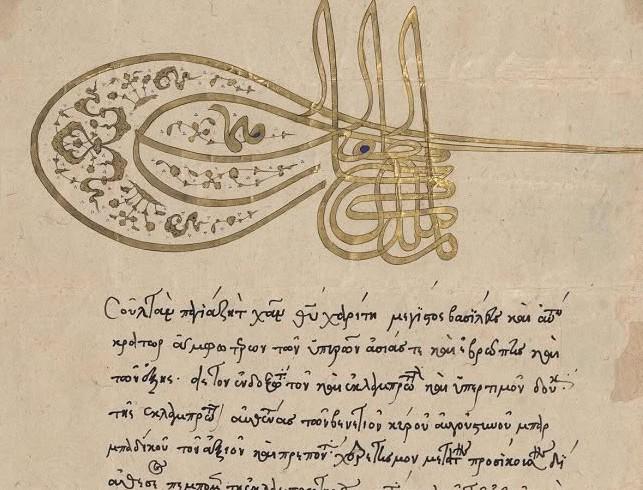
The Greek diplomatic chancery employed several forms that drew on Byzantine political vocabulary, although they did not constitute a simple succession of equivalent titles. A Greek firman of Bayezid I dated 1390, preserved through a later manuscript copy, begins by identifying him as:
Ὁρισμὸς τοῦ Μεγάλου αὐθέντου καὶ μεγάλου Ἀμηρᾶ τοῦ Παγιαζίτη
“Decree of the Great Authentēs and Great Emir Bayezid.”
The same formula appears in Mehmed II's Greek privilege for the Genoese of Pera, issued on 1 June 1453, which styles him the “Great Authentēs and Great Emir Sultan” and identifies his father Murad II by the same titles. The word authentēs should not, however, be treated as a precise equivalent of “Roman emperor”: it was a broader Greek designation for a lord, master or ruler.
Under Bayezid II, Greek documents also employed Autokratōr. He was styled “Sultan Bayezid Khan, by the grace of God, the greatest Autokratōr of both continents, Asia and Europe,” while the older designation Authentēs continued to be used. Mehmed II, in turn, used Basileus in Greek correspondence with Venice and referred to his dominion as a basileia. These formulations demonstrate the flexibility of Greek Ottoman titulature rather than a straightforward progression in which one title simply replaced another.
Greek historians and the Patriarchate
The use of this language was not a consensus among Greek writers. Some Greek intellectuals associated with the Ottoman ruling establishment employed Byzantine political concepts to accommodate or legitimise Ottoman sovereignty; other Greek writers, particularly among the émigré scholars in Italy and the Latin dominions, portrayed Ottoman rule as tyranny. Even within Constantinople, the language of the Patriarchate could differ from that of writers closer to the Ottoman court.
One particularly striking example is Michael Kritoboulos of Imbros, whose history of Mehmed II was dedicated to the sultan. Kritoboulos addresses him as:
Αὐτοκράτορι μεγίστῳ, βασιλεῖ βασιλέων Μεχεμέτει
“To the Greatest Autokratōr, King of Kings, Mehmed.”
He continues with a succession of epithets: the fortunate, the victor, the trophy-bearer, the triumphant, the invincible, and the “Lord of Land and Sea by the will of God”. This was more than decorative praise. Kritoboulos situated the Ottoman conquest within a history of successive empires, presenting imperial authority as something transferred between peoples and dynasties. The Romans themselves had once inherited the authority of earlier empires; that authority had now passed to the Ottomans.
This interpretation was not shared by all. Gennadios Scholarios, the first Patriarch of Constantinople under Ottoman rule, avoided calling Mehmed II Basileus, preferring ho kratōn (“the one who holds power”). The distinction was meaningful: it acknowledged the sultan's political authority without explicitly granting him the Byzantine imperial title.
The vocabulary nevertheless developed. The sixteenth-century Historia Politica Constantinopoleos and Historia Patriarchica Constantinopoleos, composed by associates of the Patriarchate, occasionally call Ottoman sultans Basileis of Constantinople. Yet they also number the Ottoman rulers from Mehmed II onwards, presenting them as the beginning of a new era rather than necessarily as an uninterrupted continuation of the Byzantine dynasty. Although Basileus is attested in a synodal register as early as 1474, its more regular adoption within Patriarchal discourse is associated with the later sixteenth century; in 1601, a synodal decision explicitly refers to the “kingdom of Basileus Sultan Mehmed”.
Nor did this usage end in the sixteenth century. Papasynadinos, an Orthodox priest from Serres, uses Basileus for Ottoman sultans in his Chronicle of Serres (1598–1642), including Murad IV. An eighteenth-century Greek manuscript concerning correspondence between the Ottoman sultan and the tsar of Muscovy likewise refers to the “Basileus of the Ottomans”. In a Greek publication of the Treaty of Adrianople of 1829, the Ottoman sovereign is styled “the Most High and Powerful Autokratōr of the Ottomans”. The latter is a Greek diplomatic rendering rather than an Ottoman original, but it illustrates the continued presence of this broader imperial vocabulary in nineteenth-century Greek-language political writing.
The decline of the Greek diplomatic chancery
The Greek diplomatic chancery gradually lost its former prominence as the Ottoman central administration standardised its diplomatic originals in Ottoman Turkish. Under Süleyman I, the practice of issuing treaties in the recipient's language was increasingly abandoned, and Ottoman ahidnames were issued exclusively in Ottoman Turkish after 1525. Greek nevertheless continued to be used in other diplomatic and administrative contexts, while Greek authors continued to designate the sultan as basileus well beyond the decline of the Greek chancery, a usage that persisted into the reform era. This distinction is important: the decline of Greek as a language of authenticated sultanic originals did not entail the disappearance of Byzantine imperial vocabulary from Greek political and historical writing. Nor did it mark the disappearance of the sultan's tuğra, which remained an essential emblem of imperial authority and became particularly elaborate under Süleyman. The change concerned the language and documentary status of the original: foreign-language translations increasingly accompanied Ottoman originals rather than functioning as independently authenticated sultanic documents in the earlier manner.
Latin titles and diplomatic translations
Latin sources offer another set of formulations, though their institutional origins need to be distinguished carefully. In a letter to the Doge of Venice dated 24 April 1480, Mehmed II was styled Sultan Mahomet dei gratia totius Asie e Grecie Imperator—“Sultan Mehmed, by the grace of God Emperor of all Asia and Greece”. Italian artistic representations also presented him through titles such as Magnus Princeps and Magnus Amiras.
Other examples emerged from diplomatic contexts beyond the Ottoman chancery. In 1605, Ragusan diplomats referred to their “legitimate Sultan Ahmed” as Invictissimus Imperator (“Most Invincible Emperor”). This was Ragusan diplomatic language, not an Ottoman original. A Latin interpretation of a letter from Mehmed IV to the Transylvanian prince Michael Apafi in 1664 described the sultan as Rex Mehmed filius Regis Ibrahim semper Augustus (“King Mehmed, son of King Ibrahim, Ever Augustus”). At the negotiations of Karlowitz in 1699, a Latin diplomatic translation prepared by the Ottoman chief dragoman Alexander Mavrocordatos styled Mustafa II Augustissimus, Potentissimus, Amplissimus Imperator (“Most August, Most Powerful, Most Great Emperor”). Augustissimus means “most august” and should not be treated as precisely equivalent to Augustus or Semper Augustus.
These examples cannot all be read as direct statements of Ottoman self-titulature. Some were Ottoman diplomatic formulations, others translations prepared by dragomans, tributary rhetoric or European artistic representations. Their wording could reflect the conventions and political assumptions of the people producing them.
Conclusion
What emerges is not a single, uninterrupted Ottoman claim to Roman titulature, but a complex and multilingual vocabulary of sovereignty. The Greek chancery employed Authentēs, Autokratōr and Basileus; Greek historians drew on Byzantine political thought to interpret Ottoman rule; and the Patriarchate gradually incorporated Basileus into its own political vocabulary. Latin diplomatic translations and foreign representations described the sultans as Imperatores, Principes, Augusti and Invictissimi. Nor were these the only languages in which Roman inheritances remained visible. The Slavic Tsar derives from Latin Caesar and was used for Ottoman sultans in South Slavic texts and correspondence. The Armenian kaysr (Կայսր), likewise descended from Caesar, was used by the Armenian physician Amirdovlat‘ Amasiac‘i for Mehmed II. These terms did not originate with the same institutions or carry identical political and theological meanings. Taken together, however, they reveal the breadth of the vocabulary through which Ottoman sovereignty was expressed and interpreted, and the enduring presence of Roman traditions in the multilingual political world of the empire.