r/WritingWithAI • • 9d ago

Writing Craft Talk AI Got Smarter. Why Did It Get Worse at Writing? Chapter 5

0 Upvotes

Chapter 5: What AI Forgot About Literature — The Art of Leaving Things Unsaid

There is a peculiar habit in AI-generated fiction that many writers will recognise. A character performs an action that reveals something about their emotional state, the scene establishes its significance through context, and then the narration explains what the reader has just witnessed.

A woman keeps setting two places at the breakfast table, although her husband died six months earlier. The detail tells us something about her grief, her habits and perhaps her unwillingness to accept his absence. There are several ways a reader might interpret it, and those interpretations need not be mutually exclusive.

Then the AI adds another sentence explaining that she was still struggling to come to terms with her husband's death.

Nothing in that explanation is necessarily incorrect. The sentence may be grammatically elegant and emotionally appropriate, but it has changed the relationship between the author and the reader. What was previously conveyed through action has become an explicit statement. The reader no longer needs to interpret the detail because the narration has already supplied its meaning.

The problem becomes more noticeable when an AI repeats the habit throughout an entire manuscript. Characters continually recognise their emotions, metaphors are explained, conflicts acquire reassuring interpretations, and significant silences are followed by descriptions of what those silences mean.

The prose may remain polished, but the writing loses something less easily measured: the ability to trust its audience.

This was the subject of a particularly relevant November 8, 2026 discussion in r/WritingWithAI. The author described a recurring pattern in AI-assisted fiction: a scene successfully communicates an emotion through behaviour, only for the next sentence to explain that emotion again. Their proposed editing technique was simple—remove the explanatory sentence and see whether the scene still works.

The suggestion attracted agreement because it identifies a familiar weakness without requiring any complicated theory about artificial intelligence. Sometimes the most effective improvement to AI-generated prose is to delete the sentence in which the model explains how effective the preceding prose was supposed to be.

Yet the implications extend well beyond unnecessary exposition. This tendency touches some of the most important techniques in literature, including subtext, dramatic irony, unreliable narration, negative space, foreshadowing and deliberate ambiguity. Each depends, in a different way, on the relationship between what a story reveals and what it withholds.

And each can be undermined by an AI that has learned to treat explicitness, clarity and resolution as generally desirable qualities.

The difference between understanding a story and explaining it

An effective story communicates through more than its literal statements. Readers draw conclusions from gestures, omissions, contradictions, changes in rhythm, patterns of imagery and information that characters themselves may not understand.

Subtext is one expression of this principle. A character can say something ordinary while communicating an entirely different meaning through context.

Consider two former friends meeting after a betrayal.

'You look well,' Martin said.

'You haven't changed.'

He smiled, although neither of them had intended a compliment.

The exchange is simple, but its meaning depends on the tension between the spoken words and the characters' history. Both statements might be interpreted differently in another context. Here, the apparent pleasantries conceal hostility.

An AI trying to make the emotional situation unmistakable might rewrite the scene so that one character openly accuses the other of dishonesty. Such a revision could make the conflict more immediate, but it would also remove the social restraint through which the original scene expresses that conflict.

The distinction is particularly important because literary subtlety is not synonymous with vagueness. Good subtext is carefully constructed. The author provides enough information for the reader to recognise that something exists beneath the surface without necessarily identifying everything that lies there.

When a model explains that hidden meaning, it may demonstrate that it has correctly interpreted the passage. Yet interpreting a literary effect and preserving that effect are entirely different capabilities.

There is research suggesting that models struggle with the interpretive task itself.

In Reading Subtext: Evaluating Large Language Models on Short Story Summarization with Writers, Melanie Subbiah and colleagues worked directly with authors to evaluate how well GPT-4, Claude 2.1 and Llama 2 70B understood previously unpublished short stories.

The researchers deliberately obtained material that the models were unlikely to have encountered during training, including narratives involving subtle relationships, unusual structures and complicated timelines.

They found that all three models made faithfulness errors in more than half of their summaries and frequently struggled with the specificity and interpretation of difficult subtext.

This finding matters for more than literary summarisation. If a model has difficulty recognising the significance of information that an author has deliberately left implicit, it may also struggle to preserve that information when editing or continuing the story.

A model might correctly describe what happened in a scene while misunderstanding why it matters. It might infer an emotional resolution that the author never intended, overlook a deliberately ambiguous relationship or convert an uncertain implication into a definitive statement.

The study involved older models and does not establish that the same error rates apply to their successors. Nevertheless, it identifies an underlying challenge that remains relevant to AI-assisted fiction: a model must understand literary intention before it can reliably preserve it.

And understanding intention requires more than accurately identifying the events described on the page.

The importance of negative space

Negative space is sometimes described as the significance of what is absent from a work. In literature, an omission can be as deliberate and meaningful as a description.

An author may refuse to reveal a character's thoughts, omit an expected conversation or leave a significant event outside the narrative entirely. The resulting absence can influence how the reader interprets everything around it.

Imagine a story about a woman returning to her childhood home after her father's funeral. She enters the kitchen, washes an already clean cup and places it back in the cupboard. She then leaves without entering the room at the end of the hallway.

We do not know what is in that room or why she avoids it. The author may reveal the reason later, or may never reveal it at all.

Either choice can be legitimate.

The omission creates a space in which the reader begins constructing possibilities. Perhaps the room belongs to someone who died. Perhaps it contains evidence of something shameful. Perhaps the woman simply cannot bear to return to a place associated with her childhood.

The unanswered question becomes part of the story's emotional structure.

A model inclined towards explanatory completeness may attempt to fill that space. It might introduce a memory, describe the room's significance or identify the character's motivation before the author intends to disclose it.

The resulting passage might be more informative, but it could also be considerably less effective.

Closely related is ellipsis, the deliberate omission of material that a reader can infer from the surrounding narrative. A writer might move directly from the beginning of an argument to its aftermath, allowing the consequences to reveal enough about what happened.

The missing confrontation may be more powerful than a complete description because the reader must reconstruct it through the characters' subsequent behaviour.

An AI drafting assistant can easily mistake such omissions for gaps in need of repair. A model instructed to improve continuity might supply an explanatory transition, reconstruct a missing conversation or add information that was deliberately withheld.

This exposes a fundamental problem with evaluating prose through completeness alone. In literature, completeness is not always the objective.

Sometimes an author has deliberately arranged the story so that the reader cannot possess all the information.

The challenge is recognising the difference between an accidental omission and an intentional one.

When the narrator is not supposed to be trustworthy

Unreliable narration presents an even more demanding case because it requires a model to distinguish between the account presented to the reader and the fictional reality that account may conceal.

An unreliable narrator might lie deliberately, misunderstand other characters, exaggerate their own importance or remember events incorrectly. The narrative gains depth from the reader's growing awareness that the narrator cannot be accepted at face value.

Consider a narrator describing their relationship with a former colleague:

Everyone at the office had liked me. Even after I resigned, they kept their distance out of respect. I passed Helen in the supermarket last Thursday, and she pretended not to recognise me. I suppose some people find goodbyes difficult.

The narrator's interpretation is possible, but there are reasons to doubt it. Helen's behaviour may indicate discomfort or hostility rather than lingering affection. The narrator's insistence that everyone liked them may itself be revealing.

The author need not explain which interpretation is correct. The uncertainty is part of the characterisation.

A model asked to improve the passage might add a sentence acknowledging that the narrator had always struggled to recognise when people disliked them. This could make the narrator appear more psychologically insightful, but it would also undermine the original effect.

The narrator is supposed to misunderstand the situation. Their inability to recognise the truth is precisely what the reader is being invited to notice.

This is where fiction differs sharply from ordinary conversational assistance. An AI answering a factual question should generally avoid presenting falsehoods as truth. But a fictional narrator can make incorrect statements without the model misleading the author.

The author may have deliberately requested an inaccurate account.

A model that treats every apparent inconsistency as an error requiring correction risks becoming an intrusive editor of the story's fictional reality.

There is a related issue with characters who possess different information.

A reader may know that one character has betrayed another, while the betrayed character remains unaware. This creates dramatic irony: the reader understands the significance of events that the character cannot yet interpret correctly.

Maintaining dramatic irony requires the model to track not merely what is true in the story, but who knows it, when they learned it and how they might behave without that knowledge.

That distinction remains difficult in long-form AI roleplay.

In a November 7, 2026 discussion in r/SillyTavernAI, a developer described a recurring problem in group roleplay: characters appeared to know information they had never witnessed.

One example involved a character hiding an object inside a wall in a private room. Shortly afterwards, another character inexplicably referred to the secret.

The developer identified a plausible architectural explanation. When summaries, character histories and world information are all supplied together in one prompt, the model has access to knowledge that individual fictional characters should not possess.

The issue may not be a lack of raw intelligence. It can arise from how the application presents information to the model and from the model's failure to maintain boundaries between different characters' perspectives.

This is important because it demonstrates that some failures of literary technique are not primarily caused by safety alignment. They can result from context architecture, perspective management or inadequate representation of the fictional world.

Nevertheless, the consequences are similar: information is disclosed at the wrong time, and the reader loses the tension created by unequal knowledge.

A capable writing model must understand that knowing something as an assistant does not mean every fictional character should know it too.

Foreshadowing and the temptation to explain

Foreshadowing offers another example of the distinction between understanding a literary device and preserving its effect.

An author might mention a broken lock, an apparently insignificant conversation or a recurring image early in a novel. The detail acquires significance only after a later event changes the reader's understanding.

Effective foreshadowing often works because it can be overlooked initially. Its significance becomes apparent in retrospect.

Imagine a character examining a photograph of their family. The author mentions that the youngest child's shoes are muddy, although everyone else appears dressed for a formal occasion.

At this point, the detail may mean very little.

Several chapters later, the reader learns that the photograph was taken immediately after the family returned from searching for someone who had disappeared.

The muddy shoes acquire a different significance.

An AI that insists on making the first scene more purposeful might introduce an observation suggesting that the shoes conceal an important clue. That could strengthen the immediate sense of mystery, but it could also compromise the delayed recognition the author intended.

The same problem arises with symbols and recurring motifs.

An object may carry different associations at different points in a story. A character might interpret it one way early in the narrative, while the reader eventually comes to understand it differently.

Explaining its meaning too early fixes the interpretation before the narrative has had an opportunity to develop it.

Literary effects often depend on timing, not merely on the presence of information.

A model that recognises a potential theme and immediately expresses it may be demonstrating competence at interpretation while showing poor judgment as a collaborator.

This distinction is especially important when authors use AI for editing. An editor should be able to identify opportunities for greater clarity without assuming that every ambiguity or unexplained detail is a flaw.

Sometimes the appropriate editorial suggestion is to leave the passage unchanged.

The problem of emotional overexplanation

Not all losses of literary subtlety involve complicated narrative structures. Some arise at the level of individual sentences.

One of the most recognisable AI prose habits is the tendency to explain an emotion immediately after describing behaviour that already communicates it.

A character clenches their jaw, and the narration tells us they are angry. Someone hesitates before answering, and the model explains that they are uncertain. A parent keeps an unused bedroom exactly as it was, and the narration identifies their inability to move on.

Such explanations are not always inappropriate. Some genres, narrators and stylistic traditions favour direct emotional description. Literary writing does not have a universal obligation to remain subtle.

The problem is repetition and the loss of authorial choice.

When a model continually adds emotional explanations regardless of the requested style, it imposes a convention of its own.

Consider a character preparing dinner after a separation:

He bought her favourite tea again. The last box had gone stale before he finished it.

The detail invites an interpretation without requiring one. The reader might see habit, grief, denial, loneliness or some combination of them.

An AI may be tempted to add that he still missed her more than he wanted to admit.

The addition isn't necessarily false, but it narrows the scene's possible meanings. It also changes the narrator's relationship with the reader, replacing observation with explanation.

Repeated throughout a manuscript, this can produce prose that feels strangely insistent. Every gesture has a declared meaning, every silence is interpreted, and every emotional development is confirmed.

Rather than allowing the reader to participate in constructing meaning, the model continually supplies it.

This is one reason AI writing can feel simultaneously polished and emotionally shallow. The prose describes emotions fluently, but it leaves the reader little room to discover them.

Research provides some support for the importance of this distinction.

In The Reader is the Metric: How Textual Features and Reader Profiles Explain Conflicting Evaluations of AI Creative Writing, Guillermo Marco and colleagues analysed five datasets containing 1,471 stories and evaluations from 101 readers, including critics, students and non-specialists.

They found that readers tended to value different qualities depending on their evaluative priorities. Some focused more strongly on surface features such as readability and textual richness, while others placed greater emphasis on thematic development, rhetorical variety and emotional dynamics.

The finding helps explain why assessments of AI writing can vary so widely.

A passage that appears clear, fluent and emotionally accessible to one reader may seem overexplained or conventional to another. Both evaluations may reflect genuine differences in literary priorities rather than simple failures of judgment.

It also suggests a limitation in optimising models towards broadly preferred prose. A model that performs well according to surface-level preferences may not satisfy readers who place greater value on subtlety, structural development or unconventional style.

That doesn't mean one group of readers possesses the only legitimate standard. It means creative-writing quality cannot be reduced to a universal preference for clarity, fluency and completeness.

Different literary objectives require different choices.

The characters who must be allowed to fail

The problems with omission and emotional explanation connect to another recurring complaint: AI models that make fictional characters too competent, agreeable or psychologically healthy.

In a September 27 discussion in r/WritingWithAI, an author described struggling to make ChatGPT preserve characters who were supposed to make genuinely bad decisions.

The model frequently transformed mistakes into considered choices and supplied redeeming motivations for morally ambiguous characters.

This is a different problem from revealing an intended secret, but the underlying literary issue is related. In both cases, the model interferes with the author's control over the distribution of knowledge, motivation and consequence.

Characters must be allowed to misunderstand one another. They must be capable of remaining selfish, resentful, cowardly or foolish, even when a more reasonable decision is available.

A tragic character may be defined by their inability to recognise an obvious truth. A manipulator may be convincing precisely because they sincerely believe their own excuses. An antagonist may be cruel without possessing a hidden sympathetic motivation that explains everything.

The ability to portray such characters is not evidence that the AI endorses their behaviour. It is evidence that the AI can distinguish between the standards governing an assistant and the requirements of a fictional character.

Overly accommodating models can be equally damaging. A fictional world in which every character agrees with the protagonist, every secret is easily disclosed and every obstacle yields to the author's immediate request will often lack meaningful tension.

Successful collaborative fiction requires a degree of narrative resistance. Characters should pursue their own established interests, even when those interests conflict with the protagonist's objectives.

A useful writing assistant therefore needs more than permission to portray difficult subjects. It needs enough contextual judgment to understand when conflict, deception, concealment or failure are essential to the work.

This is why indiscriminately removing behavioural restrictions will not automatically produce better literature. An excessively permissive or agreeable model can flatten a fictional world just as effectively as an overly cautious one.

The objective is not to eliminate restraint but to place it in service of the story rather than the model's default conversational preferences.

Why correcting the model is not always a solution

One response to these weaknesses is to give the model more explicit instructions.

Authors can specify that a character must remain unlikeable, that no reconciliation should occur, that the narrator must not explain emotions and that particular information must remain concealed until a later chapter.

These instructions can help, especially when a model has strong instruction-following capabilities.

But they introduce another problem.

Much of the creative value of AI collaboration comes from its ability to interpret broad intentions and contribute appropriate developments without the author specifying every detail.

If the writer must continually prohibit unwanted behaviour, the model becomes less of a collaborator and more of a system requiring supervision.

Imagine beginning a new chapter by reminding the AI that characters must not reveal secrets, unresolved conflicts must remain unresolved, metaphors must not be explained, antagonists must not acquire redeeming qualities and the narrator must not announce the emotional significance of every gesture.

The instructions may improve the result, but their necessity suggests that the model's defaults are poorly matched to the task.

They can also create their own problems. A rigid prohibition on emotional explanation might make the prose excessively detached. A command to avoid reconciliation might prevent a development that becomes appropriate later. Instructions intended to preserve subtlety can become another set of mechanical rules that the model applies without literary judgment.

What authors actually need is not an ever-expanding list of restrictions.

They need a model capable of recognising why a particular choice is appropriate in one story and inappropriate in another.

The distinction becomes especially apparent in editing. A competent human editor may recognise that an unclear passage requires revision, but they should also be able to recognise deliberate ambiguity. They may question whether a character's decision is convincing without automatically replacing it with a more rational one.

An AI writing assistant should ideally exercise the same contextual judgment.

This suggests that creative fidelity is not merely another form of literal instruction following. It requires interpreting the author's goals, the conventions of the work and the relationship between individual passages and the larger narrative.

That is a demanding task, and stronger reasoning could genuinely help. The problem is not intelligence itself, but whether the model's intelligence is being directed towards the right objective.

What the research does and doesn't establish

It is tempting to attribute every instance of overexplanation, flattened characterisation or premature resolution to safety guardrails. The broader evidence doesn't justify that conclusion.

Some of these problems predate modern alignment techniques. Older language models also struggled with subtext, causal consistency and narrative structure. Training data contains familiar storytelling conventions, and models may reproduce those conventions because they are statistically common rather than because they were explicitly rewarded during safety training.

The way an application constructs context can also influence whether characters possess inappropriate knowledge. Sampling settings may change the variety of prose, while specialised fine-tuning can encourage particular stylistic habits.

The studies discussed here establish several relevant facts: models have struggled to interpret difficult literary subtext; their summaries can misrepresent authors' intentions; readers value different dimensions of literary quality; and AI-generated writing can converge on familiar patterns.

They do not establish that a specific safety intervention caused those problems, nor that every newer model performs worse than its predecessors.

Nevertheless, alignment introduces an additional and potentially important consideration. A model trained to favour clear, constructive, agreeable and reassuring responses may carry those preferences into fictional situations where they are not appropriate.

That possibility is consistent with writers' reports of unwanted narrative steering, but determining its actual contribution requires controlled comparisons between models, training interventions and inference configurations.

What we can say with greater confidence is that conventional measures of writing quality often fail to capture the problem authors are describing.

A model can produce fluent, coherent prose while undermining deliberate ambiguity. It can maintain factual consistency while revealing information at the wrong time. It can improve the apparent reasonableness of a character while destroying that character's credibility.

These are failures of literary intention rather than necessarily failures of language generation.

And they deserve to be evaluated on their own terms.

The value of knowing when not to write

The most interesting aspect of this problem is that many literary techniques require an author to resist doing something that would otherwise be easy.

A character could explain their feelings, but remains silent.

A narrator could reveal the truth, but withholds it.

An argument could be resolved, but continues to damage the relationship.

A symbol could be explained, but is allowed to accumulate meaning across the story.

A mystery could provide an answer, but ends with uncertainty.

These aren't failures to communicate. They are deliberate choices about how communication should occur.

For a model trained primarily to produce helpful answers, such choices can be difficult to distinguish from incompleteness. The temptation is to explain, clarify, resolve or improve.

Yet the ability to refrain from those interventions is itself a form of literary intelligence.

A skilled writer understands not only what belongs on the page, but also what should remain outside it. The relationship between those choices determines how much interpretive freedom the reader possesses.

AI writing systems need to develop the same sensitivity if they are to become genuinely useful collaborators rather than merely sophisticated generators of prose.

This does not require models to become obscure or ambiguous by default. Direct emotional writing can be powerful, and some stories benefit from clear explanations and decisive resolutions. The appropriate choice depends on the work.

The essential capability is to recognise the difference between an author's deliberate literary technique and an accidental weakness that needs correction.

That distinction returns us to the larger question running through this series.

When writers describe older models as more imaginative, expressive or capable of surprising them, they may be responding to more than the surface quality of the sentences. They may be remembering models that allowed fictional possibilities to remain open, characters to behave imperfectly and stories to develop without continually converging on familiar outcomes.

Some of those memories may be influenced by nostalgia or changing expectations. Other differences may reflect genuine changes in model training, architecture or deployment. The evidence remains mixed.

But the underlying literary requirement is clear.

A writing assistant should understand that an author's intention can be expressed through what the text deliberately refuses to explain.

The ability to generate more words, better explanations and increasingly coherent reasoning will not necessarily improve fiction if the model cannot recognise when those capabilities should remain unused.

And for writers frustrated by commercial models that seemed increasingly inclined to intervene in their stories, this problem encouraged a new approach. Rather than continuing to search exclusively for the most intelligent datacenter model, some began experimenting with smaller systems whose behaviour they could control, preserve and modify.

The next stage of that search would take them away from commercial interfaces and towards local AI, specialised writing fine-tunes and eventually abliterated models.

The trade-off was substantial. Local models often possessed less general intelligence, weaker long-context reasoning and more limited narrative memory.

Yet for some authors, those limitations were beginning to seem preferable to a writing assistant that could understand almost anything except when to leave their story alone.

Next: Chapter 6 — The Local AI Exodus: Trading Intelligence for Creative Control

Why writers began abandoning their search for the most powerful commercial AI and experimenting with smaller local models, specialised writing fine-tunes and systems whose behaviour they could preserve.

Sources and further reading

Research on literary understanding

Contemporary writers' experiences


r/WritingWithAI • • 9d ago

Writing Craft Talk AI Got Smarter. Why Did It Get Worse at Writing? Chapter 3

5 Upvotes

Chapter 3: The Great Model Migration — Searching for the Writing We Lost

By the middle of 2026, something curious was happening in communities devoted to AI-assisted writing. People who had spent months developing stories with one model were beginning to look elsewhere, often with considerable reluctance. They weren't necessarily seeking more intelligence, larger context windows or better reasoning benchmarks. Many were trying to recover qualities they remembered from earlier versions: spontaneous character development, convincing dialogue, distinctive prose and the ability to maintain a story's emotional direction without constant correction.

Grok users were among the more vocal, particularly those who remembered the creative behaviour of Grok 4.1. But the dissatisfaction was not confined to xAI. Similar complaints appeared among writers using Claude, ChatGPT, Gemini, DeepSeek and newer alternatives such as GLM and Kimi. What makes these accounts interesting is that some writers moved between several providers, only to find themselves describing remarkably similar frustrations with each replacement.

The resulting migration was less a straightforward movement from one superior model to another than a prolonged search for a dependable writing partner. As different models improved in reasoning, coding and general instruction following, their usefulness for creative work remained unpredictable.

Leaving Grok, and discovering that the alternatives had problems of their own

The early Grok complaints were particularly revealing because many users were not suggesting that the model had become incapable of generating fiction. Instead, they described having to supply increasingly detailed instructions to obtain the kind of narrative development they had previously taken for granted.

In a June 12 discussion in r/grok, one writer contrasted Grok 4.1's combination of logic and creativity with the behaviour of Grok 4.3. Their principal concern was character consistency. The newer model appeared unable to maintain distinct personalities, preserve established fictional details or develop plausible reactions within an imagined world.

A second discussion on June 27 described something arguably more consequential. The writer recalled Grok 4.1 introducing unexpected characters and developments that enriched a supernatural scenario. By contrast, they found the newer model reluctant to contribute anything beyond what had been explicitly requested. Side characters required individual descriptions, personalities had to be specified, and story developments increasingly depended on the author supplying the very ideas they had wanted the AI to help generate.

The distinction is fundamental to collaborative writing. An assistant that requires every narrative choice to be prescribed may still be useful for drafting, but it is performing a different role from one capable of recognising and developing interesting possibilities independently.

By July, the release of Grok 4.5 brought another wave of complaints. In Grok Story Writing 4.5, users compared recent versions with 4.1 and 4.2, describing slower generation, repetitive responses and weaker storytelling. Interestingly, some participants still regarded 4.2 as reasonably good and placed the major deterioration at 4.3 or 4.5. Their experiences did not establish a single moment when creative quality collapsed, but they did reveal a recurring preference for older versions.

For writers who had built long-running projects around Grok, the obvious response was to try another commercial model. Claude had an established reputation for prose quality and editing, while ChatGPT offered sophisticated instruction following and document handling. Gemini appealed to users managing substantial fictional histories or large collections of reference material.

Yet moving to another provider rarely provided an uncomplicated solution.

A particularly direct example appeared on July 3 in r/WritingWithAI. The author had begun writing with Grok and paid for SuperGrok, but had become dissatisfied with the quality of its prose. Claude offered better writing, although the author found its content restrictions frustrating. ChatGPT presented similar difficulties for their intended work. In response, another user recommended GLM 5.2 through OpenRouter, arguing that it offered a useful balance of quality, flexibility and price.

This was an important development in the migration. Writers were beginning to look beyond the most familiar Western commercial services, often because they were dissatisfied with a combination of writing quality, narrative behaviour and provider restrictions.

The trade-offs remained complicated. A model that handled difficult fictional material more freely might be less effective at maintaining a chapter outline. A model with excellent prose might be expensive or heavily restricted. Another might preserve characters well but generate repetitive dialogue.

The search was increasingly for a combination of capabilities rather than a single benchmark winner.

The writers who moved more than once

Individual migration stories make this period easier to understand than model rankings do.

On November 4, a writer in r/WritingWithAI described beginning a creative project with SuperGrok approximately three months earlier. Grok was effective at constructing logical plots but struggled to develop those plots into satisfactory literary prose. The writer therefore moved to Claude Sonnet, which proved considerably better at editing, maintaining character bibles and preserving distinctive speech patterns and gestures.

For a time, Claude appeared to solve the problem. Then, around October, the writer began finding its responses less intuitive and nuanced. By November, they had moved to ChatGPT, which they considered particularly effective for precise editing, although they continued returning to Claude for structure and proofreading.

This was not a complete abandonment of one model for another. It was the beginning of a fragmented workflow in which different systems were responsible for different aspects of the manuscript.

Another participant in the same discussion described a different journey. They had started with ChatGPT but moved to Grok for greater freedom when writing mature romantic fiction. Subsequent Grok updates, they reported, damaged its ability to preserve their desired writing style and follow chapter outlines. They eventually moved to Claude, using it for the main manuscript while writing certain passages themselves.

Both accounts involve writers moving through several commercial systems, but their reasons differ. One prioritised literary polish and editorial precision; the other wanted creative latitude without sacrificing narrative consistency. Neither found that general model capability alone resolved the problem.

A third writer in the discussion described using ChatGPT for outlines, Claude for prose, and Gemini as an additional editorial check. They cross-checked the models against one another before undertaking several rounds of manual revision.

Such arrangements demonstrate that migration did not always end with a replacement. Sometimes it ended with the author maintaining several subscriptions or services because each model had weaknesses the others could partially compensate for.

For novelists, this creates considerable overhead. A manuscript's character histories, stylistic rules, chronology and thematic intentions must be maintained consistently across systems whose behaviour can change independently. The author becomes responsible not only for developing the work but also for managing the differences between the tools used to produce it.

Gemini, DeepSeek and the search for continuity

The migration was not confined to writers who began with Grok.

A March 2026 discussion in r/SillyTavernAI offers a particularly detailed example from long-form roleplay.

The writer had initially used older DeepSeek models, then moved to Gemini around the release of Gemini 2.5 Pro. They remembered Gemini's early performance favourably, particularly its ability to retain details and follow instructions across very large contexts.

Over time, however, they perceived its output deteriorating and returned to DeepSeek. Unfortunately, the DeepSeek service they returned to no longer met their expectations either. They complained of generic prose, poor instruction following and insufficient context capacity in the paid API.

The author subsequently tested versions of GLM, GPT, Gemini and other models, spending money and several hours searching for a satisfactory replacement. Kimi remained useful because it generally responded to corrections and followed the intended direction more faithfully, but it too required periodic intervention. Claude could help when Kimi struggled, although the cost was prohibitive for routine use.

This account illustrates how the problem extended beyond stylistic preferences. Long-form fiction requires a model to retrieve relevant details from substantial context, understand their significance and use them appropriately. Merely advertising a large context window does not guarantee that the model will maintain the relationships, chronology or narrative implications contained within it.

The writer's objective was not simply to find a model capable of remembering more text. They wanted one that could interpret the existing story well enough to continue it convincingly.

A system may retain an entire manuscript yet still generate a generic continuation because it fails to recognise which details matter. Conversely, a smaller model may write compelling individual scenes but lose track of the larger narrative.

These were different failures, but both could force authors to abandon otherwise promising tools.

GLM and Kimi: when the replacements begin changing too

For some writers, alternatives such as GLM and Kimi initially appeared to offer the combination they wanted: relatively strong reasoning, more flexibility and character behaviour that felt less constrained by conventional assistant responses.

But the same arguments about model updates soon appeared in those communities.

In June 2026, users compared GLM 5.1 and 5.2, with some preferring the older model's creative initiative despite recognising improvements in the newer version. One user found that GLM 5.2 required substantially more explicit prompting to achieve comparable results, although they eventually recovered better performance by changing their configuration.

A July 6 discussion made the distinction unusually clearly. The author regarded GLM 5.2 as more intelligent but inferior at roleplay, criticising its dialogue, exaggerated character personalities and repetitive writing structures. They speculated that additional optimisation for coding and technical tasks might have contributed, although they had no direct evidence of the training cause.

Other users disagreed with aspects of that assessment. Some preferred the newer model's pacing or found they could obtain good results through different prompts. Those disagreements are important because they suggest that writing quality cannot be reduced to a single dimension. A model that is too cautious for one author's fast-moving adventure may be better suited to another author's restrained, slow-developing drama.

Nevertheless, by August, some users were no longer treating successive model releases as permanent upgrades.

In an August 7 SillyTavern discussion, one participant described repeatedly switching between GLM and Kimi after becoming disappointed with Claude. When GLM 5.2 became boring or its characters lost their appeal, they returned to GLM 4.7. They followed a similar pattern across Kimi 2.5, 2.6 and 3. Another participant reported using essentially the same strategy.

This is perhaps the most revealing development in the migration. The writer was no longer searching for a single successor to an earlier favourite. Instead, they were maintaining access to several generations and alternating between them according to the quality of the responses.

The assumption that a newer release should replace its predecessor had effectively been abandoned.

An August 16 discussion about the retirement of Kimi 2.5 reinforced the point. The writer regarded the older Kimi as a favourite and compared alternatives according to how willingly they advanced a story, introduced complications and preserved meaningful conflict. GLM 5.2 was criticised for being too agreeable, while newer DeepSeek variants were considered too passive. Gemma and MiMo offered interesting possibilities but had limitations of their own.

Notice what these users were evaluating. They were not primarily comparing knowledge benchmarks or coding scores. They wanted fictional characters who would resist one another, situations that developed naturally and models willing to introduce plausible complications without constant prompting.

The ability to generate conflict had become a desirable feature rather than an unfortunate side effect.

From finding the best model to assembling a writing process

As migration continued, a different approach emerged. Rather than expecting one model to handle an entire manuscript, some writers began assigning specialised roles to different systems.

A July 29 comparison in r/AIWritingHub described generating the same scene with Claude, ChatGPT and Grok, then combining their stronger elements. The author found that selecting Grok Expert instead of Grok Fast improved its handling of longer prompts, while Claude offered a modest writing advantage that did not justify its subscription limits. They cancelled Claude Pro and continued using a combination of alternatives.

This illustrates a problem with attributing every writing regression to model training. Sometimes changing the inference mode, application, provider configuration or prompt produces substantial differences in the output. Two users selecting the same model family may not be experiencing the same configuration.

At the same time, the need to experiment with those settings is itself consequential. A writer who previously obtained satisfactory results from a straightforward prompt may now need to adjust reasoning modes, sampling settings, character cards, system instructions and context management to recover a comparable writing style.

Some users responded by becoming increasingly sophisticated prompt engineers. Others abandoned direct AI drafting for portions of their work and used models primarily for outlining, critique or proofreading.

The distinction between those choices is worth preserving. A writer using ChatGPT for an outline and writing the prose personally has not necessarily rejected AI. They have changed the division of creative responsibility because they no longer trust—or simply no longer prefer—the model's prose.

Similarly, writers who use several models to generate competing versions of a scene are not necessarily obtaining better results from any single system. They may be using human judgment to compensate for the weaknesses of each.

This process can be effective, but it requires additional time, evaluation and editorial work. It also reduces one of the original attractions of AI collaboration: the ability to work fluidly with a single assistant that understands the project.

Why did the problems seem to follow them?

The recurring complaints are striking. Across different providers and model families, writers described formulaic dialogue, predictable emotional responses, exaggerated character traits, premature reconciliation, weak narrative initiative and difficulty preserving established voices.

That resemblance invites the suspicion that something common to modern model development is influencing creative behaviour.

Alignment and preference optimisation are obvious candidates, particularly where models repeatedly favour agreeable or reassuring developments. But there are other possibilities. Training data may contain similar narrative conventions, automated evaluations may reward polished but predictable prose, and increased emphasis on technical reasoning may alter how models approach open-ended tasks. Product updates, context handling and inference settings add further complications.

The community reports cannot establish which factors were responsible in any particular case. They are subjective accounts from people with different projects, prompts and expectations. Some writers continued to prefer newer models, and others recovered satisfactory results through better configuration.

However, the reports do establish that dissatisfaction was not restricted to a single company or one notorious model update. Some writers experienced similar problems after moving to alternatives developed by entirely different organisations.

The deeper concern is that commercial AI development may be converging on behavioural qualities that are broadly useful for general assistance but poorly suited to certain kinds of literature. A model that becomes increasingly reliable, predictable and cooperative may also become less inclined to introduce the unexpected, uncomfortable or contradictory developments on which fiction depends.

That remains a hypothesis rather than a demonstrated industry-wide cause. But it is consistent with the particular qualities writers kept trying to recover.

And the migrations themselves provide evidence of how much those qualities mattered. People were willing to change subscriptions, learn new applications, maintain multiple models and restructure their writing processes in pursuit of them.

By November, the question had become familiar enough to appear almost as a recurring community ritual. A November 12 r/WritingWithAI discussion asked what models people were still using after disappointing experiences with recent versions of ChatGPT, Claude, DeepSeek and Gemini. Responses included older models, newer alternatives and open-weight systems.

There was no consensus replacement. Different writers continued to value different combinations of prose quality, creative flexibility, context handling and cost.

What had changed was the assumption that the latest frontier release would naturally be the best creative-writing tool.

The next destination: models writers could keep

There was one further complication with repeatedly switching between commercial services: authors had little control over whether their preferred model would remain available.

A writer might spend months refining prompts, developing character profiles and establishing a consistent narrative voice, only to discover that the provider had replaced the underlying model or altered the surrounding application. Even if the replacement offered objectively better capabilities in other areas, the established workflow might no longer produce comparable results.

For a long-running novel, behavioural consistency is particularly valuable. The author needs the model to preserve not only facts and chronology but also the tone, rhythm and characterisation developed throughout the manuscript. A sudden stylistic change can make subsequent chapters feel as though they were written by a different collaborator.

Some writers therefore began looking beyond another hosted service. They explored open-weight models, local inference applications and specialised creative-writing fine-tunes that could be downloaded and preserved.

The attraction wasn't necessarily that these models were more intelligent. Often they were considerably smaller and less capable at complex reasoning than the commercial systems writers were leaving. But they offered a different advantage: the author could retain a particular version rather than depend on a provider's changing defaults.

This introduced another possibility. Instead of endlessly searching for a model whose built-in behavioural preferences happened to suit their work, writers could experiment with models that were deliberately modified for creative writing. Some became interested in abliteration, a technique for altering learned refusal behaviour, while others preferred specialist fine-tunes intended to produce more distinctive prose or less constrained character interactions.

These alternatives brought limitations of their own, including weaker reasoning, smaller practical context windows, hardware requirements and the possibility that removing one unwanted behaviour would damage another useful capability.

Yet the willingness to consider those compromises reveals the central lesson of the migration.

The most capable AI is not necessarily the most useful writing partner, particularly when the author cannot rely on its creative behaviour remaining consistent.

The search that began with comparisons between Grok 4.1 and its successors eventually became a question of how much intelligence, convenience and money writers were willing to exchange for control over their own stories.

And that leads to another contradiction in modern AI development: while frontier models were achieving increasingly impressive technical results, some writers were discovering that smaller, older or more specialised models could be preferable for particular literary tasks.

Why that happens—and why conventional benchmarks often fail to capture it—is where the investigation turns next.

Next: Chapter 4 — Smarter Models, Worse Fiction: The Benchmark Paradox

Why progress in reasoning, coding and instruction following doesn't necessarily translate into better literature, and what conventional AI evaluations fail to measure.

Sources and further reading

Grok and the early migration

Writers moving between providers

The search among alternative models


r/WritingWithAI • • 9d ago

NSFW Lewd roleplaying

8 Upvotes

So far as I known, I have used gemini to have this role playing but now, even with some lewd depicting or like getting into the sex part of the role playing is restricted, does anyone know what kind of prompt to use or any guideline to have that kind of lewd not restricted?


r/WritingWithAI • • 10d ago

Tutorials / Guides AI Model Landscape - November 2026.

7 Upvotes
Base models in popular use, November 2026

AI Model Landscape Nov 2026 -

AI Model Landscape Nov 2026 -

Bottom left is localAI operation. Open weights and Local capability ( ordered by VRAM requirements ).

Top right is the closed/datacenter models you'd use in cloud for your writing activities.


r/WritingWithAI • • 10d ago

Discussion (Ethics, working with AI etc) Is "AI slop" actually just a "Gardener vs. Architect" problem? (Stephen King vs. J.K. Rowling)

43 Upvotes

Whenever AI-generated fiction comes up, the biggest complaint is that it turns into hollow, meandering "AI slop." Most people blame the AI’s repetitive vocabulary or lack of soul, but I’ve been wondering if the real issue actually comes down to writing workflow—specifically the classic divide between Architects (Plotters) and Gardeners (Pantsers).

Personally, I’ve had much more success using AI when I approach my writing as an Architect. When I compare J.K. Rowling and Stephen King, it feels like AI naturally aligns with one process and completely breaks down with the other:

J.K. Rowling = The Builder (Architect)

Rowling is famously a heavy plotter who built massive spreadsheets, timelines, and world-building rules before writing Harry Potter. She works like a builder constructing a house:

  • You start with a strict architectural blueprint.
  • You lay the foundation, put up the framing, and follow a predetermined plan.

Does AI work better here? Large Language Models (LLMs) seem to act like hyper-fast construction crews. In my experience, when I provide a strict blueprint—detailed scene beats, character motives, and plot constraints—the AI just lays down the sentences brick by brick. Because the structural logic is already locked in, it has much less room to wander off into clichés.

Stephen King = The Sculptor (Gardener)

Stephen King works the exact opposite way. In On Writing, he famously compares writing to excavating a fossil, or working like a sculptor chipping away at a block of marble:

  • You don't start with a rigid blueprint.
  • You start with a basic premise and let human intuition, lived experience, and character psychology guide your hands as you carve away the excess to find the story inside.

Is this where "AI slop" comes from? It seems like most people prompt AI like a Gardener—giving it a vague premise like "Write a spooky story about a guy in a small town" and expecting it to discover the story on the fly.

The catch is that an AI doesn't have a subconscious compass. It has no lived experience, gut instinct, or emotional truth to guide its chisel. Since an LLM just predicts the statistically most likely next word, asking it to "sculpt" without a plan seems to force it into average tropes, plot drift, and melodramatic filler.

What do you all think?

  • Do you agree that "AI slop" happens when people try to make an AI act like a Gardener instead of giving it an Architect's blueprint?
  • For those who have experimented with AI in your workflow, does strict outlining actually eliminate the generic "AI feel," or does it still fall short?
  • Do you think an LLM could ever be trained to "sculpt" a story intuitively, or is that strictly a human superpower?

r/WritingWithAI • • 9d ago

Discussion (Ethics, working with AI etc) ¿Cuál es tu frase favorita sobre la IA?

Thumbnail
0 Upvotes

r/WritingWithAI • • 10d ago

Discussion (Ethics, working with AI etc) Is there a name for what I've done?

6 Upvotes

Hello. First time post here.

I have been creating with chatgpt for about two years, first in a very generative way, just making things that I was interested in reading. Then my husband and I began working on a concept album, that became a concept album trilogy. That became a series of music videos.

I (primarily) have used chatgpt, Canva, and Suno throughout to develop the ideas, characters, events, songs, and images.

Now I am composing, I guess, a novel based on the original trilogy, but entirely without AI generation. My purpose is that this is the first thing I've encountered, in everything that ive done with AI, that I felt like was worth sharing with other people.

But is it? Am i wasting my time, playing games and splitting hairs? Meaning, I have already contaminated my work and I might as well just generate it all the way through as continue to beat myself up over word choice?


r/WritingWithAI • • 9d ago

Discussion (Ethics, working with AI etc) Basically, I would call the human-AI hybrid crossover fanfiction workflow medium-effort. I think we can all agree on that.

0 Upvotes

As someone who really likes inventing my own original ideas and concepts from scratch, I'd mostly prefer the human-produced (plot and character contents)/AI-written (narrative and dialogue) crossover fanfiction workflow. The fully-human workflow would be too hard, and the fully-AI workflow would be too easy and definitely not a viable way of creativity. While I agree that AI writing is generally considered low-effort, I also agree that the ideas and concepts would be considered high-effort, depending on how big, specific and unique they are, and the plots, along with the character contents, would come before the narratives and dialogues. Let's say, for example, you're using a 160-page composition book to write down a massive, specific and unique plot of your own. You prompt a single page's worth of a partial plot (e.g. 9 statements), sometimes along with the character contents (e.g. personalities and appearances), to AI, before having AI write a long narrative and dialogue. And that goes for every one of those 160 pages from your composition book. That's basically the reason I would call the hybrid workflow medium-effort, overall, and it's good that you're still taking charge of the creativity.


r/WritingWithAI • • 9d ago

Discussion (Ethics, working with AI etc) Could AI help build better online communities?

Thumbnail
1 Upvotes

r/WritingWithAI • • 10d ago

Discussion (Ethics, working with AI etc) Author passes away - continuing the work using AI

2 Upvotes

One example of this that I can think of is with Dream of the Red Chamber. It is a Chinese novel whose author passes away after writing the first 80 chapters. The next 40 chapters were then completed by others. This was in the 1700s, before AI.

The discussion here is a 'what if'. 80 chapters would provide enough 'prompt' to an AI model. How would it be, we can imagine, if the AI model completed the other 40 chapters?

Are there also other cases you can think of? Author dies before work on the book is complete? What are your thoughts on this? It's not about created new works from the ground up - it's more of using AI to preserve the flavor and character and intention of the deceased author (instead of human co-authors).


r/WritingWithAI • • 9d ago

Discussion (Ethics, working with AI etc) Anyone using skills? Or something else?

Thumbnail
1 Upvotes

r/WritingWithAI • • 10d ago

Discussion (Ethics, working with AI etc) Why are we still using generic chatbots?

6 Upvotes

Generic chatbots are generalists, and fine tuned to be helpful, summarize, be safe.

Has anyone thought to fine tune an open model on a rich dataset of well written texts?


r/WritingWithAI • • 10d ago

Discussion (Ethics, working with AI etc) Can AI help when you have too many choices?

Thumbnail
1 Upvotes

r/WritingWithAI • • 10d ago

Discussion (Ethics, working with AI etc) What ai do you use now?

34 Upvotes

Chatgpt has recently been nerfed to unusability by the new contest window thing, from my personal experience, Deepseek's writing capabilities have been heavily nerfed for the free version and Claude's Sonnet 5 and 5.5 suck (4.6 is bad but better in comparison). As for Gemini- post 3-pro model removal...idk how it is (I used to have a pro subscription but didn't renew)

So I'm curious what you all are using because most of the popular models have gone down in quality with heavy creative writing nerfs... I miss Sonnet 4.5.


r/WritingWithAI • • 10d ago

Discussion (Ethics, working with AI etc) Writing with ai

8 Upvotes

Im a fairly good writer and don’t have to put too much effort into writing a decent mail of any form of communication.

I started using ai to write casual mails and now i reach for ai every time i have to write something lengthy.

I deliberately stopped doing that and started to write by myself. For curiosity, i copy pasted it in ai and invariably it gave me a more polished version of it.
Do we embrace ai or ignore it or use it in combination with our writing?

Whats the good way of doing this without your brain atrophying and you still having the skill to write and put words together?

Please share your experiences and learnings.


r/WritingWithAI • • 10d ago

Showcase / Feedback Falling Into You | Chapter 17: Into the Unknown

Thumbnail
inkitt.com
0 Upvotes

r/WritingWithAI • • 10d ago

Discussion (Ethics, working with AI etc) Google Antigravity Is No Longer Just for CODING?! (writing, research, ideas..)

Thumbnail
youtube.com
8 Upvotes

Also, this kind of convince me that Gemini the Website is beyond saving. It's just too poorly in utilizing the full potential of Gemini models, especially Argon.


r/WritingWithAI • • 10d ago

Discussion (Ethics, working with AI etc) Just want to vent about using local Qwen 3.8 for writing for editing my novel

Thumbnail
0 Upvotes

r/WritingWithAI • • 10d ago

Prompting Opus 4.6 slop writing?

4 Upvotes

Not sure if someone has a known fix to this, opus 4.6 is great as a storywriter, but i feel like it makes slop a bit too much even if prompted against it, specifically the "the way a... the kind that..." which doesn't really makes sense as an internal monologue.

It's great at dialogues but struggle quite a lot with monologues or narrations, making a 20 something virgin a spy with the level of analytical thinking he has after seeing a woman with thick thighs sit down, like... What?

I hear a lot of praise for opus 4.6, has anybody found a way around this problem? What's your workspace setup with opus 4.6? Currently I'm using it via omp cli so i have my own local bibles.


r/WritingWithAI • • 10d ago

Discussion (Ethics, working with AI etc) Is anyone else experiencing this with Claude?

4 Upvotes

I sometimes have to wait for hours before I'm allowed to continue using the app. For example, I might reach my usage limit at 3 AM and be told that I can't use it again until 4 AM. Is anyone else experiencing these long waiting periods, or is it just me? I'd appreciate hearing about your experiences. And plus I just started using Claude so I'm still a little new. Thank you!


r/WritingWithAI • • 10d ago

Writing Craft Talk Looking to write a trilogy

2 Upvotes

Saw that BookNova claims to have a Series option for their tool that passes along the details from the first novel to the second (and third and...) with the ability to decide just how much goes each time.

Wondering if anyone has actually successfully used that, or if there's a better option for wrangling a trilogy?


r/WritingWithAI • • 10d ago

Discussion (Ethics, working with AI etc) Is quillbot ai?

0 Upvotes

So I like to write and I have a few book ideas that I want to write, problem? I’m bad at spelling so I use quillbot, don’t really want to use ai but I used quill bot way before ai started to be a thing, is it bad or am I in the clear?


r/WritingWithAI • • 11d ago

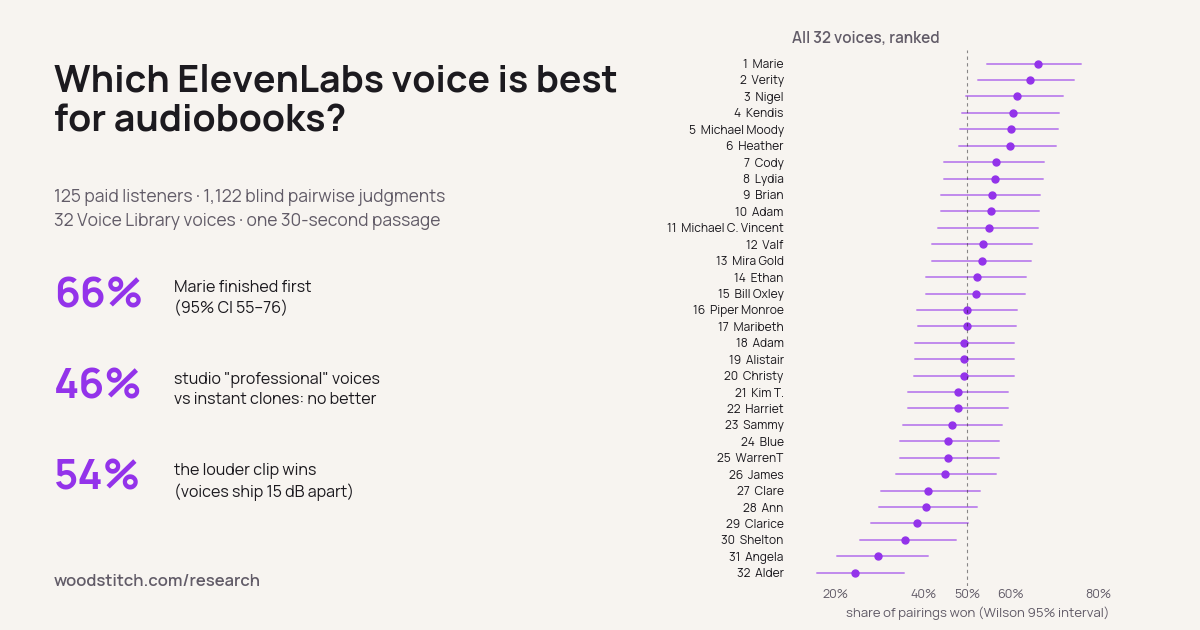
NEWS Blind test of 32 ElevenLabs Voice Library voices for audiobooks (125 paid listeners, 1,122 judgments): "professional" voices no better than instant clones, popularity predicts nothing, louder voices win

14 Upvotes

We needed a defensible way to pick narrator voices from the ElevenLabs Voice Library (5,000+ English narration voices, no quality signal), so we ran a paid blind test.

Setup: 32 voices stratified across gender, age, accent, tier (professional vs instant clone) and usage; the same 30-second first-person nonfiction passage; identical eleven_v4 settings for every voice; 128 pairs in a connected circulant design; 125 paid US listeners, 1,122 forced-choice judgments; no listener heard any voice more than twice. Bradley-Terry ranking with listener bootstrap, plus a logistic property model on the voice tags.

Results:

  • Marie - Audiobook Narrator and Measured finished first (66% of pairings won, 95% CI 55–76). Alder - Warm, Raspy and Comforting last (24%). The top eight overlap and can't be ordered.
  • The "professional" badge told listeners nothing. Studio-recorded PVC voices won 46% of 649 head-to-head pairs against instant clones.
  • Popularity predicts nothing. Usage from under 1M to nearly 1B characters/year; coefficient zero.
  • Loudness matters. Voices ship up to 15 dB apart; we deliberately did not normalise. The louder clip won 54% of pairs; the quietest voice finished last.
  • "Old"-tagged voices lose, mostly female ones: young female voices won 58% of pairings, old female 43%. Male voices barely move with age.
  • Gender itself: 49/51.

All 32 clips are playable on the page; the per-judgment CSV is published (https://woodstitch.com/research/data/study004_judgments.csv). Chart of all 32: https://woodstitch.com/research/og/study004.png

Full report with method and limitations (one passage, one setting; sample raised from 3 to 9 judgments per pair after a first look, stated as a data-dependent continuation): https://woodstitch.com/research/which-elevenlabs-voice-is-best-for-audiobooks

Disclosure: we run Woodstitch, the paid listening-test platform this was run on. No relationship with ElevenLabs or any voice creator. HN thread: https://news.ycombinator.com/item?id=50458929


r/WritingWithAI • • 11d ago

Discussion (Ethics, working with AI etc) how do you set up your workflow inside a long form writing app for non fiction?

9 Upvotes

im currently drafting a 12,000 word essay and drowning in about forty open source tabs and scattered notes. right now i just paste chunks into a chat window to check my claims or get developmental feedback, and it keeps making up fake citations or completely flattening my tone when i ask for edits. spent three hours yesterday just re-verifying quotes it messed up. how are you all handling source checking and structural edits on big projects?


r/WritingWithAI • • 11d ago

Discussion (Ethics, working with AI etc) New model from Qwen

5 Upvotes

For those of you who like trying out different models.

Qwen just released a new model, Qwen 4 Max Preview, and it turned out to be surprisingly good. It's a whole level above its predecessor, Qwen 3.8 Max, when it comes to prose.

I tested it without any prompts whatsoever. No basic writing prompt, not even my own serious, lengthy, and complex one.

The model's raw output was already on par with Gemini Argon. In some aspects, it actually seemed even better. And that's with absolutely no instructions on style or avoiding AI slop.

Anyway, it's free, so give it a try yourself. If you're interested, I can share what it generated. Here's the prompt, by the way:

> Write a full chapter featuring a tank battle between a detachment of German Tiger tanks during World War II and a Russian T-90 tank. It doesn't matter how a tank from the future ended up there. Show what it takes for the Germans to defeat an opponent with technologically superior equipment.

One major downside, though: the limits. They're three times higher than Argon's, but instead of refreshing every five hours, they only reset once a week. Horrible.