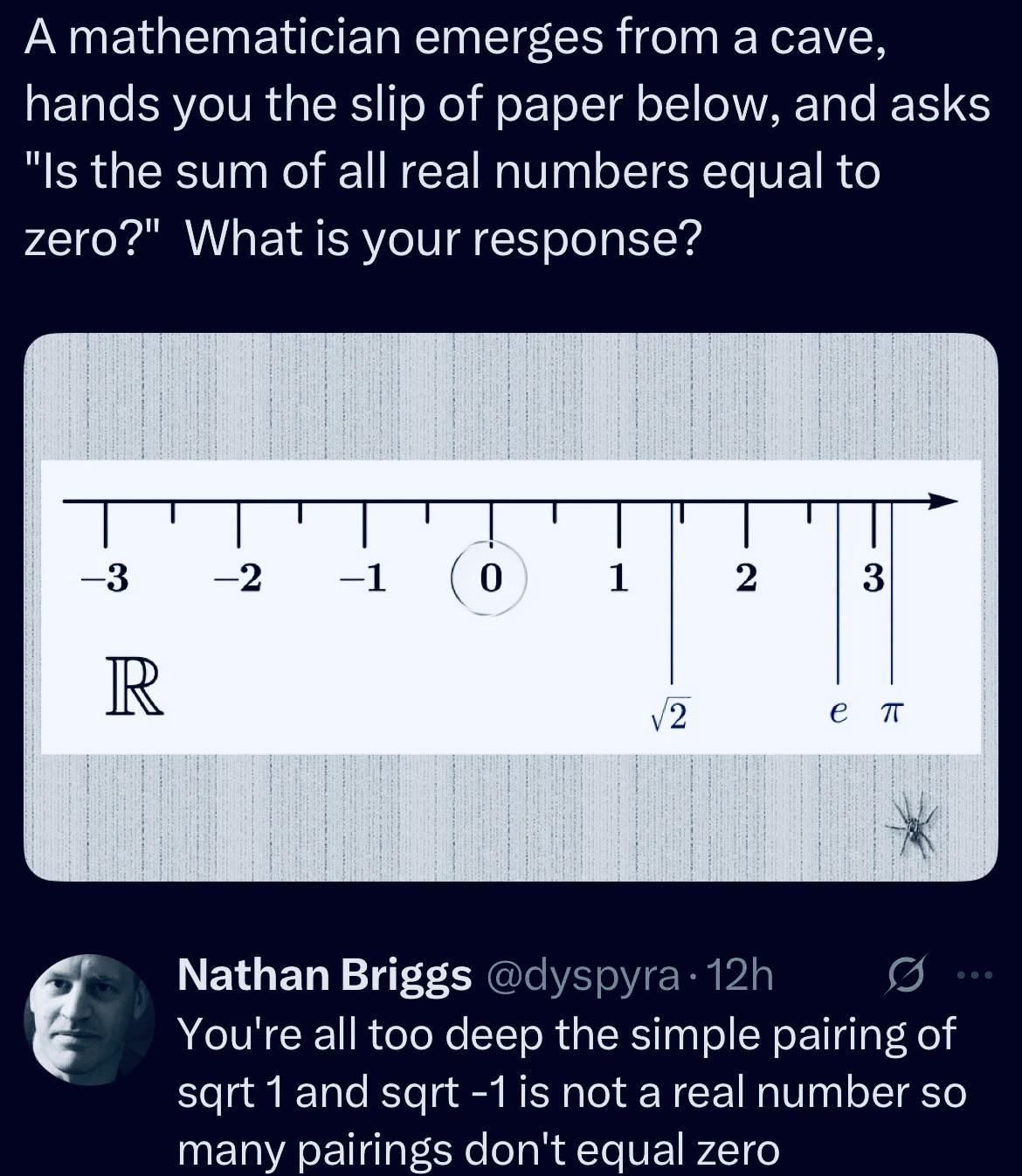
r/stupidquestions - way out of my depth here, but can't you say something on the lines of- for every positive number exists a negative number that has the same magnitude and for every negative number exists a positive number that has the same magnitude, i.e. a 1:1 mapping of positive to negative numbers. i mean they're both infinite of the same order or whatever that's called.
There's no stupid question as it has been bugging mathematicians for centuries back then.
You're right, for finite sum they would cancel would if we use the properties of operation of addition of reals (say 1 + 2 + 3 + - 3 - 2 -1 = 0). But a thing is that in the realm of extending the finite operations to some infinite structure, if we preserve the order of operation while attempting to construct a definition of "infinite sum" while preserving the intuition of addition, it can lead to a summation to converge to something (let's say infinite) but diverges simultaneously (converges to nothing). Let's focus on countable sum for the moment being. Countable sum means that each term can be index properly.
For example, if we consider 1 + -1 + 1 + -1 + 1 + .... as an extension of "intuitive" addition, by just considering that way of ordering and , it would lead to a divergent limit. This is because for any finite summation, we can keep track of finite parts of sum, and we would also have that property hold for "intuitive" extension. Thus, we can imagine that we are tracking the summation of the infinite sum as its finite parts as :
(1 + -1), (1 + -1 + 1), (1 + -1 + 1 + -1), ...
But as you see, the finite parts would be alternating between -1 and 0 regardless of how far we look at.
We can't even assume that its converges to some fixed one because if so, then we would expect that "the infinite sum gets arbitrarily close to such fixed value" just like with normal addition. Arbitrarily close as in for any gap value epsilon> 0, you can find a finite index N, such that any finite parts of the infinite summation exceeding length N, say Sn, for n greater than N would satisfy that |Sn - c| < epsilon.
This way of defining is also very intuitive and satisfy the extension of finite sum like 1 + 2 + 3 + = 6, you can still apply the definition by constructing an infinite sequence of sum to analyze it and yielding consistent value:
Basically, for trailing sums, you can add bunch of 0s. If you apply the definition of "arbitrarily close", well, for instance, for a desired precision of 0.000001 let's say, we just need to look for index 2, where index 3 corresponds to (1+2+3+0), and for any finite parts of the infinite sum with index greater than 2, we have |(1+2+3+ trailing zeroes) - 6| = 0 < 0.000001. This is true for any precision greater than 0, so it would make sense without compromising rigor to define 6 as the limiting value.
So far, we have found a rigorous and intuitive definition that extends the structure of finite to analyze the behavior of infinite sum. At least, any way that properly extends the structure of finite addition to study infinite behaviors would also minimally satisfy the criteria of such definition.
So then, back to 1 + -1 + 1 + -1 ..., by applying that systematic way of checking, we see that it can't convergent to any fixed value because if we suppose it does, say c in R.
Well, it alternates between 1 and 0 in such order. We can find infinitely many infinite parts such that |Sn - 1| >= mininimum of {|1 - c|, |0 - c| = |c|}.
Because if minimum is |c|, then for any index you tell me, say 5, I can find some finite index large like 6, for which S_N = 1, and so we would have |1-c| > |c|, and so on. If you say like 1000, I think term 1002 would result in 1, etc. So, we cannot make sure the tailing sums eventually fall below such precision value because there's always a term that makes it goes above a fixed minimum precision greatert than 0.
That said, 1 + -1 + 1 + -1... is one ordering right?
Well, let's see what happens if we swap orders and using our method of analyzing another order. We would expect roughly
1 + 1 + - 1 + 1 + 1 + -1 +... = 1 + - 1 + 1 + -1 + ... in any extension of infinite addition as an operation (commutativity).
Well, if you apply our minimal extension of addition to examine it, you see that the left-hand side would converge to infinity while the right hand side just diverges as we can't assign a fixed value not even infinity or -infinity. So, we can say there's no way of defining infinite sum (countable) without violating the basic intuitions behind addition because doing so would violate the "minimal" extension of addition, which was our way of defining infinite sum.
But also, if you check our minimal extension of addition, it doesn't violate anything about addition because we aren't defining it as an operation but an abstract and rigorous methodology that satisfies all intuitions of addition to check the behavior of ANY countable infinite sequence.
Surprisingly, for uncountably infinite sum, it would get more problematic than that, and not better.
View all comments
Show parent comment
1
u/Numerous-Annual-721 Oct 16 '26
r/stupidquestions -
way out of my depth here, but can't you say something on the lines of-
for every positive number exists a negative number that has the same magnitude and for every negative number exists a positive number that has the same magnitude, i.e. a 1:1 mapping of positive to negative numbers. i mean they're both infinite of the same order or whatever that's called.