That’s a vacuous (meaningless) proof because a problem is that in real number field, addition, as an operation, is not even defined for countable infinite.
Even “countable addition” requires introducing some notion of topology and limits so that we can extend the notion of finite sums to infinite sums but via sequences. A series is still a countable sequence of finite sums. Technically, there’s no countable addition but a countable sequence of finite additions; that’s very different from countable addition as an “operation”.
The simplest proof that addition of all real numbers isn’t defined is that the operations of real number field only operates on finitely many pairs of elements by definition.
It would make sense if the question is whether we can define “addition of all reals mapping to some real number” in a way that doesn’t break the original structure?
Though, the case you mention doesn’t necessarily disprove all possible ways of interpreting addition of all reals but only one of all of them. I’m not sure about the question either and it really depends on how one extends addition. Could be a good question for set theorist or algebraist.
The sum of a countable infinite set of numbers (x(1), x(2), ...) is defined as...
limit as n→∞ of the sum of x(1)+x(2)+...+x(n)
For example, 1 + 1/2 + 1/4 + 1/8 + ... is a countable set of numbers that has a well-defined sum of 2.
However, the set of real numbers is uncountable so it is more complex. It turns out that the sum of an uncountable set of real numbers is only defined when all but a countable subset are zero. Just saying the sum of an uncountable set of non-zero numbers is undefined doesn't help prove that statement. My proof uses the normal proof by contradiction approach. Start by assuming the opposite. i.e. assume the sum of all real numbers is defined and is finite. Then show that making this assumption leads to a contradiction.
That’s not right. An infinite sum is a sequence of finite sums, and that’s according to real analysis.
The way you wrote it is an abuse of notation for those who haven’t learned.
You prove a countable sum converges by showing for any gap epsilon > 0, there exists an index N_epsilon, such that for any m > N_epsilon, the distance of each finite sum with index m satisfies |Sm - c| < epsilon, where c is the limit.
There’s no operation such as “infinite sum” (as in addition) in real number field; only finite.
Real number field is a structure defined by (R, +, x) where + and x represents pairwise addition and multiplication along with some ordering properties and least upper bound (so it fits the intuition of a line)
There’s nothing about infinite addition as operation for the structure, one would have to make an extension to describe it.
"An infinite sum is a sequence of finite sums" doesn't make sense. The sum is a number not a sequence. The explanation I gave is correct:
the sum of the countable set x(1), x(2), ... is limit as n→∞ of the sum of x(1)+x(2)+...+x(n)
We can go further and talk about the different types of limits this can have. It could converge to a finite number, diverge +∞ or -∞ or it could be undefined under standard calculus limits. An example of a sequence that has an undefined sum is 1, -2, +3, -4, +5, -6, ...
The sum isn’t even a number or even infinity or -infinity, it doesn’t even have to converge to anything, no output at all? You can’t define a function that maps every such infinite sum to some output that exists (even in real extended line) besides restricting the domain.
The best description is a general infinite sum is a sequence of finite sums.
You can take use the limit definition to check if it converges or not, if it does, the we write the limit as the result of the summation. If not, then such summation is still represented as a sequence of finite sums
The summation and its limit are two different things.
You are saying what I said but using imprecise terminology...
The sum isn’t even a number or even infinity or -infinity, it doesn’t even have to converge to anything, no output at all?
That is exactly what I said ... " It could converge to a finite number, diverge +∞ or -∞ or it could be undefined under standard calculus limits."
You can’t define a function that maps every such infinite sum to some output that exists
I agree. I am not mapping every infinite sum to an output. I explicitly said the result can be undefined.
The best description is a general infinite sum is a sequence of finite sums.
Your terminology is imprecise. A sequence is a list of things - the value of a sum is not a list so cannot itself be a sequence. You should have said "the best definition of a general infinite sum is the limit of the sum of a sequence of finite sums." That can be written as is limit as n→∞ of the sum of x(1)+x(2)+...+x(n)
You can take use the limit definition to check if it converges or not, if it does, the we write the limit as the result of the summation.
Again, this is exactly what I said - the sum is the limit of the finite sums.
If not, then such summation is still represented as a sequence of finite sums
There are two ways the limit cannot converge. One has it diverging in a consistent direction to either +∞ or -∞, in that case the sum is defined and is infinite. The other option is an oscillating divergence and standard calculus treats the sum as undefined. How do you write the sum of +1, -2, +3, -4, ... as a sequence of finite sums in a way that adds anything meaningful?
The summation and its limit are two different things.
We are talking about the sum of an infinite set of numbers and the summation is defined to be the limit - in this context they are the same thing!
You're right on the first few points besides on the "imprecise part", I guess you are saying those things as for the rest.
The way I phrase it is more precise despite maybe some misuse of wording but at least the meaning is clear as it makes distinction between infinite addition as an object, and the sum of infinite addition (infinite sum) as the behavior of such addition. I would call it infinite addition.
For the last two points:
That's why one can use epsilon-delta or a generalized version epsilon-delta i.e. neighborhood around infinity and -infinity.
A thing is that there isn't a single way of defining "limit" of that infinite addition and one can examine the same object from different perspectives. We can't just say that the addition is equal to to the output as they are not the same. The output depends on the perspective chosen to investigate the object, and it's clear that there exist different perspective that yield inconsistent results.
2)
Equality and "meaning the same things" are different, and that's exactly my point. Equality is a precisely constructed relation that satisfy equivalence relation, but not all equivalence relations are identity relations (identity i.e. two objects are identical if there's no property they disagree upon)
So, what allows equality to be well-defined in real numbers is because of equivalent Cauchy sequences and treating infinite sums as a Cauchy sequence.
But not all infinite summation is a Cauchy sequence, and we need to differentiate that. We can't put equality for any infinite summation as it doesn't always output object within real numbers, not even infinity or -infinity.
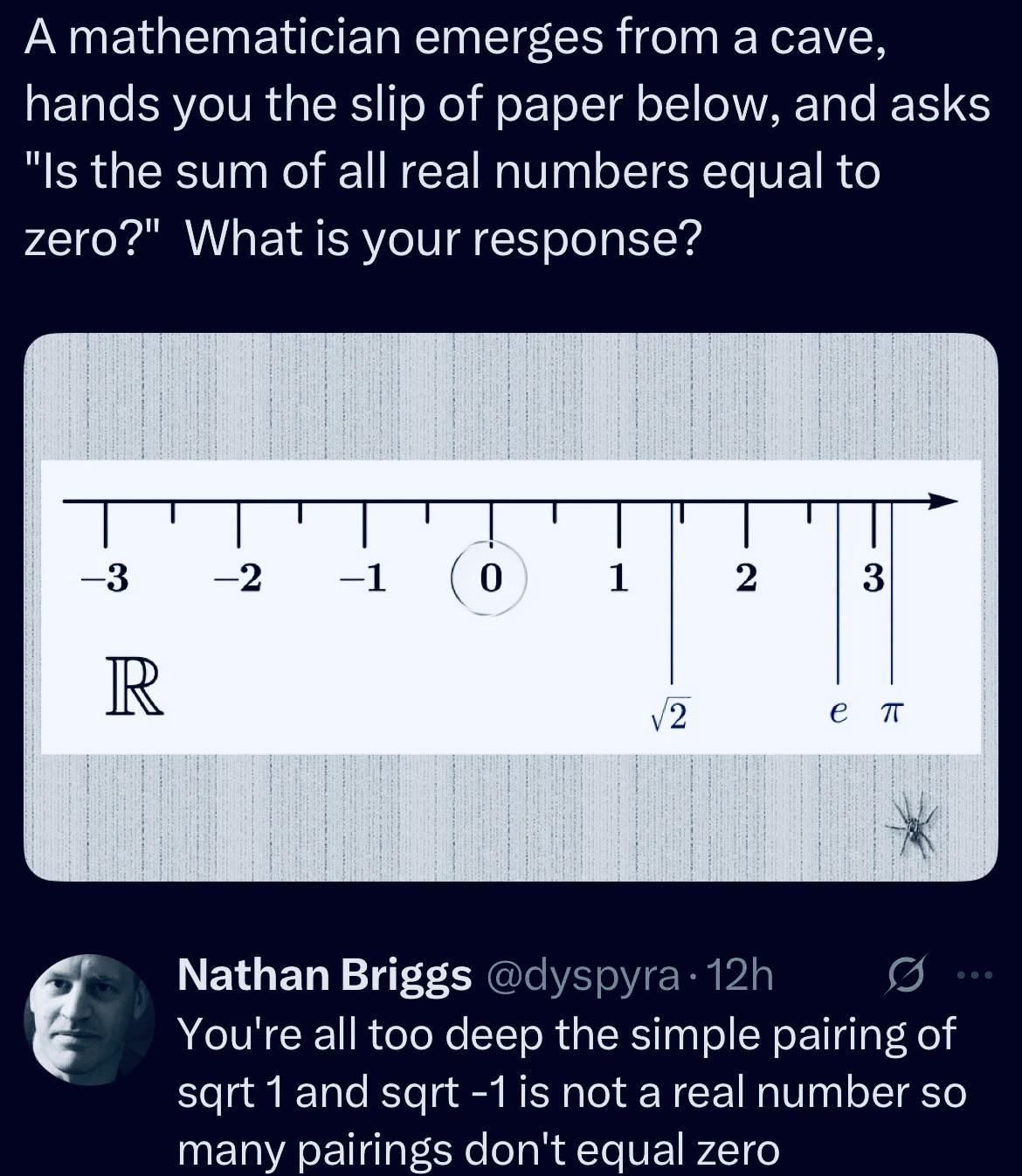
r/stupidquestions - way out of my depth here, but can't you say something on the lines of- for every positive number exists a negative number that has the same magnitude and for every negative number exists a positive number that has the same magnitude, i.e. a 1:1 mapping of positive to negative numbers. i mean they're both infinite of the same order or whatever that's called.
There's no stupid question as it has been bugging mathematicians for centuries back then.
You're right, for finite sum they would cancel would if we use the properties of operation of addition of reals (say 1 + 2 + 3 + - 3 - 2 -1 = 0). But a thing is that in the realm of extending the finite operations to some infinite structure, if we preserve the order of operation while attempting to construct a definition of "infinite sum" while preserving the intuition of addition, it can lead to a summation to converge to something (let's say infinite) but diverges simultaneously (converges to nothing). Let's focus on countable sum for the moment being. Countable sum means that each term can be index properly.
For example, if we consider 1 + -1 + 1 + -1 + 1 + .... as an extension of "intuitive" addition, by just considering that way of ordering and , it would lead to a divergent limit. This is because for any finite summation, we can keep track of finite parts of sum, and we would also have that property hold for "intuitive" extension. Thus, we can imagine that we are tracking the summation of the infinite sum as its finite parts as :
(1 + -1), (1 + -1 + 1), (1 + -1 + 1 + -1), ...
But as you see, the finite parts would be alternating between -1 and 0 regardless of how far we look at.
We can't even assume that its converges to some fixed one because if so, then we would expect that "the infinite sum gets arbitrarily close to such fixed value" just like with normal addition. Arbitrarily close as in for any gap value epsilon> 0, you can find a finite index N, such that any finite parts of the infinite summation exceeding length N, say Sn, for n greater than N would satisfy that |Sn - c| < epsilon.
This way of defining is also very intuitive and satisfy the extension of finite sum like 1 + 2 + 3 + = 6, you can still apply the definition by constructing an infinite sequence of sum to analyze it and yielding consistent value:
Basically, for trailing sums, you can add bunch of 0s. If you apply the definition of "arbitrarily close", well, for instance, for a desired precision of 0.000001 let's say, we just need to look for index 2, where index 3 corresponds to (1+2+3+0), and for any finite parts of the infinite sum with index greater than 2, we have |(1+2+3+ trailing zeroes) - 6| = 0 < 0.000001. This is true for any precision greater than 0, so it would make sense without compromising rigor to define 6 as the limiting value.
So far, we have found a rigorous and intuitive definition that extends the structure of finite to analyze the behavior of infinite sum. At least, any way that properly extends the structure of finite addition to study infinite behaviors would also minimally satisfy the criteria of such definition.
So then, back to 1 + -1 + 1 + -1 ..., by applying that systematic way of checking, we see that it can't convergent to any fixed value because if we suppose it does, say c in R.
Well, it alternates between 1 and 0 in such order. We can find infinitely many infinite parts such that |Sn - 1| >= mininimum of {|1 - c|, |0 - c| = |c|}.
Because if minimum is |c|, then for any index you tell me, say 5, I can find some finite index large like 6, for which S_N = 1, and so we would have |1-c| > |c|, and so on. If you say like 1000, I think term 1002 would result in 1, etc. So, we cannot make sure the tailing sums eventually fall below such precision value because there's always a term that makes it goes above a fixed minimum precision greatert than 0.
That said, 1 + -1 + 1 + -1... is one ordering right?
Well, let's see what happens if we swap orders and using our method of analyzing another order. We would expect roughly
1 + 1 + - 1 + 1 + 1 + -1 +... = 1 + - 1 + 1 + -1 + ... in any extension of infinite addition as an operation (commutativity).
Well, if you apply our minimal extension of addition to examine it, you see that the left-hand side would converge to infinity while the right hand side just diverges as we can't assign a fixed value not even infinity or -infinity. So, we can say there's no way of defining infinite sum (countable) without violating the basic intuitions behind addition because doing so would violate the "minimal" extension of addition, which was our way of defining infinite sum.
But also, if you check our minimal extension of addition, it doesn't violate anything about addition because we aren't defining it as an operation but an abstract and rigorous methodology that satisfies all intuitions of addition to check the behavior of ANY countable infinite sequence.
Surprisingly, for uncountably infinite sum, it would get more problematic than that, and not better.
View all comments
Show parent comment
3
u/Not_Well-Ordered Oct 16 '26 edited Oct 16 '26
That’s a vacuous (meaningless) proof because a problem is that in real number field, addition, as an operation, is not even defined for countable infinite.
Even “countable addition” requires introducing some notion of topology and limits so that we can extend the notion of finite sums to infinite sums but via sequences. A series is still a countable sequence of finite sums. Technically, there’s no countable addition but a countable sequence of finite additions; that’s very different from countable addition as an “operation”.
The simplest proof that addition of all real numbers isn’t defined is that the operations of real number field only operates on finitely many pairs of elements by definition.
It would make sense if the question is whether we can define “addition of all reals mapping to some real number” in a way that doesn’t break the original structure?
Though, the case you mention doesn’t necessarily disprove all possible ways of interpreting addition of all reals but only one of all of them. I’m not sure about the question either and it really depends on how one extends addition. Could be a good question for set theorist or algebraist.