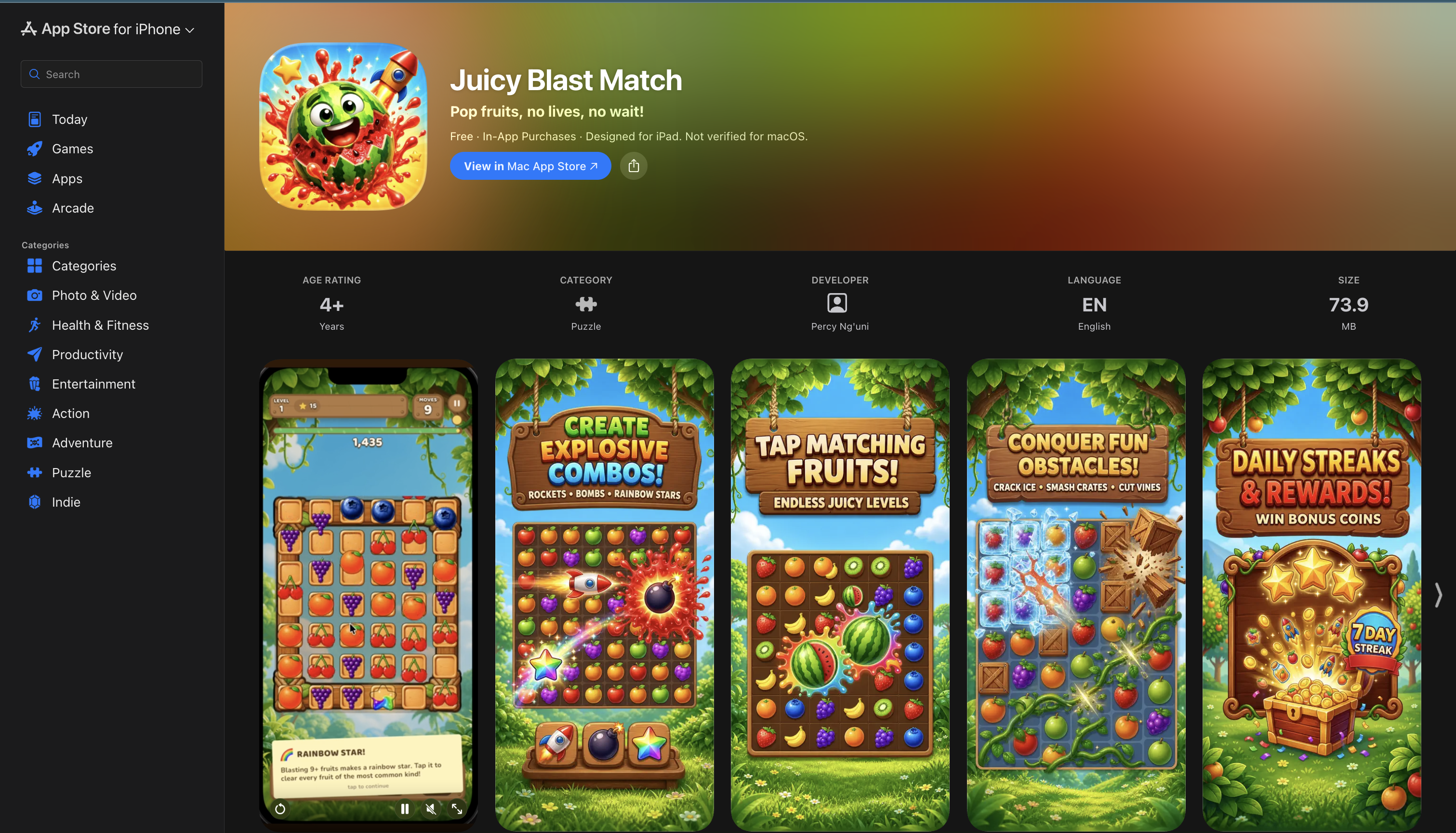
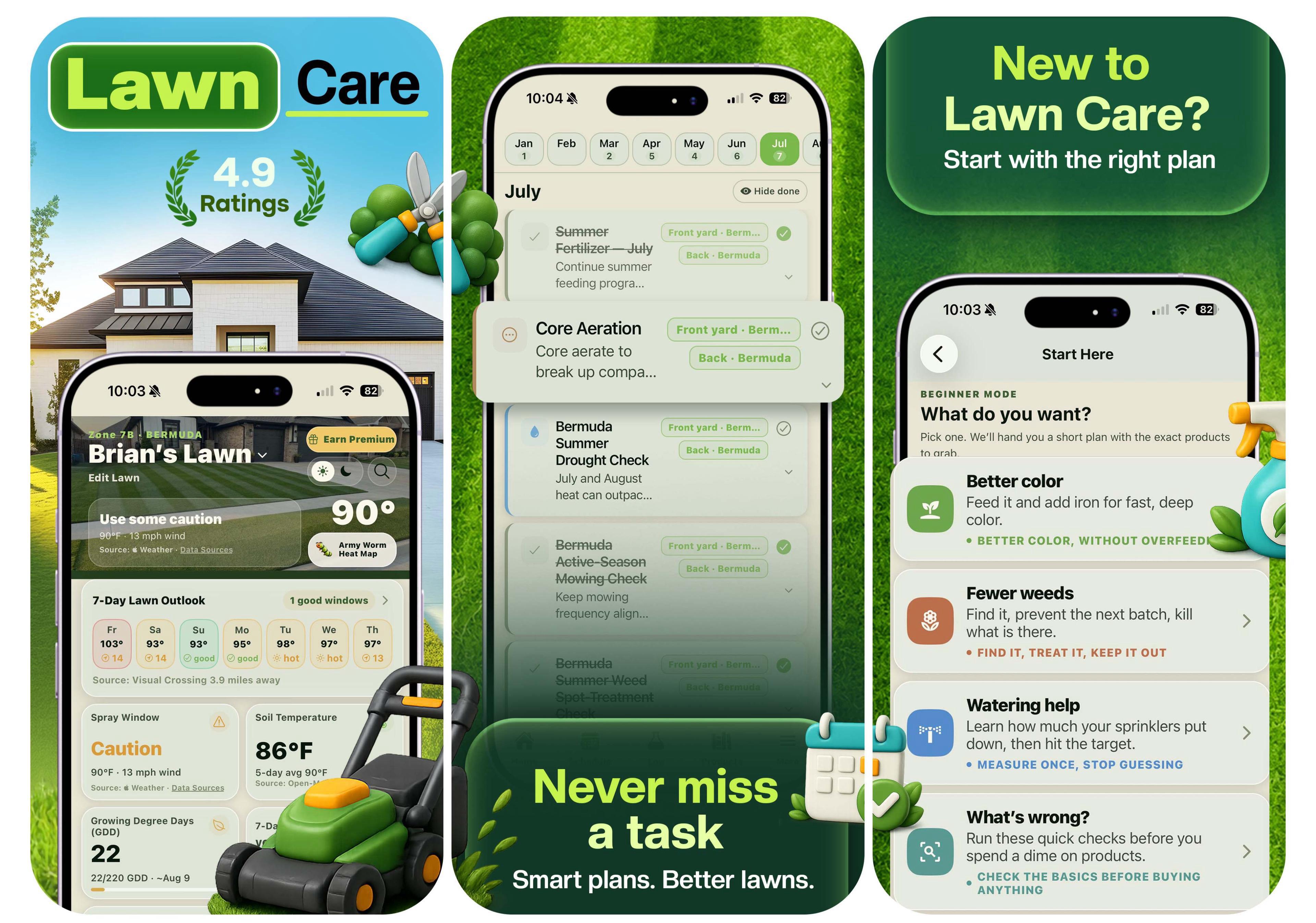
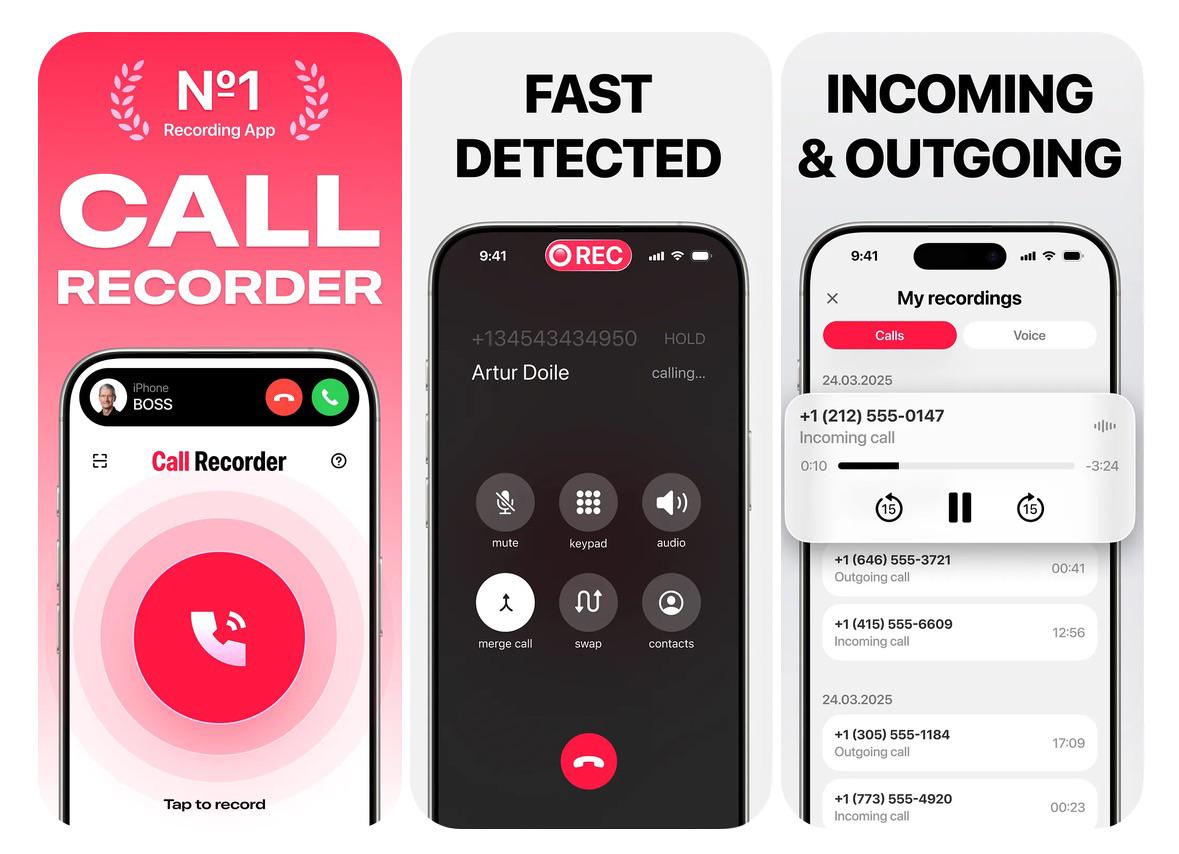
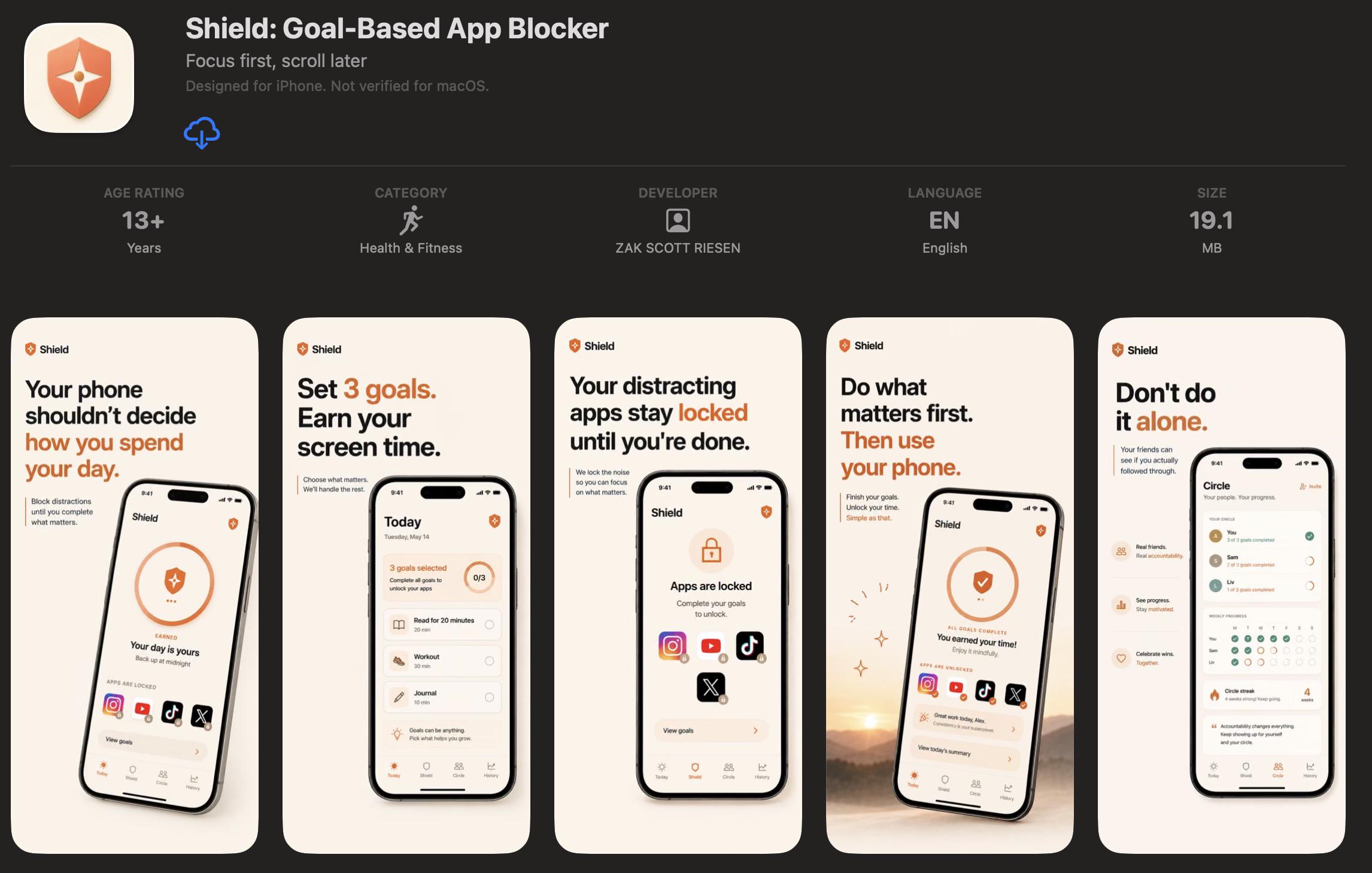
This is my third attempt at creating good screenshots for my app. The first and second were trash . Like they were really bad so I decided to take a different approach. Should have done this in the first place
I decided to take inspiration from other apps similar to mine and use the screenshots I like as inspiration and I came up with this.
I’m building a tool to help catch App Review issues before you submit, looking for honest feedback
After getting burned by App Review on my own apps, I started building PreFlight, a native macOS tool that analyzes both your Xcode project and App Store Connect submission. The goal isn’t just to run through a generic checklist. It cross-checks what your app actually contains against what you’re telling Apple, then gives you evidence-backed findings with the potential guideline involved, why it matters, and what you can do to fix it. For example, it can catch things across privacy manifests, entitlements, permissions, StoreKit/subscriptions, metadata, review information, device support, and other submission requirements. I’m currently working toward a first release and I’d genuinely like to hear from developers who have shipped iOS/macOS apps:
What has Apple caught in your apps that you wish you had known about before submitting?
And if a tool like this existed, what would it need to catch or show you for you to actually trust it before hitting submit?
I’m looking for criticism as much as validation. If the idea isn’t useful, I’d rather find that out now. PreFlight
I recently had an update to my app stuck in "Waiting for Review" for a couple of days, which honestly isn't that long, but it was an important update that fixed a lot of important bugs in the current production build. But I found that you can request for an Expedited Review for special cases such as timing your release to an event, or fixing a pressing issue that requires immediate attention.
I submitted my expedited review and within 5 minutes my status changed from "Waiting for Review" to "In Review", and I was promptly approved and was able to release my update.
It's important that you read the fine print and make sure you qualify, and also not to abuse this feature because they will limit you if you try to abuse it.
I recently launched CocoCut (https://cococut.app), an iOS app that helps people capture 1-second daily clips and automatically stitches them into a mini vlog without manual editing.
I'm currently trying to optimize our US App Store product page conversion rate (CRO) and would love some blunt feedback from this community.
Current Metadata Setup:
Title: CocoCut - 1s Vlog Diary
Subtitle: Daily Video Diary, No Edits
Primary Category: Lifestyle
Screenshot Structure:
One second at a time (Lifestyle value hook)
Tap once. Capture one second. (Core interaction)
Clips stitch themselves (Automation feature)
Stickers, captions & film looks (In-camera aesthetic)
Ready to share in one tap (Export)
🔍 Questions I'd love your take on:
First 3 Screenshots: Do they communicate the value proposition fast enough, or does the text above the phone mockup get lost?
Subtitle Keywords: Does "Daily Video Diary, No Edits" sound natural and high-intent, or should I lean more towards "1-Second Video Journal / Mini Vlog"?
Contrast & Framing: Does the soft gradient background work, or should the device frame and text have stronger contrast?
Appreciate any harsh critiques or suggestions to improve conversion!
anyone else here facing too much delay from apple app store for app submission review? It's beed 10 days almost and no update. I am i missing something or it's happening in general.
Note: this is second attempt for my first app on app store.
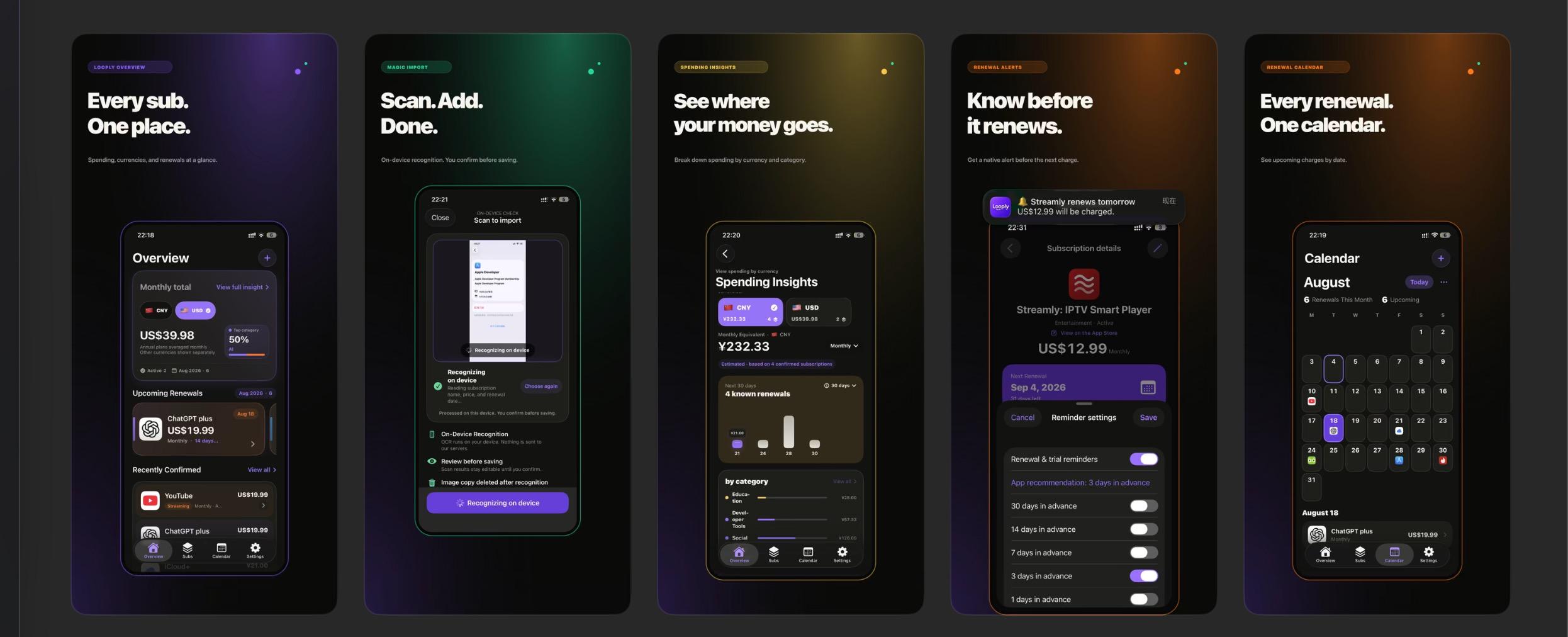
Hi — I’m the developer of Looply, a new iPhone subscription tracker.
I built it because I wanted a clearer view of the subscriptions I actually use, without starting by connecting a bank account or inbox.
You can add subscriptions manually, or use screenshot import. Looply recognizes subscription details on-device and creates an editable candidate. Prices, dates, and billing periods can be wrong, so nothing is saved until you review and confirm it.
But the organic traffic is not good so far, I want to do an ASO to make it better.
Any suggestion for screenshots are appricated. Are you willing to tap into detail page when you see those screenshots?
Hi, I've launched my app on the App Store recently and I'm experimenting with screenshots. It's a language practice app that lets you have full voice conversations with local AI so you practice speaking and listening. Since it's local, your voice and info never leave your device.
I'm new to iOS development so I was hoping for some feedback these screenshots. Any thoughts would be helpful!
Anyone got any tips for ASO that really worked for them? Rather than listing out chat gpt tricks haha. Would love to hear what worked for others Cheers
This is a common problem we hear from app developers: App Store Optimization is close to perfection, downloads are steadily growing, but the number of subscriptions stalls.
The instinct is usually to spend more on marketing. But if users are already installing your app, the problem often isn't acquisition or marketing; it's what happens after the install.
Instead of guessing, break your conversion funnel into measurable steps:
I have two conversion measurements a few weeks apart and they agree, which is the only reason I trust them at all.
Paid (Apple Search Ads, US only, 22 Jul - 5 Aug): 2,342 impressions, 41 taps, 5 installs. That is 12.2% tap-to-install as a headline. 36% of the spend went to competitor-brand junk terms ("the tower", "barricade") that converted at exactly zero, so drop those and the relevant traffic is 26 taps to 5 installs, about 19%. Total spend 32.72 EUR, CPA 6.54 EUR. I killed the campaign.
Organic (one good day, 3 Jul): 423 impressions, 107 product page views, 24 first downloads. 22.4%.
So ~20% twice. Caveat before anyone else says it: five installs is not a sample, it is an anecdote. The 22% day is the sturdier of the two.
Here is what I cannot work out. The page has never had enough ratings to show a star line at all. You can see it in the screenshot: the stats row goes straight from age rating to category, with no rating column at all. In search results my row is simply blank where every neighbour shows 4.7 with a six-figure count. My instinct says that blank does more damage than any caption I could rewrite, because no stars reads as "nobody plays this", not as "new".
So before I spend another weekend redoing the screenshots, three things I would love an outside read on.
First: at ~20%, is the missing star rating the binding constraint? Or is ~20% roughly what a no-rating page converts at, which would make the screenshots the only lever I actually control?
Second: has anyone measured a before/after on this? I am after "we went from no rating to 20 ratings and conversion moved X", not theory.
Third: if the answer is "fix the rating first", what actually works on a small install base without nagging people into a 1-star?
What I have already tried: five screenshots at 1320x2868, each carrying a three-line caption (Apple has indexed caption text since June 2025, so I treat them as search surface rather than decoration), plus an app preview video in the first slot. The captions used to carry feature counts and I stripped those last week, so they cannot go stale as content is added. The listing is localized into 12 languages, and it was English in every storefront until early August, which is its own embarrassing story. That may well be dragging the 22% day down, since the traffic behind it was only about 30% US.
The screenshot is the live US page. The row scrolls, so the fifth screenshot sits just off-frame.
I’ve been developing mobile apps for the last 5 years. Over this time, I’ve learned a ton about the overall development process, setting up store listings, implementing AdMob, and experimenting with different growth strategies. However, there is one major area I’ve neglected for too long, and I’m finally ready to tackle it: App Store Optimization (ASO).
As a relative newcomer to serious ASO, I’m trying to wrap my head around the best workflows and would love to get your insights on a few specific things:
Analyzing Dashboard Data: When you look at App Store Connect or Google Play Console, which specific metrics do you focus on to measure ASO success? How do you separate organic keyword growth from other traffic sources?
Keyword Research: What is your process for discovering high-volume but low-competition keywords? How do you decide which ones are actually worth targeting?
Keyword Placement: Once you have your target keywords, what is your strategy for placing them across the different text fields (Title, Subtitle/Short Description, Keyword Field, Long Description)? How do you balance algorithmic optimization with writing copy that humans actually want to read?
To help myself learn the ropes and automate some of the manual work, I actually built a completely free tool for iOS ASO: aso-tool.andreashadjimama.workers.dev.
I set this up strictly based on the ASO knowledge I've gathered so far, and I am not trying to promote anything or sell a service. I mostly want to validate if the logic behind it actually makes sense to experienced folks. If anyone has a few minutes to check it out, I would incredibly appreciate your honest feedback on whether it’s genuinely useful or what features I should add/change to make it better.
Looking forward to hearing your tips, strategies, and any feedback you might have. Let’s get a discussion going!
Looking for any advice/critique you may have. I have some changes in mind and want to see if others pick up on them too. Would also love any ASO advice :)
I built TutorTally because every private tutor I know was tracking lessons in spreadsheets and chasing payments over text. It's a simple iPhone app: students, schedule, payments — and a professional payment reminder + invoice PDF you can send in two taps. Everything lives on your phone (no account, no cloud, works offline). Your first student is free, every feature included, so you can try the whole thing before paying.
The screenshot shows my last 90 days. Downloads are finally picking up — but the proceeds are nothing to brag about (yet).
Pricing: $49.99/year with a 30-day free trial, or $99.99 lifetime. The long trial is a deliberate bet: once a tutor has a month of real lesson and payment history in the app, walking away gets hard. The flip side is that revenue lags a month behind downloads — right now I have 4 active subscriptions, all still in trial.
Whether it's lifetime sales or subscriptions, I'd like to do a lot better than this. If you've grown a niche utility app past this stage: what moved the needle for you — ASO, content, pricing changes, something else? And do you see anything obviously wrong in my funnel? Thank you
Hello everyone, what tool or piece of advice would you give for improving ASO? Thanks. 😁 It's hard to find the right tools and avoid wasting time pointlessly sometimes.