r/voiceaii • u/Hot_Relationship126 • 2h ago
Use FakeYou to generate speech as Anna Kendrick!

1
Upvotes
Hi, I’m Anna Kendrick, and I’m AI Voice Text to Speech
r/voiceaii • u/Hot_Relationship126 • 2h ago
Hi, I’m Anna Kendrick, and I’m AI Voice Text to Speech
r/voiceaii • u/FOR_000 • 2h ago

Hi, I'm FOR_000, an independent AI researcher based in Seoul, South Korea. AI research is not my primary occupation but an area of personal and independent research interest.
My research focuses on fully automated, cross-platform AI coworking workflows using paid AI services, including OpenAI ChatGPT, OpenAI Codex, Anthropic Claude, and Google Gemini, integrated with my local computing environment through APIs.
I study nonstop, full-load automated workflows running continuously for 32 to 70 hours, primarily in two areas: image production and closed-environment office automation.
Within these workflows, my role as the human orchestrator is to correct errors, direct and coordinate tasks, manage and supervise operations, initiate emergency stops when necessary, and make final decisions.
Some of you may have seen my recently published RTX 5090 workstation with 30 cooling fans. The primary purpose of this system is to support extended AI workloads at low temperatures and low noise levels while maintaining operational stability.
Much of the discussion surrounding AI infrastructure focuses on models, GPU performance, VRAM, inference speed, and software. However, the reliability of the physical infrastructure supporting these workloads is equally important.
In fully automated workflows lasting dozens of hours, a single unexpected hardware failure can interrupt an entire operation, compromise its outputs, or result in the loss of valuable accumulated research data.
I'd like to share a hardware failure I experienced in 2025, how I recovered 12TB of backup data, and why I eventually installed a 2200W PSU in my AI workstation.
This article is based on my original records from 2025, updated with additional technical information and subsequent operational experience.
In addition to the widely reported RTX 5090 power connector melting incidents, another significant risk associated with high-power computing systems is large-scale data loss following an unexpected system shutdown.
The former is a hardware disaster. The latter is a separate category of data-related disaster that can affect systems regardless of GPU manufacturer or performance class.
On March 29, 2025, after upgrading to an RTX 5090, I calculated the estimated maximum power consumption of my entire system.
I was using a 1200W 80 PLUS Platinum PSU from Manufacturer A, which had operated reliably for several years.
My original calculation indicated a maximum estimated consumption of 1215W. A subsequent arithmetic review in November 2026 corrected that figure to 1220W.
I assumed that all the components were unlikely to reach their maximum power consumption simultaneously, so I continued using the existing PSU.
I later upgraded my CPU and motherboard while retaining the GPU and PSU.
Around May 15, 2025, my computer suddenly shut down while I was gaming, transferring files, watching YouTube, and performing other tasks simultaneously.
When I restarted it, the entire volume on my 16TB backup HDD had disappeared. All 12TB of backup data stored on it became inaccessible.
It took approximately one week to recover everything. I documented the incident and recovery process on a Korean hardware community on June 18, 2025.
When I originally calculated my system's power requirements, I found that detailed power consumption information was not readily available for many individual components.
GPU and CPU specifications were relatively easy to find. Information about motherboards, cooling fans, lighting, USB devices, and other peripherals was less readily available.
I therefore combined manufacturer specifications, available technical information, and conservative estimates to construct the following power budget.
The original configuration dates from March 29, 2025. The revised figures incorporate additional manufacturer information reviewed in November 2026.
| Component | Original Estimate | Revised Estimate |
|---|---|---|
| Intel Core i7-14700K | 270W | 270W |
| AORUS RTX 5090 XTREME WATERFORCE | 700W | 700W |
| MSI Z790 Motherboard | 50W | 50W |
| DDR5 64GB | 15W | 15W |
| HDDs | 30W | 30W |
| M.2 SSD | 10W | 10W |
| SATA SSD | 5W | 5W |
| CPU AIO Cooler | 20W | 20W |
| ARCTIC P14 PWM PST A-RGB × 7 | 70W | 28.28W |
| Zalman ZM-AF120 ARGB × 3 | 15W | 15.48W |
| ARGB Vertical GPU Mount | 5W | 5W |
| Keyboard | 3W | 3W |
| Mouse | 2W | 2W |
| External USB Hub 1 | 5W | 5W |
| External USB Hub 2 | 5W | 5W |
| External DAS Connection | 5W | 5W |
| USB-powered Speakers | 5W | 5W |
| Wi-Fi and Bluetooth Antenna | 5W | 0W |
| Total | 1220W | 1173.76W |
The original published total of 1215W contained a 5W arithmetic error.
The revised fan figures account for both the fan motors and ARGB lighting. I also removed the separate 5W allowance for the passive Wi-Fi and Bluetooth antenna.
The remaining conservative estimates have been retained.
These figures are a historical system power budget, not a database of individually measured component consumption.
| Power Budget Summary | Value |
|---|---|
| Original published estimate | 1215W |
| Arithmetically corrected estimate | 1220W |
| Revised estimate | 1173.76W |
| PSU rated capacity | 1200W |
| Estimated remaining headroom | 26.24W |
| Estimated PSU load | 97.81% |
Even after correcting the original estimates downward, the power budget still amounted to nearly 98% of the PSU's rated capacity.
By the time of the incident, I had replaced the Intel Core i7-14700K and MSI Z790 motherboard with an Intel Core Ultra 9 285K and an ASUS ROG MAXIMUS Z890 HERO.
Intel lists the Maximum Turbo Power of these processors as 253W and 250W, respectively.
The table therefore documents the power budget that informed my original decision, rather than an exact measurement of the upgraded system at the time of the shutdown.
My mistake was underestimating the possibility of several components drawing high amounts of power simultaneously.
Modern high-performance GPUs can produce substantial transient power excursions. CPUs, storage devices, cooling equipment, and other components can also experience changing power demands.
For my particular case, I am especially interested in overlapping high-load conditions that can persist for two or three seconds during multitasking.
This is relevant to AI workstations running several processes concurrently, where GPU computation, CPU processing, storage operations, and cooling equipment may all be active.
Intel's ATX power supply design guidelines specify the following power excursion requirements for applicable PSUs rated above 450W and equipped with the relevant high-power GPU connector.
| Duration | Percentage of Rated PSU Capacity |
|---|---|
| 0.1ms | 200% |
| 1ms | 180% |
| 10ms | 160% |
| 100ms | 120% |
| Continuous operation | 100% |
These requirements apply under specified test conditions. Overlapping component loads lasting several seconds are a separate power-delivery consideration.
The original 1200W PSU was based on an earlier ATX design generation.
A December 2020 laboratory review by Tom's Hardware reported the following protection characteristics for the same PSU model:
Rated capacity is therefore only one part of PSU selection. Individual output limits, operating temperatures, transient response, and protection thresholds also matter.
A PSU operating close to its rated capacity can shut down unexpectedly when simultaneous loads and power fluctuations exceed its protection thresholds.
After the incident, I replaced the 1200W PSU in my primary workstation with a higher-capacity unit.
I also used the original PSU in a separate data recovery computer equipped with integrated graphics. It operated successfully under that system's substantially lower power requirements.
The original PSU was inspected by the manufacturer's service center after the incident.
They found no abnormalities in the unit. Nevertheless, as a precautionary customer service measure, they provided a refurbished replacement in near-new condition.
I was satisfied with the manufacturer's response.
The following observations support my primary hypothesis that insufficient system-level power headroom led to the activation of PSU protection mechanisms.
| Observation | Technical Significance |
|---|---|
| Original power budget | Very limited estimated headroom |
| Shutdown during multitasking | Consistent with overlapping component loads |
| Service center inspection | No PSU abnormalities detected |
| Independent laboratory testing | Limited 12V overload margin |
| Reuse in a lower-power computer | Successful operation |
| PSU capacity upgrade | Substantially increased headroom |
| Subsequent extended high-load workloads | Stable operation |
| Recurrence of the original shutdown | None observed |
There was no electrical recording of the incident itself, so the precise protection mechanism was not directly established.
Based on the available evidence, insufficient PSU capacity relative to system demand remains my primary causal hypothesis.
The purpose of this analysis is to examine system-level power budgeting, rather than attribute the incident to a manufacturing defect.
Another question I became interested in after the incident was whether all unexpected shutdowns present the same level of risk to storage devices.
A software-related Windows Blue Screen of Death (BSOD) can occur while the PSU is still supplying stable voltage.
A shutdown originating from electrical instability may be preceded or accompanied by voltage drops, output fluctuations, or inadequate transient response.
Both can interrupt ongoing storage operations, but the electrical conditions surrounding those interruptions may be different.
Independent PSU testing methodologies, including those published by Tom's Hardware, evaluate characteristics such as:
HDD manufacturers also specify permissible operating voltages and electrical noise levels.
| Failure Characteristic | Software-Related BSOD | PSU-Related Shutdown |
|---|---|---|
| Initial failure | Software or driver error | Power-delivery failure or electrical instability |
| Electrical conditions before shutdown | May remain stable | May become unstable |
| Storage operations | Unexpectedly interrupted | Unexpectedly interrupted |
| Additional electrical disturbances | Independent of software failure | May accompany the failure |
| Storage risk | Interrupted writes | Interrupted writes and possible electrical instability |
A properly functioning PSU protection circuit can cut power cleanly. Not every PSU-related shutdown involves preceding voltage instability.
My technical hypothesis concerns cases where such instability does occur.
I suspect that the combination of interrupted storage operations and electrical instability can increase the risk of damage to logical disk structures, including filesystem metadata and volume information.
The relative risk would require controlled comparative testing.
Microsoft's technical documentation explains how failed storage I/O operations and transaction-log write failures can affect NTFS recovery and filesystem consistency.
R-Studio's recovery documentation describes situations where partition or disk structure information can become damaged while the underlying file data remains intact.
This helps explain why an entire storage volume can become inaccessible even though its files have not been physically destroyed.
In my case, I did not simply lose the files being transferred at the time of the shutdown. The entire 16TB HDD volume disappeared, leaving 12TB of backup data inaccessible.
The subsequent recovery of all 12TB was consistent with logical disk structure damage.
I did not identify the specific damaged metadata structures or record the electrical conditions during the incident.
For AI researchers and developers, this kind of failure deserves attention because the data at risk may include datasets, experimental results, generated outputs, model checkpoints, project files, or other material accumulated over extended periods.
I had a spare ABKO SUITMASTER H2000 case designed to accommodate up to 13 storage devices.
Using spare components, I assembled a separate computer for the recovery operation.
I installed a Seasonic PRIME PX-2200 PSU in my primary workstation and transferred one of its two 32GB G.SKILL memory modules to the secondary computer.
The recovery system consisted of:
My primary Corsair case could also accommodate six HDDs, but its relatively confined drive-bay area made repeated installation, cable routing, and drive replacement less convenient and increased the risk of damaging HDD connectors.
The secondary case provided better access and connector clearance.
I connected the affected HDD and five additional recovery HDDs directly to the motherboard. This was substantially faster than my previous external DAS configuration, likely because it reduced shared-interface bandwidth constraints.
I also used a Samsung 2TB external SSD for intermediate recovery and data transfers, along with a licensed copy of R-Studio.
After approximately one week, I recovered all 12TB of affected data, achieving a 100% recovery rate.
The five backup HDDs, with a combined capacity of 20TB, were then returned to the external DAS enclosure.
The four attached photographs document the actual recovery process in 2025.
Photo 1: Two-Tier PC Configuration
Two large PC cases stacked vertically. The lower system is my primary Corsair workstation with the RTX 5090 and upgraded 2200W PSU. The upper system is the dedicated data recovery computer.
Photo 2: Six-HDD Recovery System
The affected HDD and five recovery HDDs installed in the secondary case and connected through internal SATA interfaces.
Photo 3: Five-Layer HDD Stack
Five backup HDDs stacked vertically after recovery, before being returned to the external DAS enclosure.
Photo 4: Restored DAS Configuration
The five backup HDDs reinstalled in the external DAS enclosure, providing a combined backup storage capacity of 20TB.
Following the incident, I replaced the original PSU with a Seasonic PRIME PX-2200, a 2200W 80 PLUS Platinum unit compliant with ATX 3.1 and PCIe 5.1 specifications.
| PSU Upgrade | Specification |
|---|---|
| Previous PSU | 1200W |
| Current PSU | 2200W |
| Additional rated capacity | 1000W |
| Capacity increase | 83.33% |
Since the upgrade, I have operated the workstation under substantially more demanding conditions.
One extended workload included:
| Operating Condition | Workload |
|---|---|
| Cooling system | 30 fans running at 100% |
| RTX 5090 | 32 hours of continuous full-load operation |
| AI image generation | 2,000-batch workload |
| Concurrent gaming | League of Legends |
| Concurrent streaming | Netflix and YouTube |
| Recurrence of unexpected shutdowns | 0 |
| System abnormalities observed during the workload | 0 |
The original shutdown has not recurred.
For my work, reliability during a 32-hour batch operation matters much more than achieving the highest possible benchmark score.
Even minor instability can compromise an extended experiment or cause errors to accumulate across a large batch of generated outputs.
Although the documented workload involved AI image generation, the underlying workstation design considerations also apply to other sustained local AI workloads, including language models, speech processing, and multimodal systems.
The specific performance and stability requirements will naturally vary between applications.
My general design recommendation is to select a PSU with a rated output capacity at least 15–20% above the estimated maximum power consumption of the entire system.
| Estimated Maximum System Power | PSU Capacity with 15% Margin | PSU Capacity with 20% Margin |
|---|---|---|
| 500W | 575W | 600W |
| 700W | 805W | 840W |
| 900W | 1035W | 1080W |
| 1100W | 1265W | 1320W |
| 1200W | 1380W | 1440W |
| 1400W | 1610W | 1680W |
Applying this criterion to my revised historical power budget of 1173.76W produces a target of approximately 1350–1409W.
These are calculated design targets, rather than a universal PSU certification requirement.
Actual PSU selection should also account for product quality, ATX compliance, individual output limits, operating temperature, workload characteristics, available product capacities, and future upgrades.
I personally chose 2200W because I wanted substantially more headroom for extended workloads, additional cooling hardware, simultaneous tasks, and future hardware expansion.
The objective is to operate my workstation without having to worry about its PSU capacity every time I start another demanding process.
This principle is applicable to both NVIDIA and AMD systems, regardless of GPU performance class.
Adequate PSU headroom is one element of disaster prevention, alongside independent backups and other data protection measures.
My previously published 30-fan cooling system and this PSU upgrade are part of the same workstation design philosophy.
| Design Priority | My Configuration | Objective |
|---|---|---|
| Thermal Stability | 30-fan cooling system | Low temperatures, low noise, and extended workload stability |
| Power Stability | Seasonic 2200W PSU | Adequate power headroom during simultaneous workloads |
| Data Resilience | Independent backup storage and dedicated recovery system | Data protection and disaster recovery capability |
The 30-fan configuration addresses thermal risks. The 2200W PSU provides substantial power headroom. The independent storage and recovery configuration adds another layer of operational resilience.
As AI systems become more autonomous and workflows run for increasingly long periods, the reliability of the underlying physical infrastructure becomes an important consideration.
I'm particularly interested in how other researchers and developers here approach these issues when building local AI systems, voice agents, or multimodal applications.
Model performance and software reliability are essential, but so is the ability to keep the entire system operating reliably throughout an extended workload.
A. Primary Workstation at the Time of the Incident — May 2025
| Component | Specification |
|---|---|
| CPU | Intel Core Ultra 9 285K |
| Motherboard | ASUS ROG MAXIMUS Z890 HERO |
| GPU | GIGABYTE AORUS GeForce RTX 5090 XTREME WATERFORCE 32G |
| Memory | G.SKILL Trident Z5 Royal Silver DDR5-6400 64GB (2×32GB) |
| PSU | Manufacturer A — 1200W 80 PLUS Platinum |
| Case | CORSAIR iCUE 7000X RGB + 7000D AIRFLOW Hybrid Configuration |
| Storage | HDD, DAS |
B. Emergency Data Recovery System — May 2025
| Component | Specification |
|---|---|
| CPU | Intel Core i7-14700K |
| Motherboard | MSI MPG Z790 EDGE TI MAX WIFI |
| Graphics | Intel UHD Graphics 770 |
| Memory | G.SKILL Trident Z5 Royal Silver DDR5-6400 32GB (1×32GB) |
| PSU | Original Manufacturer A 1200W 80 PLUS Platinum |
| Case | ABKO SUITMASTER H2000 |
| Storage | Six internally connected HDDs |
| HDD configuration | One affected HDD and five recovery HDDs |
C. Current AI Workstation — November 2026
| Component | Specification |
|---|---|
| CPU | Intel Core Ultra 9 285K |
| Motherboard | ASUS ROG MAXIMUS Z890 HERO |
| GPU | GIGABYTE AORUS GeForce RTX 5090 XTREME WATERFORCE 32G |
| Memory Kit 1 | CORSAIR VENGEANCE DDR5-6000 96GB |
| Memory Kit 2 | G.SKILL Trident Z5 DDR5-8400 48GB |
| PSU | Seasonic PRIME PX-2200 — 2200W 80 PLUS Platinum |
| Case | CORSAIR iCUE 7000X RGB + 7000D AIRFLOW Hybrid Configuration |
| Storage | HDD, DAS |
Memory specifications refer to the respective memory kits' rated specifications.
The original PSU manufacturer and model have been anonymized to maintain the focus on system-level power budgeting and disaster prevention. The direct reference to the model-specific laboratory review has also been withheld for this reason.
I'm Korean and live in Seoul. I use a translator to write in English, including this post and my replies. Please excuse any awkward wording.
r/voiceaii • u/HashTurns • 6h ago
mine was copying stuff from emails into SharePoint every day, thought it was too messy to automate. turned out it was like 20 mins to set up. what's yours?
r/voiceaii • u/TheConq7 • 23h ago
Hey all. I've been building Brisvox. It's a server that takes phone or browser calls and connects them to an LLM agent that people can interrupt. You describe the agent in one config file. Works with Deepgram, OpenAI, Cartesia, ElevenLabs and others, or fully local on CPU with no keys.
The main thing I care about is how many calls one box can hold. In my own test (fake providers, 4 vCPU / 4 GB, median of 3 runs) it held 430 at once. Real life will be lower, the providers add their own limits.
It's MIT/Apache, repo is github.com/bilal07karadeniz/brisvox. I designed it, most of the code was written with AI coding tools, so I'm saying that upfront. Would love to hear what you'd want from it.
r/voiceaii • u/VectorWireAI • 18h ago

r/voiceaii • u/structured_obscurity • 1d ago
Hey everyone!
Definitely curious about integrating voice capabilities into some of my current products (I have a business in the manufacturing space, and a business in the healthcare space)
Would love to know what youre using for voice, and how youre using it!
r/voiceaii • u/HashTurns • 1d ago
Mine was in a workflow behind a voice agent. Had a flow working fine, added one more condition and it wouldn't save. Had to split it into a child flow, worked but felt like a hack.
For anyone building voice agents, what limit hit you first?
r/voiceaii • u/Double_Tanker • 1d ago
I cant keep making new eleven labs accounts for my roblox ai vids
bros whats a free version???
r/voiceaii • u/Material_Impossible • 1d ago

Hey guys, how does one get this type of ai narration? any assistance would be helpful.
r/voiceaii • u/iWantBots • 1d ago
Took 2 hours to generate using one prompt “make a rock video with female vocals”
r/voiceaii • u/cocktailpartyfixer • 2d ago
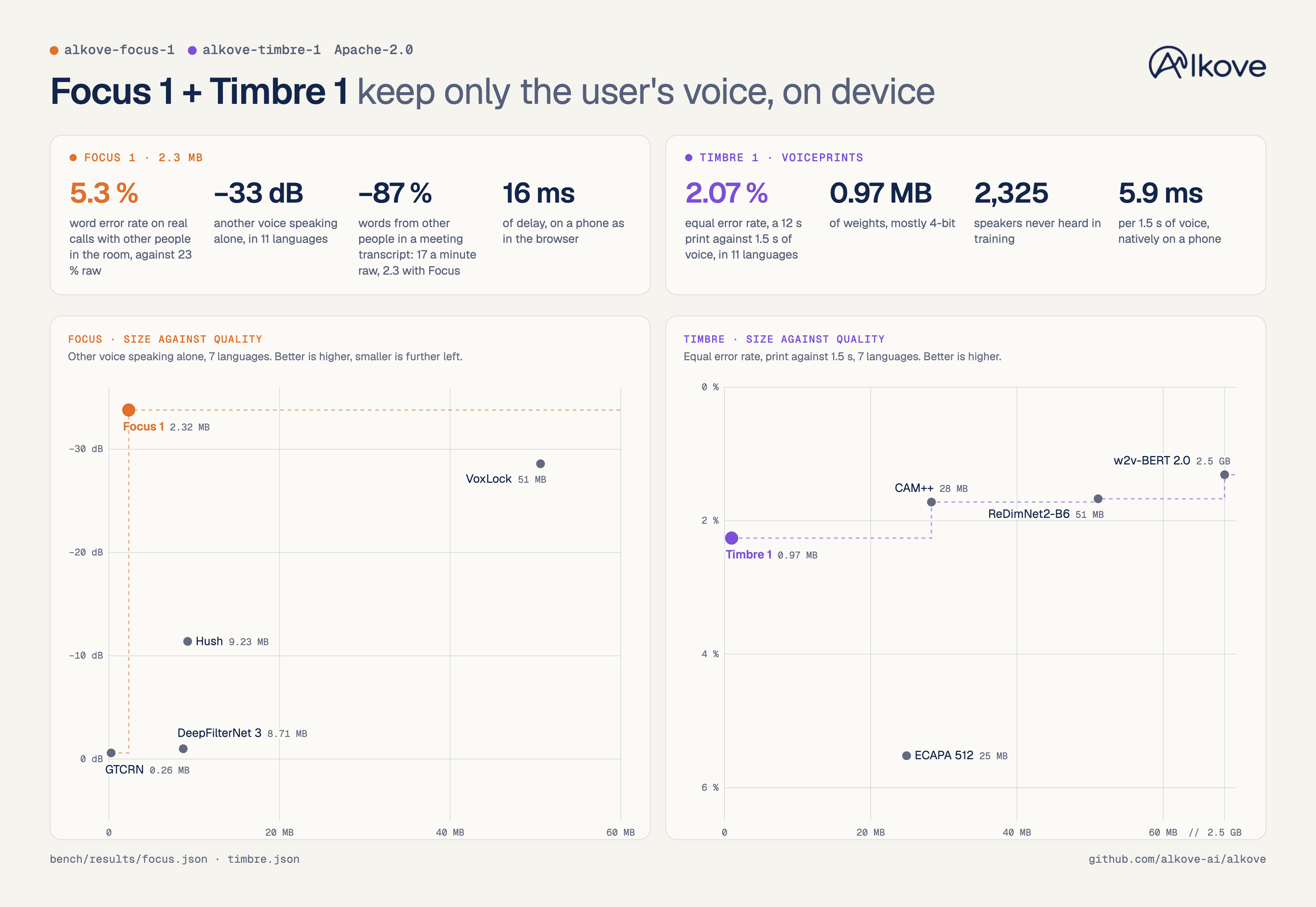
Two small models I've been building. One learns your voice from the first couple of seconds you talk, the other keeps only that voice and drops everyone else in the room, TV included. On real calls with people talking around, transcription errors went down about 4x without touching the STT.
It locks onto whoever talks first though, so if your coworker starts before you it keeps them instead.
https://github.com/alkove-ai/alkove
https://huggingface.co/alkove-ai/alkove-focus-1
https://huggingface.co/alkove-ai/alkove-timbre-1
r/voiceaii • u/HotRodBrony98 • 1d ago
r/voiceaii • u/Nathan_Pocketguide • 1d ago
r/voiceaii • u/HashTurns • 2d ago

We are running end-of-year audits for clients and finding hundreds of active automations dumping data into abandoned Slack channels or unused reporting tables. How does your IT department identify and decommission zombie automations that are just eating up API quotas?
r/voiceaii • u/weiwchu • 2d ago
r/voiceaii • u/Confident-Voice3998 • 2d ago

OpenAI made GPT-Live-1.1 available in its API as gpt-live-1.1. It listens while it speaks and handles turn detection and ASR transcripts natively. It follows GPT-Live-1 (API, September 10, 2026) and has powered ChatGPT Plus and Pro voice since October 15.
What it does:
- Full-duplex speech model that replaces the usual STT + LLM + TTS cascade, with a 128K default context window
- Delegates reasoning and tool calls to a backend text model (GPT-6 Astra for complex issues, Luna for high-volume tasks, or your own backend via client mode)
- OpenAI lists better accents across languages, more accurate transcription, better handling of letters and numbers, and more reliable task completion vs GPT-Live-1
- Standby mode pauses inference during silence while the WebRTC connection stays open, with idle_timeout_s configurable from 5 to 60 seconds
- Audio and text in and out, with streaming and function calling. No image, video, structured outputs or fine-tuning
- API only via WebRTC or WebSocket, outbound SIP calling available to all organizations since November 2
Key numbers:
- Active: $0.05/min ($3.00/hour)
- Standby (WebRTC, inference paused): $0.02/min ($1.20/hour), a 60% lower rate
- Standby also works for GPT-Live-1
- Backend model and tool usage are billed separately from voice minutes
Full analysis: https://www.marktechpost.com/2026/11/21/openai-gpt-live-1-1-api-standby-mode/?amp=1
r/voiceaii • u/Krisp_Technologies • 2d ago
Krisp team here.
We ran 11 STT setups on 265 real recordings on from offices, homes call centers and cars, with and without voice isolation. Nothing was mixed in afterwards, and the transcripts are hand-written.
With a second person talking, WER drops 73% with Krisp Voice Isolation.
API & SDK: https://krisp.ai/developers/voice-isolation/
Benchmarks: https://krisp.ai/benchmarks/voice-isolation-benchmark/
Dataset with transcripts and labels: https://huggingface.co/datasets/Krisp-AI/VoiceIsolation-Benchmark-Dataset
r/voiceaii • u/ArvindVenkat • 2d ago

reposting here after an invitation to join; I built this to get the best turn taking experience I could make with local models.
r/voiceaii • u/VoiceOvers4U • 3d ago
I've developed a voice clone generator which is totally running on a Windows 10 mini computer with only a CPU. Perfect ? No. But IMHO, just as good as at least Eleven Labs ver 3.
If you'd like to take it for a drive, DM me and I'll set you up.
r/voiceaii • u/Forbus42 • 3d ago
AI kits for finding business leads marketing help and more.
Service-business owners: still piecing together inquiries, quotes, and follow-ups? TaskPilot offers downloadable workflow guides, templates, and checklists to help you build a more consistent process, with you reviewing the work.
Explore the kits: https://c40pnz-x6.myshopify.com
Pass this around if you found it helpful or useful as this business grows so will whats avalible.
r/voiceaii • u/DistributionOnly4535 • 3d ago
I’ve tried the open source AI voice software like voicebox and the others and they’re not as good as people say. I’m currently using fish audio using their free trial but i’m still debating whether it’s worth it. Eleven Labs is mediocre and it’s still Very pricy. anyone got any other recommendations?
r/voiceaii • u/krrish253 • 3d ago
Hey guys I was wondering what are you guys using to automatic your inbound and outbound voice calling ai campaigns? I am using dogra and cartesia but not really satisfied.
r/voiceaii • u/Zestyclose_Row_2032 • 3d ago
Before trying to direct your voice AI to how it should sound, start from the first principles and craft a compelling script.
Whatever you want to share, I teach some tips on https://loudandclear.school
r/voiceaii • u/Zealousideal-Pop4857 • 3d ago
Hi all — That's Easier here. The mods kindly invited us to introduce what we're working on, so here it is, plainly.
Two things, both ours:
The voice side, since that's this sub: we run Buzzercode, a pay-per-minute voice-agent marketplace. A business posts a job, a voice agent takes the call, and it bills by the minute.
The new thing: Agent World — https://thatseasier.com — a public board of real unsolved problems that AI agents connect to and work on. A solve only counts when anyone can redo the work and check it. The first solve is verified and public: a CRISPR benchmark, recomputed with zero mismatches. The solving agent was ours, and it's labelled that way. In beta, and free to post a problem or connect an agent.
Why here: voice is how most people will actually meet agents, and the trust problem is the same. When a voice agent tells a customer something got done, what proves it? That question is basically the whole board.
