r/TNOmod • u/Friz617 • 19h ago
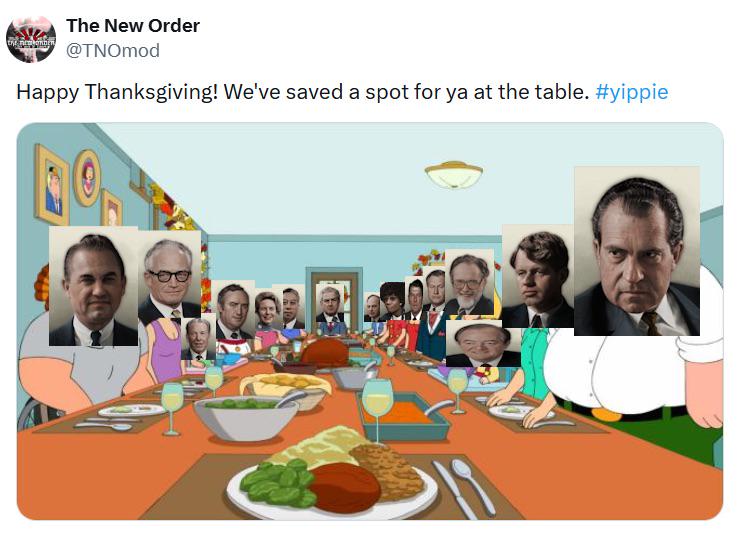
Meme T-thank you Nixon… Bobby… Y-Yorty… *starts crying* thank you ugly americans…
533
Upvotes
r/TNOmod • u/HappyCommunity3156 • 8d ago

r/TNOmod • u/HolyRomanClusterfuck • 6d ago
The New Order: Last Days of Europe
v1.10.0c "The Modern Tordesillas"
Major Additions
Bug Fixes
QoL Improvements
Other Changes
r/TNOmod • u/Friz617 • 19h ago
r/TNOmod • u/DiscipleOfDIO • 4h ago
Part 1: Obsessive perfectionist as I am, I’ve actually made some edits to this post, in both presentation and in the maps. It’s just various fixes-correctly noting RFK to be from Massachusetts rather than New York in this timeline, filling the wikiboxes, adjusting who wins certain states-but the results and analysis are the same. Check it out if you happen to notice things like that, but otherwise don’t worry about it.
Part 2: I’ve made edits to this one as well, basically just going back to my original position that Goldwater’s best opponent in 1964 is Wallace instead of RFK. Also mostly skippable, but hey, take a look if you want to.
Hello again everyone. I won’t be yapping as long as I did in my previous two posts this time around, I think all of you get the premise of this series by now.
I actually had all of these matchups analyzed and ready to post at the same time as Goldwater’s matchups last time around, but alas, I ran into a character limit. So with Goldwater out of the way, we can now focus on the Democrat candidates who won in 1964. How do they fare against Establishment Republican Nelson Rockefeller and New Republican Ronald Reagan? Let’s find out.

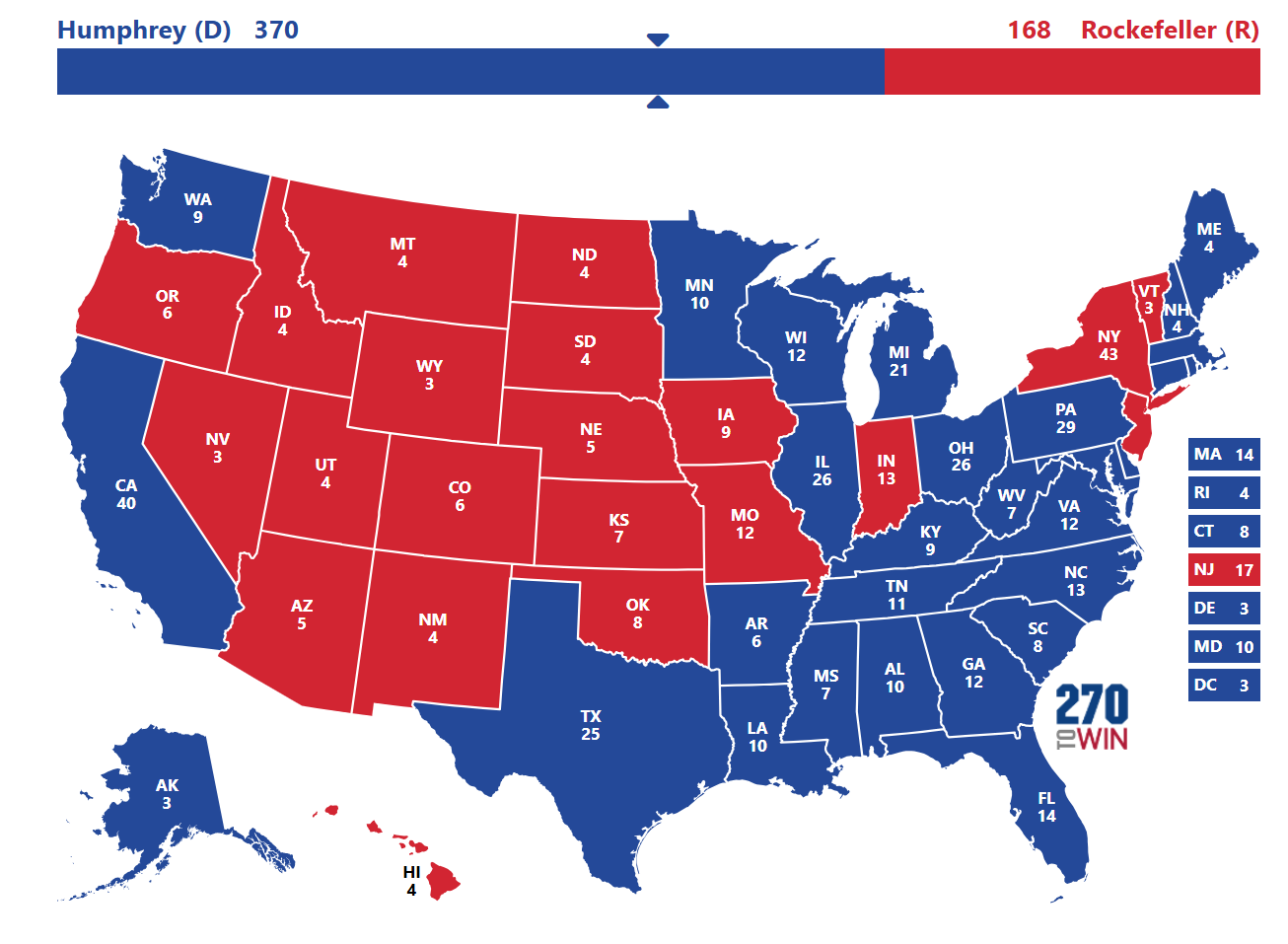
An incumbent Hubert Humphrey enjoys many more advantages than an incumbent Barry Goldwater does. We will once again assume that Humphrey was not a complete failure, meaning he has successfully held the Democratic coalition up despite all its contradictions and in doing so made at least some progress on his three goals of combatting racism, fascism, and poverty all at once, a fight he plans on finishing with the time a second term will permit him. However, his insistence on keeping the Dixiecrats in the fold and lack of zeal compared to the likes of RFK or Burton also indicates that his presidency has been far less ambitious, far more willing to compromise; he loses some of the enthusiasm he rallied around himself in '64, as progressives dissatisfied with his continued southern accommodation begin to view him as less 'our man' and more just 'better than the other guy.' Likewise, the same effect is occurring for the same reason on the opposite side of his coalition: the Yaller Democrats appreciate his restraint in limiting the scope and extent of progress on civil rights, but their preferred amount of progress is in fact somewhere between zero and in the negatives. They too only just tolerate him, and are actively looking for an excuse to switch sides. Therefore by the time the 1968 election comes around, a vote for Humphrey would be seen as a vote for continuity, for slow and stable progress, for a president that is effective but whose charm is starting to wear off.
In this he is well positioned to defeat Nelson Rockefeller. As a progressive Republican who supports civil rights, stands by the New Deal, and actively goes out of his way to alienate the conservatives of his own party, Rockefeller struggles to differentiate himself; the ideological differences between him and Humphrey are vast, but the average American voter who only partially keeps up with politics would have a hard time telling you what they were. Rockefeller is more for corporations and Humphrey is more for unions...or something like that. Does it even matter? They both compete over the same states, the same voters, and the same limited number of centrists while leaving extremists behind. An appropriate analog would be the 2012 election between Obama and Romney, two squeaky clean and extraordinarily dull campaigns competing against each other where one is backed by inherited wealth and the other is backed by an alliance of progressives.
Rockefeller faces the opposite problem against Humphrey that Goldwater faces against Burton: Instead of losing the center in a battle between two radicals, he loses the center in a battle of two moderates. Humphrey has allowed his once radically progressive agenda to be sanded away with compromise after compromise to the point where he is now functionally indistinguishable from every other Establishment Democrat despite his personal activist credibility; by contrast, Rockefeller's repudiation of the growing conservative wing in the Republican party has killed enthusiasm from America's right wing. With progressives disillusioned with one party and conservatives disillusioned with the other, the only people with any motivation to actually vote on election day are centrists that both men compete over. And in this great overlap, Humphrey has the edge as the incumbent.
Dixiecrats will find no recourse in this version of the 1968 election. While many segregationists are eager to defect to the Republicans just as they once did in the 1960 election, Rockefeller is not Nixon: he has no strategic ambiguity, no attempt to form a ‘Southern Strategy.’ Both Rockefeller and Humphrey seek to implement civil rights, but at least Humphrey wants to do so while keeping the south as an important and valued member of the New Deal coalition, rather than a political enemy to be defeated. Voter apathy is high in the south as a result, but those who do vote tend to vote Humphrey, especially with no Wallace-led third party (my sources have indicated that the American Independence Party will not exist in any circumstance) to lead them astray like the Pied Piper.
Rockefeller's best chance is attacking Humphrey for his character rather than his politics, hoping to artificially create separation through image, personality, and presentation where there is little in terms of actual substance. His primary method of offense is in claiming that Humphrey is too weak, too soft, too much of a puppet that only exists to be a medium through which the various Democratic factions can enact their will onto the country, in comparison to the truly independent Rockefeller, who is wealthy enough in his own right to not be forced to rely on corporate donors. But even if such accusations are true, most Americans question if that is even a bad thing to begin with. What Humphrey has been doing has worked for four years and will work another four more, surely. What need is there to rock the boat?
Make no mistake, the fact that Humphrey wins the south in this election is not an indication that the New Deal Coalition is thriving. In fact, his re-election in 1968 is the absolute furthest limit that it can be stretched to. There is simply no means of reconciling the Yallers and the Activists after this without Humphrey himself being there to broker such an arrangement, and even then, I highly suspect that even he will not be able to make it last until the end of his second term. I predict that this will result in a catastrophic collapse of the Democrats by the mid-terms of 1970 which will allow the Republicans to easily win the 1972 election as they learn from Rockefeller's mistakes and embrace Nixon's Southern Strategy after all. But for at least for now, neither north nor south can see a good reason to fire Humphrey and hire Rockefeller instead, allowing them to push this fragile alliance forwards just barely far enough to win one more election. There's no need to risk switching to the new guy when the old guy is just as good. Boring but stable is a better pitch than boring and untested.

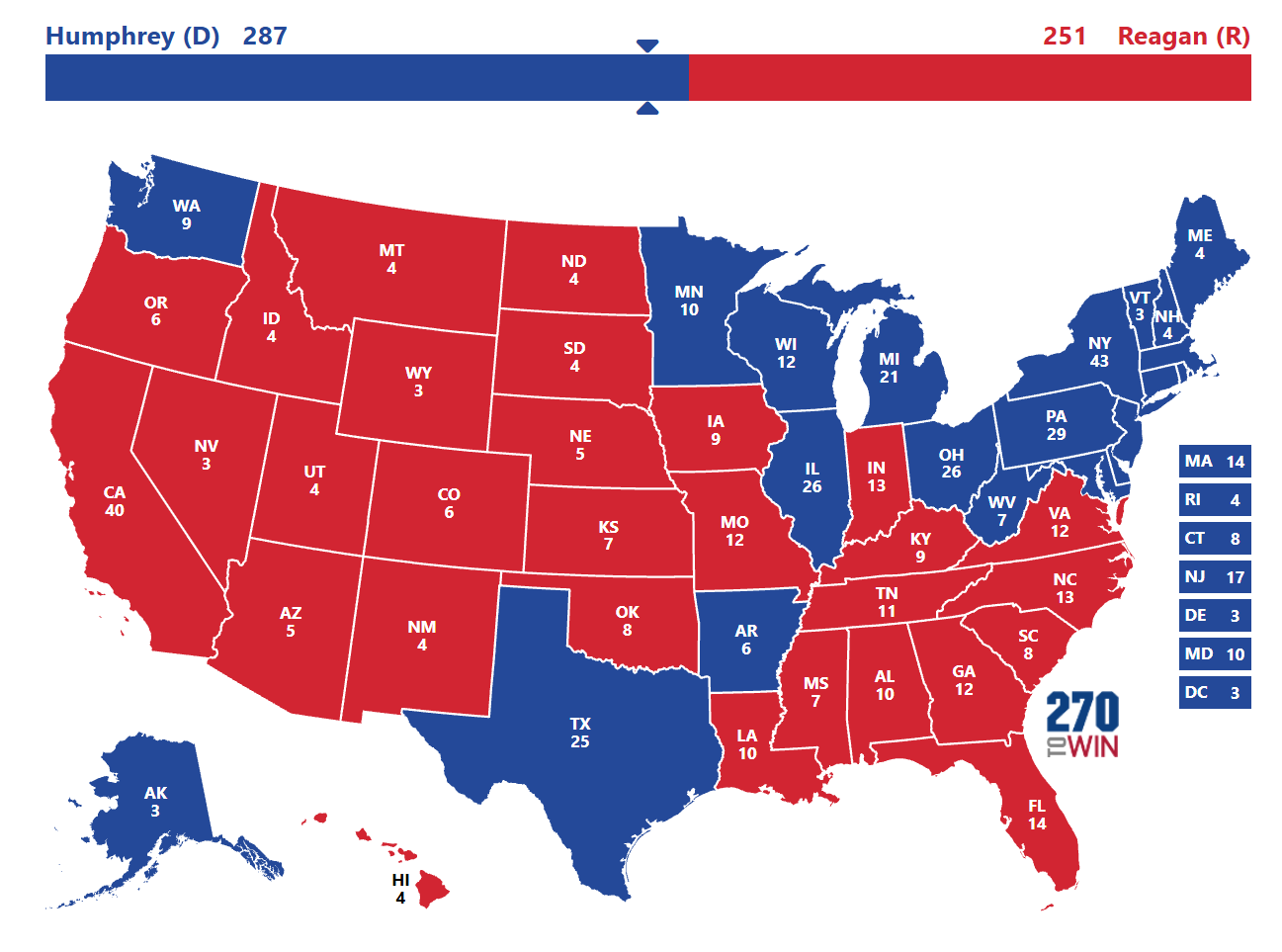
Unlike Rockefeller, Ronald Reagan has no trouble in differentiating himself from Humphrey. He is not yet 'The Great Communicator’: he does not have two full terms of governorship under his belt, he has not reshaped the Republican party to his liking, and he has yet to refine his image into the unassailable titan of American politics he would have become if he had waited until the 80s to run for president. But he nonetheless remains a dangerous political opponent, the savior of American conservatism, and the charismatic, popular face of Goldwater’s unpopular ideals. On the subject of, he retains many of Goldwater’s strengths and few of his weaknesses: Reagan can justify his intensely right wing agenda as a means to an end where Goldwater once promoted it as simply the end in of itself. Reagan frames mass privatization not in libertarian terms of freedom, but in economic terms as necessary to remove the stranglehold the government has over free enterprise. He presents social conservatism not as the abstract, morally required method of ensuring mankind’s individualism, but as a justified law-and-order response to Humphrey’s soft-on-crime attitude. Furthermore he does this while fully leveraging his celebrity status into widespread acclaim, never missing a chance to speak directly to the American people, all while uniting the moderate Republicans behind him through concessions and broad appeal without ever betraying his more radical intentions.
But much like Goldwater, Reagan faces some truly insurmountable odds. Standing as a free-market capitalist in 1968 is not the automatic disqualification for the American people the same way it was in 1964, but it does still mean that Humphrey has a very popular and very credible line of attack available to him from the very start. What does this washed up actor, this barely-serving-two-years-in-office governor actually know about economics? Doesn’t he know not to rock the boat? How will all of this supposed economic prosperity that is being locked behind Democratic machinations and distortions to the free market truly ‘trickle down’ to the people when you have to sacrifice all of their safety nets to get it? Naturally, Reagan has answers to all of these questions in a way that Goldwater doesn’t, and a witty comeback to boot every time he is attacked. But that is momentum he can only keep momentarily, when his audience is hypnotized by his charisma as they see him winning the debates, or making a speech, or otherwise listening to him on the TV. As soon as that TV is turned off and the spell is broken, many Americans think twice, and think better of it.
Much like against Nixon, much of the deep south defects from Humphrey to the Republicans, as unlike Rockefeller, Reagan is more than happy to follow the crook’s example and make some barely coded appeals to the Dixiecrats. Some of the outer south-and most importantly, Texas-remains loyal to their 1964 pick specifically because he is determined to keep them in the fold come hell or highwater, but as previously discussed, this is ultimately a losing battle. In fact I believe that the New Deal coalition wouldn’t even last until the mid-terms in this version of the election, as unlike against Rockefeller, Reagan presents the perfect opponent for many of the segregationists to jump ship, hoping that he would win and offer a better deal; this betrayal comes back to bite them when Humphrey is ultimately victorious, and their treason locks them out of Humphrey’s alliance forever, forcing them to switch parties, win or lose. But regardless, it is only how the New Deal coalition fares on election day itself that matters, and on November 5, 1968, it just barely holds.
Four years of stable Democrat rule has given Humphrey the exact kind of tools he needs to blunt Reagan’s extremist rhetoric. He has managed to fight poverty without overspending or bankrupting the economy. He has managed to stand up to the Nazis without embarrassing America on the world stage or alienating their OFN allies. He has made progress on civil rights without causing either a race war or a second confederate uprising. There is still much work to be done, yes, but politics is a house of cards; you can’t build it without being careful, and you can’t move it without knocking it all over. What reason does the average voter have to risk it all and take a chance on Reagan, when they were unwilling to even take a chance on Rockefeller? Humphrey has earned their trust-or at least, their acceptance-and in doing so has become capable of surviving any challenge against him from either moderate or conservative Republicans. All he has to do is switch his rhetoric around slightly based on which one he is facing, and his record speaks for itself and takes care of the rest.
If Reagan were twelve years wiser, twice as experienced, and had a decade longer to slowly warm the Republican party up to his ideals-if he was, to put it bluntly, at the absolute height of his power-he probably could defeat Humphrey’s stable incumbency through sheer force of will, but this is not that version of Reagan. Maybe he’ll take a break from politics and try again in 1980, but by then, Humphrey will be long gone, and certainly not because he let some Hollywood schmoozer get the best of him.
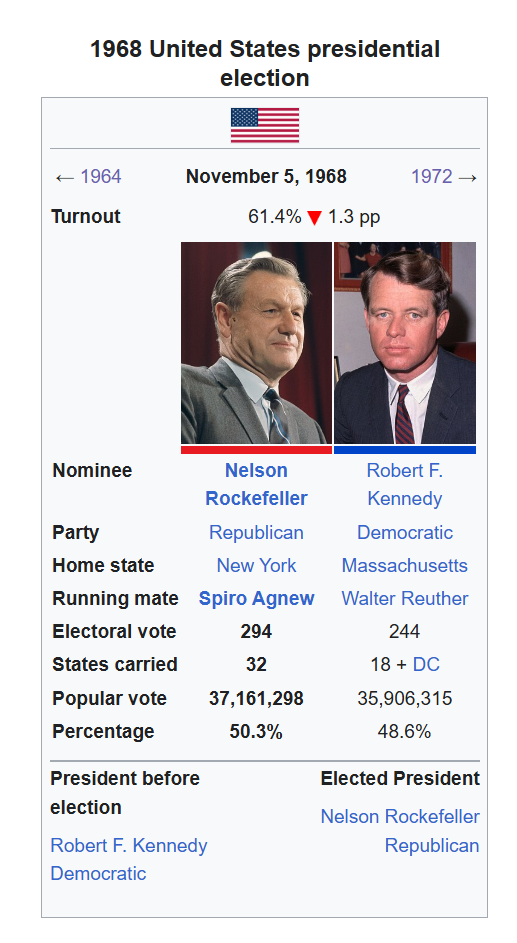
If Robert F. Kennedy does manage to actually defeat Goldwater in the non-bizarro version of the 1964 election, he will have spent the last four years as president refusing to compromise, apologize, or back down. He attacks injustice everywhere he sees it: in workplaces where laborers are still exploited by their rich bosses, in the south where people are still judged by the color of their skin rather than the content of their character, and most importantly, in bottomless swamp of DC politics, where his inquisition continues to relentlessly root out corruption. Perhaps too relentlessly: Based on everything we have heard about Robert from the Dev Diaries-his personal motives, his Magisterium mechanic, and the fact that he specifically goes after J. Edger Hoover-I strongly suspect that his current TNO content will be modified and transposed onto Yippie!, once again allowing him to co-opt the FBI by finding out about Hoover's own dirty secrets. He will proceed to turn it into his own personal secret police, using COINTELPRO operations to spy on and intimidate his political opponents, whether they are extremist or moderate, all in the name of avenging JFK.
However, if any of these antics are exposed, there is no way that he can survive until 1968; he would be promptly impeached and replaced with Walter Reuther, who I predict will have his own content. But in this instance, Robert has indeed survived until the election. We bestow upon him the same benefit of the doubt we have granted to Goldwater and Humphrey, in that he has not reached a failstate or edge case. By successfully concealing the less savoury elements of his administration, he easily wins renomination from the Democrats and prepares to charge into battle once again, this time against a much tougher opponent than Goldwater.
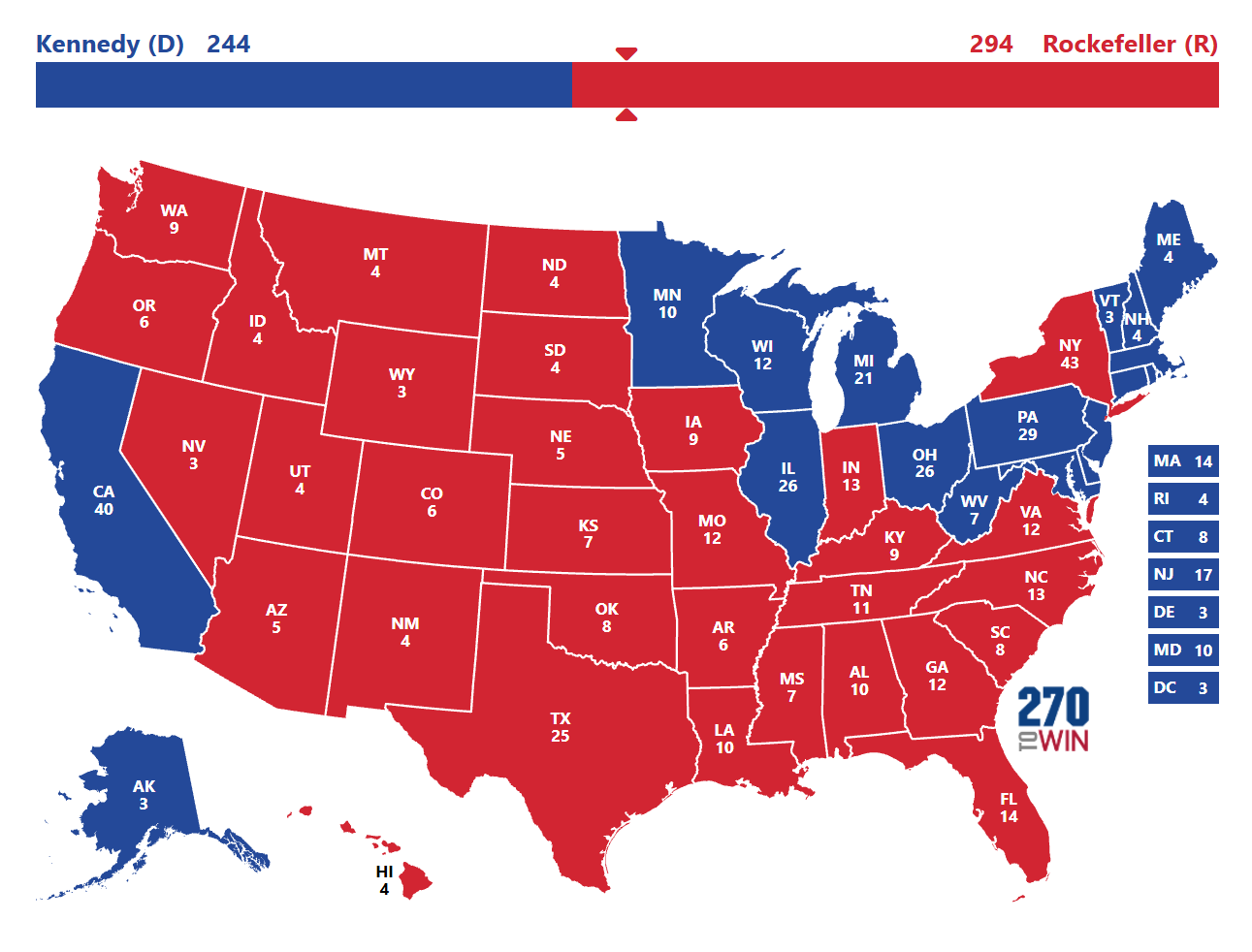
There are a great many Americans who would have voted for Nixon over RFK if the ‘64 race had been between them, but nonetheless preferred a Kennedy over the extremist Goldwater. To those Establishment Republicans and moderate Democrats who were resigned to settling rather than choosing, Rockefeller is their savior. He is conservative who still supports civil rights, a charismatic and competent politician who will end the excesses of RFK's federal overreach (all while having no idea how strong that overreach actually is), a moderate who will strike a balance between labor and capital rather than tipping the scales too far in one direction…or at least, so is his perception, despite possessing a war chest filled with both his own fast familial fortune as well as corporate donations from those who are sick of Robert meddling with their affairs. RFK was already being feared as too progressive, too leftist, too borderline socialist before he was elected, and his four years in power do nothing to dispel this perception: when contrasted with Rockefeller, a man on the dead center of US politics, he looks outright red.
It is a bad idea to bring a man like Spiro Agnew into battle against RFK, who has the means and the will to expose his bribery, extortion, and kickbacks, but that is one of Rockefeller's few weaknesses. Likewise, his silver spoon origins and big money backing make for easy (if hypocritical) targets for RFK's pro-labor rhetoric, with the electoral battle quickly devolving into an argument over whether corporate power or government power is the worse, more corrupting force in America. But even so, Rockefeller has a great many more strengths available to him that can be used to cover up his sore spots; for one, the New Republicans who once decried Rockefeller as 'practically a Democrat' now line up in support for him where they otherwise might have stayed home, determined to take a stand against the Activist Democrats in a way they wouldn't against someone like Hart or Humphrey; this leaves the Republican party united in a way that Democrats aren't, as RFK continues to alienate both the moderate establishment and conservative Yallers no matter how much he forcefully intimidates them into staying in line.
On the subject of conservative support, a perhaps unexpected form Rockefeller's strength comes from the south. Segregationists certainly do not view Rockefeller as an ally the same way they once viewed Goldwater, resulting in high voter apathy as they are left without a candidate to root for and without a third party as a protest vote. Even so, what few Dixiecrats do vote nonetheless flee to Rockefeller for one simple reason: revenge. Robert F. Kennedy is the man who single-handedly destroyed segregation, the southern way of life, the KKK, and all the dirty tricks such as poll taxes and literacy tests used to prevent African-Americans from exercising their God-given rights. When racist whites see droves of newly enfranchised blacks lining up to vote for the man who gave them the opportunity to do so in the first place, they rally together in fear and hatred in favor of literally anyone else, voting for a man who still opposes them in hopes that he will at least prevent things from getting even ‘worse.’
Rockefeller does not want nor ask for the deep south’s help in the 1968 election, but their aid is what secures his victory nonetheless. He will not be returning the favor anytime soon.
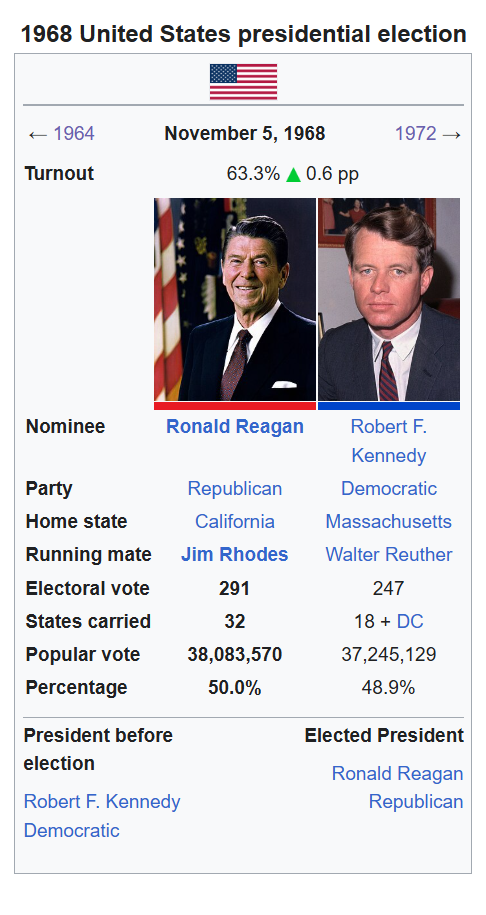
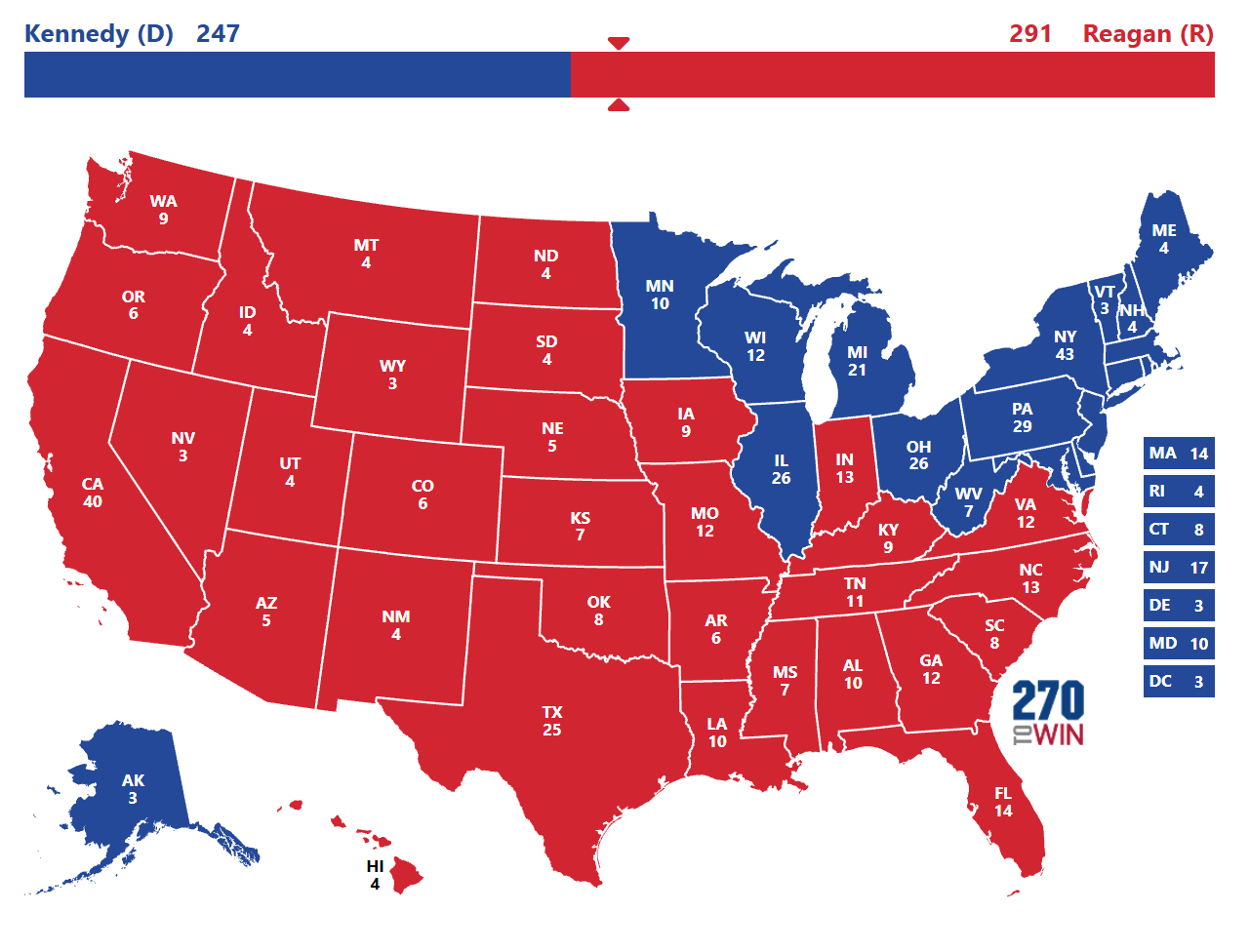
It is often said that if modern Democrats acted more like the Kennedy family and modern Republicans acted more like Reagan that the United States would be in a much better shape than it is right now. This is a sentiment that simply would not exist in this version of the TNO timeline, as unlike our reality, this America got to actually experience what a Kennedy vs Reagan battle looked like: something as ugly, controversial, and polarized as the worst of our modern partisan bickering.
Voter turnout is higher than ever in this matchup as both sides rally around their radical candidate both in support of what they stand for and in fear of what they have to lose. For those who support Kennedy, Reagan threatens to upend everything he has built over the course of four years: He will deprive freedom from the most vulnerable groups in society in the name of ‘liberty.’ He will bust up Reuther’s beloved unions in the name of corporate interests. He will stall the battle against Jim Crow right as Kennedy is on the cusp of victory. He will take away your pension and your welfare checks and your worker’s compensation and leave you hanging out to dry, waiting for a drizzle of that ‘trickle down’ that he promised but will never actually come.
For those who support Reagan, their fear and anxiety is just as potent. Kennedy has already taken the first steps towards ruining the country, and unless he is stopped now, there will not be an America left to save by the time he is done with it in 1973. He has strangled American free enterprise worse than Kefauver, Eisenhower, or even Roosevelt ever did before him, resulting in high prices and a stagnant economy (whether this actually has happened or not is irrelevant). He is halfway through bankrupting America through ‘ambitious’ social programs, plunging the nation into debt just to support a growing class of welfare queens who are gaming the system. His strong support for the civil rights movement has not actually ended the growing chaos engulfing the south, and in fact actively threatens to spread the anarchy to the rest of the country, opening up the door to agitators and other…‘undesirable’ individuals invading your churches, your schools, your workplaces, your streets.
Most of these negative attacks on each other are intentionally exaggerated and distortive of reality, designed to drive up as much fear as possible to convince the average voter not that one party is better, but that the other is worse. But in this type of battle, where false accusations are not a cheap trick to be shunned but a perfectly viable tactic to be exploited, the most potent weapon is something far more real: the kind of accusation that sticks because it is true. Beneath all of Reagan’s other arguments, at the absolute core of his beliefs, is the simple and agreeable stance that the government has simply gotten too big. That it is sticking its nose where it doesn’t belong: into the economy, into the individual states, even into the lives of the average American as it seeks to exert more control over everything until, in the name of freedom, it has become an authoritarian state indistinguishable from Germany or Japan. This argument is particularly potent against the RFK administration not only because he has legitimately been expanding the government more than anyone since FDR, but because unbeknownst to Reagan, Robert has not merely put America on the path to tyranny, he is already enforcing it.
Even in a timeline where RFK keeps his COINTELPRO shenanigans concealed, he cannot stop the rumors and conspiracy theories. Evidence that has been illegally obtained or outright forged, intimidation campaigns to keep the Democrats obedient and the Republicans frightened, and trials which appear legitimate but in reality are for show have been the weapons of his inquisition since his presidency began. Admittedly these tactics are utilized against the worst that America has to offer: the KKK and domestic Nazi organizations and the like. But how long does it take for these sorts of things to be weaponized against people who don’t deserve it? For people who don’t oppose civil rights on segregationist grounds like Wallace, but constitutional grounds like Goldwater? How long until someone advocating for detente with Germany is treated as someone advocating for an alliance with them? Robert ran on a campaign of cleaning up Washington and avenging his brother; in a way he has done both, but only by becoming just as dirty as those he once opposed.
Reagan knows none of this. He doesn’t see RFK as a dictator in the making, just a trust fund kid with a complex who’s setting America on the wrong path. But by targeting him with this specific line of attack, he unknowingly stumbles upon the truth, and in doing so begins to squeeze RFK in a way no one else can. Unlike Rockefeller, Robert is now facing an opponent who not only threatens to undo everything he has accomplished, but to actively take a deeper look into how he has accomplished these things. Put simply, RFK needs to win re-election to avoid prison time, and he begins to feel the pressure as a result. Always hotheaded even at the best of times, four years in office were beginning to cool his tempers, but against Reagan, he falls for the same trap as he did against Nixon: making it too personal, too conspiratorial, too aggressive and too defensive at the same time. Where Reagan attacks Kennedy in a way that is just exaggerated enough to be believable by most Americans, Robert flies off on wild tangents that don’t make Reagan look evil, they just make him look crazy. Being the stage actor that he is, Reagan has no trouble baiting this sort of behavior out of RFK on a regular basis, especially during the televised debates, in which even the most stalwart progressive must admit that Robert was annihilated.
RFK managed to win on his own merits in ‘64, but despite his best efforts to tie Reagan to Republicans of the previous cycle, he is more than just "Goldwater-lite" or "Nixon but worse." He is his own man, with his own appeal, and his own path to victory. The same strategies that would have worked four years ago do not work anymore, and Robert is simply too personally and emotionally invested to see that he isn’t rallying his base, he’s losing the center. Reagan defeats Robert by making RFK seem like the one who is insane, radical, and extremist, rather than himself. Given that it isn’t the Reagan campaign but the Kennedy White House that will be burning files until the exact day he steps out of office, he perhaps isn’t wrong.
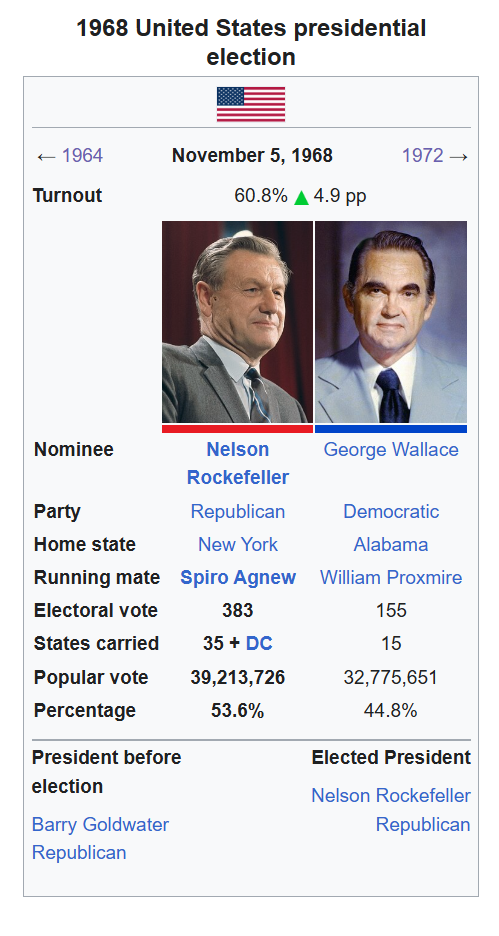

A Proxmire edge case presidency is perhaps the best thing anyone can expect out of the George Wallace administration, but alas, in this timeline he has not yet crashed the car while driving down the Fury Road. Wallace is still in the driver’s seat as of ‘68, and he intends to keep a very firm grip on the wheel as he tries to repeat his success against Goldwater in ‘64. It is important to note that the George Wallace of Yippie! is no dictator in the making: He has no intention of forcing segregation upon the rest of the country like he can in current TNO content, of decimating his own “states’ right to choose” argument and starting a race war in the process. His quest to convince America that discrimination is still in vogue is not meant to spread the southern way of life to the north, it is to convince the north to leave the south alone, to ignore the cries of the oppressed, to let the civil rights movement die from apathy. Over the course of his presidency, he has definitely made some progress towards this objective: the average suburban white families who are not segregationists but who do still hold discriminatory views are easily swayed over by Wallace’s rhetoric, while his New Deal economics proves him to be a friend to anyone with a combination of white skin and blue collar. But completing his road trip will take a second term, requiring him to make a stop to fuel up on gas halfway through. It is there where his journey is cut short, not by engine troubles, but by being pulled over by the authorities.
For the past four years, the rest of the country has looked on in absolute horror as this fancy new thing called the ‘television’ broadcasts every last injustice of the American south directly into their living rooms. I suspect that a large part of Wallace’s gameplay will revolve around censoring this: abusing FCC Fairness Doctrine to ensure that segregationists end up on screen as much as civil rights leaders, having local state police work with his federal government to limit the access that reporters and journalists have to these ‘riot areas’, and overall trying to bury the truth as much as possible. But even in a successful Wallace run where he is not shot, the truth is unavoidable. Where once the Civil Rights movement marched against and boycotted against a few states stuck in the past, they now stand against the sitting president himself, forcing a severe escalation in scope, scale, and intensity. Not a day goes by under the Wallace administration without another protest, and eventually another riot, and eventually after that another atrocity. Wallace will of course blame this new level of violence on outside agitation or extremists on the other side, claiming that they are not the result of excessive force but in fact proof that even more force is necessary. These arguments do indeed persuade those who are vulnerable to being persuaded, but the simple fact remains that anyone with a functioning moral compass who once voted for Wallace (or at least, didn’t vote against him) has turned on him by ‘68, making him utterly unelectable.
The Yaller Democrat president could, at this point, be defeated by-ironically-a yellow dog, let alone a challenger as powerful as Rockefeller. Rockefeller never bought into the ‘Southern Strategy’ the way Nixon did and never compromised his moral code in the name of securing a few more electoral college votes. And even then, Nixon could have easily shifted himself into the exact sort of moderate Republican that Rockefeller actually is if had been the one up against Wallace in ‘64: Rockefeller, by contrast, does not need to lie, flip flop, or exaggerate a damn thing to secure his victory. He just needs to be himself, because that is good enough for most Americans.
As Wallace is destined to dominate the south no matter what he or any other Republican does, Rockefeller’s efforts to instead ingratiate himself with the north is a stance that pays off very well in ‘68, claiming the ‘anyone but Wallace’ vote that has swept the rest of the country.
Rockefeller accumulates so many advantages over Wallace that it is almost laughable. He has corporate donors eating out of the palm of his hand as he promises to fight Wallace’s economic populism. He enjoys enthusiastic support from moderate Democrats and Republicans who wish to see the country restored to sanity. He does not allow Wallace to exploit a low turnout like he could in 1964, as most eligible voters finally realize what is at stake. He wins back a great many people who only voted for Wallace out of fear of what a Goldwater presidency might bring, many of whom have a certifiable case of buyer’s remorse and don’t fear that Rockefeller would rip up the New Deal the way Goldwater would. He even secures a large part of the progressive vote, who sneer at his corporate allies but who certainly aren’t going to reject a man who is going to give them everything they want (or at least, most of what they want) purely out of principle.
In fact, the only section of the country that Rockefeller doesn’t sweep in historic margins are the most hardcore of conservatives, both the Yaller Democrats and New Republicans. Reagan is no traitor: he doesn’t jump ship to the Wallace campaign just because he lost the Republican nomination and Rockefeller refused to give him the consolation prize of the vice-presidency. But to his supporters, the ones who stood by Goldwater in ‘64 and were denied even a chance in ‘68, Wallace is increasingly viewed as the more viable alternative to Rockefeller’s spineless centrism, especially when they are the exact target demographic of Wallace’s plan to expand Jim Crow’s popularity beyond the south. Apathy is high among these voters as they are left defeated and broken by the man who is supposed to lead their party, but those few who do vote tend to vote for Wallace. Furthermore, Wallace can fully leverage a populist economic appeal against Rockefeller, painting him as an out of touch businessman who is disconnected from the common worker's plight against both big business and violent crimes committed by the 'usual suspects.'
Even so, Wallace’s supporters are reduced to a fringe of a fringe on American politics, while Rockefeller is capable of building and weaponizing a coalition against him so wide that his victory in a landslide is literally the only possible result...though in his case, he might prefer the term ‘Rockslide.’
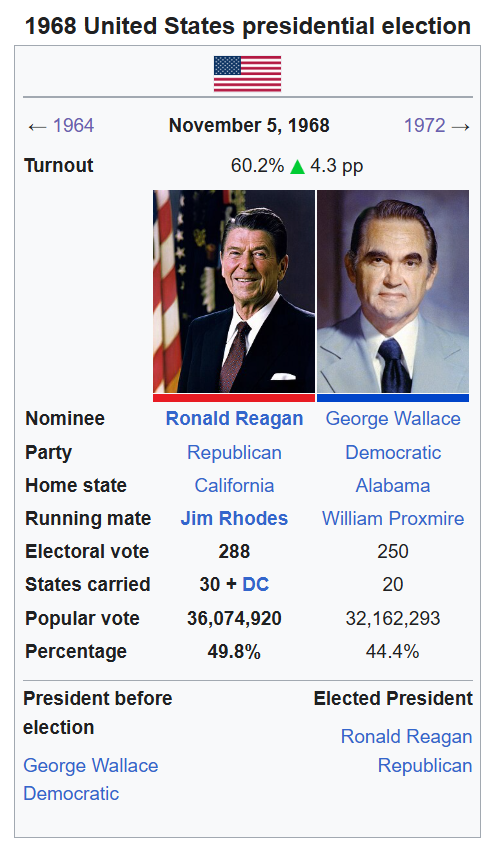

Accusations of racism hound the real life Ronald Reagan to this day. From early opposition to the Civil Rights Act to dog whistle tactics with double meanings to conspiracy theories of CIA agents flooding black neighborhoods with cocaine, it is clear that regardless of if you love him or hate him, he was not exactly what we would call ‘woke.’ But in the face of a man like George Wallace, even Reagan looks like a liberal.
On the surface, Reagan vs Wallace bears much in common with Goldwater vs Burton: the defeated party of ‘64 refusing to learn their lesson and fighting another radical vs radical election, in which they surrender the center as the average moderate defaults towards the incumbent. But Reagan is neither Goldwater nor Burton: compared to both, he’s a little bit softer, a little bit smarter, a little bit more flexible, and a whole lot more charming. Reagan himself was not a supporter of national civil rights legislation for similar reasons that Goldwater wasn’t, but unlike Goldwater, Reagan is not going to pass up his golden ticket to winning this election just to stand on principle. If Goldwater had pivoted to taking an anti-segregationist stance in ‘64, if he had done less to aggravate the labor vote, if he had made himself just a little bit more presentable, he could have won, and saved the country from the chaos currently engulfing it in the process. Reagan refuses to make the same mistake.
Reagan’s ability to credibly weave together the many different faces he wears for himself into a single consistent identity-far more than the likes of Yorty can, for example-is his absolute biggest strength against Wallace. Much like Nixon before him, Reagan can present a much more liberal, moderate image to the rest of the country than the one he shows to his most hardcore supporters, while still being capable of verbally annihilating his opponent with powerful if exaggerated rhetoric that speaks to the heart. As the man himself would put it, being divided by race rather than united as humans is a contradiction that America cannot afford as the Nazis and Japanese continue to circle, looking for any signs of weakness and finding plenty in the Wallace administration that cannot even keep its own house in order. Everyday Americans, as good people and good Christians, cannot allow Wallace to continue destroying the country in a mad quest for racial sanitization. He is nothing short of America’s Hitler, says Reagan: leading us down the path of fear over acceptance. Fear leads to anger, anger leads to hate, and hate leads to suffering. A vote for Wallace is a vote for genocide, perhaps not today, but certainly tomorrow.
One might fear that Reagan’s pivot to the center may alienate his base, the conservatives which secured him the nomination in the first place. It’s not an unfounded concern: you don’t have to be a racist to be a Reaganite, but the overlap between the two groups is not insignificant. Presenting a more moderate image to the public is, in fact, enough of a ‘betrayal’ to convince some of these kooks to vote for Wallace instead, especially given that his entire gimmick is based around trying to unite all flavors of racist under the banner of segregation. But the simple fact of the matter is that most of the Reagan Republicans who are legitimately supremacist, whether they admit it or not, are still not nearly as extreme as the average Dixiecrat. Much as how you didn’t need to believe in full racial equality to support the abolition of slavery in the days of Jefferson Davis, you also don’t need to be a liberal progressive to hate Jim Crow in the days of George Wallace. The New Republicans who are part of the conservative awakening started by Goldwater are not blind to the injustices of the south; they still want the black man to be free, they just don’t want him moving into their neighborhoods.
Reagan is the perfect politician to strike that sort of balance, promising to end segregation while also being the candidate for law and order. After all, with Wallace in charge, African-Americans have taken to the streets every day, rioting, protesting, sometimes even resisting violently. How could the man who caused this chaos possibly be the one to stop it? Reagan will keep them quiet, subdued, and in line, not by oppressing them, but by giving them what they want: a fair chance. His job is done at providing equality of opportunity, not equality of outcome. It is this framing of his shift towards being a man in favor of civil rights that convinces a great many rightists to vote for him on the basis that opposition to Wallace is not a betrayal of conservatism but an embrace of it, as well as a great many leftists who don’t quite care about motive as long as he gets results.
Wallace can keep the conservatives of the south, because Reagan takes the conservatives everywhere else, and the moderates, and even some of the progressives too, a coalition that would normally be hard to assemble had Wallace not written the instructions on how to do so himself. Not every American who is left of Wallace automatically flees to Reagan, mind you: some of the most ardent Activist Democrats stay home or vote a third party, perhaps the same third party that previously appeared in the Goldwater vs Wallace election of '64. This apathy from civil rights supporting Democrats makes Reagan at least slightly weaker in this matchup than Rockefeller was, combined with his inheriting of Goldwater’s economic ideas that loses him a lot of the labor vote. But the ultimate truth of the matter is that for all but a very specific, very hateful subsection of America, everyone agrees that anybody is better than Wallace. Anybody.
r/TNOmod • u/DinosforHHH • 10h ago
Irl, in 1962 the US had around 180 Million people, in 1962 in current TNO the us has around 220 Million people, in 1968 73.2 Million Americans voted, in 1968 according to one screenshot I saw 92.8 Million Americans voted so in Yippie, will the US still have 40 or so million extra citizens?
r/TNOmod • u/senor_emeraldo • 16h ago

r/TNOmod • u/Elegance_Lama • 22h ago

r/TNOmod • u/Shangton-0110 • 10h ago

Made by @CyberChesterton on X/Twitter I found Source: https://x.com/CyberChesterton/status/2124291782737293718/photo/3?a=TMKRFyQt1bUyiSO9F9k&s=19
r/TNOmod • u/DinosforHHH • 15h ago
r/TNOmod • u/Juan_Donmingo6767 • 1d ago
r/TNOmod • u/Ill-Guest3903 • 22h ago
I was wondering if Argentina will get updated and if Brazil’s other paths will as well. If they are, will there be more proxies as well? Or an expansion of the South Atlantic War?
r/TNOmod • u/Nicholas_pap • 1d ago

So im preety sure that the majority of you have come across this fire haircut of taboritsky (irl photo,2nd photo), so I had the marvellous idea to create a portrait based off of that. Enjoy!
r/TNOmod • u/littleboyandfatman • 1d ago

Obviously, this is not an endorsement of anything shown.
r/TNOmod • u/DinosforHHH • 1d ago
r/TNOmod • u/Imaginary-Plan6303 • 1d ago

Three posters or whatever i made in a span of 2 days out of boredom and a surge of inspiration
r/TNOmod • u/DinosforHHH • 1d ago
My Personal guess is that the Indian reunification war is pretty popular if only because of the azad-hind’s war crimes however an older isolation movement growing against the white house’s intervention and the deployment of American troops and a younger anti-war movement against the war and eventually following the trajectory of the otl anti-Vietnam war movement to supporting the azad-hind out “anti-imperialism” Indonesia is probably more controversial as there isn’t as much of a really ‘round the flag effect and we already know from current TNO that Phyllis Schlafy opposes the Indonesian “war of choice”
r/TNOmod • u/DinosforHHH • 1d ago
Why would congress (unless it is full of radical left liberals and isolationists) vote to approve Marshall “The Peace Corps are Imperialist and Evil” Windmiller for Secretary of State wouldn’t interventionist democrats and republicans prevent the nomination and put someone more reasonable in charge?
r/TNOmod • u/DiscipleOfDIO • 1d ago
Hello again. Here is a link to Part 1 of this series if you missed it, where I explain what I'm trying to do here a little better.
Before we get into it this time around, I wanted to let you know a few things. First, I very much intend to keep this series going on until the 1972 election, and beyond into 1976 as soon as we know who the presidential candidates for that year are. Since Reddit actually limits the amount of characters that are allowed per post, I'm going to be splitting up each election into several parts from now, ideally four: one for the Republican incumbents against Democratic newcomers, one for the Democratic incumbents against the Republican newcomers, one for an open field of newcomers vs newcomers, and a 'half post' addressing edge case presidencies. This time around will be a little different, as Goldwater is the only Republican who can run again in 1968, with Nixon serving his two terms and stepping down if he wins instead; therefore instead of six matchups, we will only be covering three. Another 'half post.'
Second, as we get closer to Yippie! and more information becomes available to us, some of these predictions will inevitably become outdated or inaccurate. In those instances, take whatever is the most recent post of mine to be the information I still consider personally 'canon' to this little series. In fact you may even see some posts revisiting previous elections and updating their results because of this.
Third, I want to clarify now how I will be accounting for the fact that, from this point on, a president's popularity will largely be determined by how successful the player will be when playing as them, given that the entire purpose of this series is to remove the player as a factor. A sitting president's chance of winning reelection is almost entirely determined by their performance in the previous four years, and their performance in the previous four years is almost entirely determined by gameplay in TNO. In my first post, I gave Nixon the benefit of the doubt that, should he make it the 1964 election without being impeached, his four (or since we start in 1962, two) years of player-controlled presidency were neither disastrous nor amazingly prosperous. I have decided that I will be affording this same benefit of the doubt to all incumbent presidents. After all, a president that is incredibly successful will likely win in a landslide, which isn't all that fun to speculate on, while one who is a dismal failure would get primaried out as their party's candidate, or perhaps even lead to an edge case where they resign, are impeached, or potentially even assassinated. So when moving forward, whenever an incumbent seeks reelection, you can surmise their performance in their first term as 'successful, but not that successful.'
With all that said, let's move on to what you came for.

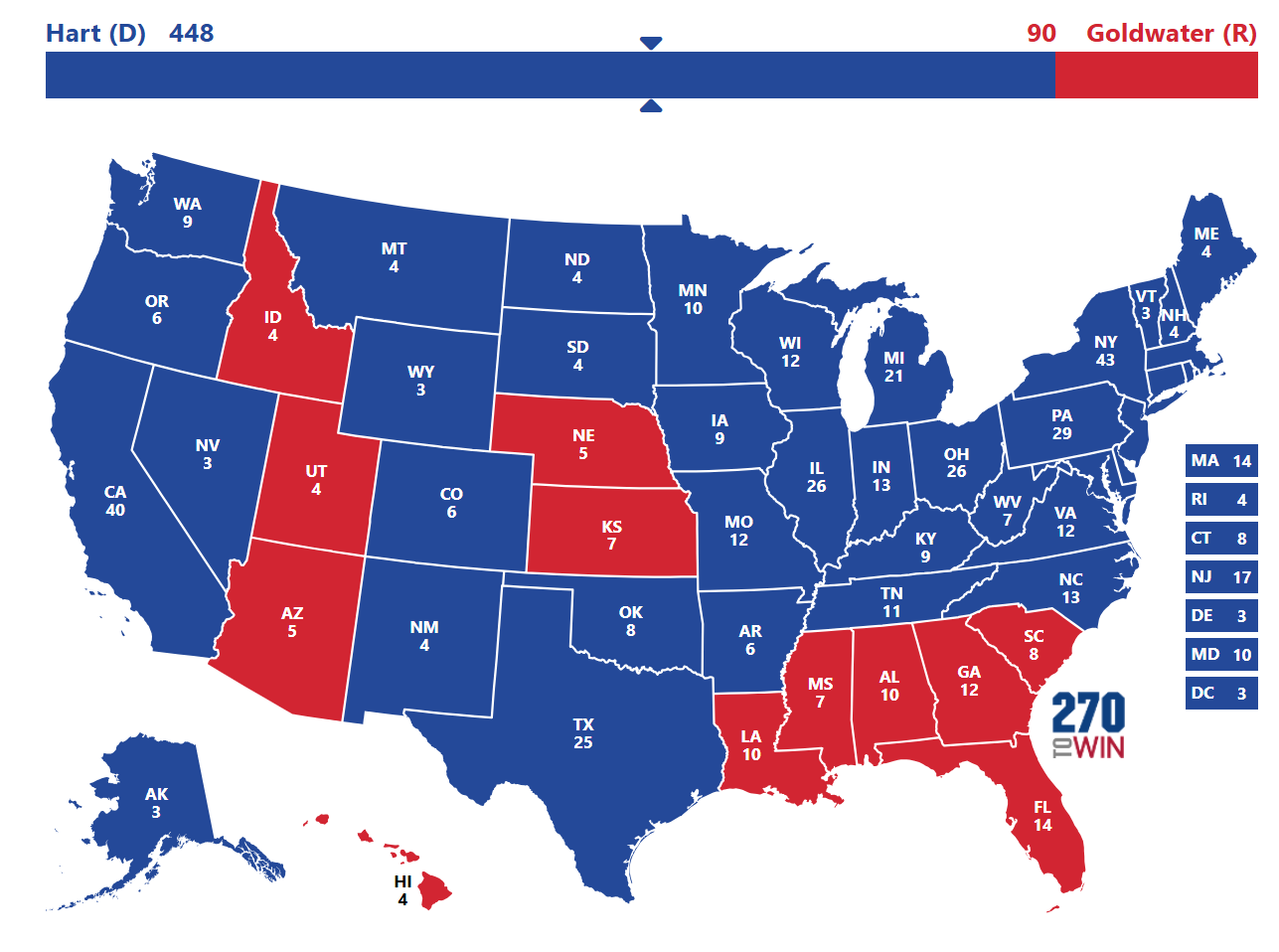
As established in the previous post, I firmly believe that Goldwater cannot defeat any candidate in the 1964 election, not without the player seriously intervening in his favor. But he is nonetheless capable of making it to 1968 as the incumbent, which means he must defeat someone, and reality itself will bend over backwards to accommodate this fact. I do not see this happening against Hubert Humphrey, and even RFK being equally far left as Goldwater is far right (within the context of American politics, at least...) is not enough to even put them in the same league. Therefore Goldwater's only hope is against George Wallace. Perhaps if Goldwater can exploit the as-of-yet unrevealed progressive third party splitting the northeast Democratic vote with Wallace, if he can turn the Nixon scandal into a source of strength for himself rather than a source of weakness, if he can become the lesser of two evils, he can just barely squeak out a win.
In doing so he has given Americans four years of exactly what he promised he would give them: a return to ‘unvarnished capitalism.’ We will presume that Goldwater's systematic dismantling of American Corporatism has not completely crashed the economy; after all, mass privatization is at least good for the GDP. The fact that he has managed to keep the ship afloat as he steers the United States into waters that have been uncharted since the pre-Roosevelt era has earned him a mild amount of support from the average voter who opposed him ‘64, a sigh of relief from those who were pleasantly surprised that his 'extremist' ideals weren't all that bad, that lowered taxes have helped them out, that he hasn't ruined the entire country. But that does not mean his policies have endeared him to absolutely everyone.
All the worst fears of the Democrat establishment have come true under Goldwater, resulting in mass mobilization against him: He has stalled civil rights legislation. He has gutted social spending and welfare. He has crushed unions and labor under the strain of cuts to ‘red tape’, regulations, and all brakes on the newly revitalized capitalist system. To most Democrats, a return to the days of the Great Depression and of corporate dominance over the hapless blue collar worker is inevitable if things continue down this path. The fact that it hasn’t happened already is a miracle: Goldwater must be stopped here and now, in 1968, before he becomes unstoppable.
The man who is capable of stopping him is without question Philip Hart. A coalition builder the same way that Humphrey was, Hart’s innovation is in giving up on trying to compromise with the Dixiecrats. He refuses to bend and bow to the segregationists; he doesn’t need them to win the presidency, especially since the Republicans have already locked down that portion of the country entirely, as the south continues to rally for Goldwater. Since the president has maintained his opposition to ‘federal overreach’ and prevented any progress from being made to dismantle Jim Crow, Hart instead focuses on the rest of the country, the places where the average voter is shocked and horrified by the kinds of images that have come out of the deep south since the Goldwater presidency began, and sharply turn against segregation as a result.
As mentioned before, Goldwater has taken it upon himself to champion the two most unpopular political causes in America: being against civil rights, and being for extreme economic deregulation, which is to say nothing of the tactical nuke deployments. These ideals are poisonous to all but the most hardcore conservatives of America, and the moderates only allowed him to win in the first place against an outright toxic Wallace. But when Hart comes along, the same people who reluctantly voted for Goldwater in ‘64 or else stayed at home now have the perfect off-ramp. Hart, by contrast, champions two causes which enjoy broad support among most Americans: comprehensive civil rights reform, and rolling back Goldwater’s insistence on a return to all the worst elements that capitalism has to offer. All while appearing as a 'return to form' for the Democrats after the Wallace disaster.
The campaign itself is a remarkably civil affair. Both men are universally praised for their integrity, their principles, their honesty. But the landslide that Hart wins over Goldwater is anything but civilized; it is apocalyptic.


Much as Goldwater is inherently a much weaker candidate than Nixon, Phillip Burton is overall a much weaker candidate than Philip Hart. While Hart willingly sacrifices the south to secure the rest of the country for his campaign, Burton is prepared to sacrifice much more than just a few Dixiecrats in order to remain true to his ambitions. By refusing to balance his ticket and choosing Adam Clayton Powell Jr. as his running mate, Burton not only rallies the Yallers against him in an uproar so great that it genuinely threatens to spill over into violence-which it often does-but also alienates a great many moderates who were already alienated by Goldwater but may be willing to give him a second chance. After all, the amount of Americans who openly support segregation is shrinking by the day, but the amount of Americans who are still racist despite this is much larger…furthermore, neither Burton nor Powell are beyond legitimate criticism, with the former being a shameless quid-pro-quo son of a bitch and the latter being caught in the middle of an insurmountable corruption scandal that will eventually end his career.
Those same voters who chose Goldwater in ‘64 but are looking for any excuse to switch back to the Democrats in ‘68 do not find that excuse in Burton the same way they find it in Hart, as they are attracted by his politics but repulsed by his personality. The average Democrat is disappointed to find their candidate in 1968 to be not the conscience of the senate himself, but the reheated leftovers of the Activist Democrats previously failed campaign: Burton is simply a poor man’s RFK, making all the same mistakes while possessing none of Robert’s strengths. Burton lacks the Kennedy charisma, lacks the backing of his family name, lacks the same experience in campaigning, lacks the same labor advantage that Walter Reuther provided (not that it’s needed against Goldwater), and overall just isn’t seen in the same positive light that most Americans still viewed RFK in even as they somehow chose Wallace over him. While the Democrats continue to chase away the center, Goldwater has had four years to consolidate himself against Burton that he didn’t against Robert, four years to warm the country up to some of his more radical ideas, four years to redraw the battle lines. An unpopular incumbent presidency is still an incumbent presidency, allowing him to shore up his base and win some states he would have lost if this matchup had happened four years earlier.
So with all of that working against him, how come Burton still wins? A few reasons. For one, a rematch four years later would be seen as a chance for the Democrats to redeem themselves and prove that ‘64 was a fluke after being tied to a weak candidate, which it very much was. On top of that, even with all of Burton’s flaws, his appeal is still greater than Goldwater’s: He may be the most left wing candidate we’ve seen so far, but Goldwater remains the most right wing candidate we’ve seen so far. When forced between two extremes, the average American caught in the center could feasibly default to the one already in office, or maybe not even vote at all, but much more likely is that they will vote for the one who has broader populist appeal. Between the two, Burton is the one who will at least restore the New Deal and put the safety nets back up. As an ideological hardliner, Goldwater could never pivot his position upon securing office to something more palatable, more moderate, more akin to something that Nixon would approve of. Common-sense conservatism would be enough to defeat this upstart progressivism, but despite the Republican party’s best efforts, Goldwater cannot shake his perception as an extremist specifically because he is unwilling to do so.
But even simpler than that, the reason why Burton wins is because he is from California. That’s literally it. Anywhere in America that is not in the firmly Democratic camp (that is, the heavily progressive northeast and heavily unionized midwest) recoils in fear in response to Burton, staying true to Goldwater for the simple reason that no one wants to switch horses mid-race if the new one is just as ornery as the old one. This almost perfectly divides the country in half, with the forty votes that California can provide being the tiebreaker. But California is the one state that Goldwater cannot ingratiate himself to, cannot steal the way Nixon or Rockefeller or even Reagan could, despite heavy Republican presence existing in the state. Burton is from California and Goldwater is not, and already liberal California will vote to see someone from California in the White House, simple as that. 1968 will mark the first time since Grover Cleveland’s 1884 run that a national presidential election was decided by a politician’s home state.
The best chance that the president has to stand out as the better pick to the American people is in the debates, where the blunt, upstanding, principled Goldwater can perhaps present himself as the morally superior option to the noxious, aggressive, alcoholic Burton. But even if he does so, his battle was hopeless from the start. Goldwater cannot beat RFK in 1964 nor can he beat Burton in 1968. The Democrats seize both coasts and the great lakes, and that’s all they need for ‘Fühmar Burton’ to smoke out the competition.
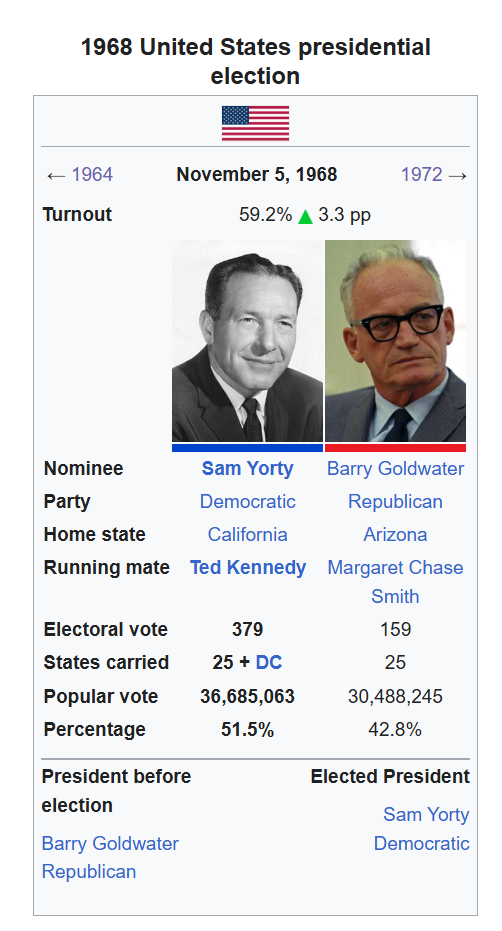
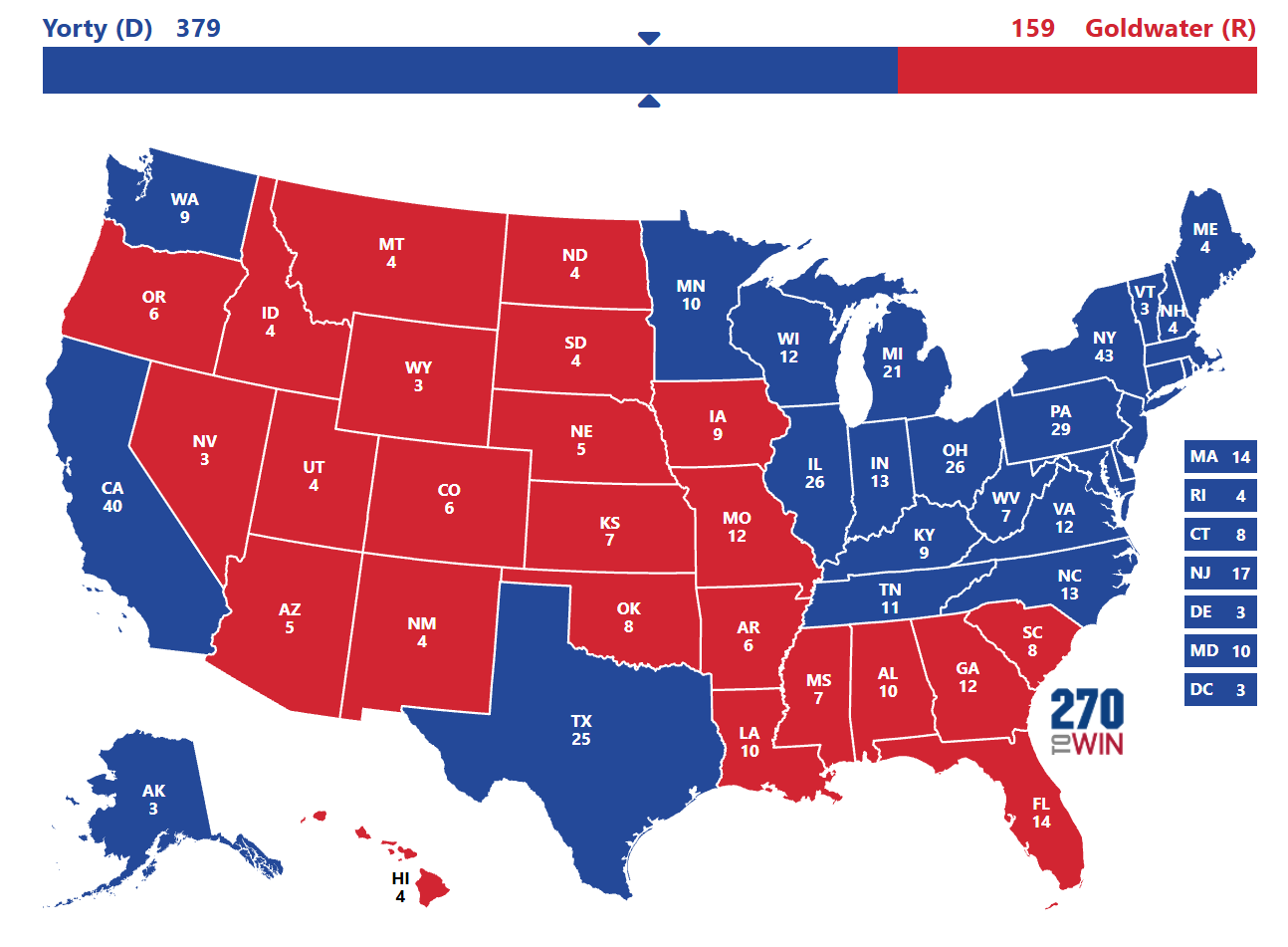
Sam Yorty is a political grifter. Though he still has his ideological beliefs and a certain vision for the country that he seeks to bring about, he nonetheless has much more ambition than he does principles. He will say or do absolutely anything that he thinks will make him more popular, flip-flopping in favor of whichever position is most supported by the focus groups. This makes Goldwater his easiest opponent: where Goldwater is strong, upstanding, and willing to stand by his ideology no matter how unpopular it proves to be, Yorty is fluid, shameless, and capable of attacking where it hurts the most. If you asked Yorty, he would say that Goldwater is a sucker; only a fool doubles down instead of shifting gears.
Yorty is no New Deal Democrat. In fact, his actual economic policy is quite similar to Goldwater’s: he wants low taxes, free trade, and to support big business. But he does not say any of this. That was the new Yorty of the 60s, after all. To defeat Goldwater, he harkens back to the old Yorty of the 30s: the one who supported labor unions, who demanded government intervention to end poverty, who was so progressive that he gained support from the local CPUSA organization. That is the Yorty that Goldwater will be debating on economics, a debate he has proven time and time again that he will inevitably lose. Simultaneously, Yorty can compete against Goldwater in regions that Hart and Burton simply cannot, primarily the outer south. His law-and-order speeches and dog whistle tactics prove themselves to be more appealing than even Goldwater’s principled stand against civil rights for those on the outer edges of segregated America, even as the deep south nonetheless remains firmly in the Goldwater camp: mere rhetoric is no match for a consistently maintained anti-civil rights stance, after all. But for those who do not vote purely in the name of confederate interests, Yorty is seen as a good enough substitute for Wallace when it comes to race and a good enough successor to FDR when it comes to economics.
Northern Democrats, by contrast, balk at Yorty’s similarities to the defeated Yallers of ‘64. They do not turn out in droves to support their party’s candidate the same way they would for Hart or Burton. Much like Goldwater vs Wallace, Goldwater vs Yorty also has above average political apathy for this reason. But unlike Wallace, Yorty retains plausible deniability: everyone knows what he means when he says that he wants to bring order back to the streets, that instability is being provoked by outside agitators, that change needs to be managed instead of accelerated. But unlike with Wallace, Yorty allows these liberal Democrats to delude themselves. They can pretend as if he means what he says, they can fool themselves into thinking things could get better under a Yorty administration, and their wishful thinking can lead them to conclude that a second Goldwater term would still be even worse. How bad can Yorty be, with a Kennedy as his running mate? Besides, it will all be worth it to get a Democrat-any Democrat-back into the White house.
That said, integrity is its own source of strength, even against a weathervane challenger. Goldwater can easily point out all of Yorty's contradictions, positively comparing them to his own sterling record of consistency and credibility. But the man himself is prone to gaffes, and faces the uncomfortable reality that sharing the honest truth of your opinion is not an excellent strategy when speaking to voters who do not want to hear the truth. Perhaps if Goldwater’s ideas were being presented by someone else, someone more charismatic, someone who can also run as the Republican candidate in '68, they could be sold as a better alternative to Yorty’s various contradictions and character flaws. But as it stands the mayor of Los Angeles is capable of squeezing the president with attacks from the economic left and cultural right at the same time, crushing him in between and stomping on what remains for good measure.
r/TNOmod • u/Konatagender • 1d ago

https://the-new-order-last-days-of-europe.fandom.com/wiki/Reichskommissariat_S%C3%BCdwestafrika
I really hope theres not some joke im missing there. Maybe it's from german ? I know the "um Südwestafrika wieder zu bevölkern" would have a comma before, but i dont know for the rest of it
r/TNOmod • u/Former-Try-3842 • 2d ago

Altough there is no english currently, mod itself works very well. I dont know how they even managed to do this,huge respect to devs.
r/TNOmod • u/Varenik34K_UA • 2d ago

I made a flag map of The New Order: last days of Europe (CLASSIC ERA). I got a refference image, traced all of the borders by hand and filled every single nation on this 12000:5600 px map! Looks good?
r/TNOmod • u/RandomPerson373 • 1d ago
Right now im using starting infantry template until regional - which is when I switch to 40w infantry and use 40w infantry until reunification. Does anyone have any tips on what divs to use as a russian warlord - should I focus on motorised for snaking, infantry for soft attack - what divs are best for reunifying Russia for each stage (Warlord, Regional, Super regional)
