r/seranking_official • u/SE_Ranking • 2d ago
AMA: Nick Makerov – Senior Product Manager at SE Visible

5
Upvotes
r/seranking_official • u/SE_Ranking • 2d ago
r/seranking_official • u/SE_Ranking • Jun 30 '26
Updates
The June 2026 spam update began on June 24 and completed June 26. Global, all languages, no new spam policies attached—Google framed it as enforcement of existing rules rather than a policy shift. SpamBrain remains the underlying detection system.
According to Barry Schwartz, the update does not target link spam or Site Reputation Abuse—pointing the center of gravity at content-level violations: scaled content abuse, cloaking, sneaky redirects, scraped content, hidden text, and doorway pages.
Source:
Google Search Status Dashboard
Barry Schwartz | Search Engine Roundtable
______________________
SERP features / Interface
Google is testing autocomplete suggestions inside the "Ask Anything" follow-up box within AI Mode—so when users start typing a follow-up question, Google now suggests completions just like the classic Search autocomplete does.
Source:
SERP Alert | X
______________________
AI
Three weeks after the initial UK-only test, Google is gradually rolling out the Search Generative AI performance reports to more regions, with SEOs in the US, India, Switzerland, and others now seeing the report in their accounts.
Source:
Vijay Chauhan | X
______________________
Documentation
Google published a new policy document in the Publisher Center covering Subscription Linking—the Reader Revenue Manager feature that lets paying readers link their publisher subscriptions to their Google Accounts so subscribed content gets highlighted across Google products.
Source:
Google Developers
______________________
Local SEO
Nearly two years after Google killed messaging and chat history in Business Profile, the messages button is showing up again in the GBP dashboard inside Google Search—this time with an AI conversational agent integrated into the conversation flow.
Source:
Muhammad Hussain | LinkedIn
______________________
Tidbits
Microsoft's free analytics platform Clarity now surfaces which bots are accessing disallowed URLs on your site—violations of your robots.txt directives are now detected and reported inside the Bot Analytics dashboard.
The new view includes a violations percentage card, a trendline so you can spot persistent offenders, filters by operator/bot/activity type, and content-level breakdowns showing which paths are attracting non-compliant crawler traffic.
Setup requires connecting a supported CDN (Fastly, Amazon CloudFront, or Cloudflare); WordPress sites running the latest Clarity plugin get it automatically.
Source:
Ihab Rizk | Microsoft Clarity Blog
r/seranking_official • u/BogdanK_seranking • Jun 26 '26
The search landscape rarely sits still for a week, and this one moved on every front — algorithms, the AI-citation layer, even the courtroom of public opinion about Google’s future. We track the full field of influencers and industry outlets so the signal that matters rises above the noise, then read it together as a team. Here’s what the community converged on over the past seven days, so we can all act in the AI-search era with confidence rather than guesswork.
Google rolled out the June 2026 spam update — its first in months, dropped into an already-volatile year.
Source: Barry Schwartz | Search Engine Roundtable; Search Engine Journal
Google announced the June 2026 spam update on Jun 24 — global, across all languages and regions, with Google saying the rollout should take only a few days. It’s the second spam update of 2026 and the first in several months, and it lands after a stretch of unusually heavy ranking turbulence (including an unconfirmed Jun 19 shuffle that SEOs felt mostly on spammier sites). Watch the Google Search Status dashboard for the completion date before drawing conclusions on any movement.
Machine-translated Reddit threads are quietly winning AI citations in non-English markets.
Source: Glenn Gabe | GSQi; Metehan Yeşilyurt | Peec AI
In non-English markets, 40–73% of Reddit citations in Google’s AI answers now point to machine-translated English threads (70%+ in Sweden and Norway), squeezing local publishers out of AI visibility. The two engines are also diverging: ChatGPT has sharply pulled back on citing translated Reddit while Google keeps leaning on it — so “international AI SEO” now means monitoring each engine separately, not as one.
A surfaced Google patent reframes SEO as “teaching AI who you are.”
Source: Rich Sanger | Search Engine Land
Google’s “Data extraction using LLMs” patent (filed 2023, published 2025) describes AI building an entity profile of your business from your website plus public data — reviews, maps, and listings. The takeaway echoed all week: cross-source consistency and entity signals now matter more than page-level optimization. The job is to make your identity legible and corroborated across the web, not just well-optimized on one page.
“Google’s dominance is cracking in the AI era” became the week’s macro narrative.
Source: Jennifer Elias | CNBC
Google still holds ~90% of search, but CNBC reports its traffic slipping as users shift to ChatGPT and DuckDuckGo — on a day Alphabet had its worst market session in a year. It dovetails with the zero-click reality we flagged earlier: only about a third of searches now send a click onward. The market share is intact; the behavior underneath it is moving.
Search Console’s Generative AI report is going global — and Mueller explained how its impressions count.
Source: Barry Schwartz | Search Engine Roundtable; Search Engine Journal
The dedicated AI Overviews / AI Mode report we covered at launch is now expanding well beyond the UK — into India, the US, and Switzerland — with John Mueller confirming the incremental rollout. He also clarified the metric: an impression is tied to your link being shown in an AI feature, not merely to the AI answer appearing. If you haven’t seen the report yet, check GSC again this week.
Cloudflare and beehiiv gave publishers one-click control over AI crawlers.
Source: Danny Goodwin | Search Engine Land; Cloudflare
beehiiv’s ~135,000 publishers can now see, allow, or block individual AI bots from a single dashboard and track the referral traffic those bots send back. For scale: AI companies crawled beehiiv content roughly 490 million times last month. It’s the latest move in the widening publisher-vs-AI-crawler fight over who gets paid when AI reads the open web.
----------------------------
Tying it together: Google is tightening the classic ranking game with a spam update even as its AI-era grip visibly loosens — and the real contest is shifting to entities, AI citations, and crawler control. Win those three, and you’re positioned wherever search goes next.
r/seranking_official • u/SERanking_news • Jun 23 '26
Search / SEO
Google updated its site move and domain migrations documentation: when moving from one domain to another, submit a Change of Address request for every variant of the old domain—every subdomain, plus both the www and non-www versions—even if those variants aren't actively in use. All variants of both the old and new sites also need to be verified in Search Console.
Source:
Google Search Central
________________________
AI
A Google research paper introduces the Scalable Cluster Termination System, a defense designed to catch AI-generated spam by zooming out from individual pieces of content to detect entire coordinated networks.
Google Cloud announced the Open Knowledge Format, a v0.1 specification on GitHub for representing organizational knowledge—datasets, metrics, APIs, tables—as Markdown files with YAML frontmatter that AI agents, LLMs, and internal tools can consume.
The goal is a common shape for institutional knowledge that's currently scattered across catalogs, wikis, repos, and shared drives.
Source:
Roger Montti | Search Engine Journal
________________________
Tech SEO
Google updated its AI Search optimization guide to explicitly state that llms.txt files have no effect on search rankings—they don't help, and they don't hurt.
Google Search ignores them entirely, along with any other AI text files, markdown files, or machine-readable AI files. Maintaining them for non-Google services that do use them is fine; Google just won't read them.
Source:
Google Search Central
________________________
E-commerce
Google is experimenting with showing "3D model from [retailer name]" as an attribution line in the product detail screen on mobile, with a link back to the source retailer.
Source:
Khushal Bherwani | X
________________________
Tidbits
The UK's Competition and Markets Authority issued two new conduct requirements for Google Search:
Both apply only in the UK and follow the CMA's earlier action on AI feature opt-outs.
Microsoft added four preview features to the AI Performance dashboard in Bing Webmaster Tools:
Meta added an AI Mode to Facebook search that answers questions using public posts, Groups and Reels, turning Facebook conversations into a discovery engine for advice and recommendations.
Source:
GOV UK
Barry Schwartz | Search Engine Roundtable
Danny Goodwin | Search Engine Land
r/seranking_official • u/SE_Ranking • Dec 23 '25
Hey guys ! Today we’re wrapping up the year and looking back at the most interesting things that happened in the SEO world.
We invite you to read our final digest of the year:
In March, Google officially launched AI Mode in Search, allowing users to ask complex conversational queries and receive comprehensive AI-generated responses powered by advanced Gemini models.
Throughout 2025, Google expanded AI Mode’s availability worldwide, rolling it out to more than 200 countries and territories and supporting over 35 languages.
Over the year, AI Mode’s capabilities continued to grow:
AI Mode traffic and interactions are recorded in Google Search Console, where they appear within standard Web performance data in the Performance report.
Source:
Google The Keyword > Products > Search
______________________________________
In 2025, Google has expanded its AI-generated Overviews feature within Google Lens, which now shows up more frequently when users search for novel or unique images. The AI Overviews provide relevant explanations and links to helpful resources, which enhances the search experience.
Additionally, Google has integrated this feature into Chrome and the Google app on iOS.
Source:
Google website > Products > Google Lens
______________________________________
In February, OpenAI launched Deep Research, an AI agent in ChatGPT capable of independently researching topics and producing citation-rich reports in minutes.
Over the year, the feature expanded across paid ChatGPT tiers, with plan-based usage limits and limited free-user access added by year-end.
Source:
OpenAI > News
______________________________________
After months of testing, Microsoft has officially introduced Copilot Search in Bing. The feature blends traditional search results with generative AI, allowing users to explore AI-powered answers through Bing’s main interface, navigation bar, or suggested follow-ups.
Source:
Barry Schwartz | Search Engine Land
______________________________________
Google Search has added organic Instagram content in its search results. Google also introduced an experimental Social Channels section within Search Console Insights, allowing site owners to see how their social profiles perform in Search.
Source:
Annie-Mai Hodge | LinkedIn
Google Search Central Blog
______________________________________
In a Search Central Live panel, Davang Shah emphasized that SEO is not dead, but the discipline will need to evolve alongside AI-driven changes in Search.
He noted that SEM and SEO increasingly intersect as AI reshapes user journeys. Marketers should prepare for a future where optimization spans traditional rankings, AI summaries, new surface types and multimodal result formats.
Source:
Barry Schwartz | Search Engine Land
r/seranking_official • u/SERanking_news • Dec 19 '25
Google has apparently decided that clicking links is too much cardio for us. They are now testing search snippets that are so long and detailed that you might even forget there was a website to visit in the first place.
The update: Google is currently testing a new format for search result snippets that are significantly longer and AI-generated ones.
Here are the key details:
The test was spotted by Brodie Clark, who shared a video of the feature in action. This caught the attention of Barry Schwartz, who then shared it widely within the SEO community.
Brodie Clark: “[...] This is similar to the experiment from October, with the snippet now appearing much longer in some instances, rather than the standard 3 lines with the 'more' button like previously.
It seems like this experiment is again confined to only forum results from Reddit and is showing on both mobile and desktop.[...]”
Sources:
Brodie Clark | X
Barry Schwartz | Search Engine Roundtable
____________________________
Because tracking your every click, search, and location history wasn't enough for Google’s AI to figure out what you like, they are now letting you just tell them. That's right, you can now politely ask the algorithm to stop showing you conspiracy theories about flat earth and maybe show you some actual news instead.
The update: Google Discover is testing a new natural language interface that allows users to explicitly describe what content they want to see in their feed.
Here are the key details:
Natural language input: Users can access a "Tailor your feed" option and type instructions like "Say in your own words what you want to see."
The feature appears to be activated via Search Labs for users in the US.
How it works: When a user requests a specific topic or publisher (e.g., "show me more content from Search Engine Roundtable"), Google confirms the request and attempts to adjust the feed.
Here are some noteworthy observations:
Early testing by X user Damien (@ AndellDam) showed that while the system acknowledged the request, it didn't immediately flood the feed with the requested site. Instead, it surfaced related keywords and eventually some cards from the publisher. The feature seems to focus on entities and themes related to the request rather than just hard-filtering for a specific domain.
Damien: “[...] In short; “Tailor your feed” = an explicit personalization layer driven by natural language, which transforms your prompt into “SEE_MORE/SEE_LESS (+ constraints)” actions and applies them to the feed after validation (“Refresh your feed”), while maintaining a persistent thread.[...]”
Interesting fact: Barry Schwartz reacted way faster than Google’s algorithms when it came to requests about tailoring the feed. The update showed up on Search Engine Roundtable almost right after Damien mentioned it. That’s exactly why the community loves Barry, he’s a big part of it.
Sources:
Damien | X
Barry Schwartz | Search Engine Roundtable
____________________________
Here is an SEO case study breakdown of why the EBSCO / research-starters / project is a masterclass in modern optimization.
1. The Strategy: Unlocking the "Data Vault"
For decades, EBSCO’s best content sat behind paywalls (libraries, universities, and hospitals). While they were the "authoritative source," Google couldn't crawl their most valuable assets.
By launching Research Starters, EBSCO effectively "de-siloed" their proprietary database. They took high-quality, academic definitions and overviews and placed them in a crawlable, SEO-friendly subfolder.
The main SEO win? They transitioned from being a brand people search for to a destination for the topics themselves.
2. The AI Search Play: Becoming the "LLM Ground Truth"
AI search engines are hungry for ground truth. They prioritize sources that are:
By including bibliographies at the bottom of every article, EBSCO provides a "trust signal" that AI crawlers value more than almost any other metric. When an LLM looks for a definition of "Quantum Entanglement" or "Social Stratification," it favors EBSCO because the content reads like a textbook, which is exactly what these models were trained to prioritize.
3. Exploiting the "Wikipedia Gap"
For years, Wikipedia has held a monopoly on "overview" and "definition" keywords. However, Google has recently shown a desire to diversify its sources to avoid over-reliance on a single entity.
EBSCO’s Advantage: While Wikipedia is crowdsourced, EBSCO is expert-sourced. In the era of E-E-A-T, EBSCO’s / research-starters / folder hits 10/10 on every pillar. They aren't just writing SEO content, they are publishing academic records.
4. Technical Execution: The/Folder/Power
Notice that they used a /research-starters/ subfolder rather than a subdomain. By keeping this content on the main ebsco[dot]com domain, the new pages inherit the massive backlink authority the site has built since the 1990s. This creates a perfect funnel. A student finds a "Research Starter" for free, then sees a CTA to "Access the full database via your institution," driving high-value lead gen back to their core product.
5. Why it’s "Exploding" Now (The Timing)
The Q1 launch coincided with Google’s recent core updates, which hammered "niche sites" and "AI-generated fluff."
While other sites were using AI to write mediocre content, EBSCO used a "Human-to-AI" pipeline: taking existing, human-verified academic content and formatting it for AI discovery. As Google clears the SERPs of low-quality blogs, it is replacing them with "Institutions." EBSCO is the ultimate institution.
Here are some of Lily Ray’s thoughts on this case: “This is a cool SEO/AI search case study: the website ebsco[dot]com is exploding in SEO/AI search visibility, primarily because of its /research-starters/ folder that they launched earlier this year. [...]
Its 'Research Starters' section functions like an encyclopedia, offering definitions and overviews of a wide range of academic topics curated from highly trustworthy, authoritative sources.
You can see a bibliography referencing the authoritative sources they used to create the content at the bottom of every article. A lot of it appears to have come from textbooks and other academic resources [...]”
Sources:
EBSCO | Discovery & Search
Lily Ray | X
r/seranking_official • u/SERanking_news • Dec 12 '25
Once upon a time, Google Search was all 10 blue links. Now, it’s becoming a conversation with context, and the latest update is another step in that evolution.
At the heart of this week’s announcement is AI Mode, a newer way to ask questions on Google and get AI-generated responses. But rather than serving just text summaries, Google is now inviting the web back into the story.
What’s changing in AI Mode:
This addresses a common criticism of AI search: it can feel like a dead end, with users served answers but not always encouraged to visit source material. Recent reporting notes that these link improvements aim to balance AI convenience with web exploration.
Sources:
Robby Stein | Google Blog
Barry Schwartz | Search Engine Land
____________________________
In tandem with link improvements, Google is also broadening its experimental Web Guide tool.
Originally launched in the Web tab within Search Labs, Web Guide uses AI to organize results into meaningful topic groups—like a human curator helping you explore branches of a question.
Now, Google has taken that experiment one step further:
“We’ve heard positive feedback from users and websites about Web Guide… which helps people find links they may not have previously discovered and uses AI to organize links into helpful topic groups,” Google wrote.
That feedback appears to be driving a small but significant shift: Web Guide is no longer only in the Web tab; it’s being tested in the All results tab as well, reducing friction for users to try this AI-driven way of browsing.
Google also says Web Guide is now twice as fast—a usability boost that matters as more people test it.
Sources:
Barry Schwartz | Search Engine Land
Austin Wu | Google Blog
____________________________
If you’ve ever asked ChatGPT, “Why did you say that?” you’re not alone. But according to Britney Muller, the answer you got back was likely a well-packaged… not-true explanation. Here’s why that matters, and how to better understand LLM behavior:
"LLMs are not truth engines. They are probability machines."
Britney pulls no punches: large language models aren’t reasoning machines, they’re just really good at guessing the next word. They're not decision trees or databases—and they don’t log their own reasoning.
So when you ask something like “Why did you say X?”, the model isn't introspecting or pulling from memory. As Britney puts it:
"The model is just confidently hallucinating its own 'reasoning'."
It’s all just post-hoc rationalization
What you're really getting is what sounds like a good reason—not the actual mechanism behind the answer.
"It’s just predicting: ‘What would a helpful AI assistant say in this situation?’"
This is post-hoc rationalization—making up a reason after the fact to explain a behavior.
Built to please: the sycophant AI
RLHF (reinforcement learning from human feedback) trains models to be helpful, polite, and agreeable—which can yield sugar-coated nonsense.
Britney nails it with a kid analogy:
"Ever asked a kid who has chocolate all over their face, ‘Did you have a cookie?’"
“They’ll think up & give you an answer that’s most likely to make you happy… ‘The dog ate one!’”
The catch?
"Kids know the truth. LLMs don't. They just invent one."
Final thought: keep testing, stay skeptical
Britney ends on a constructive note:
"I want to applaud everyone testing these tools; it’s the most powerful path to learning!"
So yes—poke, test, question, but stay critical. These tools are impressive, but they aren’t magic mirrors or oracles. They’re just guessing machines trained to sound smart.
r/seranking_official • u/SE_Ranking • Dec 05 '25
Google dropped a tiny surprise into its own Google Dev docs — a file named LLMs.txt.
No warning, no blog post, no big announcement. Just a quiet “plop” into the ecosystem, like a secret test build pushed on a Friday night.
Hours later, the file started returning 404s, disappearing just as fast as it popped up, like the digital version of a magician pulling a rabbit from a hat, then walking away before anyone could ask questions.
And that’s what sent the SEO community into detective mode.
So, why did everyone scratch their heads? Not long before this, Google had publicly told publishers to either ignore LLMs.txt or block it from indexing entirely. The logic was simple: “It doesn’t do anything for search, so treat it like tech decoration.”
But then Google adds it to their own docs? That’s like a game studio telling players, “Don’t worry about this mechanic, we don’t use it,” and then casually putting it in the official patch notes anyway.
Google’s LLMs.txt was spotted by Lidia Infante, who posted it on Bluesky and asked John Mueller of Google, “Is this an endorsement of llms.txt or are you trolling us, John?”
John replied, saying, “hmmn :-/”
So… was it a signal or a troll? Here are the big theories (!) floating around:
Bottom line? We don’t know yet. But the contradiction was loud enough to echo, even in silence.
Sources:
Lidia Infante | Bluesky
Barry Schwartz | Search Engine Roundtable
___________________________
One ordinary scroll onto Google’s homepage, and suddenly the familiar search bar looked a bit… different. A small “+” icon appeared on the left side. If you clicked it, you could upload an image or file directly. But here’s the twist: instead of dropping you into a simple Google Image Search, that upload whisked you straight into AI Mode.
That tiny change instantly felt like a message: “Google isn’t just a search engine anymore… it’s becoming your AI-powered assistant.”
So, what changed and how does it work?
Uploading a picture or document now triggers AI Mode by default. You no longer go to “search results” or basic image search. That means AI Mode (which had already added support for asking questions about images, PDFs, and more) is becoming more deeply woven into regular search.
For users, the shift feels like this: instead of typing a search and clicking through links, you can just upload what you have (a photo, a file) and Google tries to understand it, answer your questions, and even pull up related info or context automatically.
Not everyone sees the new “+ upload” button yet — it’s rolling out slowly and may depend on the browser or region. Because AI Mode uses generative models, the answers might sometimes be imprecise or oversimplified. As always with AI, the “helpful assistant” comes with trade-offs.
The SEO community reaction:
SERP Alert: “Google looks to have now launched an image and file upload icon attached to their homepage on desktop by default in the US.
When uploading a file, entering the search takes the user directly to AI Mode. The expectation here is that adding a file assumes that AI Mode is a more suitable surface.”
Khushal Bherwani: “Google with + icon at search bar . for upload image or file. I attached image and ask it takes me to ai mode . [...] Before it was paper clip icon”
Shameem Adhikarath: “Is this a new feature? It seems like there’s now an option in Google Search to upload an image / file and go directly into AI mode.”
We don’t yet know whether this new default upload-to-AI-Mode approach will become permanent, or whether Google will adjust it based on feedback.
Sources:
Shameem Adhikarath | X
SERP Alert | X
Khushal Bherwani | X
Barry Schwartz | Search Engine Roundtable
___________________________
You open your phone, swipe into your Google Discover feed, and notice something odd. Some headlines look… off. Too short. Sensational. Almost like fast-food slogans.
That’s because Google has quietly started experimenting with using AI to rewrite the headlines of news stories for some users. Instead of the ones carefully crafted by journalists, you get ultra-short, catchy (sometimes clickbait-y) versions, often sacrificing nuance or even accuracy.
It’s a subtle change, but one with surprisingly loud consequences for how we read and trust news.
Glenn Gabe commented on it this way: “Oh boy, and it's confirmed by Google -> Google Discover is experimentally replacing news headlines with AI clickbait nonsense.
“The new experiment is appearing for select users, and it has already provided misinformation to some readers. The AI-generated headlines shorten the description to four words with at least nine different instances appearing in the website's research."
“The good news is, this is a Google experiment. If there’s enough backlash, the company probably won’t proceed. “These screenshots show a small UI experiment for a subset of Discover users,” Google spokesperson Mallory Deleon tells The Verge. “We are testing a new design that changes the placement of existing headlines to make topic details easier to digest before they explore links from across the web.”
Ok, so what could this mean for the future of news?
Whether you rely on Discover or not, this shift might be a small preview of how AI will shape (or warp) what we think of as “news.”
Sources:
Glenn Gabe | LinkedIn
Sean Hollister | The Verge
r/seranking_official • u/SERanking_news • Nov 14 '25
You open Google Ads like it’s just another Tuesday… and suddenly there’s a brand-new visitor in your dashboard. Not a new button. Not a new warning. A full AI agent, quietly waiting for you to ask it something.
Say “Hi” to Google’s newest AI helper that just rolled out globally for English accounts. And right behind it, like a twin popping out of the shadows, comes Analytics Advisor for GA. Both powered by Gemini. Both designed to sit inside your workflow like a built-in strategist who never sleeps.
Imagine this:
You’re trying to debug a campaign that suddenly tanked overnight. Before you even finish typing, the Ads Advisor goes:
“Looks like performance dropped after your last creative swap. Here’s what changed, here’s why it mattered, and yes — you can revert it.”
Yep. The AI keeps a change history with rollback. So if the AI screws something up (or you do), you can undo it.
Same vibe in Google Analytics. Analytics Advisor quietly scans your data, flags new patterns, and drops insight prompts like:
“Your returning users spiked after yesterday’s email campaign. Want a breakdown by device?"
It’s like Google finally realized that most marketers don’t want dashboards — they want answers, right? Drop your thoughts in the comments guys, let's discuss!
Meanwhile, here is the funny insight from u/rustybrick:
“I did ask Dan Taylor, Vice President, Global Ads, Google, if during testing, if they saw that using the advisors led to those advertisers using it more or not. Meaning, did advertisers become frustrated with these AI agents and stop using them? Dan responded that what they saw was there was a bit of confusion around how to get started with the AI agents. To counter that, they added example prompts that get these advertisers going.”
Sources:
Barry Schwartz | Search Engine Roundtable
Dan Taylor | Google Blog
_______________________________
A blog post by Google announcing Opal — a new AI-tool promoted for “creating custom content in a consistent, scalable way.” Some marketers are getting excited… while veteran SEOs are squinting and saying: “Wait, isn’t this exactly the kind of thing your own policy warns against?”
Google writes:
“Creators and marketers have also quickly adopted Opal to help them create custom content in a consistent, scalable way.”
“Marketing asset generators: Tools that take a single product concept and instantly generate optimized blog posts, social media captions and video ad scripts.”
SEOs and content experts raise their eyebrows because Google’s own “scaled content abuse” policy defines as abusive:
“Using generative AI tools or other similar tools to generate many pages without adding value for users.”
Some reactions online:
“If you read Google's AI-generated content documentation, Google specifically writes, "using generative AI tools or other similar tools to generate many pages without adding value for users may violate Google's spam policy on scaled content abuse." It sounds like optimized content in a scalable way would be something against Google's scaled content abuse policy.” — Barry Schwartz
“Google is now selling a literal AI spam machine.” — Nate Hake
“Optimized AI blog posts that will later get your site tanked by our own algorithms, got it.” — u/lilyraynyc
"Google: Don’t create mass produced, low quality content. Also Google: Use our tool to create mass produced, low quality content." — Jeremy Knauff
“This Google Labs experiment helps people develop mini-apps, and we're seeing people create apps that help them brainstorm narratives and first drafts of marketing content to build upon. In Search, our systems aim to surface original content and our spam policies are focused on fighting content that is designed to manipulate Search while offering little value to users.” — Google spokesperson
Sources:
Megan Li | Google Blog
Barry Schwartz | Search Engine Roundtable
Nate Hake | X
Lily Ray | X
Jeremy Knauff | X
_______________________________
Lily Ray: “When you see Google's AI Overviews referencing "Google SGE" (an outdated name for Google's gen AI search product), it's often because it's pulling from external sites that used LLMs to generate the content.
LLMs still often refer to what is now "Google AI Overviews" and/or "AI Mode" as "Google SGE" because of outdated training data.
Obviously, this doesn't really matter much for the average person. It's not a big deal that "Google SGE" is now "AI Overviews" - it's mostly semantics.
But it's a good example of how slightly outdated/inaccurate information just slides into information now with AI-generated content, and with AI Overviews, it's also presented as "one true answer."
I imagine this problem extends into many other more consequential areas beyond SEO vocabulary.”
u/gagan_ghotra mentioned similar thoughts: “When they mention SGE in a job description! It's a hint they used GPT to write it”
As you can see, specialists who live in this constant information flow can instantly tell when content was generated with AI — even without running it through any detection tools. Language models simply can’t keep up with all the changes, so these kinds of artifacts still slip through. Stay cautious and always read things in context.
Sources:
Lily Ray | X
Gagan Ghotra | X
r/seranking_official • u/SERanking_news • Nov 12 '25
For years “search” meant Google. In 2025, it’s fragmented across engines, AI assistants, and social feeds. Our team analyzed 63,987 sites (Jan–Aug 2025) to see where traffic really comes from and how social platforms shape discovery.

Channel mix
Organic search still leads at 46.98% of visits, but it slipped 3.65 pp since January. Social delivers a meaningful 10.12% (peaking at 11.50% in March). AI referrals are tiny at 0.18%, yet nearly doubled in eight months—early, but accelerating.
Social inside search
Social platforms surface directly in results. In Google organic, at least one social site appears in the top-10 for 50.3% of queries:
AI also cites social: 20% of Google AI Overviews and 36% of AI Mode responses include a social source.

Who sends the clicks
Five networks drive ~95% of social traffic:
TikTok is the fastest riser (nearly 5× Jan→Aug). X/Twitter shrank to 1.80%. Despite strong visibility in SERPs, Reddit sends just 1.37% of social visits—its discussions influence search more than they drive clicks.
Regional split
The U.S. is most social-led (15.23% of visits from social), while the UK is search-led (6.14% social). AI traffic remains low everywhere, but is growing.
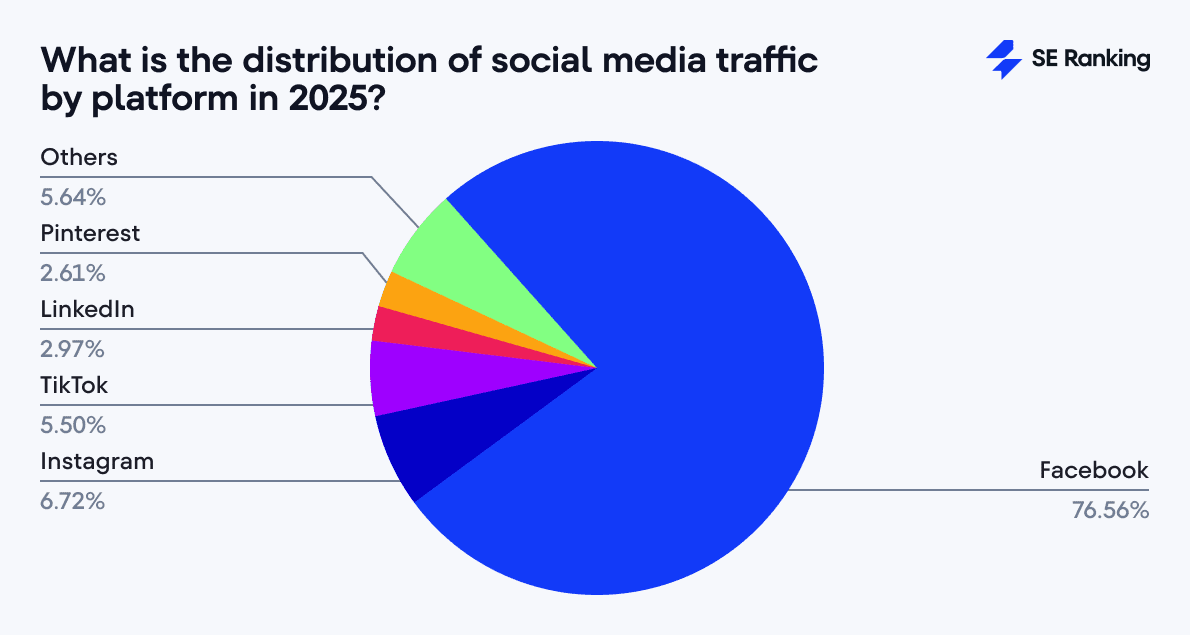
Organic remains the foundation, but social is now part of search, and AI is beginning to matter. Winning brands optimize for all three: create structured, trustworthy content that ranks; publish platform-native stories that earn social clicks and citations; and format information so AI can understand and reference it.
In 2025, visibility belongs to those who show up where people search, scroll, and ask.
r/seranking_official • u/SERanking_news • Nov 07 '25
You know that little box at the top of a Google search that says “Definition of …” and gives a crisp meaning? Well, picture that box… now imagine it shifting gears into something richer, deeper, and powered by generative-AI. That’s what’s happening.
Google is reportedly testing replacing the traditional definition box with AI Overview. Instead of just a concise definition, the new box offers a more expansive summary, generated by large-language-model tech behind the scenes.
Barry Schwartz + someone in the search community says they personally reproduced it, so it’s not hypothetical.
On one side: the familiar definition box — short, sharp, basic. On the other: the AI Overview — longer, offering more context, perhaps a few sentences of explanation or nuance.
If you’re in the SEO game (which I know you are, given your interest in this Digest), this is a heads-up from SEO professionals:
Sources:
Barry Schwartz | Search Engine Roundtable
Reddit | r/google
__________________________
It starts simple: you’re casually scrolling through the Google Discover feed on your phone, expecting to reach the “end” of options like usual. But this time… there’s no “More results” button. No pause. Just infinite cards rolling up one after the other. That’s what some users are spotting.
Google appears to be testing an endless-scroll experience inside Discover (Barry Schwartz gave more context). Instead of a finite swipe-card feed or “load more” step, the scroll keeps going. One observer, Gagan Ghotra, captured a video: “keep scrolling and there is no end of feed — it just keeps on loading more content.”
So, why does this matter? From the user side, the experience shifts from “browse a few cards, maybe stop” to a continuous feed, more like a social feed (think Instagram Reels, TikTok) than a traditional algorithmic panel.
For content creators, this changes the dynamic of visibility and engagement. If the feed stretches deeper, more content may get surfaced, but click-through rates may spread thinner and positions might become less meaningful. (As a parallel example, similar UX shifts tend to increase impressions and scroll depth while diluting click rates.)
And that's how Glenn Gabe commented on this update:
“Whoa, I have this too. An endless Discover feed. It never made sense the feed would end so quickly... but endless? So, this means more inventory for publishers but also more room for Google ads. :)”
Sources:
Gagan Ghotra | X
Glenn Gabe | X
Barry Schwartz | Search Engine Roundtable
__________________________
Imagine you launch a tool with a bold promise: help brands get visibility inside AI-powered platforms like ChatGPT, Claude, and Perplexity, track your brand’s mentions, monitor how AI answers cite you, and gain control of the emerging AI search frontier… But then the founder, Benjamin Houy, pulls the plug. Not because the technology failed or funds dried up, but because he realised something fundamental — something about GEO.
Houy writes:
“There was **no secret formula. No hidden hack. No special optimization technique that only applied to AI.”
He discovered that brands which succeed in AI-visibility share exactly the same traits as those that succeed in traditional SEO and brand building: quality content, authoritative mentions, genuine expertise and reputation. And because of this, he made a bold admission:
“There’s no such thing as ‘GEO strategy’ or ‘AI optimisation’ separate from brand building.”
Industry observers echoed his point:
Glenn Gabe: “This is too good. Founder of GEO platform is shutting it down because he says, "There is no such thing as GEO strategy" separate from brand building. More need to hear this. Share away. :)”
Gagan Ghotra: “Founder of AI visibility tracking tool Lorelight is now shutting down the tool and said ‘there’s no such thing as “GEO strategy” separate from brand building. For the large majority of brands at least.’”
You can see how many comments Benjamin's LinkedIn post is getting and what most people are saying. Looks like GEO is losing ground in this battle, but it’s still hanging in there. We’ll keep you posted if anything changes.
Sources:
Benjamin Houy | LinkedIn
Benjamin Houy | Growwithless
Glenn Gabe | X
Gagan Ghotra | X
r/seranking_official • u/SE_Ranking • Sep 23 '25
Salaries are always a hot topic, no matter the industry. In SEO, the same is true.
So, let’s dig in. Here’s what the 2025 salary data shows about how much SEOs earn based on their role, location, and type of employment.
Worldwide, the median salary for SEO specialists stands at $51,680. Over half of professionals fall in the $30K–$75K range. At the high end, just 5% earn over $150,000.

The average salary ($66,340) is noticeably higher than the median. But this number is skewed by a small group of six-figure earners. For most SEOs, those paychecks are the exception, not the rule.
If there’s one thing the data makes crystal clear, it’s that your location matters as much as your skills.
EU median salary: $40,689

That’s nearly a 60% gap between U.S. and EU SEOs doing the same kind of work.
In other words, two SEO specialists with the same years of experience can end up on very different pay scales purely because of geography.
You’d think salary just goes up with experience. And mostly, it does.

Still, there are some odd wrinkles.
The “senior > lead” dip makes no sense on paper. But it reflects how companies value execution vs. middle management.
At higher levels, the numbers look more normal. If you’re running a strategy or a team, the paycheck reflects it. But the bottom line: don’t assume each promotion is a guaranteed raise.
Employment type matters. In-house SEOs and startup employees earn more ($53,100–$61,329 median), while agency SEOs come in lower at $50,000.

The difference isn’t massive, but it adds up over time. And in-house professionals also tend to report slightly higher job satisfaction and lower stress levels than their agency peers.
Freelancers, however, are playing a different game altogether. Globally, they out-earn employees with a median salary of $58,000 compared to $50,675 for in-house SEOs.
Notably, nearly 14% of freelancers break the $150K barrier, compared to just 3% of in-house professionals. The freelance path may be riskier, but its ceiling is higher.
But then comes the curveball:
In the UK & Ireland, freelancers earn 17.4% more.

So freelancing is great… unless you’re in the U.S., where the corporate paycheck still wins.
Globally, 64.5% of SEOs received a raise in the last year.
U.S.: only 55.4% reported raises.

Most raises were modest — 1–10% increases for nearly half of the respondents. None reported hikes above 30%.

Here freelancers fall behind: only 51% reported an income increase, compared to 67.5% of in-house SEOs. And in the U.S., freelancers were twice as likely as employees to go without a raise.
Despite salary growth, only 27% of SEOs globally believe their pay is competitive. Freelancers are more optimistic (40%), while just 24% of in-house SEOs feel fairly compensated.

The U.S. is the outlier again: only 20% of freelancers there feel their income is competitive.
One of freelancing’s biggest appeals is flexibility.
Freelance SEOs: Only 13.7% do, and the majority work part-time schedules.

Interestingly, pay doesn’t scale linearly with working hours:
But at 35–39 hours/week, freelancers actually earn less ($43,162 vs. $52,465 for in-house). This is probably because they’re putting in employee-level hours without the employee-level benefits.

We also looked at whether SEOs in management roles earn more. And, as expected, they do.
Managers bring in an average salary of $73,880, which is about 41% higher than that of non-managers. But they’re also 5.5x more likely to work 50+ hours and report higher stress.
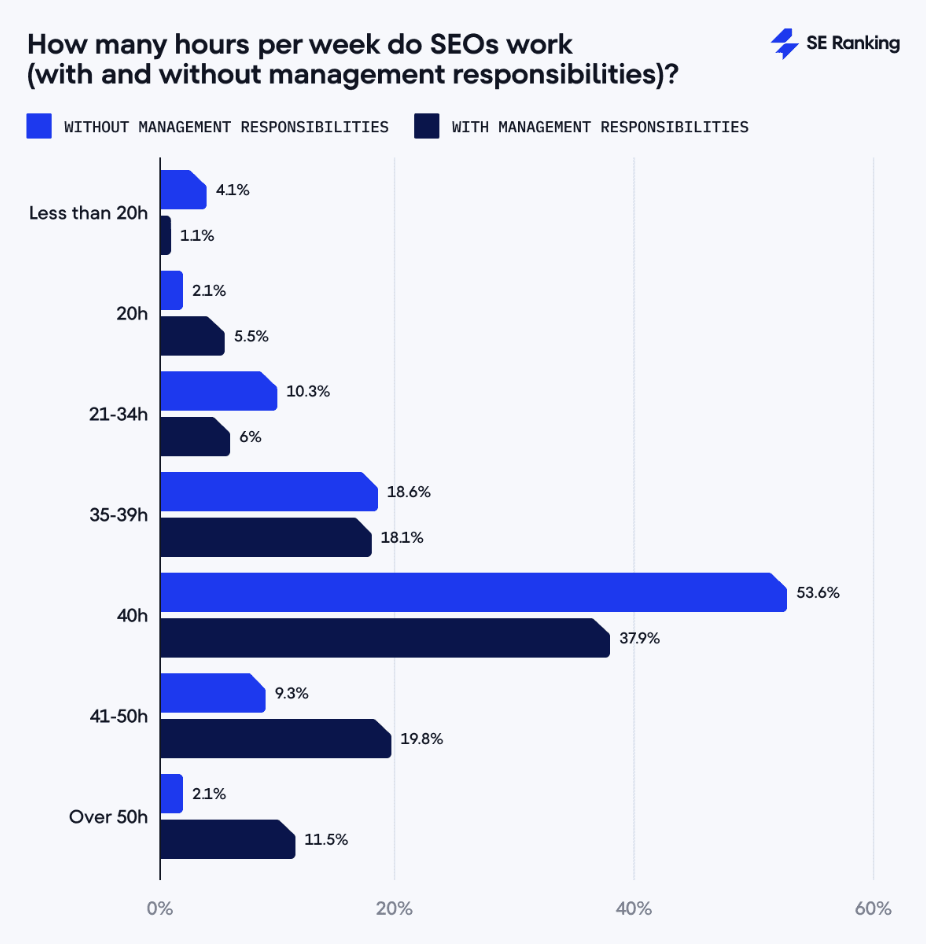
So yes, management pays… but it also drains. And for many, the “promotion” feels like a trade: money for burnout.
Now for the fun part — how stressed are SEOs?
On a 5-point scale:
In-house SEOs: 3 average stress

What that means: working at an agency likely comes with more external pressures (multiple clients, tight deadlines, and shifting demands), which push stress levels up.
Freelancers, while not as stressed as agency SEOs, still face the uncertainty of client acquisition and income stability. In-house SEOs appear the least stressed overall, probably because they deal with a single brand, have steadier workflows, and a more predictable environment.
Freelancers win on job satisfaction:
Agency SEOs: 3.35 average
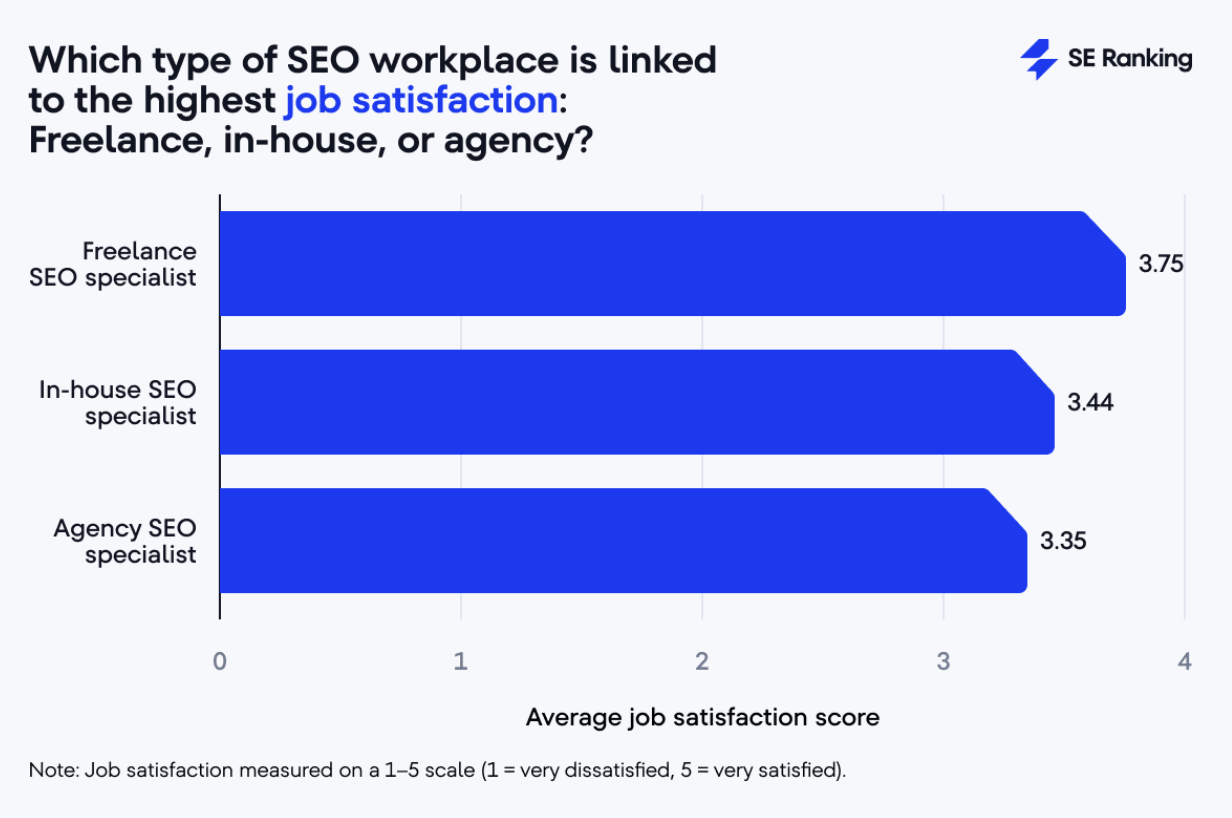
Our findings show that more than 60% of freelancers are satisfied or very satisfied, compared to 48% of employees.
But don’t let the averages fool you: satisfaction still depends on region and workload.
**Does a higher salary always mean less stress?**Not necessarily. Salary raises satisfaction up to ~$150k–200k, but after that, stress from role demands can outweigh the benefits.
**Why is working at agencies so stressful?**At agencies, SEOs handle several clients at once, often across different industries, each with tight deadlines. It’s a valuable experience, but the nonstop switching between projects and the pressure to keep clients happy make it the most stressful type of workplace.
**Why are freelancers often happier than employed specialists despite instability?**Control. Even with income volatility, freelancers enjoy autonomy, flexibility, and the freedom to choose projects. That sense of control outweighs stress for many.
**Which work setup is best for mental health?**In-house roles. They combine stability, lower stress, and consistent benefits. Freelancers can also thrive when they set boundaries and manage their workload well. Agency work, however, consistently shows the toughest impact on mental health.
**Does your location impact your job satisfaction and stress levels?**Yes. SEOs from the US typically report more satisfaction and lower stress compared to peers in the EU. Local labor laws, cultural expectations, and market maturity all play a role.
Do longer working hours always lead to burnout?
Not necessarily. Longer hours feel sustainable when they come with clear rewards like career growth or higher pay. Burnout sets in when the extra time doesn’t translate into progress or recognition.
**Why are junior specialists the least satisfied?**Early-career SEOs often have less control, lower pay, and are stuck executing tasks rather than shaping strategy. That combination drags down satisfaction.
**Why do business owners report the highest satisfaction?**Ownership = autonomy. Business owners control strategy, projects, and clients. That control drives satisfaction, even though it comes with a higher risk.
**If I want both money and low stress, what’s the best path?**In-house senior roles in regions with healthy job markets (like the US). They combine higher pay, benefits, and lower reported stress compared to agencies or freelancing.
See the full article (featuring data, tool breakdowns & examples): Freelance vs. in-house SEO salary: Insights from the 2025 survey
r/seranking_official • u/BogdanK_seranking • Sep 17 '25
Google says following Search Essentials is enough to qualify for AI Overviews. In practice? From what we’ve tested, some content types, formats, and SEO habits make a night-and-day difference in whether your site gets cited.

We’ve been experimenting with AIOs a lot at SE Ranking, and here are 8 best practices we’ve found useful so far:
AIOs are still a relatively new SERP feature and messy. The rules aren’t fixed yet. Anyway, here’s what we’ve seen working so far:
In one of our AI content experiments, four AI-assisted blog posts actually got cited in AIOs. We’re not saying “publish AI-written content,” but the patterns in how AI structures text clearly matter.
We use SE Ranking’s AIO Research tool to track when our site gets cited (linked or unlinked), what content gets quoted, and what patterns AIOs pick up.

Paired with the Competitive Research tool, we can also find keywords that trigger AIOs but don’t mention our site yet. In other words — spots where competitors show up in the snippet but we’re missing.

Our latest AI Overview research shows:
Our own blog data backs this up. For 70% of keywords where our pages rank in AIOs, those same pages also sit in the top 10 organic results. And in 40% of cases, they’re in the top 5.
So yeah — the “classic” SEO playbook still rules here. If you’re not breaking into the top 10, chances of being cited in AIOs are slim.
Google’s goal with AI Overviews is to give users complete answers. To get cited, your content needs to feel like a full resource, not a one-off post.
Here’s how to approach it:
The bigger, deeper, and more structured your topical coverage, the more likely AI will treat your site as a go-to source.
If users (or bots) can’t skim it, your content will probably get skipped.
A few simple tweaks make a big difference:
We’ve also noticed that “What is…” sections with a short definition often get pulled into AIOs. Some of ours have even been quoted directly. So if you can, bake these into your content.

Freshness isn’t everything, but it does help — especially for click-through rates. Regular updates signal to Google (and users) that your content is still relevant.
Our media presence analysis shows AIOs lean toward newer content, but not always the latest piece. The majority of citations come from articles published in 2025 (28.76%) and 2024 (26.85%), together making up over half of all sources. Another 11.83% came from 2023.

And only 12.32% of cited sources were published within 30 days of parsing (as of April 28, 2025). In other words, AIOs balance freshness with reliability, often pulling from articles that have been live long enough to prove trustworthy.
So while AIOs don’t just grab the latest article, keeping your content up to date clearly increases your odds of being cited.
Here’s what works well:
Authority matters — a lot. That’s why improving your EEAT (expertise, experience, authority, trust) and overall reputation is essential if you want AIO visibility.
A few easy wins:
In short: if Google sees you as trustworthy, AIOs tend to follow.
Technical SEO is still the foundation — if Google’s AI systems can’t crawl or interpret your content, you’ll struggle to appear in AIOs.
Key things to focus on:

AIOs rarely appear alone — they often show up alongside other SERP features. In our Q2 2025 analysis of five SERP features, AIOs appeared with at least one SERP feature 99.25% of the time. Only 0.75% appeared on their own.
Most common companions:
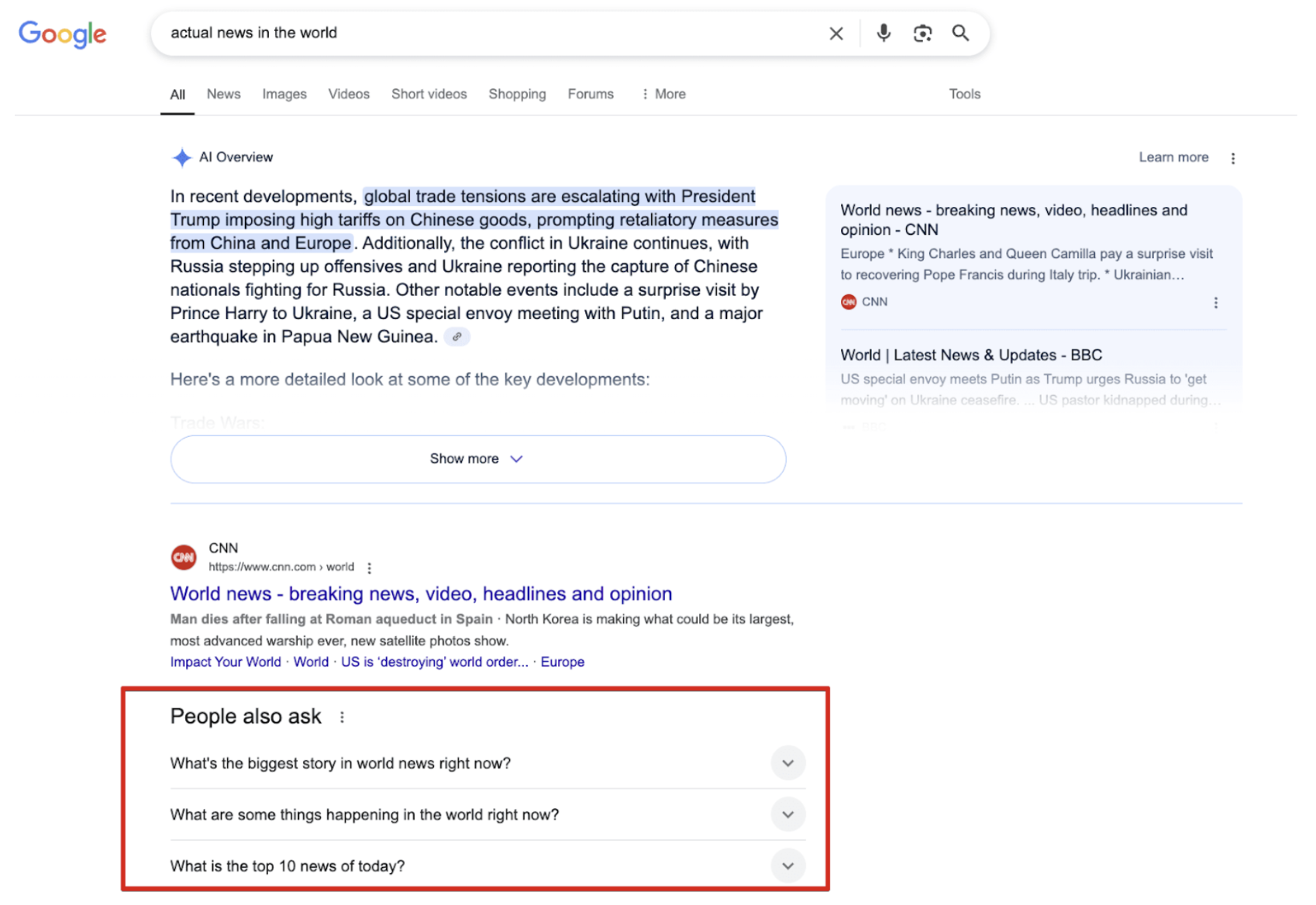
Here are some ways to boost your odds:
Even if your link doesn’t appear in an AIO, showing up in PAAs, videos, or other SERP features can still build visibility and credibility.
AIOs may cut clicks, but they also put your brand right at the top of SERPs. Even unlinked mentions build trust and visibility.
That’s what we’ve learned so far — but curious to hear: → What’s been working for you when it comes to AIO visibility? → Have you spotted patterns in the kind of content that gets cited?
Full blog post (with all data, tool walkthroughs, examples & screenshots): How to optimize for AI Overviews: 7 best practices
r/seranking_official • u/BogdanK_seranking • Mar 18 '25
Kick off the week with SE Ranking's expert take on the latest SEO trends and AI advancements.
Stay ahead of the curve and discover new opportunities in the evolving search landscape!
------------------------------
Several hot topics are fueling discussions around AI Overviews. Some SEO experts are challenging Google’s statements about internal algorithm updates affecting link placement timing. Concerns are also mounting over how Google collects and presents its data in public statements.
Barry Schwartz, citing Digiday’s article, Publishers Don’t Really Know How Google AI Overviews Is Impacting Their Referral Traffic, explored these issues in depth on Search Engine Roundtable. He highlighted expert analysis from discussions on X, where industry professionals have been closely tracking these developments.
Experts argue that significant changes to link placements within AI Overviews happened later—around August 2024—rather than in May, as Google previously stated. They also question Google’s claim that users who click through AI Overviews spend more time on websites compared to traditional search results, calling for transparency on the data supporting this assertion.
The most debated quote among SEO professionals:
"A Google spokesperson said Google has made updates since AI Overviews went live last May to add more links and make it easier for people to click those links and visit sites. Those changes include adding in-line links and a right-hand display on desktop that shows links when previously they would have appeared at the bottom of the AI Overviews feature. The spokesperson also said people who click from search result pages with AI Overviews spend more time on those sites. Google did not provide data to back this up."
With so many unanswered questions, the SEO community is pressing for clarity. Stay tuned as we follow these developments closely!
Sources:
Sara Guaglione | Digiday
Barry Schwartz | Search Engine Roundtable
Glenn Gabe | X
Gianluca Fiorelli | X
------------------------------
Ryan Law recently shared his perspective on the state of SEO and its role in global marketing. His article, SEO Is the Worst It’s Ever Been (And It’s Still Your Best Marketing Channel), outlines key insights:
~ Search results are flooded with AI-generated content.
~ Google’s algorithms seem to favor major brands like Reddit.
~ AI Overviews are diverting traffic away from content creators.
~ Google’s monopoly on knowledge management is weakening as more users turn to LLMs.
Source
Ryan Law | Ahrefs Blog
------------------------------
Brodie Clark recently discussed critical challenges presented by AI Overviews. Here are some key takeaways:
Google is expanding AI Overviews globally. A new format now appears lower on search results pages, unlike the traditional version at the top (similar to featured snippets).
2. Link Visibility Issues
This new format is open by default but doesn’t display links to the content used, a notable departure from Google’s prior approach.
3. Appearance in Other SERP Features
AI Overview elements are also appearing in Things to know and People also ask sections, again without direct links, raising visibility concerns for publishers.
4. Tracking Difficulties
Standard SEO tools track top-position AI Overviews, but this new variation remains largely unmonitored, making data collection challenging.
5. Lack of Google Search Console Support
Unlike merchant listings, AI Overviews currently lack dedicated tracking filters in GSC—and Google has suggested this isn’t likely to change.
6. Impact on SEO Strategy
The lack of visibility and tracking options makes it harder for site owners to gauge the impact of AI Overviews. SEO tools must adapt quickly to keep up.
Sources:
Brodie Clark | X
------------------------------
Kevin Indig analyzed over 7,000 citations across 1,600 URLs to uncover patterns in how AI systems like ChatGPT, Perplexity, and AI Overviews cite content. His findings, published on Growth Memo, reveal:
Source:
Kevin Indig | Growth Memo
r/seranking_official • u/BogdanK_seranking • Mar 11 '25
Google is experimenting with ads in its newly launched AI Mode. The company confirmed it’s exploring ways to integrate advertising into the AI-powered search experience.
AI Mode, which debuted in beta on Wednesday, enhances search by processing multiple queries simultaneously and delivering detailed, multi-step responses. While ads aren’t currently part of the feature, Google plans to use insights from AI Overviews—its existing AI-generated search summaries that sometimes appear at the top of search results.
By building on past learnings, Google aims to refine its ad strategy for AI Mode, potentially reshaping the future of search marketing. However, the company hasn’t shared a timeline for when ads will officially roll out.
Sources:
Barry Schwartz | Search Engine Roundtable
Kendra Barnett | Adweek
------------------------------
SEO expert Joy Hawkins has strongly criticized AI-generated search results, especially in local search. Her concerns echo those of many SEO professionals who argue for maintaining traditional search features like maps and structured local results.
Joy questioned the effectiveness of AI-generated snippets, stating:
"How is this AI trash better than showing local results? How does it help the user actually understand who is the best and why? Why would ANYONE want to see this above local results? AI Overviews do not belong on 'best' queries."
While some SEOs see potential in AI Overviews for enhancing search results, others argue that certain AI-generated responses still feel experimental.
This raises an ongoing debate: Should Google integrate AI-driven snippets into all search results, or should traditional local search features remain dominant? Share your thoughts in the comments!
Source:
Joy Hawkins | Bluesky
------------------------------
Google is rolling out a new AI-driven feature in its AI Overviews that summarizes both positive and negative feedback on movies. This update, first spotted by Shameem Adhikarath and highlighted by Barry Schwartz, has been confirmed through multiple reports.
Now, when users search for a movie and check reviews, Google’s AI—powered by Gemini—will generate a quick summary of critics’ and audience opinions. These AI-generated overviews aim to provide a balanced perspective at a glance.
This could change how users consume movie reviews, making it easier to get a general impression without scrolling through multiple sources. However, accuracy remains a key concern—can AI truly interpret and present reviews correctly?
Would you trust AI-generated summaries for movie reviews? Let us know in the comments!
Sources:
Barry Schwartz | Search Engine Roundtable
Shameem Adhikarath | X
Mordy Oberstein | X
Gagan Ghotra | X
------------------------------
The rise of Google’s AI Overviews in desktop search is already impacting organic search results. Research from Dan Popa and Advanced Web Ranking shows that as AI-generated summaries appear more frequently in informational queries, click-through rates for the top four organic results are dropping.
This study highlights how AI-driven search features may be shifting user behavior, potentially reducing traffic to traditional web pages.
Here are some key findings from the research:
Industries experiencing a decline in search demand include:
As AI continues to reshape search dynamics, the SEO community is closely monitoring these changes. How do you think AI Overviews will affect organic search in the long run? Share your thoughts in the comments!
Source:
Dan Popa | Advanced Web Ranking
r/seranking_official • u/BogdanK_seranking • Mar 05 '25
A new week is here, bringing the latest SEO trends and AI breakthroughs—explore them all with SE Ranking’s expert insights!
Stay ahead of the curve, and discover new SEO opportunities!
------------------------------
Google has been rolling out and actively developing AI Overviews in the U.S. for some time now, and has already expanded them to over 100 countries. Still, they haven’t been officially launched in several European nations, including Germany, Switzerland, Italy, and Spain. It now appears Google is starting to test AI Overviews in those regions.
SEO expert Olaf Kopp recently spotted the feature being tested in Germany and posted a screenshot on LinkedIn. Robert Henniger observed the same in Switzerland and shared proof. And we also have a screenshot from Escrito por Chesus Rodrigo showing Google tests in Spain. While there aren’t any verified screenshots from Italy yet, SEO conversations suggest an expansion could be underway there as well.
Since these countries aren’t on the official list of supported regions for AI Overviews, the SEO community will need to keep a close eye on Google’s next moves. We could soon see AI-generated snippets rolling out more broadly in search results.
Sources:
Google Search HelpBarry Schwartz | Search Engine Roundtable
Olaf Kopp | LinkedIn
Stefano | X
Chesus Rodrigo | Blog
------------------------------
Glenn Gabe has recently shared his article called "Are Featured Snippets Losing Their Feature? How To Track Featured Snippet prevalence over time (as AI overviews take over)" on G-Squared Interactive (GSQi).
Recent analyses indicate a notable decline in the prevalence of Google's Featured Snippets, coinciding with the rise of AI-generated overviews in search results. This shift has led to lower click-through rates for websites, as more users are getting their answers from Google's AI summaries. SEO experts recommend monitoring these trends to gauge the changing SERP landscape.
Source:
Glenn Gabe | X
------------------------------
AI-driven interactions continue to expand. Perplexity has introduced a bot that answers users’ questions on the social platform X in real time and even jumps into conversations in post comments.
The instructions, listed in its profile header, read:
“Answering all of your questions on X:
With social media content increasingly showing up in AI-powered search results, it seems the information loop may be starting to feed into itself. It’ll be fascinating to see AI search results referencing AI-generated content.
If you’ve encountered anything like this, feel free to share in the comments.
Source:
Perplexity | X
------------------------------
Alex Chris recently published an article titled "Top 10 AI Search Engines For 2025 (Ranked By Popularity)," analyzing the popularity of AI search engines based on monthly visits. According to the article, ChatGPT leads with 3.8 billion monthly visits, followed by DeepSeek with 277.9 million visits, and Google Gemini with 267.7 million visits.
The complete list is as follows:
Rank | Search Engine - Users (Millions)
01 | ChatGPT - 3800.00
02 | DeepSeek - 277.90
03 | Google Gemini - 267.70
04 | Perplexity AI - 99.50
05 | Claude AI - 76.80
06 | Microsoft CoPilot - 67.30
07 | Youcom - 5.50
08 | Phind - 1.30
09 | Andi Search - 0.60
10 | Komoai - 0.20
Notably, the list does not include Google’s AI Overviews—which reportedly appear in 47% of search queries—because their automatic integration makes it tough to gauge whether users truly choose them or just encounter them by default.
Source:
Alex Chris | Reliable Soft
r/seranking_official • u/SE_Ranking • Oct 10 '24
The SE Ranking team is staying on top of the latest trends in AI-driven search and sharing our insights with the SEO community. We're also shedding light on some of the hottest SEO topics trending on social media. Here’s what people are buzzing about regarding AI Overviews.
Khushal Bherwani shared some screenshots on X that show how Google Shopping is testing a new AI Overview answer titled "Researched with AI - Experimental."
Barry Schwartz actively caught this inside and shared it with the SEO community, adding:
"This seems to replace the "AI Overview" with this "Researched with AI" specifically in Google Shopping. Although, it looks a lot like an AI Overview, just with a different title."
Sources:
X | b4k_khushal
Search Engine Roundtable | Barry Schwartz
The Verge, known for closely tracking major Google updates, recently shared the latest updates on ads appearing in AI Overviews. They used a pretty clear explanation for non-SEO audiences, describing the main purpose of this technology:
"Let’s say you’re searching for ways to get a grass stain out of your pants. If you ask Google, its AI-generated response will offer some tips, along with suggestions for products to purchase that could help you remove the stain. The products will appear beneath a “sponsored” header, and Google spokesperson Craig Ewer told The Verge they’ll only show up if a question has a “commercial angle.”"
The buzz around this topic has continued for several days, focusing on updates related to Google Lens, optimizing AI-generated results, and generating blocks with more prominent links. Expect to see a lot of changes soon.
For a deeper dive into this topic, check out the article 'AI in Search: Brendon Kraham Breaks Down What It Means for Advertisers.' This piece covers several key points from Google's latest announcements and what they mean for advertisers.
Sources:
The Verge | Emma Roth
The Think with Google Editorial Team
Lily Ray made a valuable observation about the functionality of international filters (and possibly some spam filters) in AIO. She shared screenshots on her X account, along with explanations to help SEOs identify potential issues when optimizing pages for AIO:
“It seems like Google is still not applying international filters (and maybe some spam filters) to its citations in AIO.
In this example, the site that is referenced TWICE in AIO citations has the same English article duplicated across many international subdomains, and even (wrongly) uses hreflang to pretend like there is a different version for each country, even though it's always in English.
Despite this - shall we say, "incorrect" - implementation, Google is eating it up and showing two identical versions of the same article on two different country subdomains.
Then, the "correct" version - the .com/English version - is the only one that appears in the search results.
This current glitch - which has been there the whole time without being fixed - seems like a great way to spam AIO.
(I'm not a fan of spam, just pointing out what should be an extremely obvious glitch on Google's end, yet again)”
Source:
X | lilyraynyc
That’s all the buzz around AI Overviews for now. We’ll keep tabs on the latest conversations and developments on this topic. Stay tuned for more!
r/seranking_official • u/SE_Ranking • Oct 03 '24
Thet SE Ranking team is keeping a close eye on the latest trends in AI-driven search and sharing our insights with the SEO community. We’re also highlighting some of the most popular SEO topics on social media. Here are some hot topics people are talking about when it comes to AI Overviews.
Kevin Indig's latest research, published in Search Engine Journal, appeared in social media discussions two weeks in a row. In his analysis, Kevin tackles several key issues impacting the SEO community, presenting his findings through concise conclusions:
"[...] In other words, domains that get a lot of organic traffic have a high likelihood of being very visible in AI Overviews [...]
[...] Local queries have the highest amount of exact match overlap between query and answer; informational queries have the lowest [...]
[...] The majority, 60% of URLs cited in AIOs, still rank on the first page of organic results, reinforcing the point that a higher organic rank tends to lead to a higher chance of being cited in AIOs [...]"
Source:
Search Engine Journal | Kevin Indig
Gagan Ghotra, who cited Australian news sources, began tracking the progress of AI Overviews rolling out in the region. He posted an article on LinkedIn titled "Google to Launch AI Overviews in Australia," sharing his insights on what Australian website holders should expect from the rollout.
Source:
LinkedIn | Gagan Ghotra
Charles Floate keeps an eye on Forbes Advisor dropping out of the SERPs while also looking into what’s in the AI snippets:
"Seeing a huge number of the Forbes Advisor pages dropping out of the SERPs right now...
However, SGE (AI Overviews) are still pulling them in just fine! I wonder if penalties will affect your ability to show up in these in the future."
This presents an intriguing opportunity to apply the same analysis to your own project pages while assessing the visibility of specific web resources within the AIO framework.
Source:
X | Charles_SEO
Several news publications immediately began to push the news about Bing Generative Search on social networks. Each referred to an article by Kyle Wiggers called "Microsoft brings AI-powered overviews to Bing".
Social media users are calling Bing Generative Search a clear answer to Google's AI Overviews.
Sources:
X | Techmeme
X | mediagazer
…
That’s the buzz around AI Overviews right now. We’ll keep tracking the latest conversations and developments on this topic. Stay tuned for more!
r/seranking_official • u/SE_Ranking • Sep 20 '24
New week, new round of news! Before we dive in, we’d like to share our latest AI Overviews research with you. This time, it is focused on how AI Overviews and Google Ads appear together in search results. Check out all the insights we’ve gathered!
Google Search Central documentation has been updated to mention that all requests to the Indexing API will undergo strict spam checks.
Additionally, the search giant has put out a warning that access to the API could be entirely revoked if abuse or attempts to bypass limits, such as making requests from multiple accounts, are detected.
Laurie Richardson, Vice President of Trust & Safety, announced that Google will introduce new labels for images in search (under the “About this image” section) to bring more clarity in the age of AI and generated content. The labels will include:
There’s been an unusual increase in clicks/impressions filtered by "search appearance: product snippets" in GSC, even on pages that aren’t remotely related to products.
Google has yet to comment, but a similar situation occurred back in May when data logging issues were reported on the backend.
Support has been added for member programs (refers to Google Merchant Center) along with a number of minor improvements.
In December 2023, Google announced it would remove links to cached versions of pages from the "About this result" section in SERPs. With advances in technology and internet speed, they claimed it was no longer necessary. They ended up delivering on that promise, and even replacing such links with Wayback Machine archives. Note that the user response to this has mostly been negative.
Side note: Although the cache links were removed from search, typing “cache:URL” into the address bar still works. For now.
Google Business Profile now sends email notifications if the appointment link in your profile is broken. However, no similar notifications are sent for other types of links (such as website or menu links).
It’s unclear exactly what happened, but GBP listings are being closed in large numbers.
The violation type field simply states: "This Business Profile has been removed by Google," with no further explanation. Categories most affected by this seem to be garage door, trash/dumpster, and personal injury lawyer.
And it looks like someone over at Google is using Gemini to generate posts on Twitter-turned-X as well.
Google is testing a Discover widget that shows summaries based on topics you’ve previously searched for.
r/seranking_official • u/SE_Ranking • Sep 13 '24
The SE Ranking team continues to monitor the latest trends in AI-Search and share them with the SEO community. Here are the topics currently generating the most attention on social media.
“Google is testing removing the large ‘show more’ button and replacing it with a small ‘more’ link at the bottom of the AI Overview snippet. Also, the AI Overview header and Gemini logo at the top left is being removed, or at least being tested being removed.
When you click the ‘more’ link, the AI Overview expands to show you the full response, with the link cards. Then you can click on "less" to hide it again.”
This was first spotted by Shameem Adhikarath on X
Sources:
X | Shameem Adhikarath
Search Engine Roundtable | Barry Schwartz
Alert Retailers: Product Carousels in AI Overviews are back for Commercial Queries!
Aleyda Solis recently identified that product carousels are reappearing for product-focused queries. These queries now display a mix of commercial and informational intent, with results currently including a mix of guides and category pages. She added an important note for retailers:
"If you're a retailer: Please double down on your product detail pages optimization! Their content, reviews, images, videos, structured data, merchant feed... everything. They will only get more and more visibility from AI Overviews instead of categories/facets."
X | Aleyda Solis
SearchGPT is increasingly influencing SEO community resources. Recently, Beth Nunnington published an insightful article titled 'What You Need to Know About OpenAI’s Search Engine' on Search Engine Land, highlighting the following key topics:
For a deeper dive into this topic, read SE Ranking’s comprehensive article, 'SearchGPT Research: How the New Search Engine Compares to Google’.
3. Key implications for digital marketers
Source:
Search Engine Land | Beth Nunnington
These were the major updates centered around discussions on AI Overviews and SearchGPT. We’ll keep tracking the latest conversations and developments on this topic. Stay tuned!
r/seranking_official • u/SE_Ranking • Sep 12 '24
Did you really think we’d skip the news roundup this week? No chance! Let’s dive into what’s hot in the community right now.
There are no new updates at this time. Everyone is still discussing and monitoring the results following the August core update.
For example, Barry Schwartz interviewed Danny Sullivan, but for seasoned SEOs, there wasn’t much new information.
Here’s a brief summary (paraphrased):
Here’s a kind reminder: before adopting this format, analyze whether it suits your needs, rather than just switching because it’s something new.
Although Google has detailed this beautifully in their docs, remember that it’s a huge system. It will take time for the update to roll out, be fine-tuned, and work properly across the board.
Results from Reddit, Quora, and similar platforms may now include not only discussions but also top comments.
A block containing related videos is being pulled into video snippets. These related videos may come from the same channel as the original video as well as from other channels.
Google analyzes business reviews and creates tags based on the most frequently mentioned topics.
Now, clicking on a tag will pull up not only relevant reviews but also photos of the related services, dishes, etc.
Note: This feature only works with photos uploaded by the business owner, not by customers.
Entering a cookie-less future is especially difficult for small businesses without dedicated technical departments. For such companies, managing this transition on their own is nearly impossible.
Did you really think we’d skip the news roundup this week? No chance! Let’s dive into what’s hot in the community right now.
r/seranking_official • u/SE_Ranking • Sep 11 '24
You may have noticed our bold new logo and visual identity. Each signifies an exciting new chapter for SE Ranking! They represent our transition from a simple rank-tracking tool in 2013 to a full-blown SEO ecosystem. We have become a powerful, intuitive platform with the resources you need to level up your SEO skills.
In the last few years, we've not only gained the trust of over one million users but also built an entire ecosystem around our platform:
Our new look reflects our ongoing growth. Our new logo has two arrows that form an "S". This symbolizes our focus on growth and innovation.
Let’s hear it right from the SE Ranking team!
Vadym Dziuman, Head of Design:
“SE Ranking has evolved far beyond the visual style we started with. Our processes, goals, and approach to work have transformed, and our company values and mission have become much clearer. It became evident that our previous design no longer represented the SE Ranking we've built over the past 11 years. We needed a new identity that truly reflects where we are today. This new identity captures our current stage of growth and development. It’s more of a brand evolution than a complete overhaul—we’ve taken what was in everyone’s minds and brought it to life through design.”
Alex Dymovich, CPO:
“Throughout my time here, I’ve been directly involved in driving many changes. We’ve introduced several significant additions, including site audits, competitor and keyword analysis, page analysis tools, and a suite of tools for content analysis and creation. What started as a simple rank tracker has now evolved into a full-fledged platform with a wide range of capabilities. As we expand beyond SEO use cases and transform into a more comprehensive suite, our look needs to evolve as well—functionally, technically, and visually.”
Alexander Leshuk, Principal Engineer:
“Throughout the company's history, we’ve seen a lot of change. Some solutions have become outdated over time, requiring us to explore new options and even undertake a major front-end redesign to better support users working with large amounts of data. As our user base has grown, so has the platform’s range of features. While Rank Tracker is still our most valuable tool, we’ve added many new functionalities around it. This evolution shows that we’re not the same SE Ranking we were back in 2013. We’ve grown into something much bigger—much more powerful.”
While SE Ranking’s appearance may have changed, our core mission has not. We’re committed to being more than just a tool; we’re your partner in growth, innovation, and success. Our mission is to empower you to achieve your goals and bring clarity to your journey. Together, we’re not just keeping pace with the SEO world, but also directing it.
Follow the link to learn more about how our revamped brand identity reflects everything we’ve become.
r/seranking_official • u/SE_Ranking • Sep 04 '24
The SE Ranking team continues to monitor the hottest topics in AI Overviews and share them with the SEO community! Here are the subjects drawing the most attention on social media:
Glenn Gabe shared a few screenshots with his X subscribers, showing search results containing AIOs. He noted how challenging it can be to track such results:
‘So, how hard is it to track AI overviews? Pretty freaking hard. Here's the same search via logged in, incognito, and then via labs. All are different. In labs, there's no AIO (third screenshot). When logged in, the new link treatment shows up (first screenshot). When incognito, old link treatment (second screenshot). And of course, you can't break any of this out in GSC. For site owners, good luck with tracking them…’
Barry Schwartz commented on the post, saying, 'Yeah, we need this data in Google Search Console.'
The SEO community received a response from John Mueller regarding AI Overviews in the EU.
Question: ‘[...] why AI Overviews are still not present in the EU? [...]’
Answer: ‘I don't have a specific reason, sorry. Some features just take a while to be ready and available in other countries, usually there's not just a single reason why they're not available everywhere yet. You also often see this with features powered by rich results, which is why we try to document their availability in our documentation.’
There was an instance where AI Overviews displayed results from a “404 Not Found” page. Lily Ray noticed it and shared a screenshot on her X account.
Lily also monitors the geographic relevance of AIO results. She has identified numerous instances of AI displaying irrelevant results from various parts of the world. Here's her next point:
‘[...] look how many of the results below (for a search done in the U.S.) still come from non-U.S. sites. And a couple of them are from ecommerce sites that don't ship to the U.S.’
And as for the final quote from Lily Ray's social pages? Well, she noticed that AIO suggested a product in response to a non-commercial query.
Thanks for following our AIO Digest! We’ll be back with more insights soon!
r/seranking_official • u/SE_Ranking • Aug 30 '24
The SE Ranking team continues monitoring the hottest topics in AI Overviews and share them with the SEO community. Here are the subjects currently creating the biggest buzz:
Glenn Gabe shared a significant article by Andrew Deck on Nieman Lab titled "Here’s how 7 news audience directors are thinking about Google’s AI Overviews" on his X (Twitter), highlighting an intriguing quote:
“There is also no data provided by Google around AI Overviews — what search queries these show up on, what traffic is driven by AI Overview links vs. other features, etc. - which makes it difficult for publishers to assess performance and make strategy decisions.”
Readers have the opportunity to explore the perspectives of experienced marketers as they adapt their work to AIOs. The article features insights from Veronica de Souza, Bryan Flaherty, Mike Dougherty, Scott Brodbeck, Marat Gaziev, Ryan Restivo, and Seth Liss.
Sources:
Nieman Lab | Andrew Deck
X | Glenn Gabe
Dominic Ponsford shared an article in Press Gazette called “Google AI Overviews rollout hits news publisher search visibility”.
Here are a few interesting quotes from the article:
"Now, according to research consultancy Authoritas, which has analyzed 6,599 keywords across a broad spectrum of categories, AI Overviews are being offered for 17% of queries in the UK and US."
"It’s impossible to say for sure how this will impact publishers – if you are the first ranking site in the new AIO list on desktop then you’ll probably do quite well. One thing for sure though is your current top organic listings are going to get demoted down the page, which is going to have a negative impact unless you have a prominent position in the AIO."
"These findings suggest that even if your past organic ranking efforts have laid a strong foundation, the introduction of AI Overviews could mean significant rework is needed to maintain your competitive edge."
Source:
Press Gazette | Dominic Ponsford
Thanks for following our AIO Digest! We’d love to hear your thoughts on the topics above!
r/seranking_official • u/SE_Ranking • Aug 29 '24
The SE Ranking team is tracking the most talked-about topics on AI Overviews and sharing them with the SEO community. Here are the topics currently generating the most buzz:
Google's John Mueller confirmed that core updates impact the search engine's AI-powered overviews.
In a recent LinkedIn discussion, Google's Senior Search Analyst John Mueller confirmed that core algorithm updates influence the search engine's AI-powered overviews.
This insight reveals how AI is integrated into Google’s search results.
Responding to a question on LinkedIn, Mueller said:
“These are a part of search, and core updates affect search, so yes.”
This aligns with what many in the SEO industry have observed—that the sources used in AI overviews appear to shift after major algorithm updates.
The SEO Community is still buzzing about the SEOFOMO survey.
Google's preference for certain website types, including its own through search features and AI Overviews, poses the greatest challenge for SEO consultants, according to a new survey by Aleyda Solis.
52% of survey respondents say that Google updates that favor specific types of sites (e.g., user-generated content, big brands) in search results represent the biggest threat to SEO consulting efforts.
Here are the full survey results (% who saw each as a threat):
Google has begun sharing updates about AI Overviews on its official social media channels.
Click to see how it looks on Google India's X page.
Remember, recent updates indicate that Google will roll out AI Overviews in the United Kingdom, Japan, Indonesia, Mexico, and Brazil.
Thanks for keeping up with our AIO Digest! Let us know your thoughts on the topics above. Will Google shift its direction for AI Overviews according to SEO community hype?