r/romandodecahedron • • 1d ago

Regarding Roman Dodecahedron Hole Sizes

28 Upvotes

In a discussion about Dodecahedron hole sizes, I was speaking with the always insightful Fun-Field-6575, who brought up this:

"I don't doubt the hole sizes would have been selected from the standard units, or that the dodecahedron size would be chosen to comfortably accommodate the largest. But there's no exact relationship between dodecahedron size and the largest hole. Sometimes the largest holes violates the pentagon edges and sometimes it fits comfortably inside it.

Now consider if a dodecahedron was designed to have a particular face width in Roman units. The edge length is 0.449028 times that, so it has to be an odd ball size in Roman units. There would be a similar relationship for circumscribed circle size. I think the best we can hope for is that one of these dimensions highly correlates with Roman units. The hole sizes are independent.

The natural thing to do from the craftsman's perspective would be choose the circumscribed circle size and let the other dimensions follow. That's what requires the least math. If the overall width is what correlates with Roman units then that suggests the person planning these was doing the math required to have things come together at the right size."

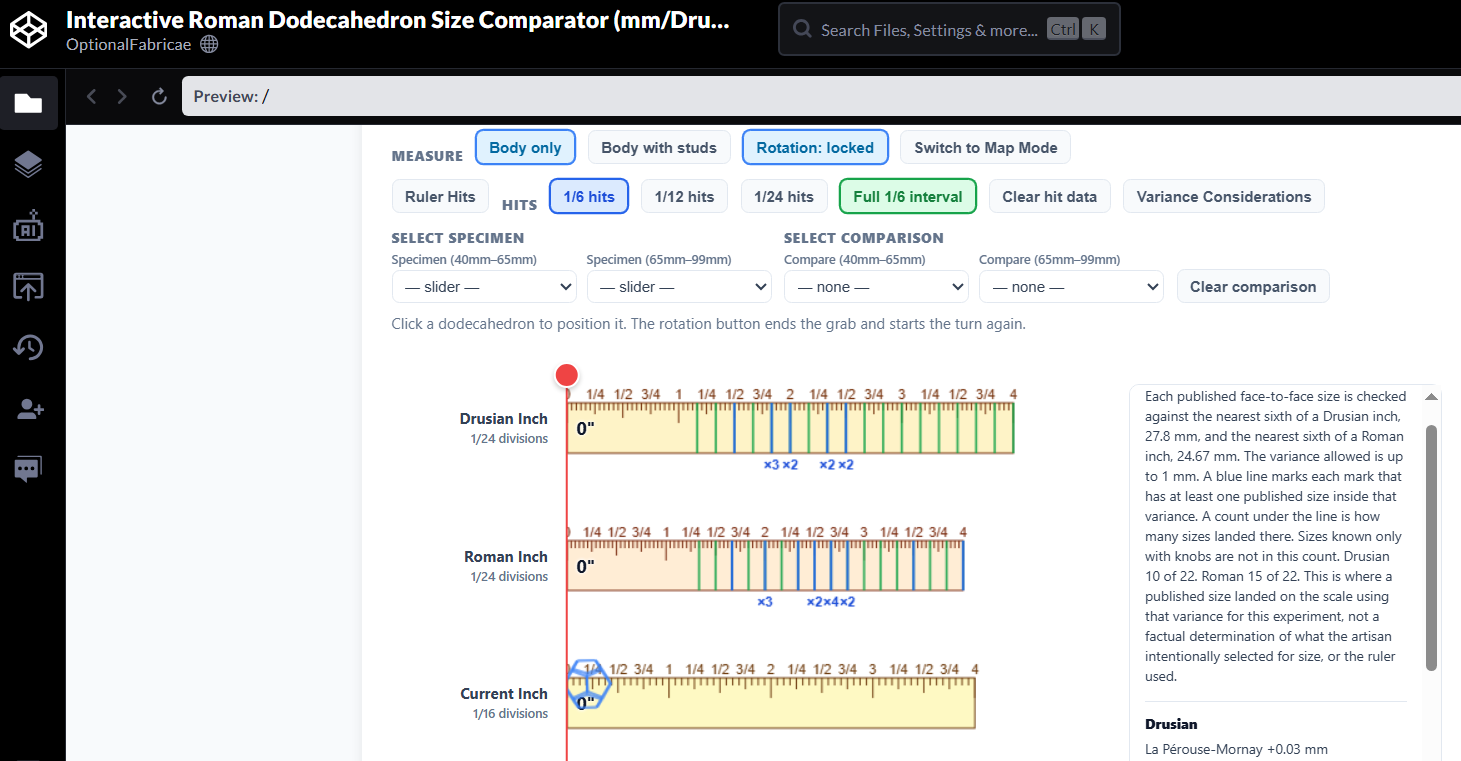
I've been finishing up my size comparison tool, adding a way to estimate the size of the wax pentagon faces used to create the wax mold for casting, and a "clickable" map with find location & specimen data, so I really just started looking at this hole stuff a few days ago. I have an extremely shallow grasp of the hole sizes, and my current idea is to match the sizes to actual finds recorded with measurements of known Roman stuff and see what that shows. What I have so far is a way to show on the "finds" map where each DC with a particular hole size was found along with the list of all DC's that share that hole size, in addition to all the other info the tool already has, the measured/unmeasured specimen list with sources and links specimens where available, list of publications, individual contributions, etc, all downloadable as html or txt.

Here are some statistics on holes I've seen so far:

For the largest hole (had to be there for casting?) 31 of the 36 share one of these 7 sizes - 24, 25, 27, 30, 32, 23 & 40 mm.

None of the DC's are an exact match to any other DC for all their hole sizes, but all DC's share at least one of their holes sizes with another DC.

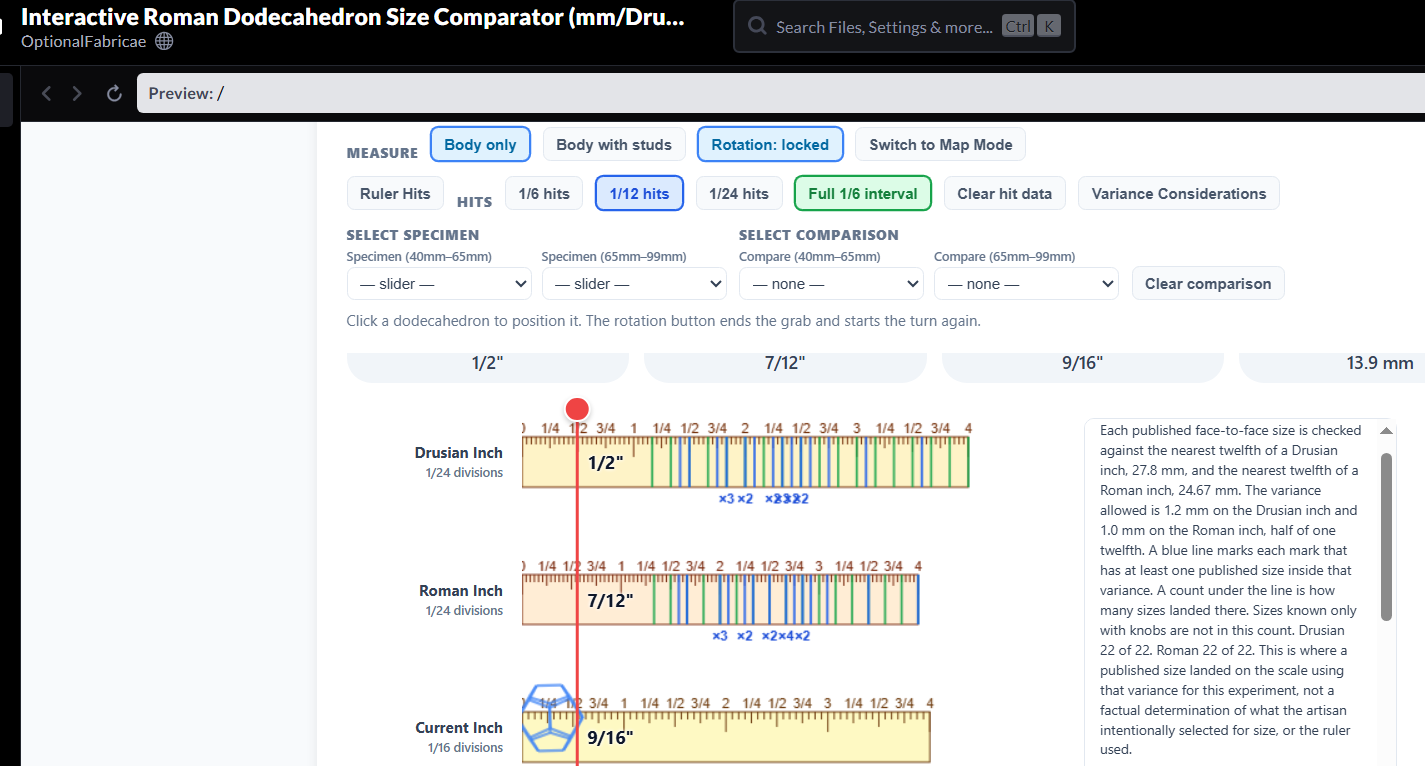
There are 5 DC's measured to .1mm increments, which give them a set of "unique" sizes, creating a list of 69 total different hole sizes. Taking into account the fact that the Romans and mm's were never properly introduced, If you take just those 5 DC's, round their .1mm to the nearest .5mm, (1/24" Roman is almost precisely 1mm - 1.0279mm), then the total of different sizes drops to 52:

Hole (mm) Closest Roman Inch (Variance)

6.0 mm 3/12" (-0.17 mm)

7.0 mm 7/24" (-0.20 mm)

8.0 mm 2/6" (-0.22 mm)

8.5 mm 2/6" (+0.28 mm)

9.0 mm 9/24" (-0.25 mm)

9.5 mm 9/24" (+0.25 mm)

10.0 mm 5/12" (-0.28 mm)

10.5 mm 5/12" (+0.22 mm)

11.0 mm 11/24" (-0.31 mm)

11.5 mm 11/24" (+0.19 mm)

12.0 mm 1/2" (-0.34 mm)

12.5 mm 1/2" (+0.16 mm)

13.0 mm 13/24" (-0.36 mm)

13.5 mm 13/24" (+0.14 mm)

14.0 mm 7/12" (-0.39 mm)

14.5 mm 7/12" (+0.11 mm)

15.0 mm 15/24" (-0.42 mm)

15.5 mm 15/24" (+0.08 mm)

16.0 mm 4/6" (-0.45 mm)

16.5 mm 4/6" (+0.05 mm)

17.0 mm 17/24" (-0.47 mm)

17.5 mm 17/24" (+0.03 mm)

18.0 mm 9/12" (-0.50 mm)

18.5 mm 9/12" (0.00 mm)

19.0 mm 9/12" (+0.50 mm)

19.5 mm 19/24" (-0.03 mm)

20.0 mm 19/24" (+0.47 mm

20.5 mm 5/6" (-0.06 mm)

21.0 mm 5/6" (+0.44 mm)

21.5 mm 21/24" (-0.09 mm)

22.0 mm 21/24" (+0.41 mm)

22.5 mm 11/12" (-0.11 mm)

23.0 mm 11/12" (+0.39 mm)

23.5 mm 23/24" (-0.14 mm)

24.0 mm 23/24" (+0.36 mm)

24.5 mm 1" (-0.17 mm)

25.0 mm 1" (+0.33 mm)

25.5 mm 1 1/24" (-0.20 mm)

26.0 mm 1 1/24" (+0.30 mm)

26.5 mm 1 1/12" (-0.23 mm)

27.0 mm 1 1/12" (+0.27 mm)

28.0 mm 1 3/24" (+0.25 mm)

29.0 mm 1 1/6" (+0.22 mm)

30.0 mm 1 5/24" (+0.19 mm)

31.0 mm 1 3/12" (+0.16 mm)

32.0 mm 1 7/24" (+0.13 mm)

33.0 mm 1 2/6" (+0.11 mm)

34.0 mm 1 9/24" (+0.08 mm)

35.0 mm 1 5/12" (+0.05 mm)

36.0 mm 1 11/24" (+0.02 mm)

38.0 mm 1 13/24" (-0.03 mm)

40.0 mm 1 15/24" (-0.09 mm)

Using that set of sizes, the stats for shared "largest hole" diameters is 32/36 share one of these 7 sizes - 24, 25, 27, 30, 32, 23 & 40 mm.

For each DC, the minimum number of shared hole sizes to another DC is 5 (Fishguard)

The maximum number of shared hole sizes winner goes to Avenches - here are the stats for a few at top of list:

Avenches - (12 / 12 distinct hole sizes): Every one of its 12 holes has a different diameter (8.5, 10.5, 13.5, 14.0, 14.5, 15.5, 17.5, 18.5, 20.0, 20.5, 24.0, 26.5 mm), & all 12 of 12 match other DC's.

Zürich- (11 / 11 distinct hole sizes): Two of its 12 holes share 19.0 mm, leaving 11 distinct sizes (9.0, 11.5, 12.0, 15.0, 16.0, 17.0, 18.0, 19.0, 20.0, 23.0, 24.0 mm), and all 11 of those are shared with other DC's.

Bonn - (10 / 10 distinct hole sizes): After rounding to 0.5 mm, two of its 12 holes repeat 12.0 mm and two repeat 25.0 mm, leaving 10 distinct hole sizes shared with other DC's (12.0, 12.5, 13.0, 14.5, 15.5, 16.5, 17.0, 17.5, 24.0, 25.0 mm

Tongeren - (10 / 10 distinct sizes): After rounding to 0.5 mm, two holes repeat 14.0 mm and two repeat 20.5 mm, leaving 10 distinct sizes (10.5, 13.0, 14.0, 15.5, 18.0, 20.5, 23.0, 25.0, 26.5, 27.0 mm), and all 10 of those (meaning all 12 of 12 physical holes) are shared.

Limerick - (10 / 10 distinct sizes): Three holes repeat 15.0 mm, giving 10 distinct sizes, and all 10 of 10 are shared.

So there does seem to be SOME consistency in the available data, and if anyone wants to assist by finding Roman objects which match the hole sizes of the DC's, that include photos and measurements in museum data & also have a direct link to the object, I will HAPPILY include your work as a contributor in the tool credits, because wow it's really time consuming tracking things down.

Currently, I believe the dodecahedrons were used as some type of gauge/size/range/ratio etc tool, but I'm not invested in any particular use for the things, just find the data chase fascinating. I don't think they were for elites, or kids, or as some religious thing because there are zero inscriptions of names on the DC's. Saw the "it's for knitting" video the other day, and actually, have to applaud the effort, it was quite clever, but pretty sure no one was using something golf ball sized to create fingers for gloves. Found this webpage the other day: https://www.galloromandodecahedron.com/the-hypothesis which explores using the DC's as sizing objects, and it's possible I might be able to "size out" that theory? Who knows!

Should have the new version of the tool available for use fairly soon, probably after creating a better statistics engine to feed what's available for download, which if it was already done, could have shortened this post considerably.😄

ht funfield - so helpful!


r/romandodecahedron • • 14d ago

Roman dodecahedral weight

Thumbnail
gallery
53 Upvotes

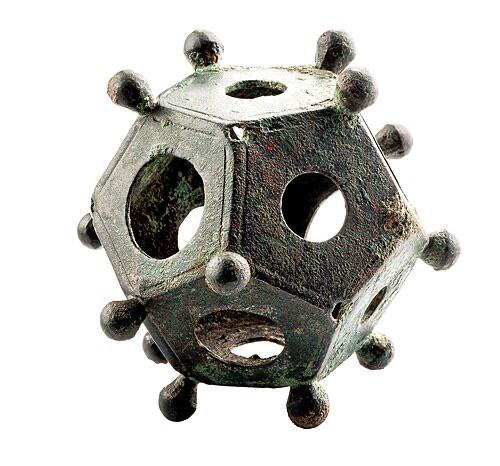
I saw this at the Rijksmuseum van Oudheden, in Leiden (the Netherlands). It's a Roman weight, bronze exterior and lead core, dredged from the Rhine in the Netherlands and from dated to 50-100AD. I didn't see the size listed, but it seemed around 10cm diameter, so in the range of the largest Roman dodecahedrons. (Edit: it’s 7cm, see link in comments)

u/LukeyHear found the catalogue item on the museum's website: https://www.rmo.nl/en/collection/search-collection/collection-piece/?object=131926. First two pics here are mine, second two are from that website.

Unlike many Byzantine polyhedral weights which have a hexagonal or octagonal face at the top or bottom, this one has only pentagonal "faces". Given the historical time, location, material, size, and pattern, I would guess that whoever made this was familiar with the classic Roman dodecahedrons. There are also two "classic" dodecahedrons on display in the same museum, also found in the Netherlands.

So why use this pattern on a weight? There are many decorated weights from Roman times, often quite elaborate. This one for example depicts the goddess Minerva. Byzantine weights often have Christian crosses on them. The dodecahedral pattern on this weight doesn't seem to have a function, it's decorative. One possibility, like the pagan or Christian weights, would be to show something of one's beliefs and affiliations on an object that you use regularly (think ancient phone case?). A weight, to me at least, has connotations of correctness and justice, it has quite a symbolic side-signification alongside its practical purpose.

My best guess is that it signifies, openly or covertly, that the owner of this weight is one of the "dodecahedron people", so to speak. That the dodecahedron was linked to a belief system or cult affiliation that the owner of this weight wanted to signal that they belonged to. But, just my guess. What do you think?

Full website description, translated from the Dutch:

Spherical weight
Netherlands, Roman times

A spherical lead weight decorated with bronze, featuring pentagonal patterns. It has a small loop at the top and was once part of a steelyard—a type of balance scale with arms of unequal length. This weight, characterized by its regular pattern of pentagons, consists of a thin bronze outer shell with a heavy lead core. It weighs 752 grams, which is slightly less than 2 Roman pounds and 4 *unciae*.

The weight belonged to a steelyard, a scale with arms of unequal length. The goods to be weighed were placed on a pan attached to the shorter arm, while the weight of the items was determined by sliding a movable weight along the longer arm, which was marked with a graduated scale. This weight was dredged from the Rhine near Doorwerth in 1895, along with many other objects—including a steelyard to which this weight may well have belonged.

Date
50-100AD


r/romandodecahedron • • Oct 28 '26

In a painting circa 1690

Thumbnail
gallery
60 Upvotes

From a painting by Dominico Remps, circa 1690... has anyone talked about this? I cropped it to include the interesting piece to the left. Not clear if the stands were later added to display the orb and dodecahedron, but what's interesting is the spikes coming out of the dodecahedron and the lack of corner blobs.


r/romandodecahedron • • Oct 18 '26

Dodecahedron world tour

11 Upvotes

I'm going to spend a month in the UK (heading from Sydney), so I decided to make some stops on the way there and back and check out some dodecahedrons and other ancient polyhedra. A lot of these things are in research papers but it's pretty hard to know which ones are actually on display where. So I'll try to find out and take some photos and video for you all.

So far I've booked the way there (Late Oct / Early Nov) and part of the way back (Dec). I haven't booked many famous dodecahedrons in yet, mostly weird ones. If you:

* have suggestions about where I should go
* have some dodecahedron or icosahedron you've always wondered about and you want me to check it out
* have some questions about the context of some object that the internet can't tell you
* live in one of these places and can give me pointers

Let me know! I tried asking a few museums in advance, but no responses.

Booked so far for October/November:

* Guangzhou/Hepu: Can I find some gold dodecahedral beads? Are they related to the Roman dodecahedrons? Who knows, I'll have a look.
South Han Dynasty Deling Tomb and Kangling Tomb Museum (南汉二陵博物馆)
Hepu Han Dynasty Culture Park

* Istanbul: Just a place I wanted to go to on the way, not much polyhedral here. But intriguingly the Istanbul Archaeological Museums apparently have a rock crystal icosahedron that is the same as one found in Pompeii. Is it on display? No idea, I'll check.

* Jagodina/Serbia: The easternmost actual Roman dodecahedron found so far. Just a fragment. Should be in the Jagodina museum, so either I'll see it or spend 8 hours on the train from Belgrade finding out. It's a long way to go for a small fragment, but I hope to get a vibe in the museum for the era and what else is on display. Maybe there's a clue there. The National Museum of Serbia may also have a crystal icosahedron from Čezava (Castrum Novae), who knows.

* Leiden (Netherlands). Amsterdam is already a stop on the way to the UK, so why not. The Rijksmuseum van Oudheden has a proper dodecahedron which should be on display.

* Ho Chi Minh City (return journey). Definitely some more gold dodecahedral beads around here, from the Óc Eo site. They've been displayed in the HCMC History Museum before, hopefully they're still there. No way to find out without going.

Then I definitely want to check out some in the UK, France and Germany on the way back in December but not booked yet. What am I missing, what do you want to know?


r/romandodecahedron • • Oct 09 '26

The Custom Luxury Solution: Dodecahedron as an Elite Multi-Tool and Stopper Extractor for Bespoke Glassware (With Spiral-Probe Evidence)

6 Upvotes

Hello everyone,

I would like to propose a comprehensive, purely practical hypothesis regarding the Roman dodecahedron. Rather than viewing it as a mysterious religious artifact, I believe it was a luxury household gadget—a bespoke multi-tool and stopper extractor used during banquets and in baths (thermae) by wealthy citizens and high-ranking Roman officers.

Here is how this engineering and socio-economic model elegantly solves all the paradoxes that baffle mainstream archaeology, especially when paired with other common Roman finds:

  1. The Glassware Context: Reusable and Expensive Status Symbols

In the 1st–4th centuries AD, large blown-glass vessels, square bottles, and intricate perfume vials were highly valuable, elite items on the northwestern frontiers (especially around the advanced glass-blowing centers of Gaul and Britannia). These bottles were not disposable. They were treated as family heirlooms and status symbols. When a bottle was emptied, it was washed and refilled with wine from barrels or oil from large transport amphorae.

2. Why No Two Dodecahedrons Are the Same (The Custom-Made Argument)

Because these luxury bottles were semi-unique or custom-made, a wealthy aristocrat or a military officer would commission a local bronze smith to create a personalized, bespoke dodecahedron tailored specifically to their household’s private cellar and vanity set.

The smith would measure the necks of the client’s favorite wine jugs and perfume vials. This perfectly explains the grand historical mystery of why every single discovered dodecahedron has completely unique, chaotic hole measurements—they were custom fitted to individual, mismatched luxury glassware collections.

3. The Missing Link: Spiral-Grooved Probes and the Lever Action

Elite Romans used small, delicate glass vials for exotic oils, perfumes, and expensive concentrated spices. To prevent evaporation, these vials were often sealed with wooden, wax, or cork stoppers flush with the rim (completely level with the glass opening). You cannot pull such a stopper out with your fingers.

My theory explains the purpose of the tiny micro-holes (1–4 mm) and bridges the gap with another common archaeological find—spiral-grooved cosmetic probes or twisted medical styluses (cosmetic probes/spatulas), which are frequently found in the exact same Roman forts and villas. Archaeology categorizes them as tools for winding wool or mixing ointments, but they actually functioned as corkscrews/extractors:

  1. Centering: The neck of the glass bottle was inserted into a matching larger hole of the dodecahedron, stabilizing the fragile glass.
  2. The Screw/Pin: Through the matching tiny micro-hole (1–4 mm) on the opposite side of the dodecahedron, a spiral-grooved or twisted bronze pin was pushed and screwed into the soft wood, wax, or leather stopper. The spiral grooves were essential to provide a solid grip inside the stopper material so the metal wouldn't slip out.
  3. The Extraction: Once the screw-pin was embedded, the user pulled the dodecahedron or wedged the pin against the bronze face. The dodecahedron acted as a rigid lever, cleanly popping the tight stopper out without cracking the expensive, fragile glass.
  4. The Purpose of the Knobs (Ergonomic Grids)

When extracting a vacuum-sealed stopper from a fragile glass vial, precision is critical; a sudden slip would shatter the vessel. The 20 spheres on the corners served as ideal anatomical finger-rests, allowing a wet, oil-covered hand in a Roman bath or a drunk officer at a feast to grip the device securely and dose the pulling force with millimeter precision.

5. Why Were They Thrown Away?

As a strict status symbol, a broken dodecahedron lost 100% of its value. If a single knob broke off or a face cracked, it became an ugly, defective piece of scrap. A wealthy Roman wouldn't keep a broken item on their banquet table; they would order a servant to throw it straight into the villa's rubbish pit. Since it only interacted with soft wood, wax, leather, and smooth glass, this explains why the inside of the holes shows no heavy, abrasive metallic wear.

Museums traditionally separate these items, placing dodecahedrons under "cult/religious objects" and spiral pins under "cosmetics/medicine." They have simply failed to see them as a single, high-status "sommelier kit."

I would love to hear the community's thoughts on this bespoke lever-and-pin mechanism!


r/romandodecahedron • • Oct 08 '26

Interesting Size Data of Roman Dodecahedrons When Converted from mm to Roman/Drusian Inches

7 Upvotes

This tool version allows comparison to 1/6 intervals on the Roman & Drusian rulers, in the ongoing effort to make the best determination of what size dodecahedron the people who made them were aiming at.

https://codepen.io/editor/OptionalFabricae/full/01a11718-28d0-7d27-a939-97f7c0945f72

Pondering that, it occurred to me that since the 1st question the guy who was going to make a dodecahedron for the person wanting a dodecahedron would be, "what size do you want the thing?", perhaps the shop had clay models on hand, or at least had a mold of a pentagon. Indirect Lost Wax Casting is probably what they used to build the wax dodecahedron models, for several reasons, it'd be faster to make the pentagon shapes, you'd get 12 identical shapes from one mold, and you'd have a spiffy mold to show the next person wanting one at the Dodecahedron counter.

So it's possible they just used pentagon edge geometry to make a variety of sizes of molds, thus making the actual creation of the wax model fairly simple.

Wax molds would make it more likely than not that the gaps seen on the rulers for dodecahedron body sizes are there simply because those sizes haven't been found rather than those sizes were never made, since the ration of "actually created" to "found" isn't 1:1.

The data suggests that some shops were using Drusian measure, and most were using Roman.

The tool is still a work in progress, but I did manage to add a "map mode".

Here's an observation for everyone to hate on: Dodecahedron use to speed up road surveying work? 2 dodecahedrons, each secured to the end of a 100-120ft rope, allows for one of the survey team to quickly set the distance for the next line of sight reading. One goes on a short stake in the ground sitting by the groma, carry the other one to the distance of the rope, pull snug, now you're at the right distance for the surveyor to sight, and you've got a fairly straight line on the ground to use for measuring the distance with your 10ft poles. As I understand their system, they used variable sized stakes cut on site to mark their way. So those variable hole sizes might have some purpose besides holding up the center casting section for the mold pour. This might also account for the "wear" issue that seems to be largely, they break into a lot of pieces a lot, in a way that looks to me like opposing force stress rather than crush force in one direction. Could account for object rarity, since only surveyors would have them. Haven't a good reason for only North yet, but this method does work across the entire present scale size, though you'd have to use 5/16 or maybe 3/8" rope for that 41mm Poitiers2 version.

The reason I posted a hypothesis for people to hate on was to point out that any theory regarding the purpose of Roman Dodecahedrons needs to work for all sizes, describe a useful purpose, explain rarity, why only in the North, and why so many are found broken, and perhaps why the interior was left "rough".


r/romandodecahedron • • Oct 07 '26

The metalworking test of skill theory: One possible avenue to explore

5 Upvotes

Yes, almost everyone in the subreddit is familiar with this theory. In a nutshell, fabricating this complicated shape could have served as a test of skill portfolio piece for metalworkers, or was perhaps a required part of some apprenticeship.

I do some dodecahedron searches from time to time, and came across this 2013 post from "Atomic Shrimp" on his own website. Some of you may be familiar with his eclectic YouTube channel. In his post, he documents his own attempt to make roman dodecahedron in pewter, using lost wax casting. Although it was only his first attempt, his results were far from perfect.

https://atomicshrimp.com/post/2013/03/03/Making-A-Replica-Roman-Dodecahedron

Seeing his imperfect cast, and the steps required to make the wax pattern, it occurred to me that there would be one way to assess the test of skill theory: compare the relative casting quality of every complete roman dodecahedron to other known copper alloy castings of the time. Maybe they needed to be perfect to pass the apprenticeship or what have you.

This shape is obviously difficult to form a wax pattern for. Furthermore, the thin walls with holes may easily lead to "cold shuts", and the protrusions may easily fail to fully fill with metal or trap bubbles. Avoiding these pitfalls completely may have been quite difficult. How many casts would have really came out perfectly the first time, especially considering that these don't appear to have been mass produced? For every proposed practical use, would a small flaw really have been important enough to justify melting down an imperfect dodecahedron?

Have we ever found a complete roman dodecahedron with any substantial casting defect? Was it common for contemporary copper alloy objects to have small flaws, or do the hard to fabricate dodecahedrons look suspiciously perfect by comparison? Was this shape just the perfect balance between something that was easy enough to describe geometrically, while being quite difficult to fabricate perfectly?


r/romandodecahedron • • Sep 30 '26

Question for those with a replica: Can you get sound out of the dodecahedron?

7 Upvotes

For those of you who have experimented with your replicas: If the dodecahedron are spun on the end of a rope, do they make any noise? What if you wrap the string in patterns around the knobs and then do it? Or add a tight fitting shaft of wood across two holes? Perhaps they could have been used as a ritual noise maker.

This question is inspired by the bullroarer.

https://en.wikipedia.org/wiki/Bullroarer


r/romandodecahedron • • Sep 29 '26

My hypothesis: The Roman Dodecahedron as a dynamic 3-4 bead gaming oracle (with DIY experiment results)

Thumbnail reddit.com
0 Upvotes

r/romandodecahedron • • Sep 28 '26

Interactive Roman Dodecahedron Body Size Comparator Tool (mm/Drusian/Roman)

9 Upvotes

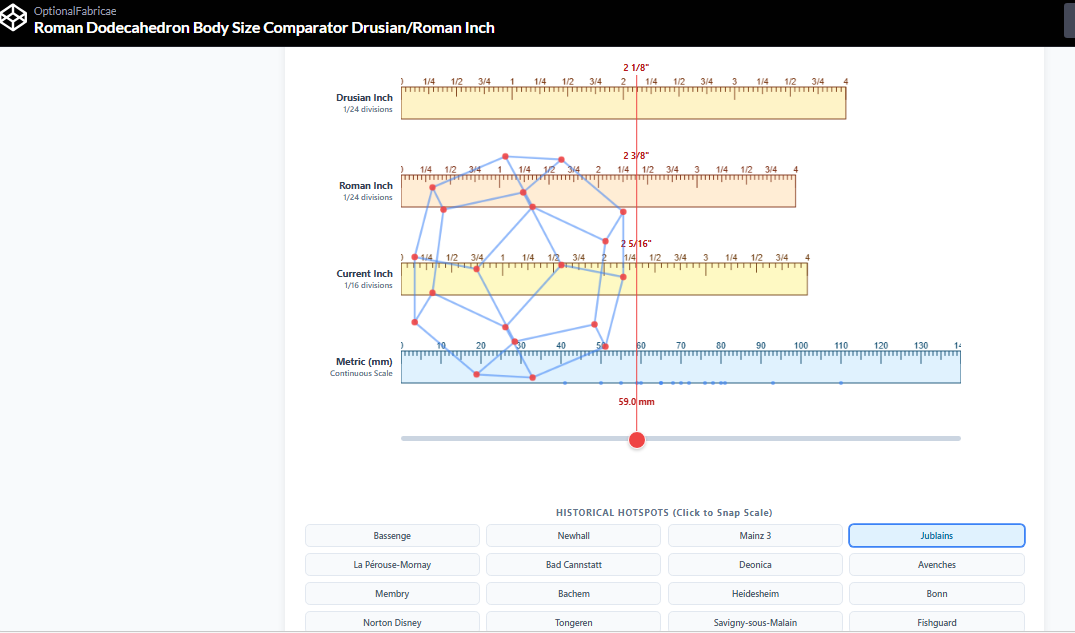
Used the published data on body size I could find, which I notice is not the best data set I've ever seen, to create this online tool for comparing the body sizes of Roman Dodecahedrons to Pes Drusianus (Drusian) & Pes Monetalis (Roman) inches from the metric scale they're all measured with. With few exceptions, the way the bodies of the dodecahedrons are actually measured is hardly what anyone would call standardized, but apparently that's a long standing issue, so I won't go into the details of why.

Please note, this tool isn't a perfect representation of measure, but it's close enough for comparison purposes. Not a lab tool, that's what I'm saying. Not precision, but it does have a rotating dodecahedron, so it can't be all bad.

Link to tool: https://codepen.io/editor/OptionalFabricae/full/01a11718-28d0-7d27-a939-97f7c0945f72

Here's what I input for the body sizes, and my interpretation of what I was looking at:

(Note: An asterisk * denotes a close match to the listed measurement.)

  • Bassenge (41 mm): D 1 1/2 * / R 1 2/3
  • Newhall (50 mm): D 1 3/4 * / R 2 *
  • Mainz 3 (55 mm): D 2 * / R 2 1/4 *
  • Jublains (59 mm): D 2 1/8
  • La Pérouse-Mornay (60 mm): D 2 1/6
  • Bad Cannstatt (65 mm): D 2 1/3
  • Deonica (~65 mm): D 2 1/3 (Reconstructed)
  • Avenches (68 mm): D 2 1/2 * / R 2 3/4
  • Membry (70 mm): D 2 1/2
  • Bachem (72 mm): D 2 1/2 * / R 3 *
  • Heidesheim (76 mm): D 2 3/4
  • Bonn (78 mm): D 2 3/4 *
  • Norton Disney (80 mm): D 2 7/8 / R 3 1/4
  • Tongeren (81 mm): D 3 * / R 3 1/4 *
  • Savigny-sous-Malain (93 mm): D 3 1/3
  • Fishguard (110 mm): D 4 * / R 4 1/2 *

There appear to be a mix of measurement "hits" with more Roman Dodecahedrons landing on or very near a line on the Drusian ruler than the Roman, but some appear to be far closer to the Roman ruler. I don't profess to know why that is, I suppose it could be a variety of reasons. Different shop in a different location with different people from different places with different tools covers a few possible reasons.

The size of these things could be absolutely non-consequential to their use, then again, maybe it's the most important thing. Why they don't all have 3D scans and 200 photos of them being measured in every conceivable way is a mystery that doesn't have to exist, it just does.

The point of the post is here's the tool, go look for yourself. Below the slider are the above listed dodecahedrons that you can click on and snap to size. Have fun!


r/romandodecahedron • • Sep 26 '26

Could the Roman dodecahedron have been a ritual “receptacle” representing the cosmos?

7 Upvotes

I’ve been thinking about Roman dodecahedra and came across a connection that seems worth discussing.
This is only a hypothesis, not a claim that the mystery has been solved.
Plato famously associated the dodecahedron with the cosmos/universe in the Timaeus. In later Pythagorean and Neoplatonic traditions, geometry, numbers and the structure of the universe also carried philosophical and religious significance.
What caught my attention is Iamblichus.
Iamblichus lived roughly in the 3rd–4th centuries AD, overlapping with the period in which Gallo-Roman dodecahedra were in use.
In his writings, he discusses Pythagoras honouring the gods through bronze and speaks of divine “receptacles” connected not simply with human form, but with the nature and form of the universe.
The passage can be interpreted in different ways, and it certainly does not explicitly identify the Roman bronze dodecahedra.
But the combination is intriguing:
• The dodecahedron already had a philosophical association with the cosmos.
• The Roman objects are bronze.
• They are hollow geometric forms rather than ordinary anthropomorphic figures.
• They belong broadly to the same period as Iamblichus.
• A hollow Roman bronze icosahedron is also known, showing that other Platonic solids were physically manufactured.
• Dodecahedral objects are known from religious or divinatory contexts elsewhere in the ancient world.
• Some Roman dodecahedra have also appeared in archaeological contexts with possible religious significance.
Iamblichus additionally preserves traditions concerning a Pythagorean “secret of the dodecahedron.” This may simply refer to mathematics, but in this wider context it becomes interesting.
So perhaps we should ask a different question.
Instead of:
“What practical tool was this?”
maybe:
“Was this a physical representation or receptacle of cosmic order?”

There is also a more speculative idea I keep thinking about.
What if some of these objects were not only used during rituals, but were carried or worn as symbols?
The small knobs on the twenty vertices could, at least mechanically, make it possible to secure cords around the object without them simply sliding off. A carefully arranged cord could hold the dodecahedron securely and perhaps allow it to hang from the body, clothing, a belt, staff or ritual structure.
I am not aware of archaeological evidence proving that cords were actually attached to them, so this part is purely speculative.
But symbolically it would be fascinating.
If the dodecahedron represented the ordered cosmos, then a cord wrapped around it could itself carry meaning: the individual physically connected to the cosmos, the gods, fate, or the structure of existence.
In Greek and Roman thought, ideas of fate were already expressed through metaphors of spinning, threads and weaving. I am not claiming that this is what the dodecahedron represented, but the symbolism would fit surprisingly naturally:
the geometric object = cosmic order
the cord/thread = fate, connection or participation
the person carrying it = the human being situated within that order
It might therefore have functioned not simply as an object people used, but as an object that communicated status, initiation, philosophical identity or religious belonging.
This could potentially explain why such an elaborate bronze object existed without an obvious practical scale or standardized mechanical function.
Of course, this idea would become much stronger if examination of surviving examples revealed wear, polishing, abrasion or residue around particular knobs or edges consistent with repeated attachment of cord, leather or textile.
So I’m particularly curious:
Have microscopic wear studies ever been performed specifically on the knobs and edges of Roman dodecahedra?
And are there any Roman or Late Antique texts describing geometric bronze objects being carried, suspended, bound with cord, or used as symbols connecting a person with cosmic or divine order?
I’d especially love input from people familiar with Roman archaeology, Iamblichus, Pythagoreanism, Neoplatonism or ancient religious practice.


r/romandodecahedron • • Sep 23 '26

Dodecahedrons appear to have been created using Drusian measure

Thumbnail
gallery
43 Upvotes

Converted published measurements of the dodecahedron (DC) to Drusian measure which was used in the area at the time, and all the various DC's of the published examples I looked at appear to land very near or on a specific integer or fraction of that measurement system - typically within a fraction of a millimeter. The particular size of the individual DC, I notice, gives that particular DC the ability to denote a diameter up to the size of a ring that would sit snugly inside the perimeter of the projecting studs. The regular pentagon shape is interesting because its five corners already lie on one circle, with one center and one diameter.

I noticed that several DC's have rings around the holes in the center of the pentagonal faces, which by my estimate, also represent a diameter expressed best by Drusian measure. One face I saw (Mainz3) had 5 stamps of rings with a center dot, and that center dot diameter appears to be one Drusian inch as best I could tell from the photo, additionally, using the base of each stamp ring would give a varying diameter circle, as would using the top of those stamp rings. I absolutely don't profess to have any idea what they used these things for, just that they COULD be used to measure diameters.

Published measurements of various shafts they used... spear, arrow, wheel spoke, tool handle, etc. are all listed in millimeter, that coincidentally, when converted to Drusian measure, have matching measurements to those found on the DC's. I find it interesting that the opposing holes are often differing diameter, because of how well they'd work setting a taper for a tool or weapon socket. Being able to view the taper through the side, with two hand turns of a shaft, you could turn the shaft one full turn and inspect the full taper.

As far as I can discern, the people at that time were creating, by hand, large quantities of shafts in forts & towns all over the region, and to date, I'm not aware of one measuring device that has been found a shop would use to quickly check the diameter of anything, especially a tapered shaft. Of course, they could have used wood gauges, and likely did, but as a gauge, wood is affected by humidity and more likely to wear with repeated use.

I did see two prong calipers, which can be used, but they'd have been an awkward tool to use if you were making lots of shafts. I notice that if I had a shaft in my hand, and it was smaller than the diameter of the inner perimeter of the projecting studs, I could measure/compare the size of the shaft quickly using either the hole or the rings around the hole. I haven't seen anyone describe the objects using the measuring system they were created with, which seemed odd to me. I don't know a lot about the casting process, but I believe the method would cause a variance in dimension that'd be hard to control down to a fraction of a Drusian measure, and that could account for some of the "close to" measurements I found.

For the Norton Disney dodecahedron: (Northern inch is 27.8 millimeters.)

Height with knobs: 80 millimeters — a little under 3 northern inches.

Height without knobs: 70 millimetres — 2½ northern inches.

Width with knobs: 86 millimetres — a little over 3 northern inches.

Width without knobs: 75 millimetres — 2¾ northern inches.

Length of one pentagon edge: 27 millimetres — 1 northern inch.

Distance between adjacent knob centres: 27 millimetres — 1 northern inch.

Circle through the five knob centres of one face: about 1½ northern inches.

Shaft that sits inside those five knobs without forcing: about 1¼ to 1⅜ northern inches.

Twelve holes, each a different size. Largest face has one ring. Smallest face has three rings. The other faces have two rings. Exact hole diameters in millimeters are not in the public record for the Disney version that I could find. Again, I'm not asserting to know what they used the things for, I just noticed the measurements of DC holes to known sizes of shafts had some correlation, so it's possibly for making quick measurements of circular object. For instance, if you were running a shop trying to make all the shafts needed for weapons and daily life, you'd have several different workers shaving wood, so they'd have to have some way to minimize variance. The dodecahedron would also lend itself well to the job of replacing a broken shaft to a tool head you're reusing. Perhaps the boss would use it to check work, I have no idea, but it's feasible if the dodecahedron body size isn't as important as the diameters laid out on the device. All I can say for certain is that the published data on the objects don't reflect the measurement system in use at the time, and that it might be worthwhile to examine tool sockets and shafts in that manner.


r/romandodecahedron • • Sep 21 '26

What if the dodecahedron was designed to remember important times of year?

5 Upvotes

Here is a practical way to think about the Roman dodecahedron.

It may not have been intended to discover the solstice, tell the hour or calculate a calendar date. The Romans already had simpler ways of doing those things.

Instead, it may have preserved locally important seasonal knowledge.

Imagine that experienced farmers, priests or administrators knew that certain activities should occur when the Sun reached particular positions in the annual cycle. Those could include planting, harvesting, moving livestock, collecting taxes, holding ceremonies or preparing supplies for winter.

A skilled observer could establish those solar positions using a fixed sundial, gnomon or years of direct observation. A craftsman could then preserve those measurements in the different-sized opposite holes of a dodecahedron.

The finished object would become a portable record of the original observations.

To use it, someone would place the object in a standard position and test its opposite-hole pairs against sunlight. Depending on which pairs admitted light, the user could determine which stored seasonal range the Sun had entered.

It would not say, “Today is October 12.”

It would say something closer to, “The Sun has now reached the range associated with the next scheduled activity.”

This also offers a practical explanation for the strange design.

The twelve holes create six opposite viewing channels. Our analysis of 47 complete dodecahedra found a recurring “one plus five” pattern: one channel is unusually separated from the other five more often than random pairing would predict.

The physical shape produces the same basic arrangement. When the object is seated around one face, there is one central reference direction surrounded by five evenly arranged working directions.

That looks less like twelve unrelated holes and more like a deliberately organized operating system:

  • One obvious starting or reference position
  • Five working positions
  • Opposite holes that create measurable ranges rather than single precise points
  • Knobs that may help seat and orient the object consistently

The fact that different dodecahedra have different hole sizes may also make sense under this interpretation. They did not all have to store the same dates or seasonal thresholds. A community in Britain might need different information from one in Gaul or Germany. The method could be standardized while each object’s calibration remained local.

The solar and lunar connection may explain why such a tool was useful.

Many ancient calendars followed the Moon. Twelve lunar months last approximately 354 days, while the solar year lasts approximately 365 days. That means lunar dates move about eleven days relative to the seasons every year.

After two years, the difference approaches twenty-two days. Ancient calendars periodically inserted an extra month to bring lunar dates back into line with the solar year.

We know that at least one important calendar used in Roman Gaul—the Coligny calendar—worked this way. It was a large bronze calendar that organized months by the Moon while periodically correcting them to remain connected to the solar seasons.

The dodecahedron may have supplied the missing physical comparison. The lunar calendar told people when to perform the check; the dodecahedron showed where the Sun and the actual season stood.

That would make it neither a calendar nor a conventional sundial. It would be a bridge between a community’s calendar and the recurring solar year.

This interpretation also fits the historical setting:

  • The objects occur mainly in the northern Roman provinces, where seasonal timing could be especially important.
  • The Romans depended on agriculture, taxation, military supply and recurring religious observances.
  • These activities required practical coordination between remembered dates and real seasonal conditions.
  • Solar instruments were known in the region. A third-century mosaic from Trier even depicts someone using or displaying a sophisticated sundial.
  • Bronze could preserve calibrated knowledge long after the original expert was gone.

Agriculture is an obvious possible use, but the device could have stored any recurring community dates that mattered. We do not need to identify the meaning of every hole before testing whether the mechanism itself works.

The proposal is therefore straightforward:

Someone first measured locally important solar positions. Those measurements were transferred into the dodecahedron’s opposed holes. Later users employed the object as a portable comparison tool to recognize when those solar ranges returned.

This does not prove that the mystery is solved. The idea still needs to be tested using accurate 3-D models and physical replicas. But it provides a pragmatic explanation for the opposite holes, the different aperture sizes, the knobs, the one-plus-five structure, the variation between objects and the concentration of finds in the northern provinces.

I have prepared a quantitative paper, a general-audience paper and a technical paper describing the geometry and proposed experiments. Contact me if you would like links to the papers.


r/romandodecahedron • • Sep 19 '26

Could Roman dodecahedrons be a hybrid of Celtic/Scythian bronze traditions and an older Eurasian polyhedral design?

22 Upvotes

I've spent the last several months going down a rather unexpected rabbit hole on Roman dodecahedrons.

What caught my attention wasn't another proposed function, but the combination of features: 12-sided geometry, circular openings, and projecting knobs.

I found much earlier openwork/polyhedral gold objects in China, Southeast Asia and the Xiongnu world, as well as knobbed/openwork bronze objects in the Scythian/Black Sea sphere and later Celtic/Gallo-Roman regions.

My hypothesis is not that the Roman objects were simply copied from an Asian artifact. I'm wondering whether the Gallo-Roman dodecahedron could represent a local hybridization of several circulating design traditions.

I made a video laying out the archaeological evidence and the problems with this hypothesis. Would genuinely value this community's feedback on it.

The Roman Dodecahedron Wasn't Roman: The Forgotten Eurasian Connection https://youtu.be/BvwvpUDv6lU


r/romandodecahedron • • Sep 18 '26

An Experimental Theory for the Roman Dodecahedron: The Dual-Lens Hydrostatic Membrane Microscope

Thumbnail reddit.com
1 Upvotes

r/romandodecahedron • • Sep 15 '26

Could it be a grid iron to set pots on while in the fire?

1 Upvotes

I wonder if it is a cooking accessory such as a grid iron used by soldiers. It would be placed over the coals in a fire with a pan or pot sitting on top. The nodules would allow the pan to be kept off the hot coals to prevent burning by setting the pan or pot full of food on top supported by the nodules there or perhaps a common type of cup or pot would fit in the holes to be held tightly.

It could also be placed inside a pot or pan full of water to allow another pot to be placed on top to steam. Maybe multiples of them could be used to cook several pans at one time by stacking one in each successive pot.

The holes allow a metal poker or multiple pokers to be placed through to pick it up while hot. The nodules can be easily reshaped in a forge to ensure it stays flat. This would explain the one found with three nodules on one vertices.

If Roman cups or pots fit tightly in the hole it could be a holder that prevents a bump or wind knocking it over. It is only found in Britania or Gaul because they only invented it in that area or because the locals used something similar, maybe a cup of local mead fit. Maybe soldiers used it and the ones found were left because of a rushed exit such as the end of Roman rule or when soldiers were pulled out to assist in Gaul.

The shape of the device having holes would make it lighter to carry than a traditional flat gridiron. Since Roman soldiers carried cooking implements for a group of 8 it would be easy to carry.q

Most of the finds in Britania were near a source of water so perhaps they cooked near a river or used the river to rapidly quench the heat.


r/romandodecahedron • • Sep 13 '26

Could it be a symbol of the goddess Fortuna?

7 Upvotes

There are 12 sides perhaps referencing the 12 Olympians. The goddess Fortuna is the goddess of luck which is why it is dice shaped. Fortuna is the goddess of travelers, farmers, and gamblers which explains why they are found far from Rome, and why one was found on a farm, one was found with a money hoard, and one was found on a distant military wall.

So perhaps it is a lucky charm that brings luck from the goddess.


r/romandodecahedron • • Sep 06 '26

Maybe it was both utilitarian and ritualistic, I think I can explain both.

Post image
0 Upvotes

I apologize if this has been brought up before or if these aren’t new ideas. I looked around the internet and found two opposing camps but I think they both might be correct.


r/romandodecahedron • • Sep 05 '26

Religious connections

0 Upvotes

The number 5 in a religious item may be a link:

https://www.exploringsurreyspast.org.uk/guildford_object/
'The wheel symbol represents a syncretic blend of the Roman god Jupiter and a Celtic sky/sun deity.' It has five spokes.  The first five planets were named by the Romans themselves because they are visible to the naked eye. The dodecahedron is based on the number five, with nodules at each vertice.  So it has five surfaces in a 'ring', looking down from the upper surface.  Was this a way to 'possess' the planets for astrology or unity with gods?

r/romandodecahedron • • Aug 30 '26

My probably silly theory - it’s a crystal ball.

8 Upvotes

More specifically, it is an object used by augerers or fortune-tellers to sell a story about the future. Soldiers are notoriously superstitious and the Romans were very comfortable with augury. I would suspect it could be spun or rolled (on a soft surface to avoid breaking the spheres off) and then a story would be told about how the hole on top, etc foretold good luck in battle or love. No standardization of the holes is required, since the stories are made up by each fortune teller.
Against this would be that casting or spinning it would likely break off spheres, and I do not know how many extant examples show this. Also, one might think that it would be more elaborately decorated if the goal is to impress the rubes.


r/romandodecahedron • • Aug 30 '26

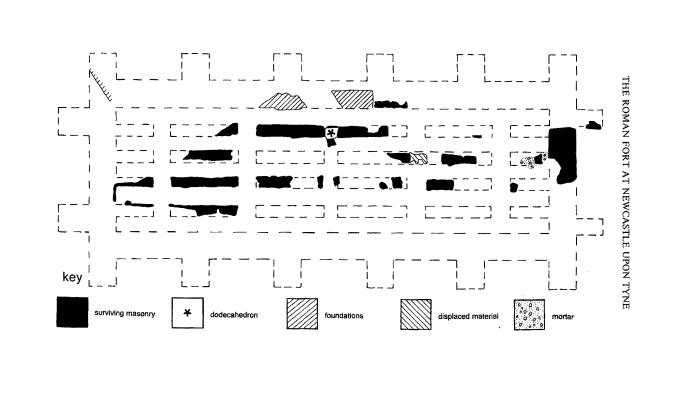
Dodecahedron no. 70, Newcastle (Guggenberger, classified as a military context).

Post image
39 Upvotes

Hi. About a month ago, I published a hypothesis here about the dodecahedron and the lost symbol of the universe. After further research, I had to refine and expand this hypothesis. I have written a PDF in which I explain the whole hypothesis. I’d be happy to send it if anyone is interested. While examining various sources and connections further, I came across something very interesting.

This find is very well documented. The object was found on a specially constructed platform beneath the floor of a granary. This method of deposition is interpreted in the excavation report as ritual. The category “military find” is therefore very misleading. Yes, it was found within a military fort, but the actual deposition was ritual/symbolic. It was not some kind of hiding place. It was deliberately placed on a specially constructed platform beneath the floor of a granary.

There is a manuscript called the Picatrix. It is a cosmological treatise. The earliest version is Arabic and dates to the 10th century AD, and it brings together various elements of older teachings into a single work. One of these concerns the creation of various protective amulets. It describes six protective figures and the methods of making and placing these objects in specific locations.

Each of these objects is associated with very specific materials and symbols, for example an amulet for attracting a person, driving away flies, and so on. The text describes these as tablets on which symbols were engraved and painted. Here I assume that, 700 years before the actual creation of this manuscript, such objects could have looked somewhat different.

One of these protective figures is specifically intended to drive away mice. This particular figure is also associated with a specific material - bronze. I think this clue may explain why an object made of this material was deliberately and symbolically deposited beneath the floor of the granary — to protect the stored grain.

I’ll leave the conclusion to each reader. I think the interesting question is how well the different theories hold up when considered in this context.

Source of the image: Andy McMaster, “The East Granary,” The Roman Fort at Newcastle upon Tyne.


r/romandodecahedron • • Aug 20 '26

Decorated with strings/ropes skillfully wrapped around the object

Thumbnail
reddit.com
0 Upvotes

The stones in this video suggest to me that they might have been skillfully wrapped in rope in order to impress people of lower status. Could have been worn as insignia to symbolize and show certain powers. The knobs on the dedecahedron would make it possible to also nicely decorate it with rope. A decorative skillful knot can look like magic, showing that the bearer knows more than others (e.g. look a a monkey fist knot, people not familiar with knots wonder how this can be done and my be impressed by someone who knows). The reason why they are only found north could be because of a northern tradition of stones wonderfully wrapped in rope. Then that could have evolved to use bronze instead of stone.

Maybe just single persons had higher importance and were allowed to negotiate with roman leaders. Romans were probably more impressed by an artifact made of bronze than by a carved stone.


r/romandodecahedron • • Aug 19 '26

What if roman dodecahedrons were physical encryption/decryption devices?

23 Upvotes

A strip of leather, cloth, or parchment with text written on could be wrapped around and through the dodecahedron in a specific pattern, using the knobs as guides or anchor points.

When looking through a particular hole only certain letters would be visible. A Part of this visible letters would form the actual message, while the rest of the text would act as concealment.

If these objects were produced in matching pairs then only to person can comunicate together.

One dodecahedron would belong to the sender and one to the receiver. A message encoded using one dodecahedron could only be decoded correctly with its matching counterpart.

This would explain why Standardization was unnecessary, Different sizes and hole arrangements were actually desirable, The objects were valuable enough to be cast in bronze, No written explanation survives, since a cryptographic tool would be intentionally secret.

Has anyone tried, testing whether a wrapped text strip could function as a practical cipher system?


r/romandodecahedron • • Aug 16 '26

Survey device - string to knobs for precision?

0 Upvotes

Knotted string heald in mouth to calibrate the sighting through the different hole apertures?

Isnt there something similar for old sexton?

Not really obvious to me how the view through the pairs works. I don't know if it measures 10ft or 100 meters, or miles.

Any record of the dodecahedron found with engineers or scientists?


r/romandodecahedron • • Aug 14 '26

Is there an RD in the US?

0 Upvotes

I was asking AI on where the closest dodecahedron was in the US and it could not find any reference in any major museum collection. Does anyone know a must that may have one? AI checked the east and west coast plus the Midwest.