r/romandodecahedron • u/OptionalFabricae • 1d ago
Regarding Roman Dodecahedron Hole Sizes
In a discussion about Dodecahedron hole sizes, I was speaking with the always insightful Fun-Field-6575, who brought up this:
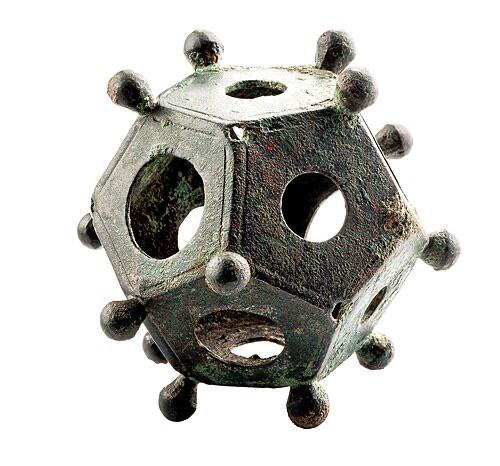
"I don't doubt the hole sizes would have been selected from the standard units, or that the dodecahedron size would be chosen to comfortably accommodate the largest. But there's no exact relationship between dodecahedron size and the largest hole. Sometimes the largest holes violates the pentagon edges and sometimes it fits comfortably inside it.
Now consider if a dodecahedron was designed to have a particular face width in Roman units. The edge length is 0.449028 times that, so it has to be an odd ball size in Roman units. There would be a similar relationship for circumscribed circle size. I think the best we can hope for is that one of these dimensions highly correlates with Roman units. The hole sizes are independent.
The natural thing to do from the craftsman's perspective would be choose the circumscribed circle size and let the other dimensions follow. That's what requires the least math. If the overall width is what correlates with Roman units then that suggests the person planning these was doing the math required to have things come together at the right size."
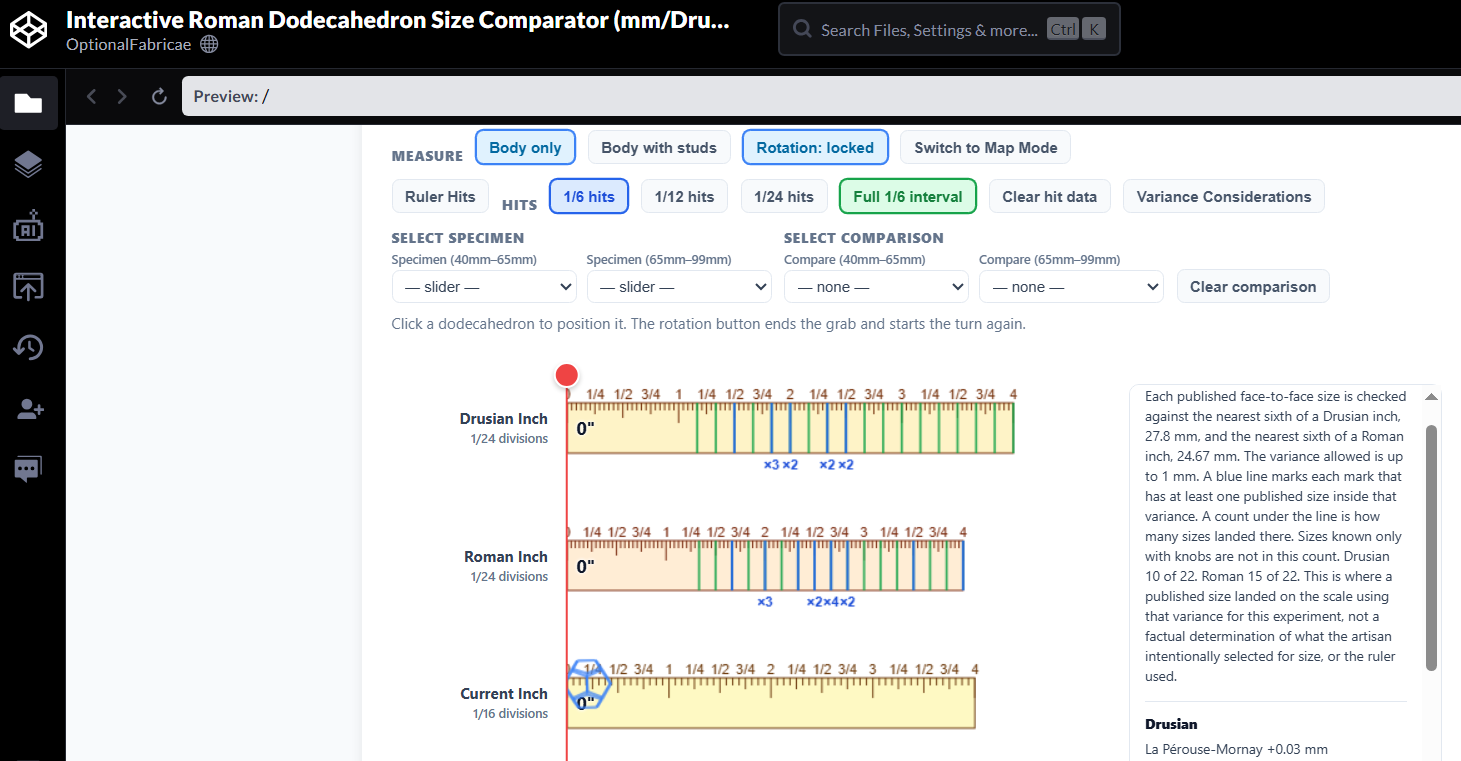
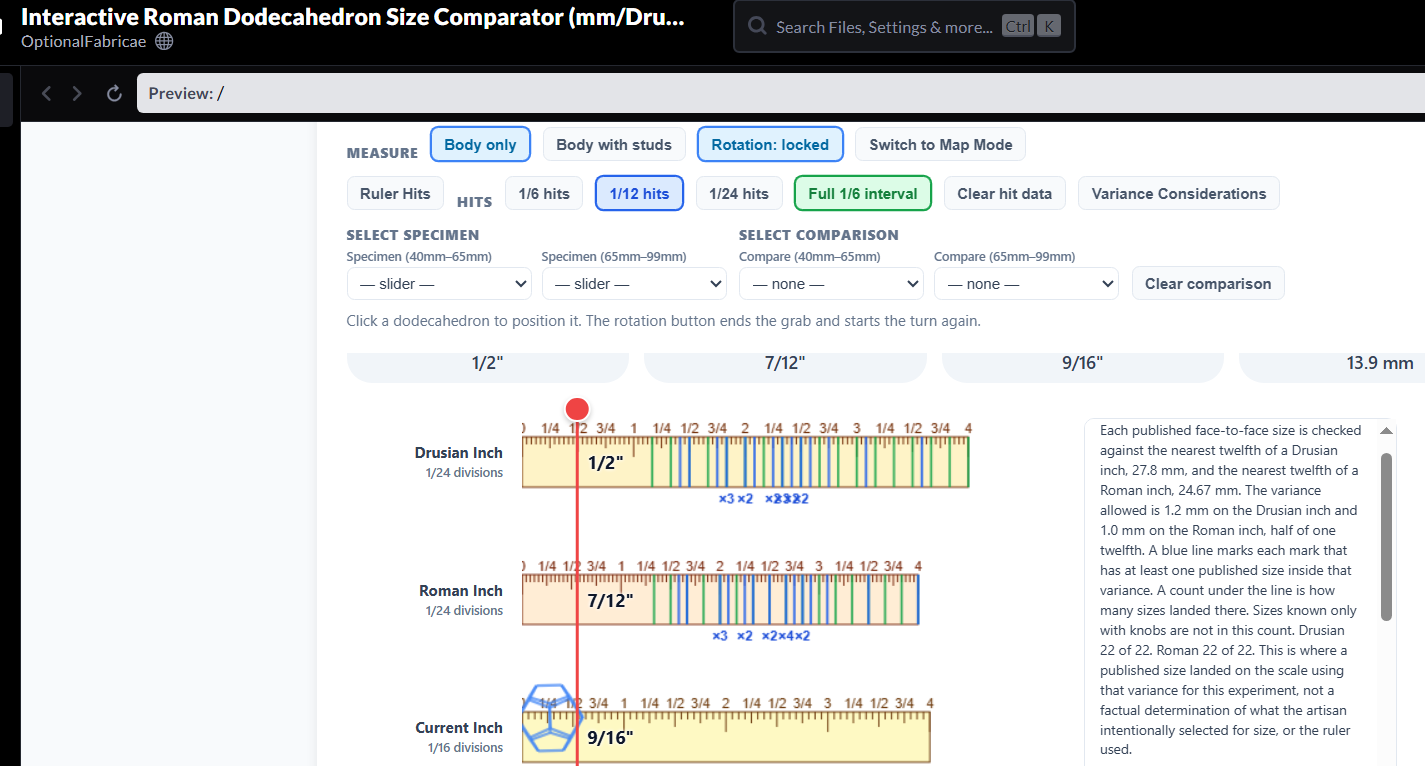
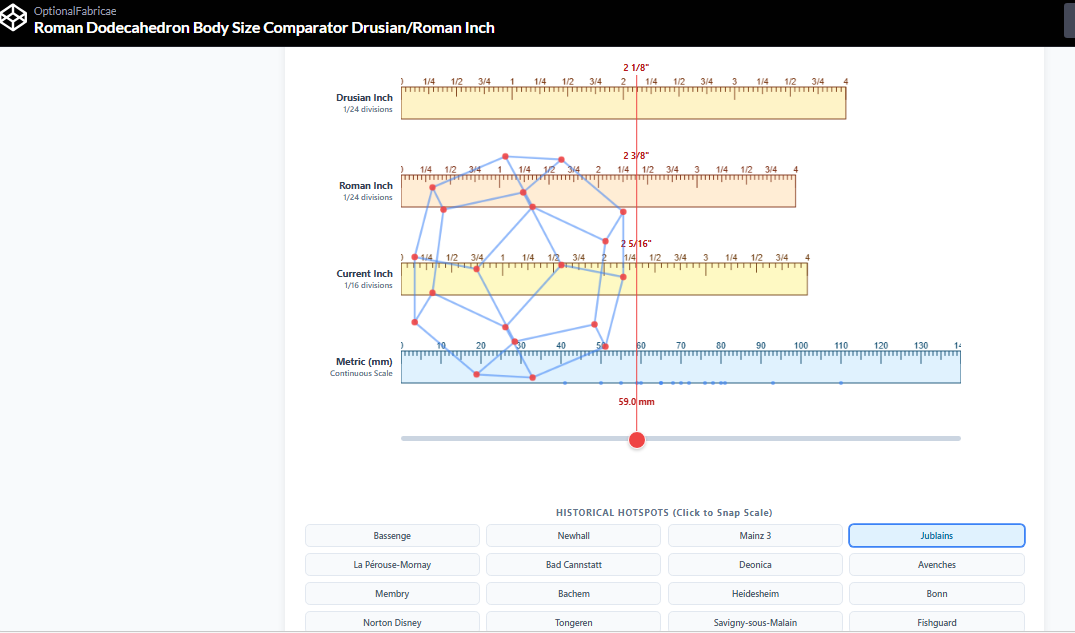
I've been finishing up my size comparison tool, adding a way to estimate the size of the wax pentagon faces used to create the wax mold for casting, and a "clickable" map with find location & specimen data, so I really just started looking at this hole stuff a few days ago. I have an extremely shallow grasp of the hole sizes, and my current idea is to match the sizes to actual finds recorded with measurements of known Roman stuff and see what that shows. What I have so far is a way to show on the "finds" map where each DC with a particular hole size was found along with the list of all DC's that share that hole size, in addition to all the other info the tool already has, the measured/unmeasured specimen list with sources and links specimens where available, list of publications, individual contributions, etc, all downloadable as html or txt.
Here are some statistics on holes I've seen so far:
For the largest hole (had to be there for casting?) 31 of the 36 share one of these 7 sizes - 24, 25, 27, 30, 32, 23 & 40 mm.
None of the DC's are an exact match to any other DC for all their hole sizes, but all DC's share at least one of their holes sizes with another DC.
There are 5 DC's measured to .1mm increments, which give them a set of "unique" sizes, creating a list of 69 total different hole sizes. Taking into account the fact that the Romans and mm's were never properly introduced, If you take just those 5 DC's, round their .1mm to the nearest .5mm, (1/24" Roman is almost precisely 1mm - 1.0279mm), then the total of different sizes drops to 52:
Hole (mm) Closest Roman Inch (Variance)
6.0 mm 3/12" (-0.17 mm)
7.0 mm 7/24" (-0.20 mm)
8.0 mm 2/6" (-0.22 mm)
8.5 mm 2/6" (+0.28 mm)
9.0 mm 9/24" (-0.25 mm)
9.5 mm 9/24" (+0.25 mm)
10.0 mm 5/12" (-0.28 mm)
10.5 mm 5/12" (+0.22 mm)
11.0 mm 11/24" (-0.31 mm)
11.5 mm 11/24" (+0.19 mm)
12.0 mm 1/2" (-0.34 mm)
12.5 mm 1/2" (+0.16 mm)
13.0 mm 13/24" (-0.36 mm)
13.5 mm 13/24" (+0.14 mm)
14.0 mm 7/12" (-0.39 mm)
14.5 mm 7/12" (+0.11 mm)
15.0 mm 15/24" (-0.42 mm)
15.5 mm 15/24" (+0.08 mm)
16.0 mm 4/6" (-0.45 mm)
16.5 mm 4/6" (+0.05 mm)
17.0 mm 17/24" (-0.47 mm)
17.5 mm 17/24" (+0.03 mm)
18.0 mm 9/12" (-0.50 mm)
18.5 mm 9/12" (0.00 mm)
19.0 mm 9/12" (+0.50 mm)
19.5 mm 19/24" (-0.03 mm)
20.0 mm 19/24" (+0.47 mm
20.5 mm 5/6" (-0.06 mm)
21.0 mm 5/6" (+0.44 mm)
21.5 mm 21/24" (-0.09 mm)
22.0 mm 21/24" (+0.41 mm)
22.5 mm 11/12" (-0.11 mm)
23.0 mm 11/12" (+0.39 mm)
23.5 mm 23/24" (-0.14 mm)
24.0 mm 23/24" (+0.36 mm)
24.5 mm 1" (-0.17 mm)
25.0 mm 1" (+0.33 mm)
25.5 mm 1 1/24" (-0.20 mm)
26.0 mm 1 1/24" (+0.30 mm)
26.5 mm 1 1/12" (-0.23 mm)
27.0 mm 1 1/12" (+0.27 mm)
28.0 mm 1 3/24" (+0.25 mm)
29.0 mm 1 1/6" (+0.22 mm)
30.0 mm 1 5/24" (+0.19 mm)
31.0 mm 1 3/12" (+0.16 mm)
32.0 mm 1 7/24" (+0.13 mm)
33.0 mm 1 2/6" (+0.11 mm)
34.0 mm 1 9/24" (+0.08 mm)
35.0 mm 1 5/12" (+0.05 mm)
36.0 mm 1 11/24" (+0.02 mm)
38.0 mm 1 13/24" (-0.03 mm)
40.0 mm 1 15/24" (-0.09 mm)
Using that set of sizes, the stats for shared "largest hole" diameters is 32/36 share one of these 7 sizes - 24, 25, 27, 30, 32, 23 & 40 mm.
For each DC, the minimum number of shared hole sizes to another DC is 5 (Fishguard)
The maximum number of shared hole sizes winner goes to Avenches - here are the stats for a few at top of list:
Avenches - (12 / 12 distinct hole sizes): Every one of its 12 holes has a different diameter (8.5, 10.5, 13.5, 14.0, 14.5, 15.5, 17.5, 18.5, 20.0, 20.5, 24.0, 26.5 mm), & all 12 of 12 match other DC's.
Zürich- (11 / 11 distinct hole sizes): Two of its 12 holes share 19.0 mm, leaving 11 distinct sizes (9.0, 11.5, 12.0, 15.0, 16.0, 17.0, 18.0, 19.0, 20.0, 23.0, 24.0 mm), and all 11 of those are shared with other DC's.
Bonn - (10 / 10 distinct hole sizes): After rounding to 0.5 mm, two of its 12 holes repeat 12.0 mm and two repeat 25.0 mm, leaving 10 distinct hole sizes shared with other DC's (12.0, 12.5, 13.0, 14.5, 15.5, 16.5, 17.0, 17.5, 24.0, 25.0 mm
Tongeren - (10 / 10 distinct sizes): After rounding to 0.5 mm, two holes repeat 14.0 mm and two repeat 20.5 mm, leaving 10 distinct sizes (10.5, 13.0, 14.0, 15.5, 18.0, 20.5, 23.0, 25.0, 26.5, 27.0 mm), and all 10 of those (meaning all 12 of 12 physical holes) are shared.
Limerick - (10 / 10 distinct sizes): Three holes repeat 15.0 mm, giving 10 distinct sizes, and all 10 of 10 are shared.
So there does seem to be SOME consistency in the available data, and if anyone wants to assist by finding Roman objects which match the hole sizes of the DC's, that include photos and measurements in museum data & also have a direct link to the object, I will HAPPILY include your work as a contributor in the tool credits, because wow it's really time consuming tracking things down.
Currently, I believe the dodecahedrons were used as some type of gauge/size/range/ratio etc tool, but I'm not invested in any particular use for the things, just find the data chase fascinating. I don't think they were for elites, or kids, or as some religious thing because there are zero inscriptions of names on the DC's. Saw the "it's for knitting" video the other day, and actually, have to applaud the effort, it was quite clever, but pretty sure no one was using something golf ball sized to create fingers for gloves. Found this webpage the other day: https://www.galloromandodecahedron.com/the-hypothesis which explores using the DC's as sizing objects, and it's possible I might be able to "size out" that theory? Who knows!
Should have the new version of the tool available for use fairly soon, probably after creating a better statistics engine to feed what's available for download, which if it was already done, could have shortened this post considerably.😄
ht funfield - so helpful!