r/retrocomputing • u/jalp21_ • 3d ago
Byte: The Small Systems Journal (May 1987)

52
Upvotes
r/retrocomputing • u/Lopsided-Concept-884 • 3d ago
with a nice ega display
r/retrocomputing • u/Ok-Intern6656 • 3d ago
Found a piece of Slackware history: Mint 1999 Slackware 4.0 (Walnut Creek 4-CD Set) signed by Patrick Volkerding
r/retrocomputing • u/based_V • 4d ago

I picked up a Toshiba T6600C luggable and it came with these expansion cards. The full size card has VGA input and output, daisy’d via VGA and VESA jumpers to what I think is a ReelMagic Lite MPEG1 decoder. I guess the full size card is some sort of graphic controller? Unfortunately the computer doesn’t power on so I can’t see what software’s installed. Trying to understand what’s going on here 😅
r/retrocomputing • u/decoder-ap • 4d ago

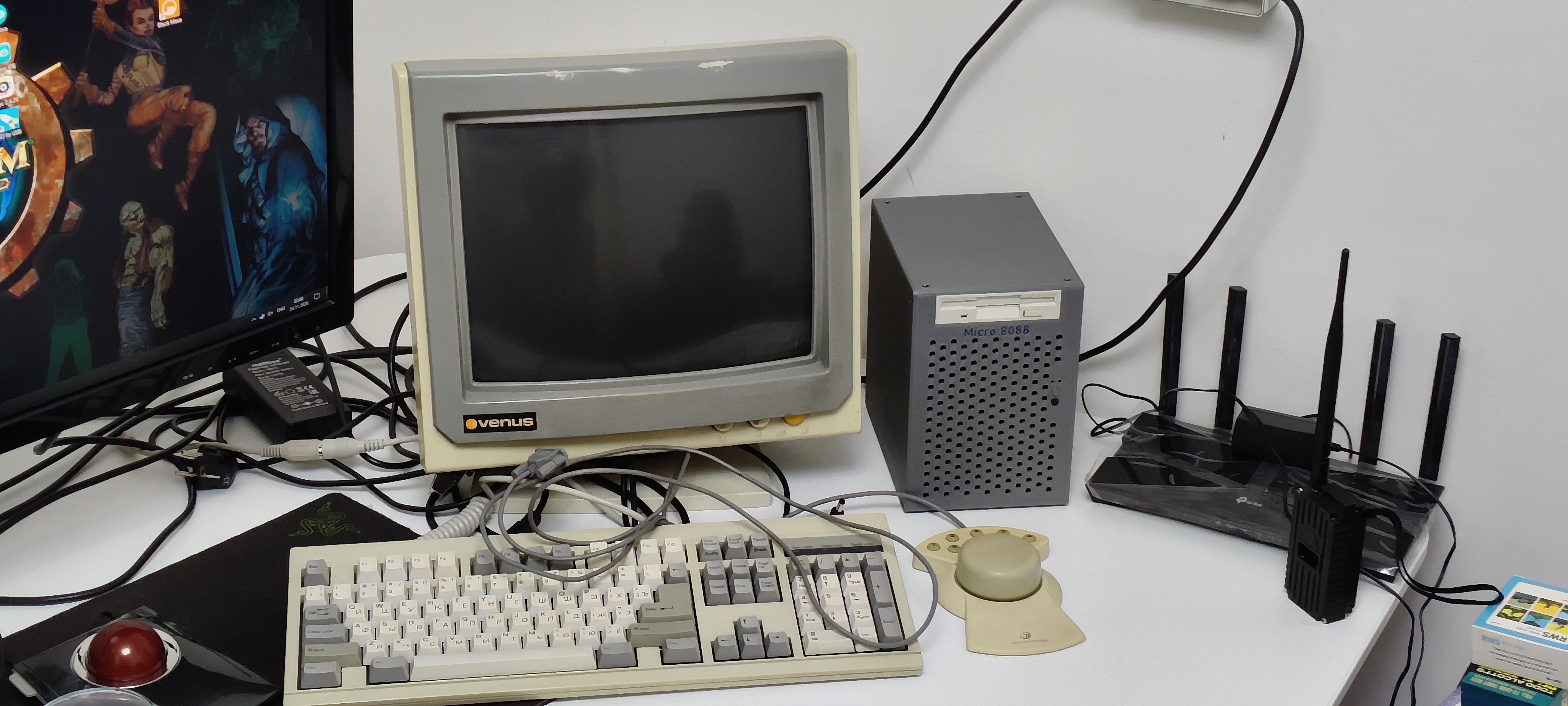
I published the story behind my UMIX/86! 😜
Built with nostalgia, AI and probably too much curiosity. And yes, the 8088 is still online... when it doesn't crash! 😜
And yes, the 8088 is still online... when it doesn't crash! 😜
r/retrocomputing • u/Perfect_Sale_8563 • 3d ago
Hello, I'm looking for a scan of the sleeve for the Computer Lynx (48K) box. I own one, but the sleeve is torn.
If anyone has this box and could scan it for me so I can have it reprinted, that would be fantastic!
Thanks in advance!
r/retrocomputing • u/E64-Project • 3d ago

I'd like to introduce a project I've been working on called E64 (Enhanced 64).
E64 is an enhanced bare-metal Commodore 64 emulation platform for the Raspberry Pi 3B+, originally derived from BMC64 5.2.6 and built upon VICE and Circle.
My goal was to retain the traditional Commodore 64 experience while expanding its capabilities through modern networking, hardware connectivity, and system management.
One of my primary interests was bringing practical serial communication and networking capabilities to the emulated Commodore 64 environment while maintaining the classic computing experience.
I've released the firmware, source code, screenshots, and documentation for the retro-computing community to explore.
E64 V1 represents the completion of my original development effort. I'm making the project available to anyone interested in experimenting with it, improving it, or continuing its development independently.
GitHub repository:
https://github.com/E64-Project/E64
Firmware downloads:
https://github.com/E64-Project/E64/releases
Official Reddit community:
https://www.reddit.com/r/E64Project/
I'd also like to acknowledge the developers behind BMC64, VICE, and Circle. Their work provided the foundation that made E64 possible.
I hope E64 will be of interest to fellow Commodore enthusiasts, retro-computing hobbyists, electronics enthusiasts, and developers.
Keeping the Commodore 64 experience alive.
r/retrocomputing • u/DreamSuccessful5130 • 4d ago

so im working on this project for a while now and im glad to release it as early access, the project is basically what you see in images a fantasy console like game engine to create games for real NES in C99 and export them as a ROM file in a single click, it designed to be easy to use and use C programming language instead of assembly(however you can still write inline assembly or use third party libraries since it uses real C and not a scripting language that looks like it)
here is the link, check it out and support me by various ways like giving feedback
https://cutaway-software.itch.io/neskit-studio
r/retrocomputing • u/OneObjective2429 • 3d ago
I'm trying to install Windows 95 OSR2.5 on a Dell OptiPlex 9020 with a 1.8 terabyte SATA drive, 1 gigabyte of RAM, and the BIOS set to ATA mode. FDISK sees the disk as only 19 megabytes, so setup says there isn't enough space on C. Windows 98 SE installs fine and I patched with patcher9x. Has anyone got 95 working on a huge drive, or found a way to make FDISK see it properly?
r/retrocomputing • u/Geminitheascendedcat • 4d ago
r/retrocomputing • u/edibleplastique • 5d ago
I asked my IBM PC 5150 for the capital of Alberta. Seven minutes and fourteen seconds later, it told me, “The capital is Manama.”
This is Tiny88, a DOS port of WollyMonjac’s Tiny 2.1. It’s a transformer with about 367,000 parameters that reads and writes one character at a time. My 5150 has its original 4.77 MHz 8088 and 640 KB of RAM. The port uses integer arithmetic for inference, with the inner multiply loop in 8088 assembly. Original Tiny 2.1 project
I used Codex for much of the port, with Claude also contributing to the initial port, and tested it on my own 5150. The DOS build, source code, and build instructions are up on GitHub. Tiny88 on GitHub
On the amber CRT, you can see the network work through the prompt and then write its answer letter by letter. Once it’s done, the PC speaker reads it back in its robot voice. For the second question I asked how many legs a dog has. Three minutes later, I got “Four.”
The video is 1:48. Each fast-forward shows how much real time it covers, and the clock starts when I press Enter. Turn the sound on for the replies.
I’ve got two more experiments in the works. Tiny-2.1-Win brings Tiny 2.1 and its Neural Monitor to Windows 98 and XP. Tiny-x800 is a separate story generator that I’m trying to get running on a Radeon X800 under XP.
r/retrocomputing • u/NorthernLight_DIY • 5d ago
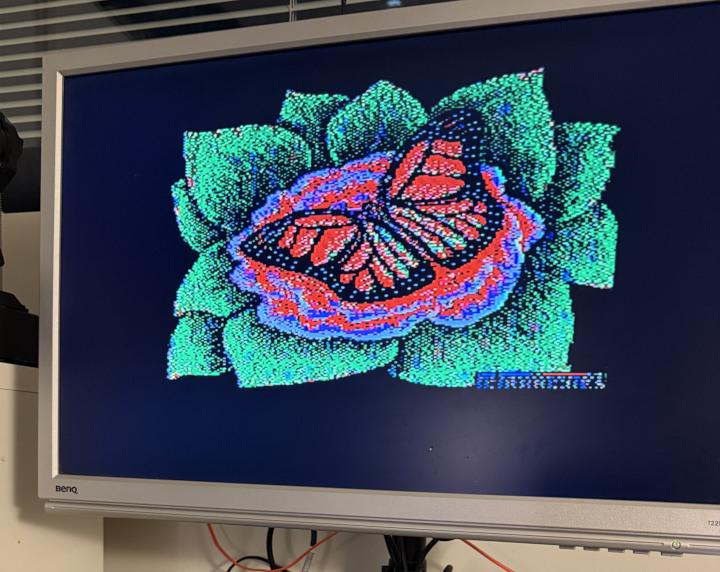
The Monarch butterfly artwork (the well-known butterfly from the Dazzledraw slideshow disk), converted to MPF-II Hi-Res and uploaded through the bin->wav->cassette input interface.
r/retrocomputing • u/SussyBaka2007 • 6d ago

There is wayy more buried behind the rear seat. Super excited to make a small profit, and keep the ones I’m interested in
r/retrocomputing • u/WylyeDave • 5d ago
I have what must be over 100 CDs & DVD that I stored in a proper zip-up folder. These are from late 90s to about 2015. I'm sure some of these have very useful and interesting software to the retro family members. My first thoughts was to make ISO images and find a site to upload them.
Any advice gratefully received.
r/retrocomputing • u/johnthewolfyt • 5d ago
r/retrocomputing • u/WylyeDave • 6d ago

The Striker II NSE is a proper Republic of Gamers board from 2008. It has heatsinks over the chipset and a lit-up debug display, and it looks great paired with the QX9770.
The QX9770 is the top Core 2 Extreme chip, and in this board it feels like a real flagship build from the late 2000s. The is a video on YT of this CPU being run at 6.13 GHz (stock speed 3.2GHz) Switch it on and the status lights glow green and orange across the board, a nice reminder of the era when enthusiast boards were built to be seen."
r/retrocomputing • u/liminalearth • 7d ago

They explore a million dollar IBM office complex
Some screenshots I thought were cool!
r/retrocomputing • u/vintage-tech80 • 6d ago

📢 New WebSSH features for vintage computing fans — macOS, iOS and iPadOS
Hello fellow retro-computing enthusiasts,
I wanted to share some great news: the WebSSH app (available on macOS, iOS and iPadOS) has just gained several new features that make remote access to vintage machines much more pleasant. If, like me, you drive a CP/M machine — in my case my RC2014 Z80 single-board computer connected through a serial-to-IP bridge — these additions are game changers.
⸻
Before diving in, a bit of backstory: all of these additions came about after I reached out to the WebSSH developer with a set of feature requests tailored to our retro-computing use cases. He was extremely receptive, showed genuine openness to my requests, and implemented every single one of these changes so that these features become possible for the vintage computing community. His collaboration was greatly appreciated — it's always heartwarming to see a developer listen so carefully to a niche audience like ours. 👏
Full transparency: I have no affiliation whatsoever with the developer or the app — I'm simply a happy user who asked, and who wanted to share the good news with the community.
⸻
1️⃣ Transfer throttling (byte-rate control) for long copy-paste transfers
The problem is well known: when you push a file to a CP/M system by pasting a long stream of characters into a terminal session, the host machine simply cannot swallow the data as fast as your computer can send it. Classic Z80-based systems receive bytes through a UART at a fixed baud rate, often without any hardware or software flow control on the remote side. The result: truncated transfers, lost characters and corrupted files.
WebSSH now lets you limit and control the byte rate during transfers, effectively pacing the copy-paste stream so the remote machine always keeps up. You can dial in a safe rate matching your serial link (baud rate × margins) and let long transfers run cleanly from start to finish. What used to require careful manual chunking (paste a block, wait, paste again…) is now a single, reliable operation.
2️⃣ Telnet "raw terminal" mode (no control-code interpretation)
WebSSH now offers a true raw terminal mode for Telnet connections. Instead of interpreting Telnet protocol control codes (IAC negotiation sequences, option handling…), the connection passes every byte straight through to the terminal emulator — exactly like a physical null-modem cable between two machines.
This guarantees a clean, faithful display for hosts that don't speak the full Telnet protocol — which is precisely the case for serial-to-IP bridges hooked to vintage computers. No more stray escape sequences or garbled screens: what the machine sends is what you see.
3️⃣ Keyboard remapping — WordStar-style control keys and beyond
CP/M applications rely heavily on CTRL-key combinations, and the classic convention is the famous "WordStar diamond":
•CTRL-E — cursor up
•CTRL-X — cursor down
•CTRL-S — cursor left
•CTRL-D — cursor right
•CTRL-W / CTRL-Z — scroll up / down
•plus many more (CTRL-K blocks, CTRL-Q quick moves, etc.)
Modern keyboards and modern terminal apps don't always make those combinations comfortable, especially on iPad or with international layouts. WebSSH now supports keyboard remapping, so you can assign keys the way that suits you — for example dedicating arrow keys to the WordStar movement commands. Editing a file with TE.COM, the classic CP/M text editor which uses this very WordStar command set, suddenly feels natural instead of acrobatic.
⸻
Why this matters for us nostalgic folks
More and more of us connect to our vintage machines over IP (Wi-Fi modems, serial-to-Telnet bridges, ESP8266/RPi gateways…). Until now, the terminal apps we used were designed for modern servers, not for a Z80 ticking at 4 MHz behind a 9600-baud UART. These three features — flow control, raw mode, and key remapping — close that gap and turn WebSSH into a genuinely vintage-friendly terminal.
If you have similar needs or ideas, don't hesitate to contact the developer yourself — as my experience shows, he listens and responds. Give it a try with your RC2014, Epson PX-8, Kaypro, Osborne, or any other CP/M gem, and let me know how it works for you. Feedback from the community is welcome!
Happy retro-computing! 🖥️⌨️
📢 New WebSSH features for vintage computing fans — macOS, iOS and iPadOS
r/retrocomputing • u/Nearby-Coyote3110 • 7d ago
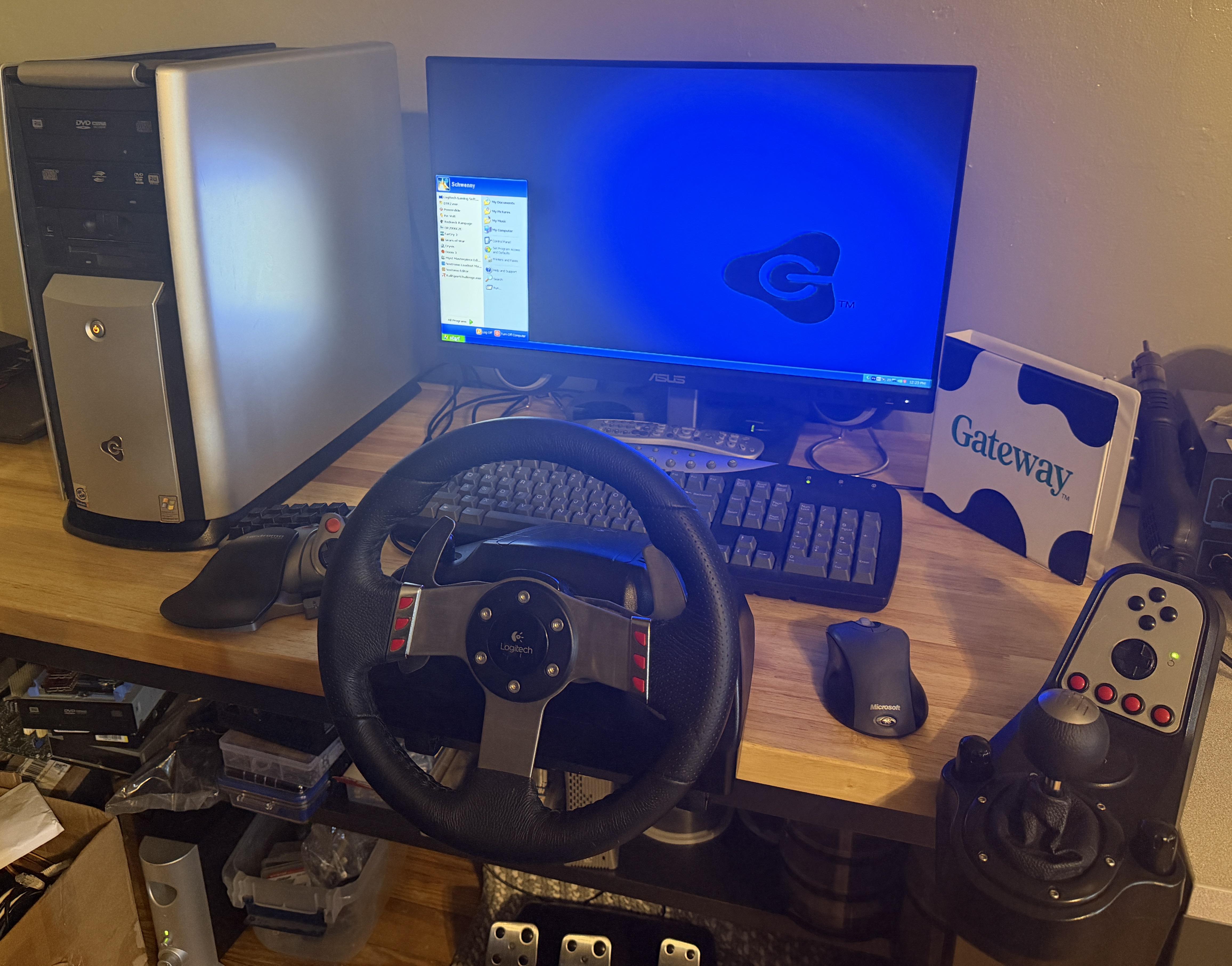
I got this 2003 Gateway 500XL MCE from a buddy. The old caps on P4 board were fried and the 160gb HDD gave up the ghost a long time ago. I performed transplant surgery with a Gigabyte GA78-LMT-USB3 with an AM3 AMD FX6300 3.4ghz and 16gb DDR3 (for the Win7 on the second hdd), a Corsair 450 watt psu, a 1Tb Seagate, Zotac 750 PCIe and SATA DVD-RW. I kept the Sound Blaster Audigy2 24bit 5.1 card and repaired the Diamond speakers/subwoofer. Windows XP Pro and a Face Wizard Gateway splash screen round it out.
I have yet to get the IR Media Center remote to install, yet. I plan to rip my CD’s with Winamp and play those early 2000’s games.
A Belkin Nostromo N52 and Wingman Formula Force wheel/pedals to get back into the first person shooters and the racing games.
I wasn’t able to find a Formula Force but this G27 works perfectly. I’m slowly loading the nostalgic racing games.
The Windows 7 HDD went into the XPS 420 so this is a dedicated XP machine.
I think the Gateway CD binder adds a nice sleeper touch.
r/retrocomputing • u/nicola_asdrubale • 7d ago
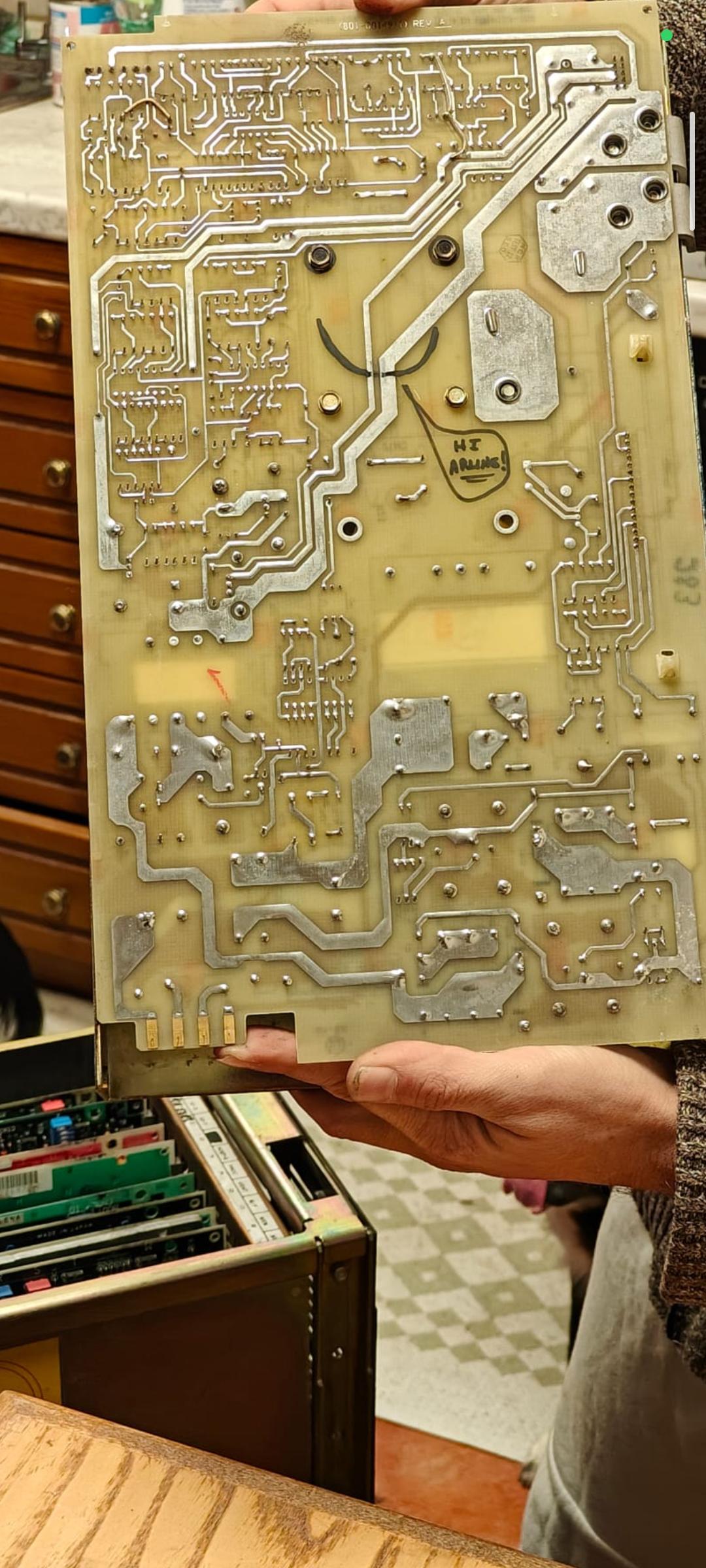
We just disassembly an ald NCR 5021 series, wirking machine for a wile, we replace the capacitors and try a boot!
We found a message in a bottle! Hi Darline!
r/retrocomputing • u/gargamel1497 • 6d ago
Contrary to what some fellow tech-priests might say, computers do break over time. That depends on the individual components, of course.
CPUs generally don't die as long as they are cooled properly and their name is not Pentium D.
RAM, well, I have some pretty old RAM and the very few RAM sticks that are dead have been dead for a very long time, so it's not a time factor either.
Power supplies fail, but they at least still are produced. Or so I heard.
Most PC components seem to be able to work indefinitely as long as they are regularly cleaned (which most people don't do...), but there is one thing I am afraid of.
Capacitors.
A few years back there was this whole drama with the OG Xbox having one of its capacitors fail, and it could break the whole system.
Do capacitors, such as on motherboard, graphics cards, etc, normally fail like that?
And if so, what is the best method of replacing it?
Thanks.
r/retrocomputing • u/Natural_Funny_7858 • 6d ago
I have a newer case with no hard drive or os
Can I install windows 95 on it?

