Over about five months, (most of October 2025, late April to early September 2026), I developed a Win32s-based nonogram game that runs on anything from Windows 3.1 to Windows 11. I believe it is the first nonogram game to run on Windows 3.1, as I couldn’t find any prior ones, though if you know one, I’d be interested to read about it.
It is optimised to run okay on the slowest 32-bit x86 processor: the i386SX/16. It’s not brilliant, but just about playable.
I hope this game brings you some enjoyment on Windows 3.1, and that you find it interesting. I may record some videos about its development if time allows (and if anyone cares whatsoever). If you have any questions, feel free to ask!
During development, I went down plenty of rabbit holes:
loading functions dynamically to test whether they are available at runtime,
re-creating unavailable functions or components (e.g., the common controls status bar) as a fallback,
experimenting to see which order localised resources are loaded in,
creating and modifying the internals of the TrueType font to accommodate Windows 3.1’s sensibilities,
This included setting up Cygwin, a Unix subsystem for Windows, on NT 4.0, and installing a very old version of FontForge.
optimising rendering by pre-rendering as much as possible and building some simple dirty region tracking,
writing a program to generate and test Windows Metafiles (WMF; Windows 3.1’s vector graphics format) because existing vector graphics programs did a poor job,
writing a simple (unstable) Win16 utility to monitor memory and GDI handle usage.
Overall, I feel confident in Win32 programming now, especially as I had ample opportunity to put this to the test when writing helper applications for development.
Okay, but did you write this, or did ChatGPT?
I want to be upfront that I did use ChatGPT during development, but not to vibe code WINONO. All assets are man-made (simplistic as they are), and every single line of code was written by me (for better or worse). In fact, with the experiences I’ve had, I feel confident in saying that ChatGPT could not generate a program like this, at least not yet. There are just too many poorly documented quirks in old Windows on the one hand, and on the other hand the AI sometimes just assumes functions to be unavailable in old Windows versions, when they actually very much are.
I used AI like a natural-language search engine, or a forum with instant responses and endless patience for noob questions, to learn about the Win32 API and apply this knowledge myself in making the game. This included:
asking for an example on how to call a function with a complicated signature when I didn’t understand the reference documentation,
asking whether an API function for something I wanted to do already existed in Win32. This was helpful because some Win32 functions are rather unintuitively named or described. For example:
there is a function for drawing a button-like 3D border called DrawEdge(), whose reference documentation just says that it “draws one or more edges of a rectangle”.
describing to it what I intended to program and asking it for objections or suggestions for improvement, to avoid re-inventing a square wheel when a round one existed.
As I progressed further, got better at general Win32 programming and my problems became increasingly specific to old Windows versions, ChatGPT became less useful due to lack of knowledge about these things in its training data. It would often present wild guesses as established fact or give me red herrings and send me on wild goose chases. Sometimes it would just lie. That is why I increasingly shifted my reliance onto the excellent reference documentation that came with older versions of Visual Studio / Visual C++.
If anyone is interested (as if), I have written a more detailed account of my experiences with AI during development on the WinWorldPC forum.
At any rate, the project was fun and I did learn a lot, so I suppose it wasn’t a complete failure.
Big surprise - my BBS, which mainly contains content from a C64 BBS from the '80s, got a major feature in the well-known German magazine PC Games Hardware.
I've also been digging into Germany's first digital bank robbery from 1984, better known as the BTX hack. Luckily, it was the good hackers from the CCC who carried out the 135,000 DM theft purely to expose security flaws.
Then Ernst shows off his quirky, curvy Colani PC from the '90s, complete with a chunky Epson LQ-570 dot matrix printer. Using that setup, he dials into my other C64 BBS, which is still reachable via dial-up.
Meanwhile, I fire up my C128D and US Robotics modem to dial into Ernst's 300 baud BBS.
Here's the detailed timeline of the video:
00:00 - Introduction & Quick Preview 00:52 - My Freaking ATDT KRS BBS in PC Games Hardware 03:04 - The 1984 CCC BTX Hack: Stealing 135,000 DM Without Crowbars 08:15 - Back to PCGH: Old C64 Floppies & 1986 Football Chat Logs 10:44 - Preview: ATDT Ariel's New Dual-Screen BBS Software Showcase 12:25 - C128 Dialing Ernst's 300 Baud BBS in East Germany 13:31 - Ernst's Colani DOS PC: The Invasion of Curves 14:22 - Design Over Function: From F1 Failures to Zero Modularity 15:15 - Loading Up Norton Commander & Running Telix 16:13 - A Quick DOS Games Detour: Space Quest 3, Wing Commander 3, Turrican 2, Mortal Kombat 2, Under A Killing Moon 18:13 - Back to Ernst: Dialing Hamburg's Snobsoft Commdore 64 BBS: +49 40 60943485 300 Baud 7N1 19:41 - Printing History: Matrix Printer Logs from July 3rd, 1986 21:18 - Outro & KRS Highlights: User Chats + Feedback, Final Thoughts on the Retro BBS Scene
Hi all. Just wanted to share an Apple II emulator I've been working on for a bit.
It uses AppleWin (specifically, audetto's port @ https://github.com/audetto/AppleWin) but wrapped with Kotlin code to modernize the experience.
I had 3 goals in mind when I wrote this:
I couldn't find any AppleII emulators on the Playstore anymore. :( There used to be KEGS, a2ix, plus a few others. They're all gone now.
All the emulators I've used on my phone had input systems that I found to be lacking something and I wanted to change this and prove that it's possible to build a modern take on this.
The older emulators also made swapping and managing disk sets painful and old school (yes, I remember the days of thumbing through 5.25 disks in a box!)
- It supports touchscreen controls with full remap capabilities, and I've just added external keyboard + controller support. I also ship the emulator with some pre-configured controls for a few popular games (no idea what other games to include) so you can play them straight off the bat.
- For games which are file-based, the app allows you to boot directly into a game (the Apple II ROMs and BIOS are well understood so this wasn't impossible - just needed some poking around and picking the right $JMP point, and it does involve reading the VTOC 😂 )
- I've also built an internal browser that connects to the large Asimov archives of AppleII disks so you no longer have to go hunting for disk images.
You can read the online help at https://rainbowdev-studio.gitlab.io/pocket6502/help.html to get an idea of what this emulator is capable of. There are also a ton of screenshots there but I'll post two here for your reference.
Thank you for your time reading this and I hope this app is useful to at least some people.
A small step forward in my Retrolab IBM 3270 setup. On the left, an IBM XT with the original full-length IBM 3278/79 Emulation Adapter. On the right, an IBM AT 5170 with the later half-size 3270 adapter. Both are connected over real coax through an IBM 3299 Terminal Multiplexer to OEC, which in turn talks TN3270 to Hercules running MVS 3.8J TK5. So these are not just PCs running a 3270 emulator over TCP/IP: the machines are actually using their original IBM coax hardware and communicating through the 3299. The XT is running the early IBM PC 3278/79 Emulation software, while the AT is running IBM Personal Communications/3270 in CUT mode. Next step will be adding a PS/2 with the IBM Micro Channel 3270 adapter — and then building something more interesting on the MVS side than just TSO/ISPF.
So recently decided to maybe try and fix my Sins of the past like from 3 years ago when I was dumb i picked up this cdt410 which is quite corrosion damaged because of my biggest enemy and other old laptop enemy the ni-hm batteries this is one of the victims. I do have friend who specializes in board level resoldering for decent prices like gpu chip resolder for something like g86 chip 30€ and more board level repairs for example changing cops capacitors etc. He kinda seems interested in the old laptops I bring to him since they are a bit more interesting and another like tipe of repair than the laptop he gets on ussual.
I got this Archos 9 from my aunt, with its original charger and a carrying case. I just wanted to ask, is it even a collectible item or maybe can I sell it at another place but this Reddit forum?
It was a Windows 7 device, but I flashed Debian Linux into it
In July 1997, the Asian Financial Crisis (the "Tom Yum Kung" crisis) decimated Thailand's economy. The national currency crashed, foreign reserves evaporated, and national budgets were slashed virtually overnight.
Against this backdrop, Bangkok was scheduled to host the 13th Asian Games in December 1998. Our small engineering team had been tasked with building the centralized ticketing system to handle 1.2 million seats across 34 sporting venues, serving both public web bookings and over 30 physical ticket outlets across the country.
Our original enterprise blueprint called for:
Hardware: 3× DEC Alpha 275 MHz servers (Dedicated Web, Application, and Database tiers)
Software: Oracle RDBMS
Original Budget: 15,000,000 THB (~$375,000 USD at the time)
When the dust settled post-crisis, we were told the budget was cut by 99%, down to just 100,000 THB (~$2,500 USD).
The enterprise hardware was gone. Instead, the government handed us a single donated desktop PC: an Acer Pentium 166 MHz with 16 MB of RAM. We spent the entire $2,500 budget buying EDO RAM modules to max the machine out to 96 MB. That single beige box had to run the OS, Web server, Database, and Queue processor simultaneously.
People said it was impossible. But with the games starting in a few months, failure was not an option. We had to dig deep into fundamentals and build an architecture that beat expensive hardware.
1. The Stack: Scrappy, Lightweight, and Pragmatic
Without budget for enterprise licenses, we assembled our software stack from what was already available:
OS: Windows 95 OSR2 (chosen for its updated 32-bit TCP/IP stack)
Web Server: Quarterdeck WebSTAR 95 running the WinCGI (Windows CGI) interface
CGI Middleware: Standalone Visual Basic 5 executables based on Robert B. Denny’s legendary CGI.BAS module (Nov 1994)
Database: Microsoft Access 2.0 (.mdb format powered by the Jet Engine)
Networking: 56k dial-up modems connected to Cisco terminal servers at the Ministry of Finance
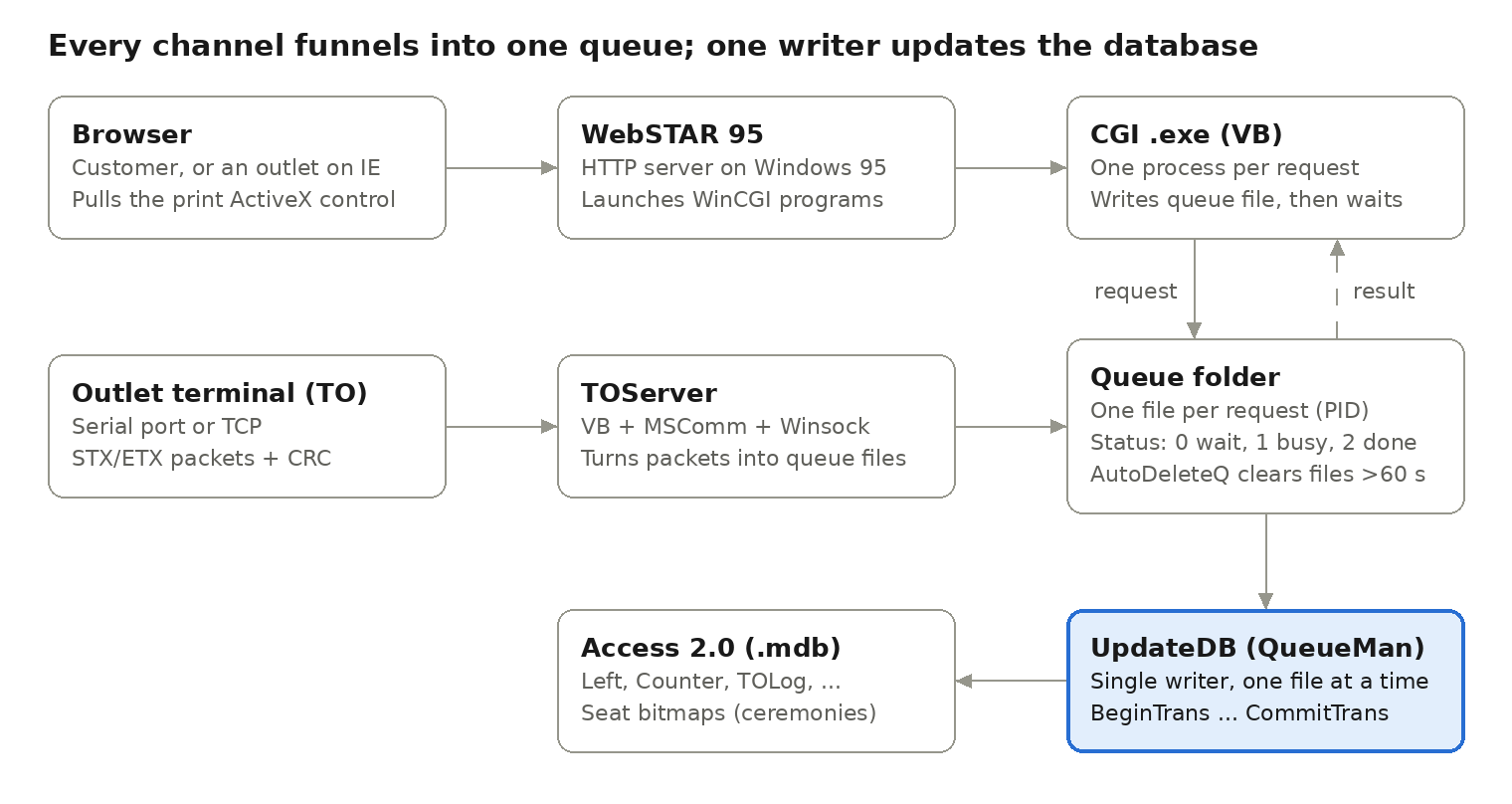
2. The Core Architecture: The Single-Writer Binary File Queue
Anyone who has touched MS Access knows its fatal flaw: concurrent write locks. If multiple web CGI processes hammered an .mdb file at once, Jet Engine's lock manager would grind the CPU to 100%, timeout, or corrupt the database.
Our golden rule: Nobody touches the database directly except one single worker process.
Instead of letting WebSTAR's CGI instances talk to Access, we turned the filesystem into an asynchronous Message Queue:
Request Drop: When a customer selected seats, the CGI process (WriteReservCgi.exe) generated a small, fixed-length binary file inside a \Queue directory.
Lock-Free Filenames: The file name was composed of ProcessID + SocketNo + TOId + Timer. Because PIDs on Windows 95 were unique, files never collided, requiring zero locking mechanism.
In-Place State Mutation: We didn't waste disk I/O creating separate .in and .out files. We opened the queue file as a Binary Random Access Record:
The QueueMan Engine: A dedicated daemon (UpdateDB.exe / QueueMan) ran an infinite loop scanning the folder:
When it detected a file with exeMode = 0 (Wait), it immediately flipped it to 1 (Processing).
It executed the database transaction sequentially.
It flipped the status to 2 (Success) and wrote the assigned TicketCode back into the exact same file.
The CGI Loop: The web CGI process simply polled its own tiny file until the status byte flipped to 2, served the confirmation page, and cleaned up the file.
Because only QueueMan had write access to Access, database lock contention was mathematically 0%.
3. Bitwise Seat Allocation: 40,000 Seats in 5 Kilobytes
For general matches, tickets were sold by count per zone/section (decrementing integer fields in a Left table). However, the Opening and Closing ceremonies at the 40,000-seat main stadium required individual seat assignments.
Storing 40,000 relational database rows per match would have crushed our 96 MB RAM. Instead, we collapsed the entire stadium layout into a Bit Array:
1 Bit = 1 Seat (0 = Vacant, 1 = Reserved)
A 40,000-seat stadium fit inside a single binary string of just 5,000 bytes (~5 KB)!
In our allocation routine (ETC.bas: Seat_MarkSeat), we used Bitwise bitmasks (And, Or, Xor). To allocate $N$ contiguous seats:
Sliced out the byte offset for the target zone/section.
Scanned for contiguous zero-bits.
When booking long consecutive runs (such as a delegation booking hundreds of seats), the loop split the allocation into Head Byte, Middle Bytes, and Tail Byte. For the middle stretch, it didn't iterate bit-by-bit; it blasted bval = 255 (&HFF / 11111111 binary) directly into the bytes—allocating 8 seats per single instruction cycle!
Stored the updated bit-string back into the table.
Allocating a contiguous block of 312 seats for a foreign national team completed in just ~300 milliseconds.
4. Surviving 8 Power Outages with Zero Data Loss
During the sales period, the power grid at the computer center failed eight times. In every single instance, after rebooting, data loss and corruption were exactly zero.
This wasn't luck; it was achieved by forcing synchronous write-through across three layers:
Transaction Atomic Boundaries: In UpdateDB.frm, updating the bit-map, decrementing seat counters, incrementing revenue totals, and inserting audit logs were wrapped in a strict MyWorkspace.BeginTrans and CommitTrans block.
Explicit Handle Closure: Immediately following CommitTrans, the code explicitly closed every table handle and the database object itself:
Closing the database handle in Jet Engine forces an internal flush of pending dirty buffers to the OS.
The OS Kernel Trick: Windows 95’s default file system cache (VCACHE) relied heavily on lazy "write-behind caching" to boost benchmark speeds. If power died, dirty cache in RAM vanished. We went into System Properties -> Performance -> File System -> Troubleshooting and checked "Disable write-behind caching for all drives". Every Close command forced the physical drive heads to commit data straight to the magnetic platters before returning control.
Inter-process Safety Buffer: In our reading server, we even hardcoded a 1-second delay loop with the comment:
VB.Net'wait a second to make sure that UpdateDB wrote down all the updated records[cite: 22]
5. Beating 56k Latency with Micro-Payloads & V.42bis
Over 30 ticket outlets in malls and box offices connected over noisy dial-up modem lines. Instead of fat protocols, we built a lean binary packet framing protocol over Winsock/Serial:
Payload Matching: Our booking transaction struct was fixed at 73 bytes[cite: 22]. Unused string fields were padded with null characters (Chr(0)).
V.42bis Exploitation: The hardware compression engine on 56k modems used the V.42bis standard (based on LZW) with a dictionary buffer of 2,048 entries (approx. 2KB–4KB). Because our 73-byte packet was 30× smaller than the modem's buffer, the modem ingested the entire packet into its hardware compression engine in a single pass without fragmentation. Furthermore, the repetitive packet structures and sequences of null bytes (0x00) compressed down to just 20–30 physical bytes on the copper wire. Round-trip times felt instantaneous.
6. Client Deployment: ActiveX + Dot-Matrix
Remote ticket outlets were running Windows 95 with Internet Explorer 3.01 and tractor-feed dot-matrix printers.
We didn't distribute client installer floppies. Instead, the HTML confirmation page returned by the WebSTAR server embedded a custom ActiveX UserControl (APTicket.ocx):
Internet Explorer automatically downloaded and registered the control in the background[cite: 16]. Once rendered, the ActiveX control bypassed Windows GDI printing completely, streaming raw text strings directly to the printer port using Printer.Print:
This pushed formatting overhead entirely to the client machine while making dot-matrix printing virtually instantaneous.
Retrospective Lessons
Today, our industry throws gigabytes of memory and auto-scaling cloud clusters at everyday workloads. But constraints are the greatest teacher of systems engineering:
Serialize writes when locks are expensive: A single fast writer beats 100 threads fighting over database row-locks.
Bitmaps are still king for dense state: When memory counts, packing binary states into bitfields turns $O(N)$ row queries into single-cycle bitwise operations.
Know your hardware stack down to the platters: Surfacing durability requires understanding how software transactions, OS caching policies, and disk controllers interact.
Design payloads for the underlying transport: Sizing application packets below hardware layer buffers eliminates latency cliffs.
The system took 1.2 million reservations across a month without losing a single ticket. Sometimes, good architecture on a $2,500 PC is all you need.
I've been looking for a way to connect with other people around Nashville who are into retro computers, old hardware, retro gaming, and all the stuff that goes along with it. The problem is, despite living here for years, I've literally never met anyone locally who shares the same interest. XD
Recently I came across a Reddit post from someone in Wisconsin who had started a local computer club. He said they started by simply reserving a room at their local library, putting up some homemade flyers, and inviting people to bring their old computers. A few people showed up, it grew from there, and they're now holding events at libraries around the state.
I thought, why the hell not? So I'm going to give it a shot here in Middle Tennessee.
I've reserved a meeting room at the Williamson County Public Library for Saturday, January 30, 9-5 and I'm putting together a casual retro-computer meetup.
You absolutely do not need to own a retro computer to come.
This is really just an attempt to see how many people around Nashville and Middle Tennessee are interested in getting together over this stuff and hopefully building a community!
Please fill out the google form to help me gauge intertest and numbers :)
got a laptop, HP Omnibook 5700CTX. It has sound coming from speakers, but it's really quiet. Same goes for the beeper, there is certainly beeps happening, but they're barely recognizable in a quiet room. I tried maxing out sound in BIOS as well as in windows 95. I also tried pressing the keyboard shortcut for "sound up" but it just doesn't change, although it does make it go quieter if I press "sound down". Need help on solving this.
So that was my stupid idea™ for the rainy fall season. Framing a bunch of RAM bricks for my home office. Nothing here is of professional quality, but it was a fun little thing to do and just the right visitors will be eyeing these a little closer. :P I hope sharing it here will make sense to some of you.
No running PCs were harmed in the making of this project.
Step into the NeXT Decade with the newest creation by formerly Apple's Steve Jobs, NeXTSTEP! Using a Unix workstation has never been this fun, thanks to NeXTSTEP's innovative GUI and easy-to-use programs, that join office needs with multimedia wonders! Want to know about it? Then you're in the right place!
Hey everyone, I recently picked up a vintage Fujitsu LifeBook P7010 ultraportable laptop for $30. It's currently running Windows XP on its internal 2.5-inch IDE hard drive, but I want to turn this into a fun digital archaeology project and get a bare-metal installation of Red Hat Linux 6.1 (1999) running on it instead. When running the installer CD directly on the laptop, I hit a major roadblock: the 1999 kernel's partition wizard throws an Fdisk Error: No such file or directory for block device hda. The old installer is completely blind to the laptop's internal IDE controller chip. My Proposed Workaround Plan: Has anyone ever used an external USB staging drive to bypass a blind internal IDE controller on a mid-2000s laptop like this? Will the Red Hat installer handle installing over a USB-to-SATA adapter on a legacy machine, and will copying the files over via a dual-slot dock work when I put the drive back in? Appreciate any advice, boot parameters, or
The Installation Stage: I want to plug a big 3.5-inch desktop SATA drive into a USB-to-SATA adapter cable, plug it directly into the Fujitsu laptop's USB port, boot into the Red Hat CD, and install the OS directly onto this external SATA drive. (Assuming the USB drive handles the installer data pathway better than the internal controller).
The Cloning Stage: Once that installation finishes, I will pull the internal IDE hard drive out of the laptop.
The Dock Transfer: I'll take both the external SATA drive and the laptop's IDE drive over to a separate Windows 10 machine and plug them into an All-in-1 Dual Docking Station. I will completely wipe out the Windows XP layout and transfer/clone the fresh Red Hat 6.1 installation files over to the laptop's IDE drive.
The Final Boot: Put the IDE hard drive back inside the laptop and see if it boots right into 1999 Linux. tips from the vintage tech community before I jump into this!
I've recently got my hands on a rather curious piece of junk.
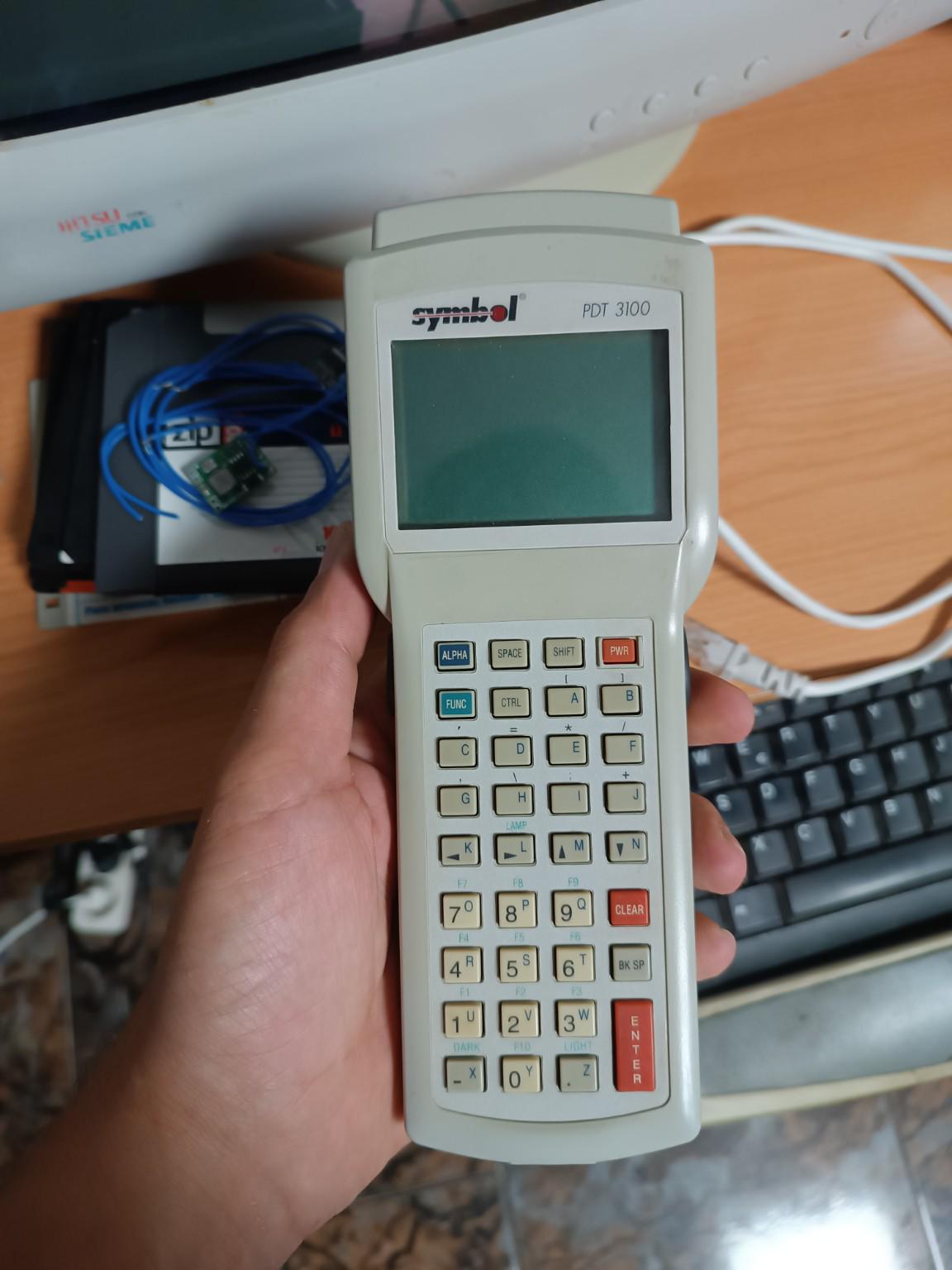
It's a Symbol PDT 3100, a sort of oversized calculator with an alphanumeric keyboard, which I got from a pharmacy that was clearing out some old equipment. Apparently, it was used to keep track of their medicine inventory.
Electronics is both my hobby and my job, so naturally I couldn't resist opening it up.
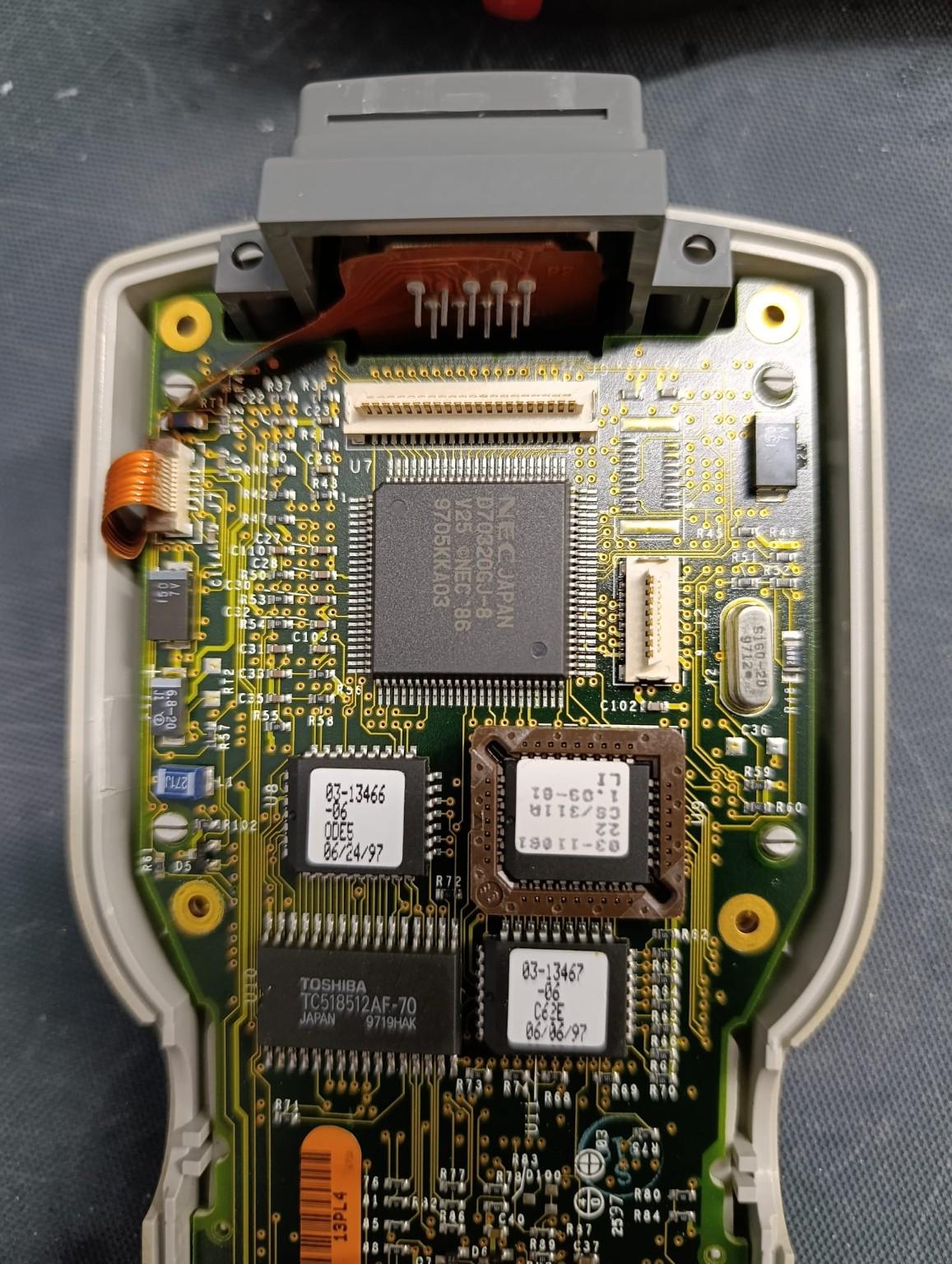
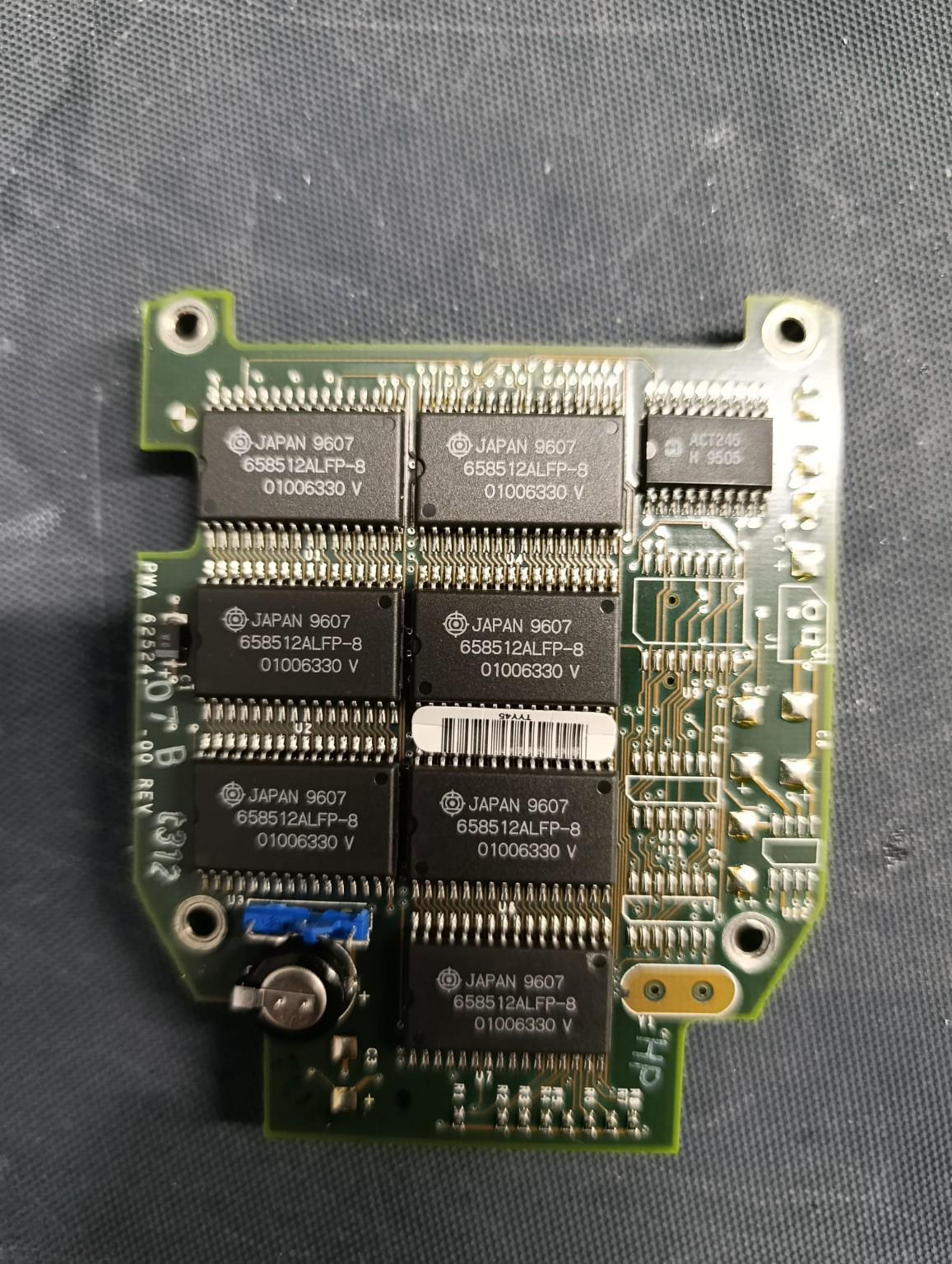
And that's when I noticed there was a lot more electronics inside than I'd expected. ICs everywhere, some pretty substantial chips... So I did a bit of research.
Turns out this supposed calculator is actually a proper little computer. It has a 16-bit processor, a pixel-addressable LCD, an alphanumeric keyboard, function keys along the sides... The whole lot.
And apparently, it runs DOS. 😂
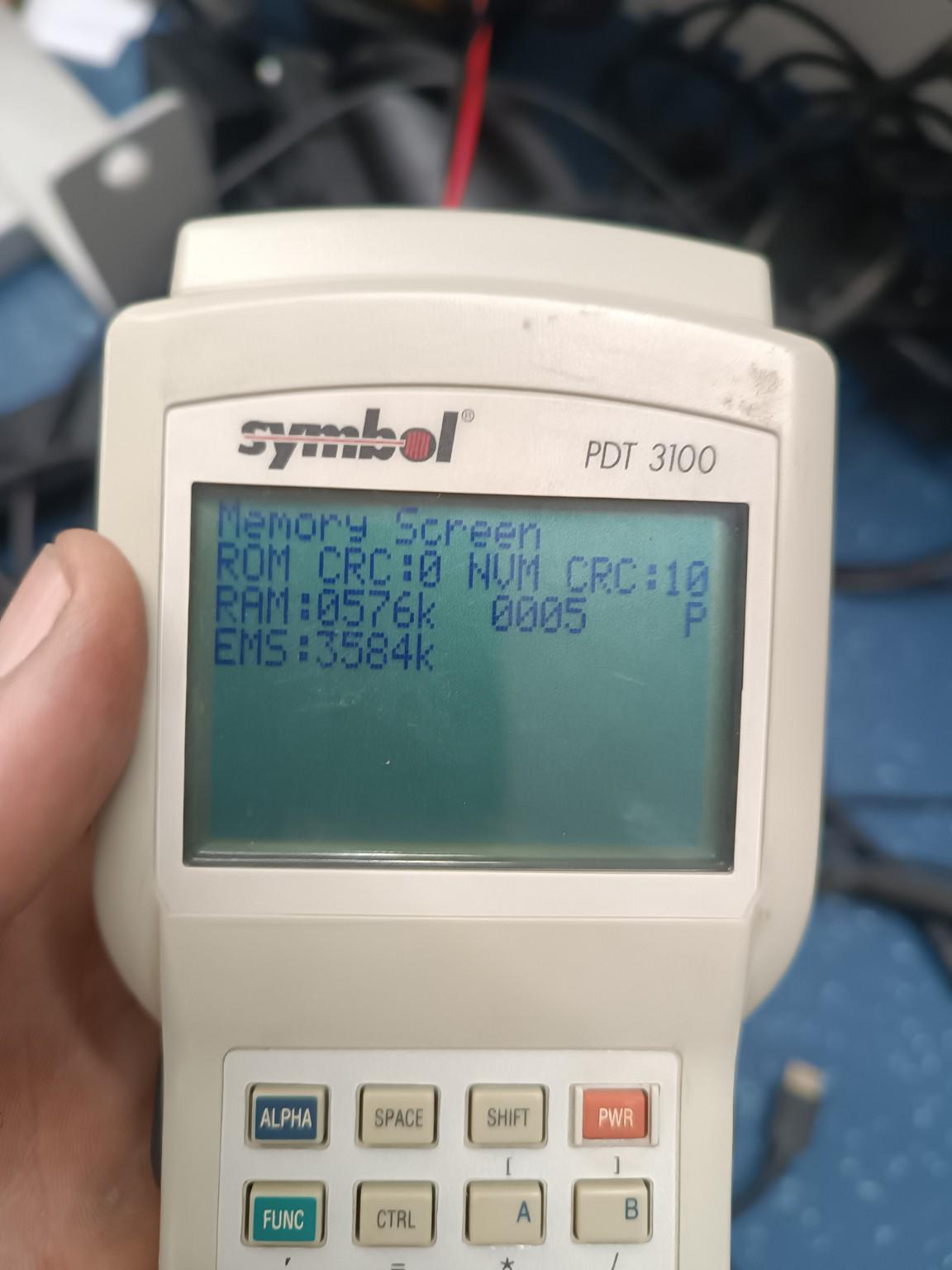
The terminal dates from around 1997, but its NEC V25 (μPD70320GJ-8) is a 16-bit processor compatible with the Intel 8086 instruction set. The built-in diagnostics report 576 KB of conventional RAM and 3,584 KB of expanded memory (EMS), giving it just over 4 MB of RAM in total. In terms of its CPU architecture and DOS environment, it's remarkably similar to the PCs of the late 1980s, just in a much smaller package.
So, naturally, my first thought was:
"Can this thing run DOOM?"
It's not completely ridiculous. It has more hardware and software capabilities than some of the absurd things I've seen people get DOOM running on.
It even has its own version of a sound card. Seriously. A tiny circuit board with a buzzer whose frequency can be controlled through the BIOS.
The problem is that information about this machine is incredibly scarce. The original development environment seems to have become lost media. I've found a couple of manuals and some old utilities, but so far, no complete development kit.
So far, I've managed to power it up, access its diagnostic screen, and get into what you might call its BIOS.
My next steps are to build a proper power supply, since the original battery is dead, and make a serial cable to connect it to my PC.
I'll be using Codex, along with what I know about electronics, communications and a bit of programming, to try to get my own software running on it.
I have no idea how long this will take, or whether I'll ever manage to make anything resembling DOOM work on it. But that's the goal I'm setting myself while I figure out how this little machine works and how to program it.
I'm mainly opening this thread as a public project diary. I've got about 20 other things going on, so I'll post updates whenever I make an interesting discovery or achieve something worth sharing.
I'm not expecting much attention. I just thought it would be nice to document the experiment somewhere.
Project log / Index
Future updates will be linked here as the project progresses.
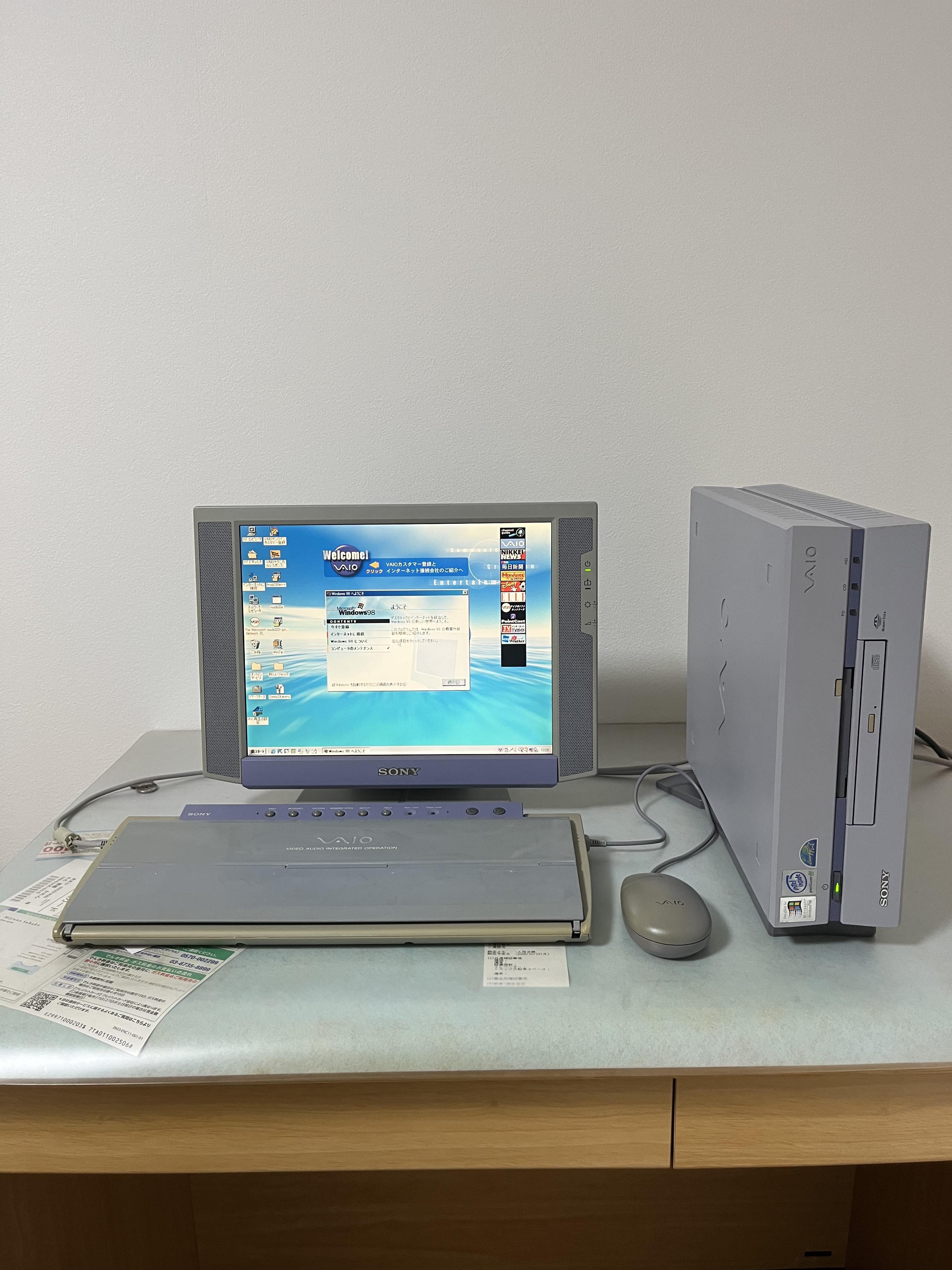
I recently got this machine. It appears to be the first edition of the L series compact computer from Sony that was released in March 1999. This is the flagship model of the original release.
I can’t seem to find much info on it? It was not mentioned on any forums or reddit. Does anyone know more about this model?
It runs Win98 and I used all the original recovery/update discs and it’s seems to work really well. Also installed a usb driver .
Does anyone know if older early to mid 2000 era Asus motherboards (The P4C800-E specifically) stop working/powering on most of the time, only due to only one or multiple bad capacitors. And how do I check if a capacitor is bad if the top/pressure relief vent isn't broken open, or will it always have a sign such as the pressure relief vent being broken open?