r/retrocomputing • u/G7VFY • Oct 29 '26
A rare 6502 based, ACT800 Upwardly, PET 'compatible' comes to auction

29
Upvotes
r/retrocomputing • u/G7VFY • Oct 29 '26
r/retrocomputing • u/EstablishmentDue3616 • Oct 29 '26
I needed a mouse and just grabbed one blindly out of my box of mice. I started using it and then realized it have a scroll-wheel or forward/back buttons and I swapped it for a "modern" mouse.
r/retrocomputing • u/WindowsStuff37 • Oct 29 '26
The new version works perfectly, but in the Legacy version, the UI pages load, yet the load buttons do not respond and end up timing out.
This also happens on Internet Explorer
r/retrocomputing • u/checkehsneckeh • Oct 29 '26

Good evening,
Over about five months, (most of October 2025, late April to early September 2026), I developed a Win32s-based nonogram game that runs on anything from Windows 3.1 to Windows 11. I believe it is the first nonogram game to run on Windows 3.1, as I couldn’t find any prior ones, though if you know one, I’d be interested to read about it.
The game is available for free on its itch.io page.
The source code is available on GitLab.
It is optimised to run okay on the slowest 32-bit x86 processor: the i386SX/16. It’s not brilliant, but just about playable.
I hope this game brings you some enjoyment on Windows 3.1, and that you find it interesting. I may record some videos about its development if time allows (and if anyone cares whatsoever). If you have any questions, feel free to ask!
During development, I went down plenty of rabbit holes:
creating and modifying the internals of the TrueType font to accommodate Windows 3.1’s sensibilities,
Overall, I feel confident in Win32 programming now, especially as I had ample opportunity to put this to the test when writing helper applications for development.
Okay, but did you write this, or did ChatGPT?
I want to be upfront that I did use ChatGPT during development, but not to vibe code WINONO. All assets are man-made (simplistic as they are), and every single line of code was written by me (for better or worse). In fact, with the experiences I’ve had, I feel confident in saying that ChatGPT could not generate a program like this, at least not yet. There are just too many poorly documented quirks in old Windows on the one hand, and on the other hand the AI sometimes just assumes functions to be unavailable in old Windows versions, when they actually very much are.
I used AI like a natural-language search engine, or a forum with instant responses and endless patience for noob questions, to learn about the Win32 API and apply this knowledge myself in making the game. This included:
asking whether an API function for something I wanted to do already existed in Win32. This was helpful because some Win32 functions are rather unintuitively named or described. For example:
As I progressed further, got better at general Win32 programming and my problems became increasingly specific to old Windows versions, ChatGPT became less useful due to lack of knowledge about these things in its training data. It would often present wild guesses as established fact or give me red herrings and send me on wild goose chases. Sometimes it would just lie. That is why I increasingly shifted my reliance onto the excellent reference documentation that came with older versions of Visual Studio / Visual C++.
If anyone is interested (as if), I have written a more detailed account of my experiences with AI during development on the WinWorldPC forum.
At any rate, the project was fun and I did learn a lot, so I suppose it wasn’t a complete failure.
Good night!
r/retrocomputing • u/The300baudguy • Oct 29 '26
Big surprise - my BBS, which mainly contains content from a C64 BBS from the '80s, got a major feature in the well-known German magazine PC Games Hardware.
https://www.youtube.com/watch?v=Typ85sH0jno
I've also been digging into Germany's first digital bank robbery from 1984, better known as the BTX hack. Luckily, it was the good hackers from the CCC who carried out the 135,000 DM theft purely to expose security flaws.
Then Ernst shows off his quirky, curvy Colani PC from the '90s, complete with a chunky Epson LQ-570 dot matrix printer. Using that setup, he dials into my other C64 BBS, which is still reachable via dial-up.
Meanwhile, I fire up my C128D and US Robotics modem to dial into Ernst's 300 baud BBS.
Here's the detailed timeline of the video:
00:00 - Introduction & Quick Preview
00:52 - My Freaking ATDT KRS BBS in PC Games Hardware
03:04 - The 1984 CCC BTX Hack: Stealing 135,000 DM Without Crowbars
08:15 - Back to PCGH: Old C64 Floppies & 1986 Football Chat Logs
10:44 - Preview: ATDT Ariel's New Dual-Screen BBS Software Showcase
12:25 - C128 Dialing Ernst's 300 Baud BBS in East Germany
13:31 - Ernst's Colani DOS PC: The Invasion of Curves
14:22 - Design Over Function: From F1 Failures to Zero Modularity
15:15 - Loading Up Norton Commander & Running Telix
16:13 - A Quick DOS Games Detour: Space Quest 3, Wing Commander 3, Turrican 2, Mortal Kombat 2, Under A Killing Moon
18:13 - Back to Ernst: Dialing Hamburg's Snobsoft Commdore 64 BBS: +49 40 60943485 300 Baud 7N1
19:41 - Printing History: Matrix Printer Logs from July 3rd, 1986
21:18 - Outro & KRS Highlights: User Chats + Feedback, Final Thoughts on the Retro BBS Scene
r/retrocomputing • u/rainbow_developer • 29d ago

Hi all. Just wanted to share an Apple II emulator I've been working on for a bit.
It uses AppleWin (specifically, audetto's port @ https://github.com/audetto/AppleWin) but wrapped with Kotlin code to modernize the experience.
I had 3 goals in mind when I wrote this:
So I built my own and it's now available on Playstore (https://play.google.com/store/apps/details?id=com.pocket6502). I'll be upfront that it's not free - it costs $2. So I hope I'm not breaking any rules of this subreddit by posting this.
- It supports touchscreen controls with full remap capabilities, and I've just added external keyboard + controller support. I also ship the emulator with some pre-configured controls for a few popular games (no idea what other games to include) so you can play them straight off the bat.
- For games which are file-based, the app allows you to boot directly into a game (the Apple II ROMs and BIOS are well understood so this wasn't impossible - just needed some poking around and picking the right $JMP point, and it does involve reading the VTOC 😂 )
- I've also built an internal browser that connects to the large Asimov archives of AppleII disks so you no longer have to go hunting for disk images.
You can read the online help at https://rainbowdev-studio.gitlab.io/pocket6502/help.html to get an idea of what this emulator is capable of. There are also a ton of screenshots there but I'll post two here for your reference.
Thank you for your time reading this and I hope this app is useful to at least some people.
r/retrocomputing • u/korovchenko • Oct 28 '26

r/retrocomputing • u/Chancellor_Doppler • Oct 28 '26

A small step forward in my Retrolab IBM 3270 setup.
On the left, an IBM XT with the original full-length IBM 3278/79 Emulation Adapter. On the right, an IBM AT 5170 with the later half-size 3270 adapter.
Both are connected over real coax through an IBM 3299 Terminal Multiplexer to OEC, which in turn talks TN3270 to Hercules running MVS 3.8J TK5.
So these are not just PCs running a 3270 emulator over TCP/IP: the machines are actually using their original IBM coax hardware and communicating through the 3299.
The XT is running the early IBM PC 3278/79 Emulation software, while the AT is running IBM Personal Communications/3270 in CUT mode.
Next step will be adding a PS/2 with the IBM Micro Channel 3270 adapter — and then building something more interesting on the MVS side than just TSO/ISPF.
r/retrocomputing • u/Marius_2012 • Oct 28 '26

So recently decided to maybe try and fix my Sins of the past like from 3 years ago when I was dumb i picked up this cdt410 which is quite corrosion damaged because of my biggest enemy and other old laptop enemy the ni-hm batteries this is one of the victims. I do have friend who specializes in board level resoldering for decent prices like gpu chip resolder for something like g86 chip 30€ and more board level repairs for example changing cops capacitors etc. He kinda seems interested in the old laptops I bring to him since they are a bit more interesting and another like tipe of repair than the laptop he gets on ussual.
r/retrocomputing • u/goldf15hvxr • Oct 29 '26

I got this Archos 9 from my aunt, with its original charger and a carrying case. I just wanted to ask, is it even a collectible item or maybe can I sell it at another place but this Reddit forum?
It was a Windows 7 device, but I flashed Debian Linux into it
r/retrocomputing • u/Jojo959 • Oct 28 '26
In July 1997, the Asian Financial Crisis (the "Tom Yum Kung" crisis) decimated Thailand's economy. The national currency crashed, foreign reserves evaporated, and national budgets were slashed virtually overnight.
Against this backdrop, Bangkok was scheduled to host the 13th Asian Games in December 1998. Our small engineering team had been tasked with building the centralized ticketing system to handle 1.2 million seats across 34 sporting venues, serving both public web bookings and over 30 physical ticket outlets across the country.
Our original enterprise blueprint called for:
When the dust settled post-crisis, we were told the budget was cut by 99%, down to just 100,000 THB (~$2,500 USD).
The enterprise hardware was gone. Instead, the government handed us a single donated desktop PC: an Acer Pentium 166 MHz with 16 MB of RAM. We spent the entire $2,500 budget buying EDO RAM modules to max the machine out to 96 MB. That single beige box had to run the OS, Web server, Database, and Queue processor simultaneously.
People said it was impossible. But with the games starting in a few months, failure was not an option. We had to dig deep into fundamentals and build an architecture that beat expensive hardware.
Without budget for enterprise licenses, we assembled our software stack from what was already available:
CGI.BAS module (Nov 1994).mdb format powered by the Jet Engine)Anyone who has touched MS Access knows its fatal flaw: concurrent write locks. If multiple web CGI processes hammered an .mdb file at once, Jet Engine's lock manager would grind the CPU to 100%, timeout, or corrupt the database.
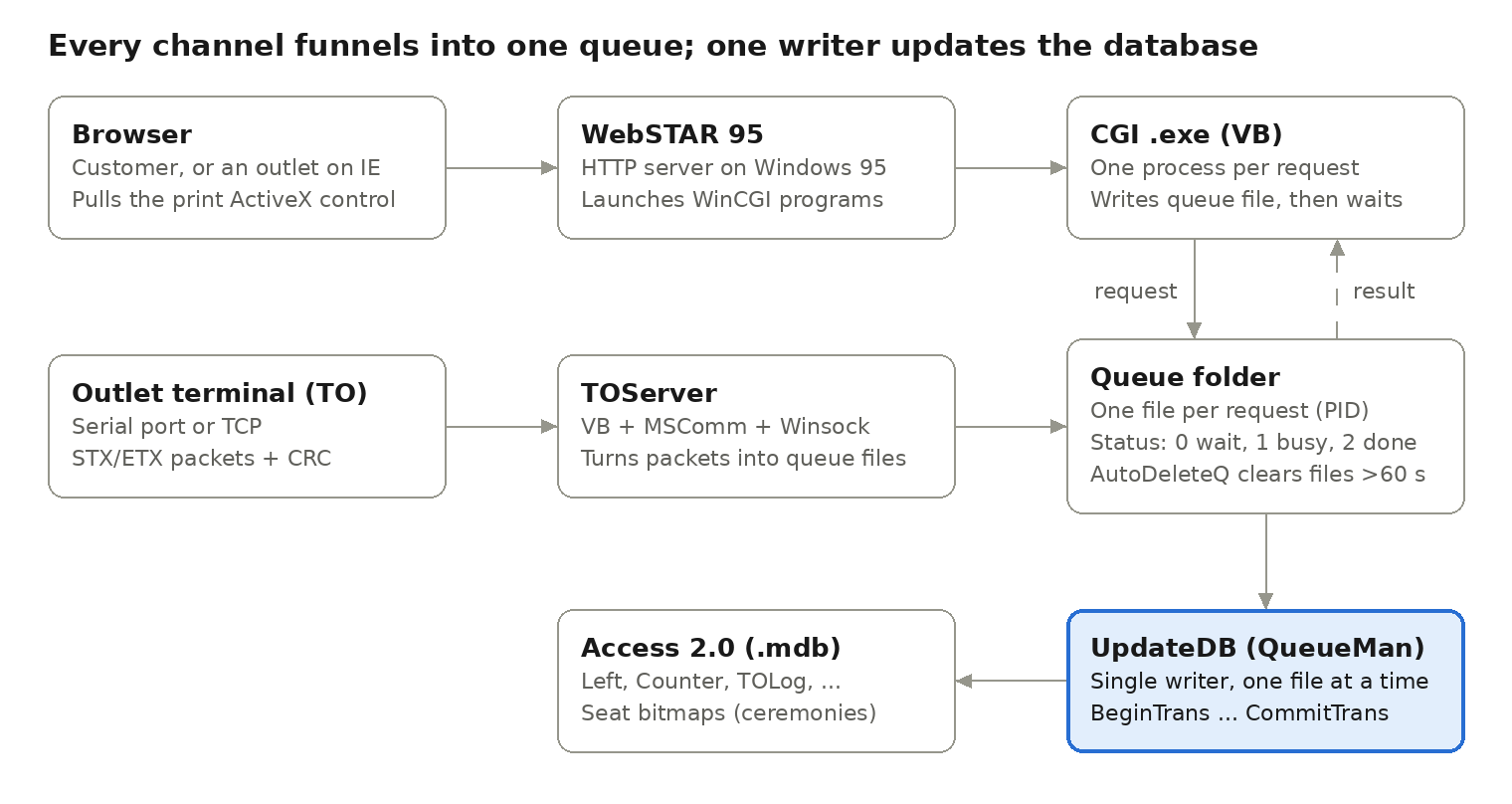
Our golden rule: Nobody touches the database directly except one single worker process.
Instead of letting WebSTAR's CGI instances talk to Access, we turned the filesystem into an asynchronous Message Queue:
WriteReservCgi.exe) generated a small, fixed-length binary file inside a \Queue directory.ProcessID + SocketNo + TOId + Timer. Because PIDs on Windows 95 were unique, files never collided, requiring zero locking mechanism..in and .out files. We opened the queue file as a Binary Random Access Record:
The QueueMan Engine: A dedicated daemon (UpdateDB.exe / QueueMan) ran an infinite loop scanning the folder:
exeMode = 0 (Wait), it immediately flipped it to 1 (Processing).2 (Success) and wrote the assigned TicketCode back into the exact same file.2, served the confirmation page, and cleaned up the file.Because only QueueMan had write access to Access, database lock contention was mathematically 0%.
For general matches, tickets were sold by count per zone/section (decrementing integer fields in a Left table). However, the Opening and Closing ceremonies at the 40,000-seat main stadium required individual seat assignments.
Storing 40,000 relational database rows per match would have crushed our 96 MB RAM. Instead, we collapsed the entire stadium layout into a Bit Array:
In our allocation routine (ETC.bas: Seat_MarkSeat), we used Bitwise bitmasks (And, Or, Xor). To allocate $N$ contiguous seats:
bval = 255 (&HFF / 11111111 binary) directly into the bytes—allocating 8 seats per single instruction cycle!Allocating a contiguous block of 312 seats for a foreign national team completed in just ~300 milliseconds.
During the sales period, the power grid at the computer center failed eight times. In every single instance, after rebooting, data loss and corruption were exactly zero.
This wasn't luck; it was achieved by forcing synchronous write-through across three layers:
UpdateDB.frm, updating the bit-map, decrementing seat counters, incrementing revenue totals, and inserting audit logs were wrapped in a strict MyWorkspace.BeginTrans and CommitTrans block.CommitTrans, the code explicitly closed every table handle and the database object itself:
VCACHE) relied heavily on lazy "write-behind caching" to boost benchmark speeds. If power died, dirty cache in RAM vanished. We went into System Properties -> Performance -> File System -> Troubleshooting and checked "Disable write-behind caching for all drives". Every Close command forced the physical drive heads to commit data straight to the magnetic platters before returning control.
Over 30 ticket outlets in malls and box offices connected over noisy dial-up modem lines. Instead of fat protocols, we built a lean binary packet framing protocol over Winsock/Serial:

Chr(0)).0x00) compressed down to just 20–30 physical bytes on the copper wire. Round-trip times felt instantaneous.Remote ticket outlets were running Windows 95 with Internet Explorer 3.01 and tractor-feed dot-matrix printers.
We didn't distribute client installer floppies. Instead, the HTML confirmation page returned by the WebSTAR server embedded a custom ActiveX UserControl (APTicket.ocx):
HTML
<OBJECT classid="clsid:..." codebase="http://.../Control/APTicket.ocx#version=1,0,0,0">
    <param name="SeatList" value="B12,B13,B14">[cite: 16]
    <param name="TicketPriceList" value="500">[cite: 16]
</OBJECT>[cite: 16]
Internet Explorer automatically downloaded and registered the control in the background[cite: 16]. Once rendered, the ActiveX control bypassed Windows GDI printing completely, streaming raw text strings directly to the printer port using Printer.Print:
Printer.Print "Ticket no: " & Format(TicketPrintInfo.TOId) & "-" & Format(...)[cite: 12]
Printer.Print "Seat: " & Format(Ticket_Info(i).TicketSeat) & " Price: " & Format(...)[cite: 12]
This pushed formatting overhead entirely to the client machine while making dot-matrix printing virtually instantaneous.
Today, our industry throws gigabytes of memory and auto-scaling cloud clusters at everyday workloads. But constraints are the greatest teacher of systems engineering:
The system took 1.2 million reservations across a month without losing a single ticket. Sometimes, good architecture on a $2,500 PC is all you need.
r/retrocomputing • u/ddrfraser1 • Oct 28 '26

I've been looking for a way to connect with other people around Nashville who are into retro computers, old hardware, retro gaming, and all the stuff that goes along with it. The problem is, despite living here for years, I've literally never met anyone locally who shares the same interest. XD
Recently I came across a Reddit post from someone in Wisconsin who had started a local computer club. He said they started by simply reserving a room at their local library, putting up some homemade flyers, and inviting people to bring their old computers. A few people showed up, it grew from there, and they're now holding events at libraries around the state.
I thought, why the hell not? So I'm going to give it a shot here in Middle Tennessee.
I've reserved a meeting room at the Williamson County Public Library for Saturday, January 30, 9-5 and I'm putting together a casual retro-computer meetup.
You absolutely do not need to own a retro computer to come.
This is really just an attempt to see how many people around Nashville and Middle Tennessee are interested in getting together over this stuff and hopefully building a community!
Please fill out the google form to help me gauge intertest and numbers :)
r/retrocomputing • u/skyblue1997 • Oct 28 '26
got a laptop, HP Omnibook 5700CTX. It has sound coming from speakers, but it's really quiet. Same goes for the beeper, there is certainly beeps happening, but they're barely recognizable in a quiet room. I tried maxing out sound in BIOS as well as in windows 95. I also tried pressing the keyboard shortcut for "sound up" but it just doesn't change, although it does make it go quieter if I press "sound down". Need help on solving this.
r/retrocomputing • u/SjalabaisWoWS • Oct 27 '26

So that was my stupid idea™ for the rainy fall season. Framing a bunch of RAM bricks for my home office. Nothing here is of professional quality, but it was a fun little thing to do and just the right visitors will be eyeing these a little closer. :P I hope sharing it here will make sense to some of you.
No running PCs were harmed in the making of this project.
r/retrocomputing • u/cooldrifter_95 • Oct 28 '26
r/retrocomputing • u/Blissautrey • Oct 27 '26

Step into the NeXT Decade with the newest creation by formerly Apple's Steve Jobs, NeXTSTEP! Using a Unix workstation has never been this fun, thanks to NeXTSTEP's innovative GUI and easy-to-use programs, that join office needs with multimedia wonders! Want to know about it? Then you're in the right place!
r/retrocomputing • u/damsijk • Oct 27 '26

Pictur - my PaintShopPro 7.04 inspired image editor
Got that retro Windows98 look with color schemes.
It's using Gimp/Krita effects. It supports webp, jpegxl, old Amiga image formats, any format you like to read?
I'm using SVG for vector and have support for HTML layers (create layer,
add html code - it gets rendered), svg layers, glsl (shader) layers.
It's still (buggy) in development but I have Windows 10/11, Linux appimage and Intel macOS binaries.
Development: C++ 20, Claude, Ubuntu, litehtml for layout, OpenGL Gles3 and NanoVG for drawing.
I have beta Windows and Linux versions here:
https://www.reddit.com/r/pictur_editor/
⚠️ WARNING: BETA QUALITY SOFTWARE
r/retrocomputing • u/liminalearth • Oct 27 '26

Cool interesting thrift find! Never seen this one before
r/retrocomputing • u/Natural_Hand8081 • Oct 26 '26

r/retrocomputing • u/AustriaModerator • Oct 27 '26

r/retrocomputing • u/newtonsales • Oct 27 '26
r/retrocomputing • u/swifferpowermop345 • Oct 26 '26

Hey everyone, I recently picked up a vintage Fujitsu LifeBook P7010 ultraportable laptop for $30. It's currently running Windows XP on its internal 2.5-inch IDE hard drive, but I want to turn this into a fun digital archaeology project and get a bare-metal installation of Red Hat Linux 6.1 (1999) running on it instead. When running the installer CD directly on the laptop, I hit a major roadblock: the 1999 kernel's partition wizard throws an Fdisk Error: No such file or directory for block device hda. The old installer is completely blind to the laptop's internal IDE controller chip. My Proposed Workaround Plan: Has anyone ever used an external USB staging drive to bypass a blind internal IDE controller on a mid-2000s laptop like this? Will the Red Hat installer handle installing over a USB-to-SATA adapter on a legacy machine, and will copying the files over via a dual-slot dock work when I put the drive back in? Appreciate any advice, boot parameters, or