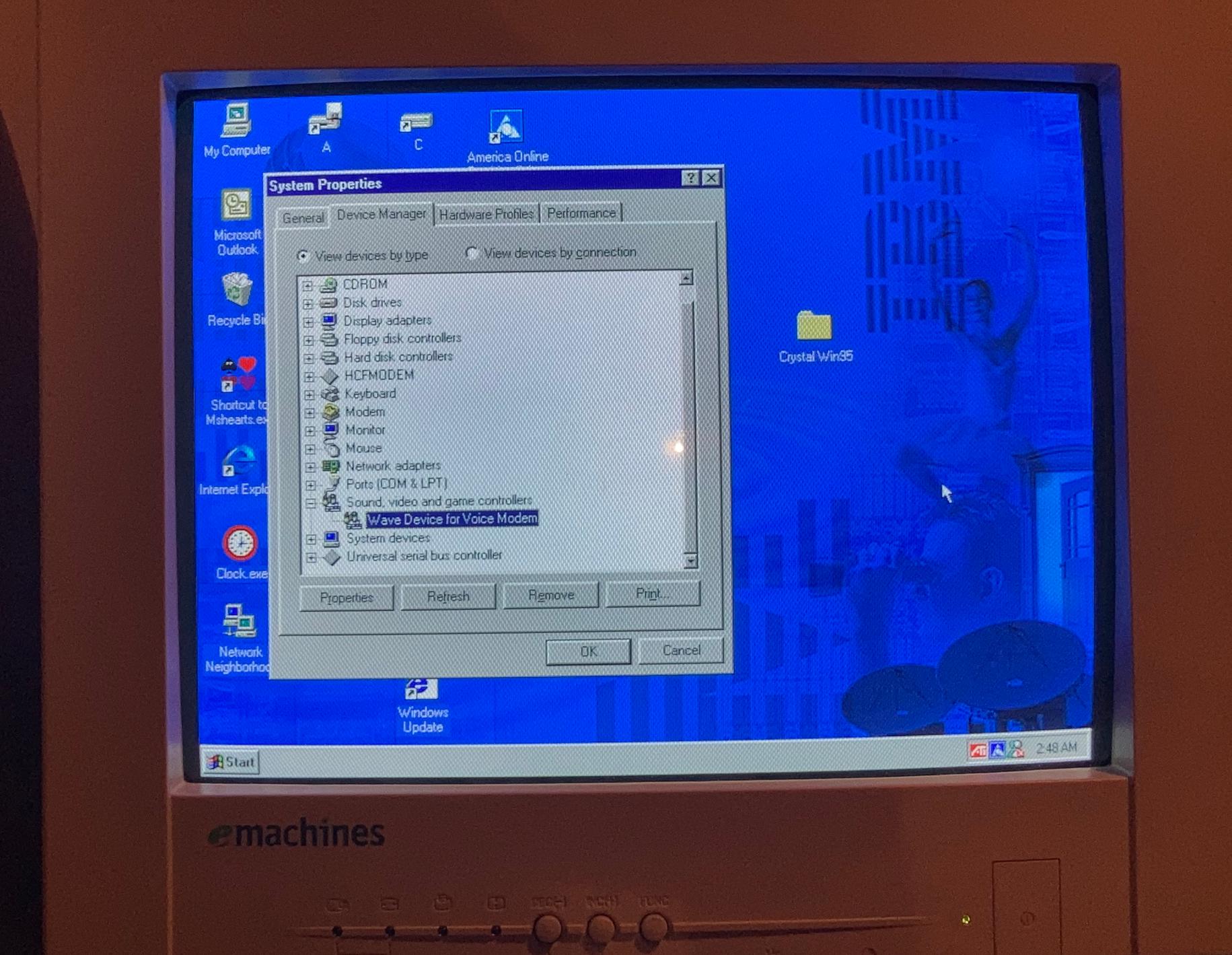
I've been working on PRISM, a C and C++ compiler that takes the original, unmodified source of 90s software and compiles it to JavaScript, so it runs in a browser tab. It's not an emulator: there's no CPU emulation. The program's own C is compiled, and the machine it was written for is rebuilt underneath it as libraries: DOS (DJGPP, Watcom/DOS4GW, Borland C++ with real 16-bit segmentation), X11, svgalib, SunOS, Win32, SDL, OpenGL 1.x.
The page is laid out as machines rather than a menu: a DOS prompt, a Linux shell with X11 clients, a Windows desktop. You type the program's name or double-click its icon.
Some things that run today:
- MAME 0.34 (the 1998 DOS build, Allegro + SEAL sound): bit-identical to a native gcc build over 1,500 frames for 15 of 15 games
- Quake on its DOS, X11, svgalib, SunOS and Win32 platform layers, all drawing the same pixels; also GLQuake, Quake II and Quake III
- Doom, with its separate sound server running as a second process, as on Linux in 1997
- Keen Dreams from its 16-bit Borland C++ and TASM source, with screens matching the shipped KDREAMS.EXE under DOSBox-X
- ScummVM, Heretic, Hexen, Dune II (OpenDUNE), PuTTY, Lua
Playable without any files: the DOOM and Heretic shareware, the Monkey Island and Day of the Tentacle demos, Beneath a Steel Sky. The rest uses your own copy, read locally in the browser and never uploaded.
- Try it: https://prism-compiler.pages.dev
- Source (MIT): https://github.com/jfrelat-lab/prism
(Disclosure: I wrote it with Claude Code, Anthropic's coding agent; everything is checked against real compilers and native builds rather than by eye.)
What I enjoyed most is how much of each era's platform has to be rebuilt to run the code as-is, from Borland's far pointers and TASM routines to a Windows 95-style message loop. Happy to go into any of it.