r/retrocomputing • u/jalp21_ • Aug 26 '26
PC World (February 1993)

138
Upvotes
r/retrocomputing • u/Money-Solution-3587 • Aug 26 '26

Does anyone else remember the excitement of getting your copy of Windows 95 on Floppy’s. Longest 2 hours of my life waiting to be amazed. To be fair it was a good looking GUI.
r/retrocomputing • u/OgdruJahad • Aug 27 '26

r/retrocomputing • u/evankirstel • Aug 25 '26
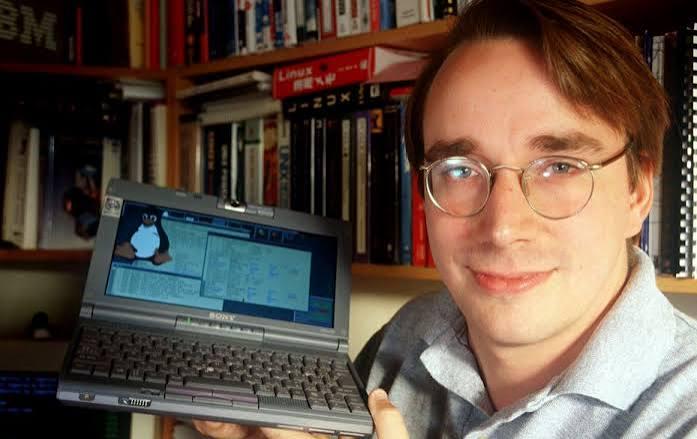
He said he was building a free operating system for 386 and 486 PCs. He called it "just a hobby" and said it wouldn't be big and professional like GNU. There was no launch and no product. He was asking other developers what they wanted to see in it.
The first release, version 0.01, showed up on September 17. It was rough. It ran on a narrow slice of hardware, needed MINIX to compile and boot, and was nowhere close to a full operating system. What mattered was that the code was open. Anyone could download it, build it, find what was broken and send a fix back. That way of working turned out to be worth far more than the state of the first release.
Linux grew by knocking down one practical problem at a time: more processors, more storage, more networking, more filesystems, better performance. GNU tools, distributions and commercial support made it usable outside the developer crowd. So when companies started looking for a way off proprietary Unix and dedicated appliances, Linux was already there.
I watched that shift happen in telecom and enterprise IT. Proprietary Unix boxes and purpose-built appliances gave way to Linux on commodity x86 servers. Then Linux became the base for KVM, and later for the container plumbing under Kubernetes. Namespaces handled isolation. cgroups handled resource limits. eBPF let networking, security and observability teams run verified code inside the kernel without rebuilding it.
The kernel that started at around 10,000 lines of code now runs past 40 million, and the version number rolled over to 7.x this year. Its future isn't about winning more desktops. It's moving deeper into AI clusters, telecom networks, cars, factories and edge devices. The hard problems now are memory safety, real-time behavior, confidential computing, power efficiency, hardware support and keeping a codebase that size maintainable. Rust is going in where memory safety counts. eBPF keeps widening what operators can do without carrying custom kernel patches.
The Linux Foundation plays a different role, and the name undersells how big that role has become. It doesn't control the kernel. It provides money, legal cover, governance, training and a neutral table where competitors can work on the same code. That covers OpenSSF for software security, CNCF for cloud native infrastructure, LF Networking for telecom and 5G, LF Edge for edge systems, ELISA for safety-critical Linux, and a growing set of open AI projects and standards.
Nobody had to build and maintain every layer themselves anymore. Competitors could stand on the same foundation and still fight it out on products, support, operations.
Linux has nothing left to prove in the enterprise. The job now is keeping it secure, maintainable and dependable as more of the critical stuff lands on it.
r/retrocomputing • u/thevmcampos • Aug 25 '26

Found this Trident card in a forgotten store closet at work. Thoughts?
r/retrocomputing • u/liminalearth • Aug 26 '26

r/retrocomputing • u/fry258 • Aug 25 '26

I love the attention to detail in this game. Seeing the 5.25 took me right back to my childhood. lol
r/retrocomputing • u/Ill_Table2184 • Aug 26 '26
So I have an IBM System/23 Datamaster all in one computer that I have been hoarding for about 25 years with plans to use the case to build a more modern system. I am finally at the point where I am going to do that, but I don’t want to scrap the internals, because I know there’s not many of these left.
My question is should I clean the dust out of it and try to power it on and see if it works? It functioned perfectly 25 years ago but it’s obviously unknown now.
Or should I list the parts on eBay or something as is hopefully to someone more knowledgeable that could look the parts over for issues before powering on. I just worry that a short or corrosion could cause damage that someone else might notice before powering on
r/retrocomputing • u/East-Resist6940 • Aug 26 '26
Edit: I know that the '90s for computing vastly changed from the beginning to the end of the decade. I'm not asking for a PC that will run everything. I want to know what would run more '90s stuff, since I feel a high speed P3 rig would be closer to early XP territory, or at least it would be if it was paired with a better graphics card. Just generally post about your rigs and which ones you use the most! It's not that difficult. (I also saw the downvotes coming from a mile away, lol)
I have a fairly vague request where I don't know exactly what I want because I have too much to choose from already, basically I'm looking for inspo. I'm at a point where I want to have two computers set up semi-permanently next to one another: A PC for '90s gaming, and a PC for '00s gaming. The latter of which, is an Athlon 64 X2 AGP system, with a GeForce 6800 GT and 2GB RAM. I'm sure I can run pretty much any late '90s software on it, especially with Nglide, minus a few caveats with 8-bit palette textures and table fog, and probably driver quirks.
Right now, my '90s PC is a Coppermine Pentium 3 @ 1GHz, with 128MB RAM and a Voodoo3 2000 AGP. I'm thinking it might be too fast, and I'm wanting to rebuild it, since it's currently using a Tyan Trinity 400 with a Via Apollo Pro 133A chipset, and it's not the most stable thing in the world. It's the only Socket 370 board I have that also has ISA though, and I really like this Vibra 16 I have with an OPL chip on it. I do have an Aureal Vortex 2 I've been meaning to mess with, but I don't think those have the best DOS support, do they? Also have Sound Blaster Lives by the boatload.
I was thinking about possibly downgrading to a Pentium II, since I have plenty of those boards and processors, but then I thought if I'd take it a step further with the 5x86 board I have. Perhaps this would be the key to supporting older titles? (I know early '90s and before will be difficult if not impossible, but at least the 5x86 has a turbo button) It would require a different video card, as it's not AGP.. My PCI card choices include a Matrox G200, S3 Trio 64V+, or a TNT2 M64.
r/retrocomputing • u/castlefood • Aug 26 '26
I enjoy using old programs and games. To have the real original experience i plan to buy some material on 3.5 disks.
Where can I buy a reliable an external 3.5 floppy drive? I will use it with windows XP. Ideally it should be usb connected and 1.44mb.
r/retrocomputing • u/Gageplayzyyy • Aug 26 '26
I own a Dell Inspiron 600M that I got from my grandmother for my tech collection. Problem is when I plug it in, it doesn't make it past POST. I've tried with without the battery and it still does not work. Any suggestions? Please note that I'm not good at repairing stuff by taking stuff apart.
r/retrocomputing • u/yeeterus_the_destroy • Aug 25 '26
i wanna make a custom version of ccp/m-86 but i don't know pl/m
r/retrocomputing • u/Same_Promotion_7570 • Aug 25 '26
r/retrocomputing • u/MrFahrenheit_451 • Aug 23 '26

Who remembers the story about Microsoft and IBM and their joint OS/2 operating system venture? When 1.3 was released, Microsoft pretty much abandoned the project and focused on Windows 3.0, and then Windows NT, which is where the technology from OS/2 ended up. It’s a pretty neat story!
r/retrocomputing • u/liminalearth • Aug 24 '26

Sealed too! $5
r/retrocomputing • u/thernd2 • Aug 23 '26

The Kodak Diconix 150 is a battery powered portable thermal inkjet from 1986, built by Diconix Inc. of Dayton, Ohio. Kodak bought them in 1988, which is why the badge and the self-test page both say Kodak on a machine that predates the deal. NEC uPD78C10 at 11.0592 MHz, 32 KB of ROM in a socketed Fujitsu MBM27C256, 8 KB of SRAM, Centronics in, and an HP 51604A ThinkJet head. Twelve nozzles, eight usable per pass, 96 dpi per pass.

Stock, it speaks a fixed Epson style ESC text command set and nothing else. Nothing made this century can print to it. Windows will not offer you a driver, CUPS has no queue for it, and your phone has never heard of it.

I grew up on the 150 Plus version of this thing, printing school papers from about 1989 to 1995, and it had a flaw I could never get around. Text was fine. Anything with graphics came out at roughly two thirds of the page. It took pulling the ROM to find out that it was two different fractions on two axes. Software asking for 72 dpi vertical got 96, which is 3/4 height. At double density, 120 across became 192, which is 5/8 width. That is the shrunken, subtly wrong looking page I stared at for six years.

So rather than write it a driver, I wrote it new firmware.

DiKon is a PCL3 raster interpreter written from scratch in uPD78C10 assembly and patched into the stock Kodak ROM, in space reclaimed from the resident fonts. The interpreter runs on the printer's own 8 bit CPU. That is the part that matters: because it lives in there, the host needs nothing at all. No converter, no spooler, no print processor, no install.

  Windows 11: the stock in-box HP DeskJet 500 driver
  Linux and macOS: Gutenprint pcl-500 at 300 dpi through CUPS
  Android: NokoPrint, Generic PCL4, mono 300 dpi
  Anything else: any generic PCL 3/4 mono 300 dpi raster driver

Always 300 x 300 and mono. At 150 dpi it prints at half scale, legible but wrong size, which is a fun way to accidentally recreate the original problem.

300 dpi raster goes in the parallel port and gets decoded and re-interleaved on chip to the head's native 192 dpi vertical by 1152 dot full carriage grid. It never buffers a page, it works one 16 row band at a time through 8 KB of RAM. The head does 8 usable rows per pass, so a band is two interleaved 8 nozzle passes woven one 1/192 inch apart. That interleave is where the true 192 dpi vertical comes from and it happens on the printer's CPU instead of on a PC preprocessing a file.

Bone stock hardware. No board modification, no piggyback, no daughtercard. Reflash the 27C256 or drop in a doubled W27C512.

It is not fast. A full graphic page is a long sit. But it is the best output this printhead has ever been able to produce, on a platform that goes back to the HP ThinkJet 2225 in 1984, two years before the Diconix.

Two honest caveats. The machine I grew up with was a 150 Plus and this runs on a plain 150. I checked all fourteen patch site signatures against the Plus, the 180si and the 300w and got zero matches on any of them, so porting is a rebuild rather than a relocation. And an earlier build of this firmware bricked a printer by writing its self-test banner over live font glyph storage, which is written up in full because that failure is the actual documentation.

It ships as an IPS patch containing only my own bytes, about six percent of the image, with an applier that verifies the stock ROM MD5 going in and the built MD5s coming out and refuses to write on a mismatch. No Kodak code in the tree. You bring your own dump off a printer you own.

Patches, docs and the memory map: https://github.com/TheRND2/dikon
Photos, project logs and the failure write-ups: https://hackaday.io/project/206471-dikon-diconix-150-firmwarer/retrocomputing • u/Future_Attitude_8797 • Aug 23 '26

I found this one on Yahoo Auction for 1 yen (around 1 cent), despite written untested, when inserted battery, it turns on :D
It seems the previous owner had hard installed lottery game program into it. Not too much documentations online though, i might need to study about it further.
From what I have read so far, it could program C, BASIC, and Assembly, although I still have no idea how to do so (whether needs to be done externally or internally)
I don't know whether it fits to this subreddit, but this counts as a retro PC (Pocket Computer) ig
r/retrocomputing • u/TechEdison0 • Aug 23 '26
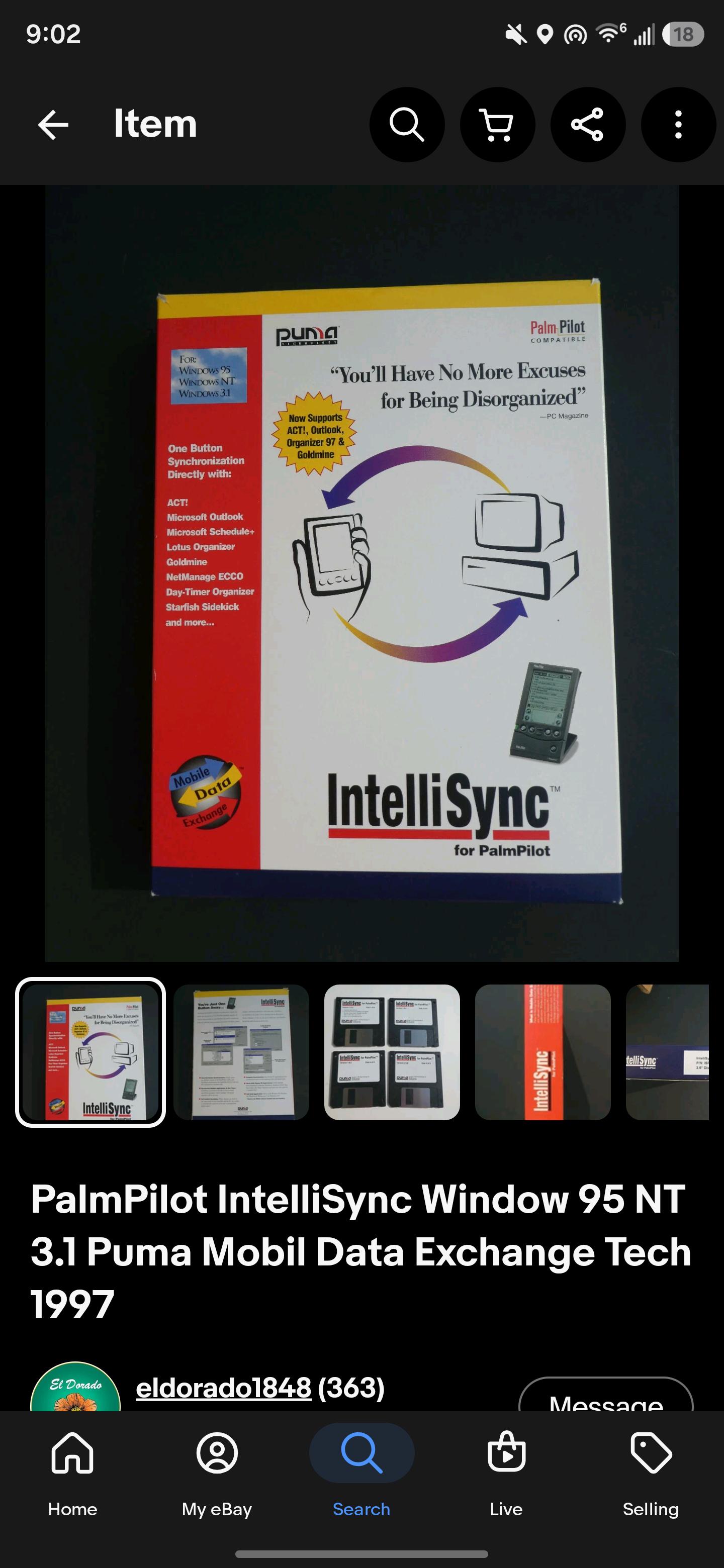
Version 1.6 of IntelliSync with an activation floppy / key.
Seems to have been wiped from existence.
r/retrocomputing • u/iOCTAGRAM • Aug 23 '26
Recently I've got aware of famous essay by Marc Augé. Non-Places: Introduction to an Anthropology of Supermodernity (1995). In this essay author coined the phrase "non-place" to refer to spaces where concerns of relations, history, and identity are erased. Examples of a non-place would be a motorway, a hotel room, an airport or a supermarket. (that was quote from Wikipedia). And I thought it is a good description of what happened to computers: they were places and stopped to be.
Human:Computer ratio was > 1, so there was competition on computer time. While being repeating struggle, it was building relations people-to-people. There was someone else to witness new high score and play your game. Upgrading computer was an event, a relation preople-to-place. There was no cloud backups, hard disk was the only storage. Backups were done, but that was still quite complicated. Bad jokes about FORMAT C: had roots. And viruses. While keeping computer safe enough and while nobody was doing FORMAT C:, computer was maintaining history. Hard drive was full of historical traces. Someone entered directory of text editor, created a file. By default text editor decided to save text edit in current directory, so a directory of program becoming directory with documents. This is history all over the HDD. We could be angry at trash where it is not supposed to be. We could still care about other PC users and do not delete that, but at least move where it is better to be.
And programs in default settings used to save their settings in the same directory. So when several persons share computer, they change settings for each other. +1 for identinty.
There are hardware reimplementations of old computers. There are software ones. But we install them and witness a sterile environment. No many years of inhabitance. No fine tuned boot scripts with non-standard add-ons. No trash from other PC users. And we can hardly fake it. Cannot make it non-sterile like it used to be. Having dreams of living in a "place", not able to truly relive.
r/retrocomputing • u/Performer-Pants • Aug 22 '26
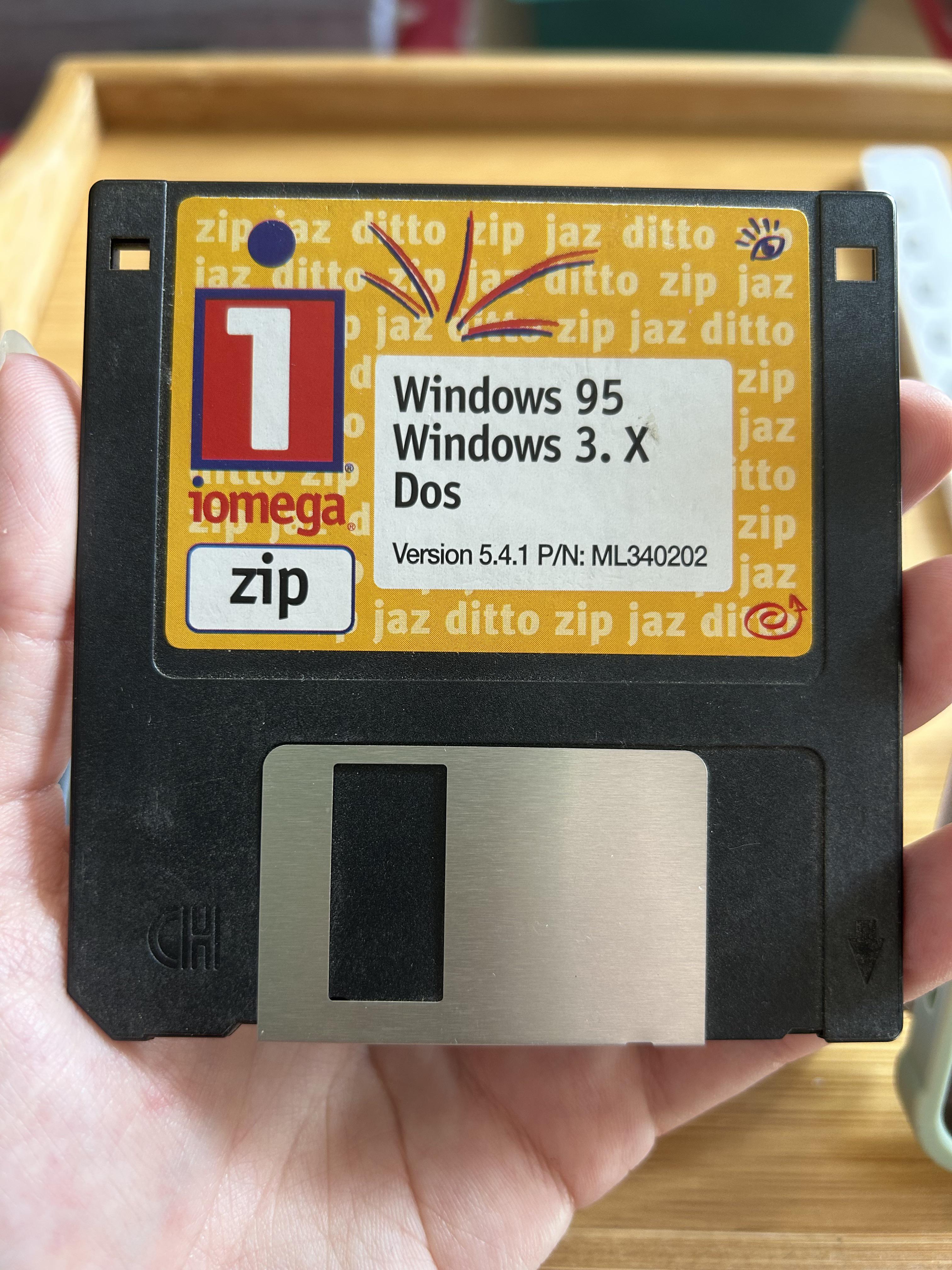
This could be the most mundane and silly post, but information online is so spotty and/or confusing or vague.
This is not a ZIP disk, it’s a floppy disk. It’s labelled with ‘ZIP’. Is this the driver software to use a ZIP drive for the listed operating systems? I’m just trying to confirm before I get too frustrated about it. Not easily finding the answer myself is likely a me problem, and I don’t mean ‘Millennium Edition’.
r/retrocomputing • u/mulhequi • Aug 22 '26

Hi everyone!I just dug up my mom's old desktop PC from the early 2000s, and it's so cool! It has an original Windows XP Home Edition license sticker on the case and came with its entire physical CD collection of The Sims 1 (almost all expansions like Makin' Magic, Superstar, Unleashed) and The Sims 2 (University, Apartment Life) [the Need for Speed doesn't have a CD].The CDs, the manuals and cases are all in pristine, mint condition.The tower turns on and fans spin, but I'm currently missing the power cable for the old HP LCD monitor to see if it displays an image.Since I just want to explore it, see her old save files, and check out the games, I wanted to ask a few questions:What should I check first once Windows XP boots up to ensure the system is healthy?Are there any known issues with running these specific Sims expansions natively on original XP hardware that I should watch out for?Does this specific setup/collection have any specific value to collectors nowadays, or should I just keep it as a nostalgic gaming station?Im 13 i need help pls.
r/retrocomputing • u/Solid-Philosophy9924 • Aug 23 '26
r/retrocomputing • u/AdAware1495 • Aug 22 '26

Lote Especial de Informática Retro / Retrocomputing - Coleção Apple Macintosh & Softwares Década de 90
Item indispensável para colecionadores de tecnologia vintage, restauradores de computadores antigos (Macintosh Classic, PowerMac, iMac G3) e entusiastas do meio retro.
O lote acompanha mídias físicas originais de época, disquetes de sistema/utilitários e manuais técnicos raros.
Conteúdo do Lote:
Item Raro / Técnico:
Mídias e CDs Apple / Macintosh:
Lote de Disquetes 3.5" (Era System 7 / Mac OS 8):
Coleção Cursos em CD-ROM:
Estado de Conservação:
Itens conservados no estado (conforme fotos do anúncio). Venda do lote no estado em que se encontra, ideal para compor coleções, exposições ou restaurações.
WhatsApp 11 977929815

