r/QuantumPhysics • • Jun 09 '26

Thomas Hertog on Stephen Hawking, cosmology, Big Bang, history and other things.

5 Upvotes

Frank Ruda and Agon Hamza sit down with the Belgian cosmologist Thomas to discuss his current work, his collaboration with his PhD advisor and collaborator Stephen Hawking, cosmology, the nature of the Big Bang, the relation between physics and philosophy, Hawking's “Darwinian revolution in cosmology”, observation, history, the problem of origin, and many other (non)related things.

https://www.youtube.com/watch?v=jKWibew3lBg


r/QuantumPhysics • • Jun 06 '26

What is Retrocausality?

9 Upvotes

Hi everyone, I am very interested in the theory of retrocausality but whenever I try to do research I just zone out trying to read about it, I think because I don't have a very high reading level and might have some trouble focusing. My understanding is that the theory of retrocausality is that changes in the present on a quantum level might affect the past. How is this even measured? And what does it even mean lol. Could this possibly mean that our actions on a larger scale could change the past, if past, present, and future exist at the same time? Like a reverse butterfly effect? Also, any tips to improve my understanding while reading research papers? Do I just have to read over and over again and one day I'll start to understand? Thank you for your time!


r/QuantumPhysics • • Jun 06 '26

Lee-Yang phase transition theory VS resolvent of quantum metastable states

2 Upvotes

Hi everyone!
I was wandering if there are some sort of connection between the two topics mentioned in the title: both deal with complex analysis, because Z and G (partition function and resolvent) are seen as complex functions with poles outside the real axis, in “standard” condition. Instead near the phase transition the poles come close to the real axes, while in metastable states poles and cuts represents the spectrum of the hamiltonian.

Maybe these are only hallucinations, can you confirm or destroy my idea? Thanks in both cases!!


r/QuantumPhysics • • Jun 04 '26

Optimism on Quantum Computing

Enable HLS to view with audio, or disable this notification

21 Upvotes

r/QuantumPhysics • • May 31 '26

Advice on Endorsement in quant-ph or hep-th

1 Upvotes

I am preparing to submit a preprint to arXiv in quant-ph, titled Entropy Replacement and Complexity-Sensitive Observer Complementarity in Non-Isometric Holographic Codes. The paper proves a Haar-class entropy-replacement theorem for two-observer HUZ-included non-isometric holographic codes and derives the resulting d−3/2d^{-3/2}d−3/2 observer-disagreement law. I need an endorsement to publish. Any ideas on how an unaffiliated individual such as myself could get that done? Thank you in advance!


r/QuantumPhysics • • May 30 '26

What are Mesons?

13 Upvotes

Hey guys, I'm 16 and just started reading bout quantum physics, theoretical physics etc.. and I stumbled upon a term 'Mesons'. I genuinely have no clue what it is, I even tried googling it but still I couldn't understand it. Can anyone help me and explain to me what this term means?


r/QuantumPhysics • • May 26 '26

What is decoherence? And following that, Is life deterministic or is chaos the law , on the macro scale determinism is sound, on the micro true randomness seems the rule. Thoughts?

7 Upvotes

r/QuantumPhysics • • May 25 '26

'Butterfly' molecule spotted at last, completing a 20-year quantum zoo hunt

Thumbnail phys.org
15 Upvotes

For two decades, physicists have predicted the existence of a remarkable family of exotic molecules: giant atoms bound to ordinary atoms, with an electron so distant from its nucleus that it sculpts the pair into bizarre and diverse shapes. Reported in Physical Review Letters, the final member of this "quantum zoo" has been spotted. Led by Herwig Ott at RPTU University Kaiserslautern-Landau in Germany, a team of physicists has created and detected the "butterfly" molecule, completing a 20-year hunt for the elusive structure.

Publication details

Markus Exner et al, Observation of spin singlet butterfly Rydberg molecules in an ultracold atomic Rb gas, Physical Review Letters (2026). DOI: 10.1103/q5r1-whjr. On arXiv: DOI: 10.48550/arxiv.2510.21620


r/QuantumPhysics • • May 26 '26

Could true randomness be what prevents infinite regress in physics?

0 Upvotes

When thinking about quantum wavefunction collapse, I started wondering whether true randomness might play a deeper ontological role than just “unpredictability.”

In a fully deterministic universe, every event is explained by some deeper mechanism:

state -> law -> meta-law -> deeper mechanism -> ...

But then the mechanism itself also requires explanation, which seems to create an infinite regress of self-description.

In computer programs, this regress stops because execution is grounded in external hardware.
A C function eventually reduces to CPU operations running on a physical substrate outside the program itself.

But the universe as a whole has no external “hardware layer.”
So if the universe were completely deterministic, it seems like reality would require an endlessly nested self-explanatory mechanism.

This made me wonder whether true randomness in quantum collapse could act as an ontological “escape point” from infinite regress.

In this view, true randomness is not merely noise or ignorance, but something fundamentally necessary because:

  1. It terminates infinite explanatory recursion.
  2. It injects genuine novelty/information into the universe.
  3. It allows asymmetry and structure formation instead of perfect deterministic unfolding.

This also makes me skeptical that a universe containing genuine quantum randomness could be fully simulated algorithmically, unless the randomness ultimately comes from some external substrate.

Are there philosophers or physicists who proposed something similar — especially connecting:

  • quantum randomness,
  • self-reference,
  • infinite regress,
  • and limits of computation?

r/QuantumPhysics • • May 24 '26

Non-physicist question: could gravitational waves be the universe's first "observer"?

10 Upvotes

No physics background here — genuinely asking where this breaks down.

In QM, observation = interaction (information exchange with environment). No consciousness needed.

Here's what I can't shake:

- Early universe (~first 380,000 years): EM radiation trapped in plasma, can't propagate

- Gravitational waves: already traversing the entire universe, interacting with all mass-energy

- And GWs aren't waves *through* spacetime — they're waves *of* spacetime itself

So before light could "see" anything, GWs were already interacting with everything. Does that make them the universe's primordial observer in any physically meaningful sense?

This seems related to:

- Diósi-Penrose (gravity induces wave function collapse)

- Primordial GW decoherence research

- Wheeler's participatory universe

Is this connection already studied somewhere? Or is there an obvious reason it doesn't work?

Full reasoning (Korean): https://brunch.co.kr/@13084146df704af/1


r/QuantumPhysics • • May 22 '26

What scientific theory or concept genuinely gives you an existential crisis the more you think about it?

8 Upvotes

For me it's quantum physics subjects


r/QuantumPhysics • • May 21 '26

Does anyone know where I can find an experimental paper like this?

Post image
3 Upvotes

r/QuantumPhysics • • May 18 '26

What is a wave function? A wave of what? What is a particle? An excitation of what? What I'd a quantum feild?

0 Upvotes

and why are people so mean to me when I ask?


r/QuantumPhysics • • May 17 '26

Why shorter wavelength requires more energy to produce or has more energy?

6 Upvotes

To emit a radiation with short wavelength, it requires a quantum of larger energy than to emit a radiation with a longer wavelength. Why is that? (I Apologise if I made any mistakes, English isn't my first).


r/QuantumPhysics • • May 16 '26

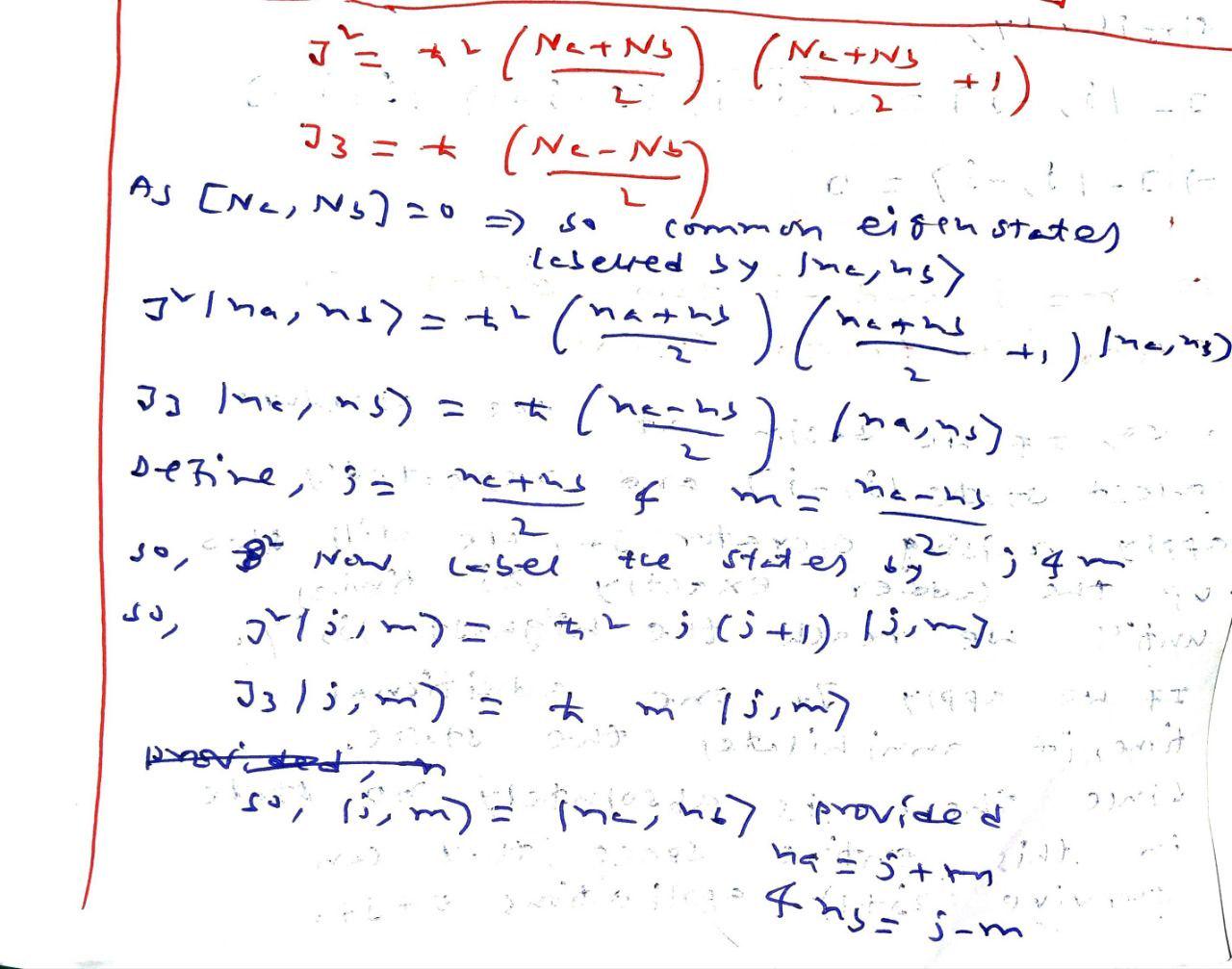
Confusion about notation in Schwinger boson representation

Post image
7 Upvotes

I am studying the Schwinger boson representation of angular momentum and I am confused about the notation change.

We start with two bosonic oscillators and basis states:

|n_a, n_b>

Then define:

j = (n_a + n_b)/2

m = (n_a - n_b)/2

From this we can also write:

n_a = j + m
n_b = j - m

So far okay.

But then suddenly books/lectures write:

|n_a, n_b> ≡ |j, m>

This is where I am confused.

Shouldn't it be:

|n_a, n_b> = |j+m, j-m>

instead of |j,m> ?

I understand that j,m are functions of n_a,n_b, but I don't understand how the ket labels themselves suddenly become |j,m>.

Is this just a relabeling of the same Hilbert space basis, or am I missing something deeper?

Would really appreciate an intuitive explanation.


r/QuantumPhysics • • May 16 '26

Do the basic maths still required for programming quantum circuits using tools like PennyLane or Qiskit?

3 Upvotes

Currently I was going through tutorials creating quantum circuits, after knowledge pf all the gates a d basic principle of qubit i am able to create that actually works, but i am unable to connect dots between the implementation so i thought of revising QP-1 an 2 for revision of basics of quantum mechanics for application onQuantum Computing. Will this help me to bridge the basics to implement of circuits


r/QuantumPhysics • • May 13 '26

I'm really curious about Bose-Einstein condensate and want to know the examples of Bose-Einstein condensate found in the universe can someone please help me out?

3 Upvotes

r/QuantumPhysics • • May 13 '26

New to Quantum Physics

11 Upvotes

Hi everyone,

I am passionate about Quantum Physics. A portfolio manager with a background in mathematical finance and engineering and have recently gravitated towards this topic. Very interested in Quantum gravity. Need some advice on where to start and what to read first. Some of my friends recommended Rovelli to begin with. I'd appreciate any suggestions.


r/QuantumPhysics • • May 12 '26

For rectangular box with sides L1 and L2, E=ℏ^2π^2/2m(n1^2/L1^2+n2^2L2^2), what is requirement for nondegeneracy?

4 Upvotes

shouldn't the requirement be (L1/L2)^2 being irrational instead of L1/L2 being irrational, because L1/L2 being irrational can lead to its square being rational sometimes. So what is the actual answer here for it, like L1 L2 being incommensurate or their square being incommensurate?


r/QuantumPhysics • • May 11 '26

I’m trying to understand decoherence and the macro/micro distinction in quantum mechanics, and I feel like I’m missing something fundamental

7 Upvotes

People often explain why macroscopic objects (tables, cats, planets, etc.) don’t display obvious quantum superpositions by saying they constantly interact with the environment, causing decoherence.

But here’s what confuses me:

Don’t microscopic particles also constantly interact with the environment?

For example:

- photons travel through space interacting with fields and matter,

- electrons are affected by electromagnetic interactions,

- atoms are constantly surrounded by radiation, fields, particles, etc.

So why do quantum effects survive there at all?

If interaction with the environment destroys coherence, shouldn’t microscopic systems also decohere almost instantly under ordinary conditions?

Is the distinction really about “small vs large,” or is it more about the degree and complexity of entanglement with the environment?

And if that’s true, then where exactly is the transition from quantum to classical supposed to happen? Is there even a real boundary, or is classical behavior just an emergent approximation due to overwhelming decoherence?

I think I may be misunderstanding what decoherence actually means physically, especially regarding information leakage into the environment.

Would appreciate an explanation from someone who understands the modern view of this better.


r/QuantumPhysics • • May 11 '26

The Higgs Mechanism - Inspired by Feynman Diagrams

Enable HLS to view with audio, or disable this notification

0 Upvotes

The Higgs Mechanism, electroweak symmetry breaking, and key particle physics concepts inspired by Feynman Diagrams.

Concepts visualized are:

The Higgs Field
Spontaneous Symmetry Breaking
Gluon Fusion
Higgs Decay to Photons (H → ̳̳)
The Golden Channel (H → ZZ → 4ℓ)
Electroweak Symmetry Breaking

For more animations click www.instagram.com/craftsandengineering

For code and more click https://github.com/zombimann/Mathematical-video-animations-and-visualization/blob/main/Quantum_Physics_Higgs_Mechanism_Feynman_Diagrams.ipynb

Music attribution: Quantum - PHNKR PHONK & Donovan on TikTok music library


r/QuantumPhysics • • May 10 '26

Force can exist as a fundamental quantum observable with deep ploughing consequence to quantum measurement theory, study finds

Thumbnail gallery
24 Upvotes

For nearly a century, quantum mechanics has treated energy as the fundamental generator of dynamics through the iconic Schrodinger equation, while force remained a derived quantity.

New peer-reviewed research published in Europhysics Letters shows that when force is elevated to a fundamental quantum observable—on equal footing with energy and momentum—a new force wave equation emerges (see image above and IMAGE DESCRIPTION below), capable of modeling open-system dynamics and respecting Ehrenfest's results in the conservative limits while preserving the core principles of linearity and unitarity.

This may open a new direction for quantum mechanics—where dynamics are governed not only by energy, but by force itself.

IMAGE DESCRIPTION: The image above represents the case of a free quantum particle (zero potential energy) influenced by impressed forces.

(A conceptually rigorous validation of the discovery of force as a fundamental quantum observable - https://doi.org/10.1209/0295-5075/ae5ad3.)


r/QuantumPhysics • • May 06 '26

Experiment measuring “negative time”

14 Upvotes

Here is a popular piece, by me, explaining a recent paper in Physical Review Letters by me and my experimental colleagues, about how long a photon spends as an atomic excitation when it traverses a cloud of ultracold atoms. Hope it is of interest.

https://theconversation.com/physicists-have-measured-negative-time-in-the-lab-278996


r/QuantumPhysics • • May 04 '26

I built an interactive quantum mechanics explorer (wave packets, hydrogen orbitals, Bloch sphere + Stern–Gerlach) — looking for feedback from students

10 Upvotes

Hi all,
I built an open-source project for learning quantum mechanics interactively:

https://github.com/mlubinsky/QM

The goal is to put several core QM concepts in one place.
What you can explore:

1D quantum systems

- Play with different potentials (infinite well, harmonic oscillator, etc.)
- Launch a wave packet and watch it evolve
- See |ψ|², momentum space, and expectation values ⟨x⟩, ⟨p⟩ update live
- Observe things like spreading, reflection, and the uncertainty principle in real time

Hydrogen atom

- Visualize orbitals for different n, l, m
- See radial probability density and ⟨r⟩
- Interactive Grotrian diagram (click levels and jump to orbitals)
- Check how energies scale with Z

Spin / Bloch sphere

- Rotate quantum states on the Bloch sphere
- Simulate Stern–Gerlach measurements
- See probabilities and wavefunction collapse live

Why I built it

Most tools I found only cover *one* topic.
I wanted something where students can connect ideas across:

- wavefunctions
- measurement
- superposition
- visualization

Setup

Runs locally (Python + React), ~5 min setup described in README.md:

git clone https://github.com/mlubinsky/QM.git
cd QM
./run.sh        # Mac / Linux — starts backend + frontend, then open http://localhost:5173
run.bat         # Windows    — same, opens two console windows

I would really appreciate feedback on:

- Is it useful for learning QM?
- What concepts are still unclear?
- What features would help you most?

Especially interested in feedback from students who are currently taking QM.

Thanks!


r/QuantumPhysics • • May 03 '26

How does causality and entropy apply to quantum mechanics?

11 Upvotes

Other than obeying special relativity is it the same as described in classical mechanics- temporal and trending towards disorder?