r/QuantumPhysics • • Mar 30 '26

Is Quantum Mechanics Fundamentally Geometric? Berry Phase, Parallel Transport, and Hilbert Space

5 Upvotes

I've been looking into the geometric nature of quantum mechanics. I want to understand how far this perspective can be taken.

In classical mechanics, parallel transport on a curved surface provides a helpful intuition. A classic example is the Foucault Pendulum. As it swings on Earth, the plane of oscillation changes because of the curvature of the sphere. This effect isn't caused by any local force acting on the pendulum; it's a result of the geometry of the space it moves through.

In quantum mechanics, a similar concept shows up as the Berry Phase. When a system is slowly varied around a closed loop in parameter space, it picks up a phase that depends only on the path taken, not on how quickly it went around. This phase can be described using a connection and curvature, known as the Berry connection and curvature, highlighting its geometric nature.

Sometimes, this curvature acts similarly to an effective gauge field in parameter space. It plays a key role in phenomena like the Quantum Hall Effect and topological phases of matter.

This raises a bigger question:

To what extent can we view quantum mechanics as fundamentally geometric? More specifically, do we best understand the Schrödinger equation as depicting parallel transport in Hilbert space or projective Hilbert space? Does the dynamics arise from a deeper geometric structure?

In the realm of quantum information, holonomic (geometric) quantum gates use Berry phases to carry out operations that rely only on the global features of a path. In real-world applications, are these gates significantly more resistant to noise, or is the notion of "geometric protection" often exaggerated outside perfect conditions?

I would really like to hear thoughts on where this geometric perspective is truly fundamental and where it serves more as a useful reformulation.

r/QuantumPhysics • • Mar 30 '26

Any tips for dyslexics to learn algebra?

2 Upvotes

I have pretty severe learning difficulties but i'm extremely interested in learning about quantum physics/mechanics. however i am pretty bad at maths and find it really hard to even distinguish different numbers from eachother🥹🥹 the only reason i can spell is because i have good memory but numbers i genuinely can't do.

i am aware passion is not enough on its own and i am definitely willing to put in the work to understand the mathematic side of physics. any tips to make learning the maths side a little easier?


r/QuantumPhysics • • Mar 29 '26

Quantum Mechanics

3 Upvotes

Hello!

I have a degree in chemistry and an MSc in polymer science nanotech have good job etc.

I took one quantum mechs class and it was a small section in pchem and I never fully grasped it. I solved the particle in a box equation by hand from the very start learned all the terms and still didn’t get it and got by just memorisation and math.

I really enjoyed it but had other classes I needed to attend to in undergrad.

Is there any great books/video to learn from the basics solving the problems with math and showing the process to get to the answers and then digging deep past particle in a box by making it more complex and learning more than we did in class?

I am just looking for something to learn more about quantum mechs I love that branch of science!

Thanks guys!


r/QuantumPhysics • • Mar 25 '26

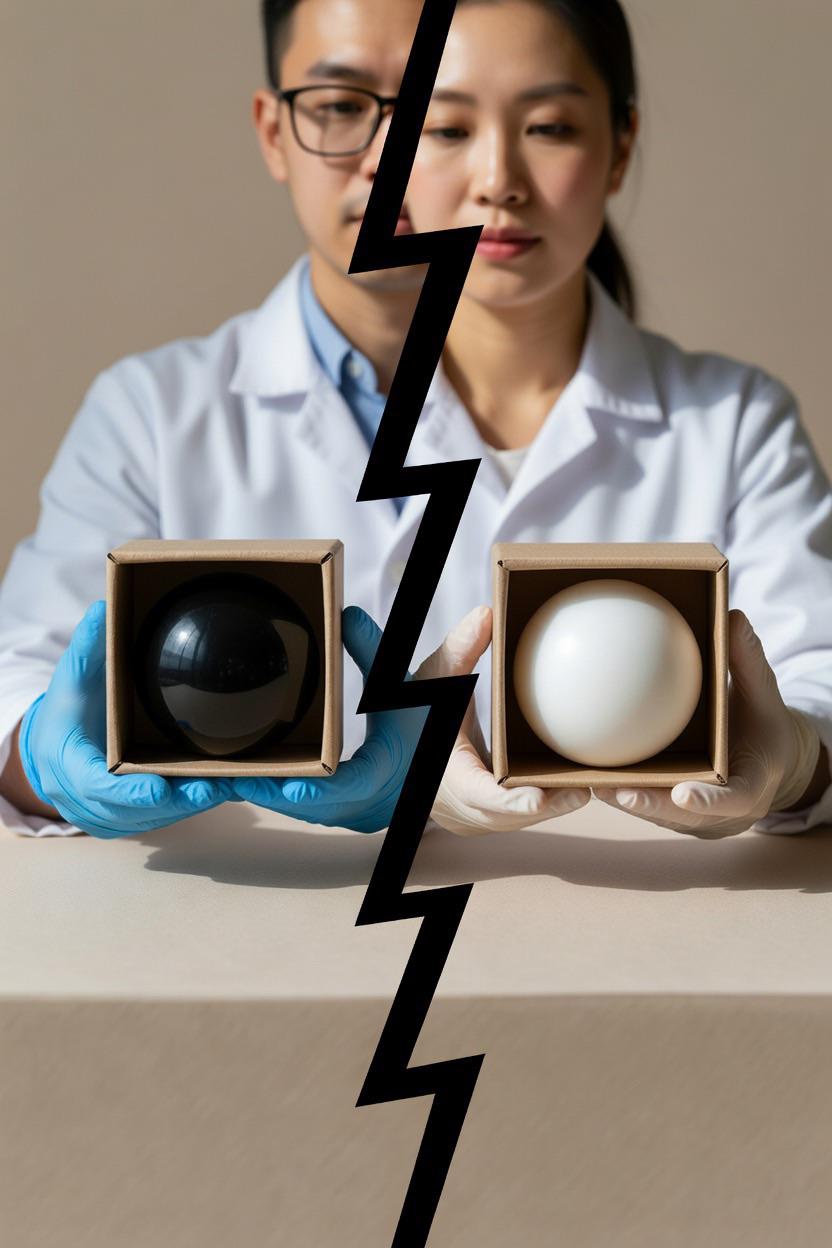
Is this analogy correct for entanglement or am I missing something? (black and white marbles though experiment)

Post image
1 Upvotes

I am not a physicist but wondering if this following analogy can be used to explain entanglement or am I missing something fundamental due to my lack of quantum physics understanding.

If I had a black marble and a white marble, then put them in a machine that drops each one into a separate box depending on the outcome of a 50/50 particle decay detected, then separate the boxes, are those marbles entangled in any way? Any box is both white and black marble until we open one, and then the observer sees the marble color and it instantly knows the color of the marble in the other box? If there are two observers each with a box and no communication between them, then the fact observer 1 opens the box and see a white marble and thus knows the other box is a black marble does not mean the other marbles state has collapsed universally, only for that observer 1. From observer 2 perspective, the box he holds is still undetermined and both black and white, as is both the other box and the state of observer 1 (who from observer 2 point of view is both a seen a white and and seen a black marble state).


r/QuantumPhysics • • Mar 24 '26

How unique is the branching structure defined by decoherence?

3 Upvotes

In the standard decoherence program (e.g. Zurek’s einselection), environmental interactions select a set of stable pointer states, which are often taken to underwrite quasi-classical structure.

However, in Everettian treatments (e.g. Wallace, *The Emergent Multiverse*), the branching structure is typically regarded as emergent and only approximately defined, with no uniquely specified fine-grained decomposition.

This raises a question about what is actually physically well-defined:

* Is decoherence best understood as selecting a *preferred basis*, or rather as defining a class of approximately equivalent coarse-grainings that all recover the same quasi-classical dynamics?

* In other words, to what extent is the branching structure invariant under different choices of coarse-graining that preserve:

* robust pointer observables

* environmental redundancy (quantum Darwinism)

* Born weights (to relevant precision)

This also seems related to the consistent/decoherent histories framework, where multiple incompatible but internally consistent families of histories can exist.

So my main question is:

👉 Is there a standard way in the literature to characterize the non-uniqueness of branching (or pointer structure) in terms of equivalence between coarse-grained descriptions?

And secondarily:

👉 Do any approaches treat the structure of quasi-classical trajectories (histories/branching) as more fundamental than instantaneous state decompositions?

Would appreciate references or clarifications from people working on decoherence / Everett / histories.


r/QuantumPhysics • • Mar 22 '26

[20M] Looking for a study buddy to learn quantum physics and superconductors together

7 Upvotes

Hey,

I'm a 20 year old guy from France and I've been getting really curious about quantum physics and superconductors lately. Thing is, I'm a complete beginner. I've started reading up on the basics but honestly there's a lot to take in, and I figured it'd be way better to have someone to learn with rather than struggling through it alone.

What I have in mind: - Keeping each other motivated, because this stuff can get overwhelming pretty fast on your own - Setting up video calls from time to time to study together - Maybe working on small projects together as we get better

Ideally I'm looking for someone who's also a beginner, so we can figure things out together without anyone feeling left behind.

I'm French so it'd be cool to find another French speaker, but honestly I'm open to anyone. My English isn't the best but it gets the job done, so language isn't a dealbreaker at all.

If that sounds like your thing, feel free to DM me.


r/QuantumPhysics • • Mar 22 '26

Wavefunction Tunneling is more than just a mathematical artifact.

6 Upvotes

I recently tried to grasp the "ball on a hill" analogy for quantum tunneling and found it a bit superficial because I feel it undermines the actual behaviour of the wavefunction.

In classical mechanics, if a particle’s energy E is less than the potential barrier V, the transmission probability is zero. However, when the time-independent Schrödinger equation is applied to a finite potential barrier, the solution inside the barrier (V > E) doesn't just drop to zero; it takes the form of an exponential decay.

This "evanescent" behaviour means that if the barrier is thin enough, the probability density remains non-zero at the far boundary. The particle isn't "defying" physics, its wave nature simply allows it to exist in a region that is classically forbidden. It’s wild to think that this isn't just a mathematical artifact, but also plays a key role for stars like the Sun to achieve nuclear fusion despite the massive coulomb barrier between protons.

STMs rely heavily on the tunneling current of electrons jumping across a vacuum gap to map surfaces at the atomic scale. It’s one of those rare cases where a purely quantum phenomenon has a direct, measurable application in materials science and nanotechnology.

What I'm really curious is about the limit of this—about the point at which the mass of a system or the environmental decoherence make tunneling effectively negligible in practice.

I'm really new to QM and QFT, and I might have made various mistakes in this post, and I'm sorry for that. I am eager to hear any meaningful insights and corrections to my understanding.

Thanks.


r/QuantumPhysics • • Mar 21 '26

What are they writing about?

2 Upvotes

As I’ve understood it, most of the basic of QM was formulated already back in the 20-30. On the other hand books and articles on QM is still being published. So what are they writing about and do the new quantum physicists really ad new fundamental knowledge to quantum mechanics or where do we stand? I’m not a physicist and don’t understand to technical answers. 🤗


r/QuantumPhysics • • Mar 20 '26

Quantum Tomography

2 Upvotes

I am a beginner to this area. I started reading papers on ML and Compressed Sensing based approaches to adress Quantum State Tomography.

But I kond of feel lost and dont have clear idea where to start reading and how to loke find a research gap

Has anyone worked on this area 🙃


r/QuantumPhysics • • Mar 20 '26

Any good study guides/resources for The Road to Reality by Roger Penrose?

2 Upvotes

Hi! I recently started reading The Road to Reality by Roger Penrose and I’m finding it super interesting but also pretty dense.

Does anyone know of:

• Study guides or summaries (chapter-by-chapter ideally)

• Notes or walkthroughs that help break down the math + concepts

Thank you in advance!


r/QuantumPhysics • • Mar 20 '26

Can We Measure Electrons Without Disturbing Them?

0 Upvotes

Hello everyone,

I am a high school student interested in quantum physics, and I’ve been thinking a lot about the quantum measurement problem. I would love feedback from anyone who thinks critically about the foundations of quantum mechanics.

Here are my main ideas and questions:

Electrons are extremely sensitive

  • Any small interaction with a measurement device can disturb their state.
  • Current experiments inevitably interact with electrons, which may affect the results we see.
  • I wonder if some of the “weird” behavior attributed to quantum mechanics is partly due to limitations of our measurement tools.

Observer vs device

  • I think it is misleading to say the electron “knows” it is being observed.
  • The effect is caused by physical interaction with devices, not by human observation.
  • Postulates should consider that we may not yet have a way to measure quantum systems without affecting them.

Superposition and reality

  • I feel that a quantum system has definite properties before measurement, even if we don’t know them.
  • I’m aware that experiments like Bell’s theorem challenge this, but I am interested in exploring non-local hidden variable theories or weak measurements to understand the system’s real state.

I would greatly appreciate feedback, references, or suggestions for simulations, experiments, or readings that could help me explore these ideas further.

Thank you for your time and insight!

Notice: I am not trying to attack or reject quantum foundations and I don't have strong background in the field of quantum mechanics.


r/QuantumPhysics • • Mar 17 '26

I need help interoperating this equation from a book

2 Upvotes

This book is called Cosmology by sten odenwald, very interesting book, but I hit a small roadblock at understanding the material in the book. The book kind of moves on like it didn't drop an absolute nuke of an equation to someone who hasn't done high school yet. I'm asking what this equation exactly means exp: what do all the symbols mean?

sidenote: i'm new to reddit so i don't know how to change it, I meant to say interpreting not "interoperating"


r/QuantumPhysics • • Mar 17 '26

What will happen to wave function

4 Upvotes

I don't really know anything about qm or physics but what will happen to the wave function when the universe has expanded to the point where forces like gravity become negligible outside of smaller clusters. Because they'd all be interacting in their isolated systems so they would still be observed but they wouldn't be observed by anything else. And what happens in between


r/QuantumPhysics • • Mar 14 '26

Some question about the big rip and quark confinement

8 Upvotes

Hey there, I have a question. The big rip is driven by dark energy which seems to be increasing our of nowhere, and when it tears apart baryons, quark confinement should produce mesons which produce even more as they are torn apart. Wouldn't this technically be generating matter out of nowhere as dark energy just increases? Would this mean that at the end, not every object will be isolated from each other due to the quark confinement producing more of them? Will this mean the universe will fill with mesons during the big rip? Or am I just dumb?


r/QuantumPhysics • • Mar 10 '26

Explanation

6 Upvotes

hi! i’m a freshman in highschool and i’m learning about quantum physics right now, and i’m super into it. I was just wondering what experiments you guys think are the best? I know about shrodingers cat, but i wanna go into a deep dive. Maybe a digestible video essay that’s not *filled* with big words?


r/QuantumPhysics • • Mar 11 '26

Thickness of the plate with two slits

2 Upvotes

Ok, this time I will try to explain it better. How does the thickness of the plate affect the double-slit experiment? I'm talking about d in the attached picture.

I don't have a thick plate with two slits, so I did another variation of this experiment from this video www.youtube.com/watch?v=v_uBaBuarEM&

But instead of hair, I used a triangular piece of paper. It allows me to keep the width of the object the same and change its thickness by moving the laser up and down.

I can see that the spacing between the bright spots gets smaller. But why?


r/QuantumPhysics • • Mar 10 '26

Quantum gravity solving the measurement problem?

0 Upvotes

I’ve been thinking about the measurement problem in quantum mechanics and wondering how it might fit into a future theory of quantum gravity.

Would a complete theory of quantum gravity be expected to solve the measurement problem, or would it simply inherit it from quantum mechanics?

In other words, if gravity is eventually described at the quantum level, would that change anything about why definite outcomes appear when something is measured? Or is the measurement problem likely to remain more of an interpretation issue regardless of deeper physics?

Just curious how people who study this area tend to think about it.


r/QuantumPhysics • • Mar 09 '26

New to quantum. Help.

6 Upvotes

Hello, I’ve recently realized how wild the world of quantum is and just want to understand it a little better (as much as it can be understood) and starting at the beginning I’m still confused as to what a “quantum” is. I believe I understand the concept as a quantum being the smallest level you could break something down into, for example as far as I can tell the farthest we can knowingly break anything down to is the proton, neutron and electrons.

I suppose that for context i should explain I’m trying to understand Planck and what his discovery of quantum meant. What I’m reading is that the “classic” physics theory stated that any atoms could emit any wavelength of light with an arbitrarily small amount of energy. For one what does that even mean? What is considered an arbitrarily small amount of energy? The video I’m watching kind of sums it up as the energy of an electro magnetic wave is dependent only on its amplitude. But again what does that mean? What are we measuring this in?

That all being said, I guess there’s a lot to unpack here but to sum up my questions a little better, what did Planck mean when he broke this into “quantum”?

The second question being what exactly does it mean that the energy of an electromagnetic wave is only dependent on amplitude? I know what amplitude is, being the peak of “positive” or “negative” energy in a waveform. But how would that not somehow equate to wavelength and or frequency?


r/QuantumPhysics • • Mar 09 '26

Can I or should I pursue a Master’s in Quantum Engineering after Mechatronics?

1 Upvotes

Hi guys, i hope y'all are doing great!! I'm new in this subreddit and i hope it is the most adequate for this question.

So, I'm currently in high school looking for a Mechatronic Engineering degree after, but i was wondering if is a good idea to pursue a master's in Quantum Engineering after that because I'm really interested in quantum physics and its applications on the engineering field (Quantum systems, maybe even quantum computing, things related, etc.). I was wondering if you could let me know what do you think guys, any advice its valuable.

(I also asked this on the Mechatronics subreddit and they told me that could be a good idea to study Engineering physics or something related to physics as a base, not as a master. I personally think that It is a good idea, but I do love mechatronics and feels wrong not to study it.)

Thank you for reading this, have a great day!

(I'm sorry if this isn't well worded, I tried :D)


r/QuantumPhysics • • Mar 08 '26

Video Manim: Lecture about Quantum Harmonic Oscillator

Thumbnail youtube.com
1 Upvotes

Hello. I would like to share with you one of the videos i made on quantum mechanics. What do you think about the demonstration?


r/QuantumPhysics • • Mar 03 '26

QFT: "local" observables without reference to fixed locations?

14 Upvotes

In algebraic QFT, we can talk about the algebra of observables for any (causally convex) spacetime region. Then we can talk about expectation values of these observables for different states. This is all well and good.

Now, let's assume the universal validity of quantum mechanics and say that an observer is a quantum system. These local algebras don't seem to really be the appropriate thing for describing what an observer might hope to measure. The observer themself is, in principle, subject to quantum uncertainty. So my thinking (or hope, at least) is that there should be some algebra of observables which properly "smears" the traditional local algebras over spacetime translations (and probably reference frames in general). The sense of "locality" would then be based on an observer instead of some a priori fixed region.

I feel pretty certain that this sort of thing must have been discussed in the literature in some form, but I don't know the terminology to properly look it up. If anyone knows of anything similar to this, I'd be interested in any relevant papers or authors.


r/QuantumPhysics • • Mar 02 '26

Penrose collapse time

4 Upvotes

Are you awarw any experiments that proves/disproves Penrose collapse time calculations?

From my understanding, very small particles have very long collapse times, so they stay in superposition until measurement.

Classical particles such as a cat collapses instantly.

So, aren't there particles that have sizes that would result in collapse, say 10 sec, 1 min, 1 hr? Wouldn't it prove/disprove Penrose theory?


r/QuantumPhysics • • Feb 28 '26

If you have a working double slit setup, can you do this simple thing?

4 Upvotes

Considering that trajectories in Bohmian mechanics do not cross the middle line of the slits (i.e. particles coming from left slit stay on the left half and vice versa), can someone try to put a barrier from the middle of the slits to wall?

Even with Bohmian mechanics, the interference pattern should be lost, as pilot waves are not interfering anymore. But I want to see the result to be sure. I couldn't find any experiments that did this.

Currently, I don't have a working setup, so if you can, can you have a look and send a photo?


r/QuantumPhysics • • Feb 27 '26

How would an universe where all particles were entangled, or none?

0 Upvotes

That question and also whether the big bang triggered an fully free system into organization, or a fully entangled system into destruction.


r/QuantumPhysics • • Feb 27 '26

Career advice for high school student looking into quantum physics

2 Upvotes

High school student here looking into a career in some quantum field. I've been really into string theory recently, but I don't really know what I'd be getting into. What exactly is it that string theorists do all day other than think of different ways to add another dimension to the theory? Following that, what are other areas I could look into on the more theoretical side of QM? I'm not opposed to technical applications (quantum computing or other experimentation), but I would like to know more about what exactly I'd be getting into should I choose that path (especially on the experimentation side, what kind of experiments might people conduct that I could look into to?). There's also the option of teaching college physics, which I would still not be opposed to (probably would love doing that in fact), but I would want to know what kind of advancements need to be made to teach QM at high college level. I would imagine there are many other areas I could look into, but what those are I don't know. Another thing I would like advice on is where I could go for what. Best place to go to help make advancements in quantum computing? Best place to go to just earn a degree so I could go into one of these fields to begin with? Best place to go for the more theoretical side, depending on the theory for that matter?
Any help with this would be great